Short Length Cut Specimen Perimeter Error Mechanics in Fabric Mass Testing
Rotary punch cutters distort fabric mass testing via yarn severance and perimeter loss, demanding multi-radius mathematical correction or full-width sampling.


Specimen
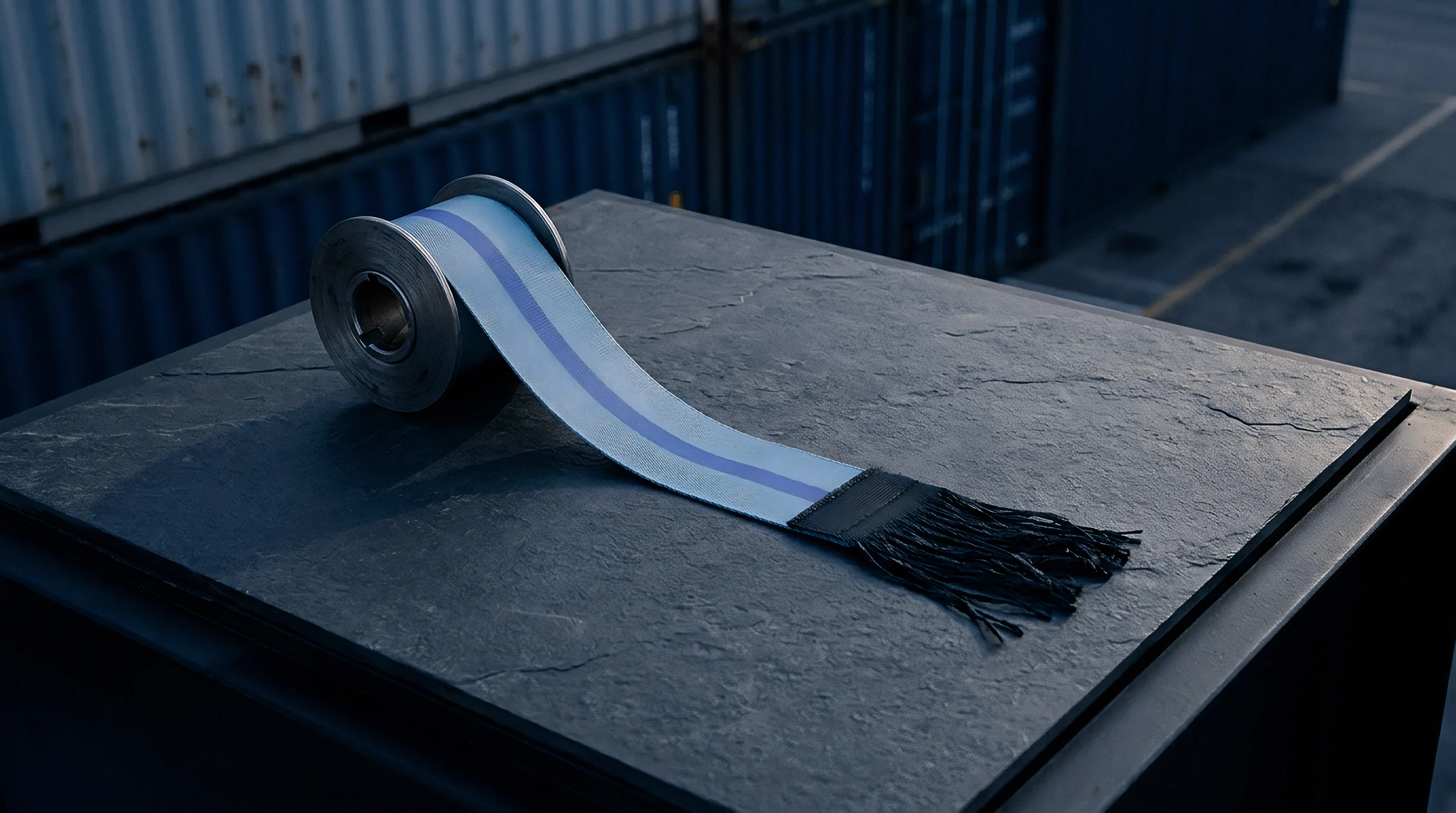
Mass Deviation at Narrow Specimen Geometries
Circular cut swatches of 100 square centimetres extracted using hand-driven rotary punch cutters routinely produce systematic mass measurement bias on commercial testing benches. In standard laboratory inspection under ISO 3801 Method 5 or ASTM D3776 Option C, technician teams evaluate woven and knitted lots by weighing discs stamped from rolls across the width. The target parameter is mass per unit area, expressed in grams per square metre.
The mechanical action of circular dies shears through structural yarns, creating an unconstrained outer boundary where yarn fragments escape or distort under tension.
Every circular cut specimen with an area of 100 square centimetres possesses a diameter of 11.28 centimetres and an outer perimeter of 35.45 centimetres. This geometry yields a perimeter-to-area ratio of 0.354 centimetres per square centimetre. When test operators scale down to smaller diameter cutters, such as 50 square centimetre dies with an 7.98 centimetre diameter and a 25.07 centimetre perimeter, that ratio climbs to 0.501 centimetres per square centimetre.
The exposed edge length relative to contained mass increases sharply.
Every circular punch cut exposes thirty-five linear centimetres of raw perimeter edge per hundred square centimetres of measured area.
The boundary edge represents a zone of mechanical disruption. Shear forces applied by rotary circular blades drag individual filaments across the cutting radius, destabilizing the interlacing or interlooping geometry. Fiber lint, fractured filaments, and whole yarn segments shed during sample handling between the cutting mat and the analytical balance pan.
The resulting gravimetric read consistently falls below the true bulk areal weight of the continuous roll.

Yarn Severance along the Circumference
The circular blade intersects the structural yarns of orthogonal wovens at continuously shifting angular geometries. At four tangent points along the circular path, the cutting edge runs parallel to either the warp or the weft systems. At all intermediate locations, the blade cuts obliquely across yarn axes.
Oblique cutting leaves short yarn tails supported by fewer crossover binding nodes. The crimp within the yarn structure stores strain energy, which releases instantly upon severance. Unbalanced yarn tensions push cut yarn tips outward past the die circumference, while loose filament fragments separate entirely from the specimen core.
Knitted structures experience even greater mechanical instability along this boundary line, as severed knit loops lack frictional lock points and drop free as fiber debris.
The standard industry practice of using small 100 square centimetre discs trades measurement fidelity for speed and fabric preservation. Full-width specimen strips evaluated under ISO 3801 Method B utilize massive physical samples measuring 0.5 to 1.0 metre across the full roll width, where edge severance constitutes less than 1 percent of total weighed mass. The small punch cut amplifies edge mechanics into an immediate commercial dispute.
A supplier defaults to loose rotary cutter blades, claiming the lighter specimen weight falls within standard commercial variance.

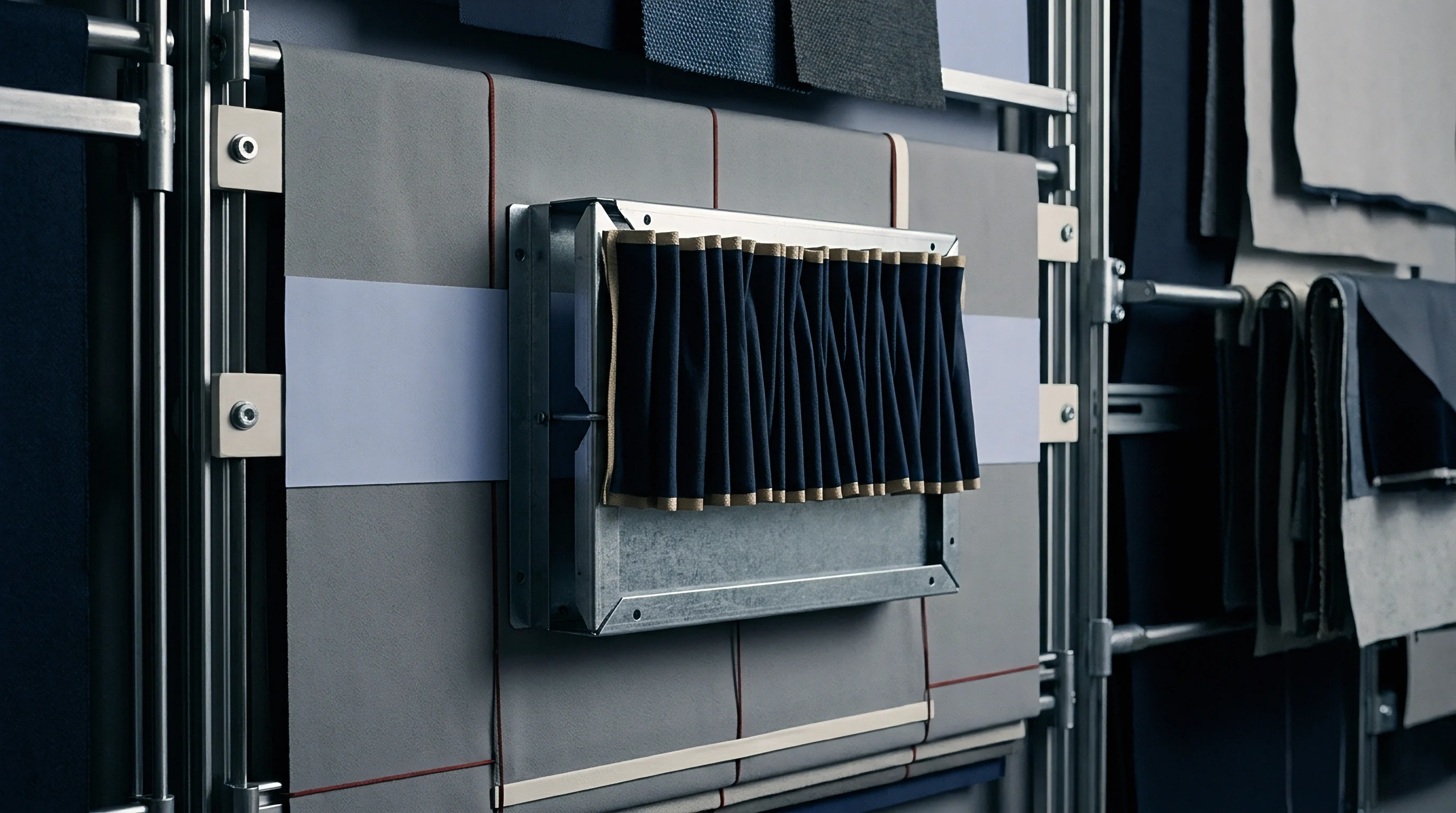
Boundary
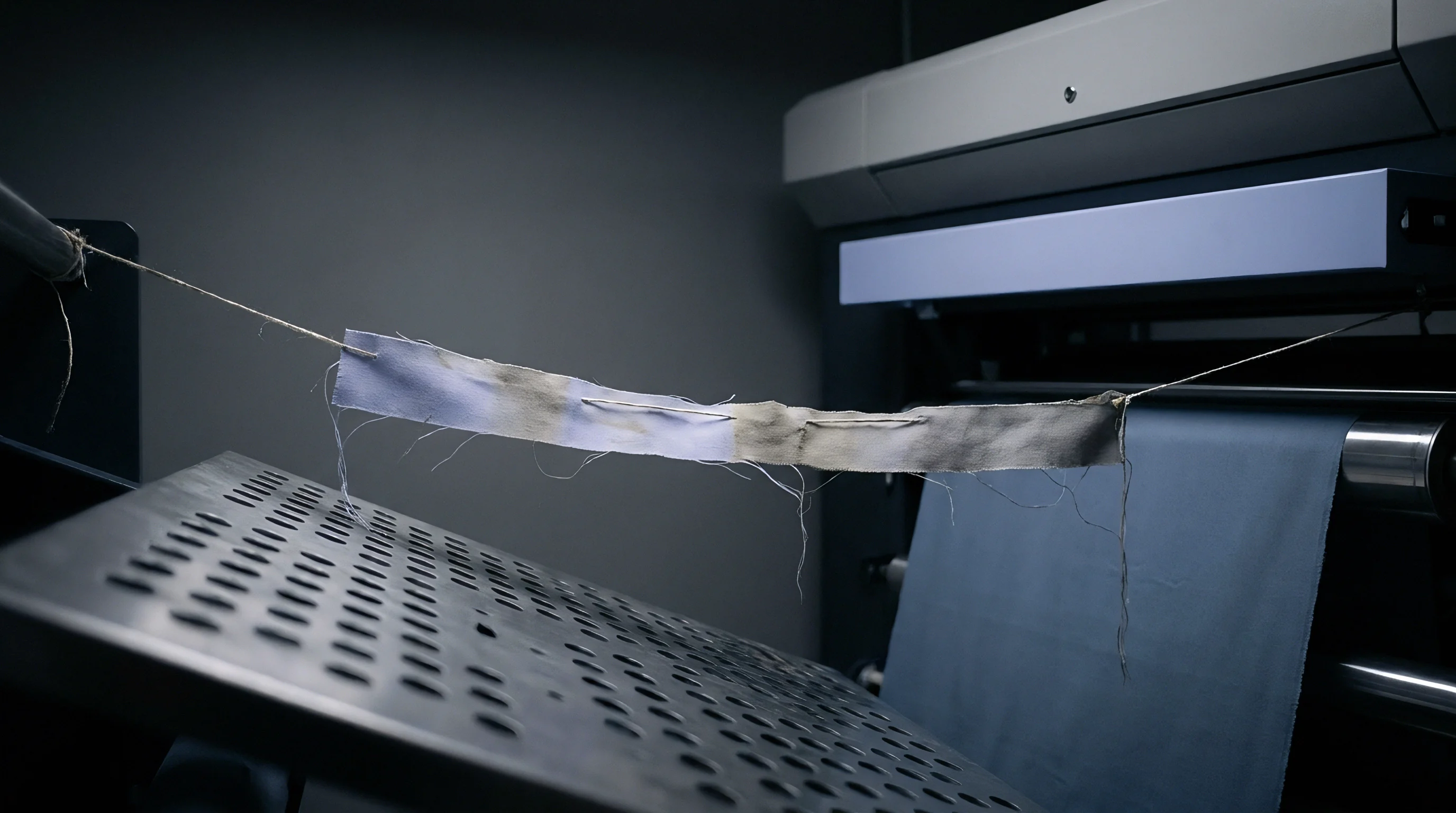
Filament Loss Mechanics at the Die Line
The cutting zone is a site of high localized shear deformation. Die blades push individual structural yarns laterally against the support pad before penetrating through the core polymer structure. This displacement generates a ragged edge boundary where fringe threads remain partially attached to the specimen core.
The mass error is governed by two physical mechanisms acting simultaneously: peripheral yarn shedding and tensile contraction along the perimeter.
Peripheral yarn shedding manifests through the total loss of fiber material severed outside inter-yarn friction points. Coarse staple wovens suffer extreme boundary decay compared to high-twist continuous filament fabrics. In open plain weaves, boundary yarns lose up to eight crossover binding points along a single circular arc segment.
Deprived of normal frictional pressure from perpendicular yarn systems, these exterior boundary segments fall away during manual transfer onto the balance plate.
| Specimen Area (sq cm) | Diameter (cm) | Perimeter (cm) | Perimeter-to-Area Ratio (cm/sq cm) | Theoretical Edge Exposure Factor |
|---|---|---|---|---|
| 20.0 | 5.05 | 15.85 | 0.793 | 2.24 |
| 50.0 | 7.98 | 25.07 | 0.501 | 1.42 |
| 100.0 | 11.28 | 35.45 | 0.354 | 1.00 |
| 200.0 | 15.96 | 50.13 | 0.251 | 0.71 |
| 500.0 | 25.23 | 79.27 | 0.159 | 0.45 |

Tensile Stress Relaxation and Diameter Shrinkage
Structural yarns exist under internal tension induced by loom beat-up, yarn crimp paths, and stenter pin-frame elongation. Finishing plants set fabrics on pin frames under substantial warp and weft draft to hit contractual width targets. The moment a circular blade cuts a specimen free from the web, the internal tension relaxes completely within the cut boundaries.
This localized stress relaxation causes the specimen diameter to shrink immediately below the theoretical 11.28 centimetre dimension of the cutter die. A specimen cut by a certified 100 square centimetre die contracts in practice to 98.2 or 97.5 square centimetres within minutes of severance, particularly when handling elastomeric circular knits. If an operator assumes the sample area remains precisely 100 square centimetres, multiplying the measured scale mass by one hundred overstates the true grams per square metre of the finished lot.
Elastomeric circular knits contract across the cutting radius, creating an artificial increase in calculated mass per unit area.
The interaction of boundary mass shedding and elastic contraction pulls test values in opposite directions. For low-density, open wovens with coarse yarns, boundary shedding dominates, yielding artificially depressed weight readings. For high-stretch knit structures, elastic recovery dominates, producing artificially elevated weight metrics.
The magnitude of this divergence depends on the construction architecture of the substrate.
ISO 3801 Method 5 dictates that cut disc specimens displaying loose peripheral threads require manual extraction and individual inclusion on the balance plate, eliminating standard weighing shortcuts.

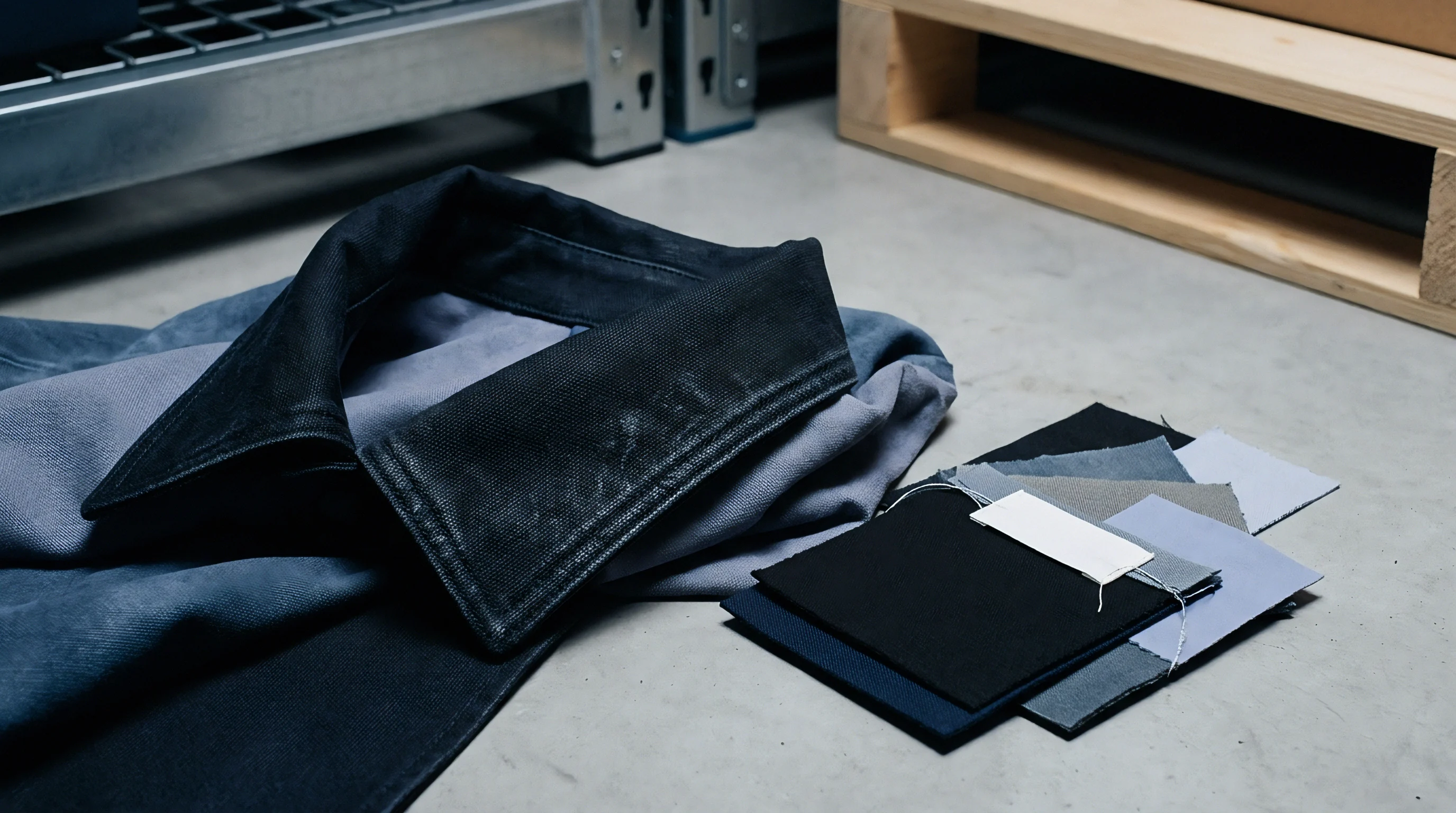
Fray

Sett Density and Inter-Yarn Frictional Hold
Fabric architecture determines the tenacity with which cut edge fibers remain anchored to the core body. Warp and weft yarn cover factors define the packing density within the structural matrix. When the warp sett exceeds 45 ends per centimetre and weft sett exceeds 30 picks per centimetre, yarn crossover contact points produce sufficient normal force to resist peripheral detachment.
In low sett constructions, such as coarse cotton canvas or plain weave filter substrates with fewer than 15 ends per centimetre, boundary cohesion collapses. The distance between adjacent binding points exceeds the mechanical coherence length of loose staple fibers. Cutting shear displaces yarn segments across distances greater than the fiber staple length, triggering extensive fiber fall-out.
The table below models edge shedding across varied commercial constructions using a standard 100 square centimetre circular cutting die. The tested specimens reflect finished goods conditioned according to ISO 139 atmosphere requirements at 20 degrees Celsius and 65 percent relative humidity.
| Fabric Construction | Yarn Count (Tex) | Sett (ends x picks / cm) | Nominal Mass (g/sq m) | Mean Perimeter Loss (mg) | Areal Weight Bias (%) |
|---|---|---|---|---|---|
| Plain Weave Gauze | 20 x 20 | 12 x 10 | 58.0 | 21.4 | -3.69 |
| Open Sheeting | 30 x 30 | 24 x 22 | 145.0 | 28.2 | -1.94 |
| 3/1 Twill Workwear | 40 x 35 | 38 x 24 | 245.0 | 18.6 | -0.76 |
| Combed Cotton Poplin | 15 x 15 | 52 x 30 | 128.0 | 7.1 | -0.55 |
| Filament Ripstop | 8.4 x 8.4 | 46 x 42 | 78.0 | 1.8 | -0.23 |
| Circular Single Jersey | 20/1 Ne + Spandex | 18 wales x 26 courses | 195.0 | 14.2 | -0.73 |

Textile Structural Mechanics at Cut Margins
The mechanical stability of a severed fabric boundary follows defined structural parameters:
- Inter-yarn friction coefficients determine the resistance of peripheral fibers against pull-out during blade contact, where fluorocarbon or silicone surface finishes reduce contact friction and dramatically accelerate perimeter fraying.
- Weave float lengths dictate the unsupported distance along each yarn axis, meaning twill and satin structures lose significantly more boundary material than high-crimp plain weaves of identical mass.
- Yarn twist factor controls internal fiber cohesion within cut yarn ends, causing low-twist open-end yarns to shed larger fiber volumes than high-twist ring-spun or continuous filament configurations.
- Finishing resin crosslinking bonds intersecting yarns at crossover junction points, providing chemical stabilization against boundary shear forces during die cutting.
Consider the structural contrast between a 3/1 warp-faced twill and a 1/1 plain weave. The 3/1 twill construction presents long floats where yarns cross three opposing threads on the surface before diving beneath one. A circular die cutting across the face floats severs the yarn without engaging a locking crossover point for up to two millimetres along the circumference.
These severed floats unseat under the minor vibration of the cutter spring mechanism. The operator removes the disc from the cutting board, leaving behind a visible halo of loose fiber segments. In contrast, plain weave structures lock every single end and pick at each subsequent intersection, confining fray to the immediate blade cut line.
Loose yarn shedding along cut edges increases as yarn sett decreases.


Tooling
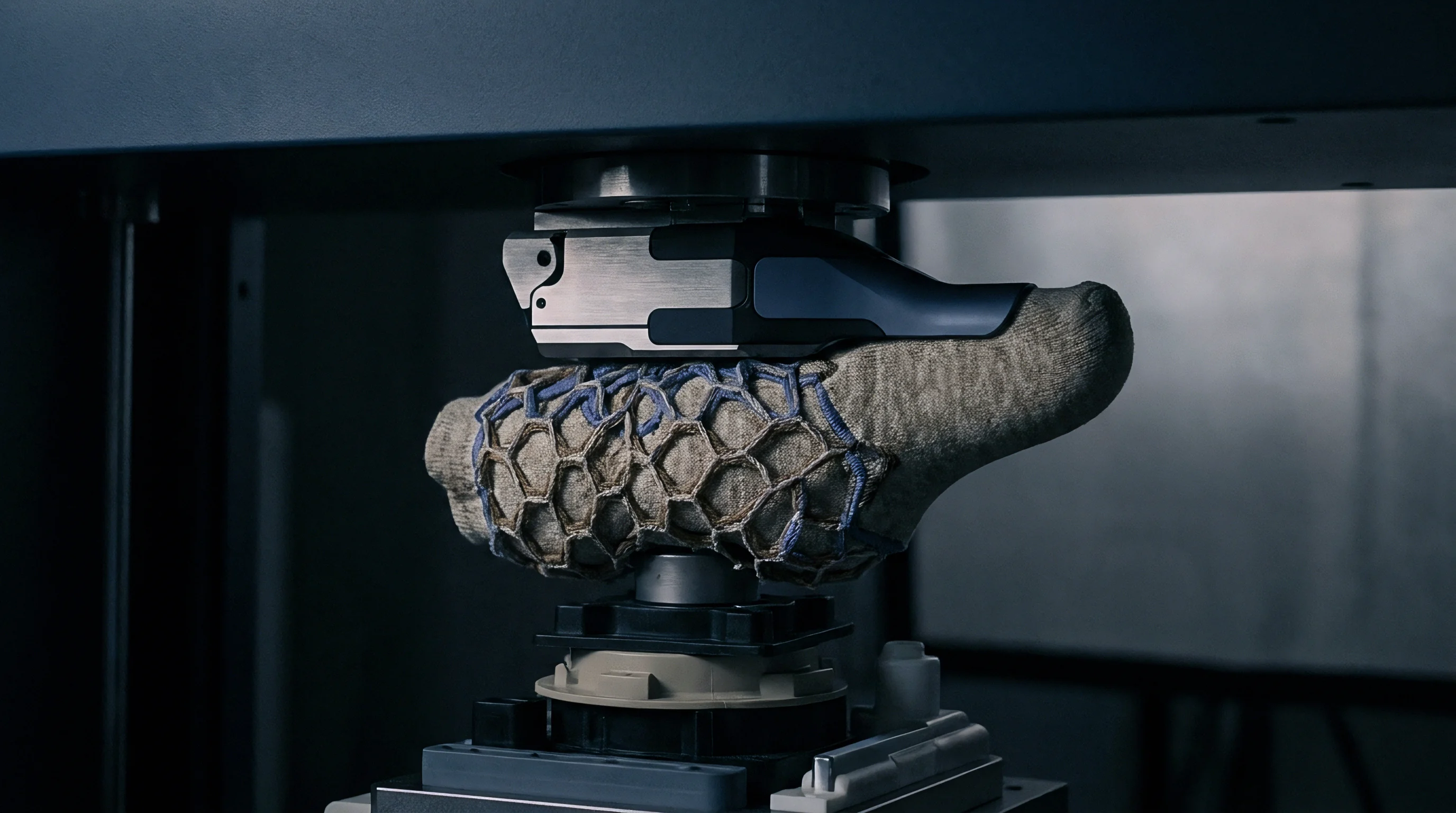
Blade Dynamics and Shear Mechanics
Rotary punch cutters depend on sharp, circular razor blades mounted on a central drive spindle. When an operator pushes the handle down and applies torsional force, the angled cutting edge penetrates the fabric surface while turning against a dense rubber or polyurethane cutting pad. The state of this cutting edge dictates the mechanics of specimen edge severance.
Dull blades distort yarn paths through compressive dragging rather than clean transverse shearing. Under a blunted edge, yarns roll beneath the blade, extending up to twenty percent before snapping under localized tensile failure. This stretching pulls auxiliary filaments from deeper within the specimen body, resulting in ragged, uneven edge profiles and erratic mass loss across test replicates.

Operator Variance and Cutting Mat Degradation
Manual testing introduces significant variability in specimen boundary integrity:
- Blade edge deterioration rounds the micro-bevel radius beyond five micrometres, transforming clean shear actions into abrasive tearing that displaces boundary fibers.
- Inconsistent vertical load applied by laboratory operators causes uneven blade penetration, stretching elastic fabrics along one perimeter sector while cutting cleanly through another.
- Surface grooves in the backing mat catch edge yarns during rotational cutting, tearing peripheral picks out of the specimen disc before weighing.
- Excessive rotational cycles applied during punch activation abrade the freshly severed edge against the rubber base, turning intact yarns into detached fly waste.
Worn cutting mats catch boundary threads, pulling intact structural picks from the core sample during die rotation.
Backing pads require systematic rotation and scheduled resurfacing. Deep circular grooves cut into the substrate create channels that trap low-twist yarns during blade rotation. The operator pulls the specimen disc away from the pad, leaving those trapped boundary yarns adhered to the rubber surface.
The balance records a deflated mass metric that reflects poor tooling rather than incorrect mill production.

Scale Precision and Ambient Conditioning
Perimeter fray error directly compounds errors arising from analytical balance inaccuracy and atmospheric moisture flux. Standard 100 square centimetre specimens cut from lightweight fabrics weigh less than two grams total. A mass loss of 30 milligrams along the 35.45 centimetre perimeter represents a 1.5 to 2.0 percent direct error on the reported fabric areal mass.
Analytical scales lacking draft shields permit air currents to induce balance drift larger than the mass of the severed edge fringe. Conditioning rooms that fail to stabilize within the ISO 139 envelope shift fiber moisture regain, masking edge loss behind substantial moisture content swings. True perimeter error analysis requires conditioned weighing on calibrated 0.001-gram balances inside enclosed glass draft shields immediately post-cutting.
Are rotational punch cutters capable of matching the precision of laser cutting dies on loose weave structures?


Correction
Mathematical Derivation of Specimen Boundary Loss
The mathematical compensation for boundary edge error derives from comparing two circular specimens of differing radii cut from the same conditioned lot. Let true fabric mass per unit area be denoted by M in grams per square centimetre. Let the boundary mass loss per unit of perimeter length be denoted by the edge coefficient k in grams per centimetre.
For a circular specimen of radius r, the measured mass m equals the true area mass minus the edge perimeter loss. This relation gives m equals M multiplied by pi r squared, minus k multiplied by two pi r. Dividing this measured mass by the nominal area pi r squared produces the apparent mass per unit area M_app.
The apparent mass per unit area resolves to the equation: M_app equals M minus two k divided by r. The systemic error term is directly proportional to two k divided by r. As the specimen radius r increases, this negative error term approaches zero.
When using a small radius, the edge coefficient k exerts substantial downward leverage on the apparent weight reading.
| Variable Notation | Physical Description | Standard Units | Measurement Basis |
|---|---|---|---|
| r1 | Radius of primary small specimen disc | centimetres | Cutter die geometry (typically 5.64 cm) |
| r2 | Radius of secondary large specimen disc | centimetres | Cutter die geometry (typically 7.98 or 11.28 cm) |
| m1 | Measured scale mass of small specimen | grams | Analytical balance conditioned reading |
| m2 | Measured scale mass of large specimen | grams | Analytical balance conditioned reading |
| k | Perimeter edge loss coefficient | grams / centimetre | Calculated boundary mass detachment factor |
| M | Corrected bulk mass per unit area | grams / sq metre | Derived true bulk mass metric |
Worked Calculation on Open Linen Sheeting
Assumptions for the correction model: evaluate an open-structure 100 percent linen apparel fabric prone to boundary fraying. Laboratory technicians cut two circular specimens from the same conditioned sample roll using fresh precision punch dies. Die 1 features a nominal area of 100 square centimetres with a radius r1 of 5.642 centimetres.
Die 2 features a nominal area of 200 square centimetres with a radius r2 of 7.979 centimetres.
The analytical balance records specimen mass m1 at 1.942 grams for the 100 square centimetre disc. The balance records specimen mass m2 at 3.938 grams for the 200 square centimetre disc. The uncorrected apparent weights are calculated directly:
Apparent weight 1 equals 1.942 grams divided by 0.0100 square metres, yielding 194.20 grams per square metre. Apparent weight 2 equals 3.938 grams divided by 0.0200 square metres, yielding 196.90 grams per square metre. The larger specimen indicates higher areal mass, confirming boundary loss mechanics on the smaller disc.
To isolate the edge loss coefficient k, subtract the two linear mass expressions:
m1 equals M times pi times r1 squared minus 2 times pi times r1 times k.
m2 equals M times pi times r2 squared minus 2 times pi times r2 times k.
Multiplying m1 by r2 and m2 by r1 isolates the perimeter coefficient k:
k equals (m2 times r1 squared minus m1 times r2 squared) divided by (2 times pi times r1 times r2 times (r1 minus r2)).
Applying the measured values: r1 squared equals 31.83, r2 squared equals 63.66. The denominator resolves to 2 times 3.14159 times 5.642 times 7.979 times (5.642 minus 7.979), yielding negative 659.84. The numerator evaluates as 3.938 times 31.83 minus 1.942 times 63.66, which equals 125.35 minus 123.63, leaving 1.72.
Dividing 1.72 by 659.84 produces an edge coefficient k of 0.000261 grams per centimetre, or 0.261 milligrams per linear centimetre of perimeter.
Substituting k back into the primary equation reveals the true bulk areal mass M:
M equals (m1 plus 2 times pi times r1 times k) divided by (pi times r1 squared).
M equals (1.942 plus 2 times 3.14159 times 5.642 times 0.000261) divided by 0.0100.
M equals (1.942 plus 0.00925) divided by 0.0100, which evaluates to 1.95125 divided by 0.0100, reaching 195.13 grams per square metre.
The uncorrected 100 square centimetre punch cut underreported fabric weight by 0.93 grams per square metre due strictly to boundary fray. Across a 100,000-metre purchase order, this fractional percentage shifts payment terms and customs tariff categories.
Failure to compensate for perimeter mass decay leads commercial buyers to reject bulk shipments that strictly comply with contract specifications.


Protocol

Bench Protocols for High-Fidelity Verification
Standard quality control operations must abandon single-punch disc weighing on open-sett fabrics. Technical teams handling critical mass determinations implement multi-step cut-and-seal procedures to eliminate perimeter filament separation before balance placement.
Boundary fray can be controlled via thermal sealing on synthetic substrates. When testing continuous filament polyester, nylon, or polypropylene fabrics, operators replace mechanical shearing with ultrasonic punch cutting or heated die elements. The thermal perimeter edge seals outer yarn loops into a stable solid bead, eliminating edge shedding during transfer.
The operator measures the sealed perimeter bead to ensure the thermal boundary does not capture mass from outside the target cutting diameter.
For natural fiber substrates like cotton, linen, and wool, mechanical perimeter sealing using thin boundary adhesives provides equivalent control. Prior to die actuation, the operator applies an ultra-low-viscosity cyanoacrylate or acrylic film ring to the cutting perimeter zone. The adhesive locks ends and picks within a 0.5-millimetre channel centered on the cutting line.
The circular blade cuts through the center of this adhesive channel, locking severed yarn tips into place.

Auditing Mill Test Data
Mill test certificates often mask perimeter error behind selective method reporting. When an overseas weaving mill quotes fabric weight, sourcing managers require clarity on whether the testing team utilized ISO 3801 Method 5 punch discs or Method B full-width continuous specimens. Full-width strips eliminate boundary bias by integrating edge fringes into a broad cross-roll average.
When an internal audit uncovers weight discrepancies between the factory floor and the receiving warehouse, the technical auditor examines the cutting benches. Dull punch blades, scored cutting mats, and missing balance draft shields confirm systemic edge error in factory documentation. The inspection team verifies that balance calibration logs, ambient hygrometer readouts, and cutting blade replacement schedules are strictly maintained.
How does perimeter yarn slippage shift balance readouts on high-gauge raschel knits?


Exposure

Commercial Friction in Mass-Per-Unit-Area Disputes
Fabric weight operates as a legal baseline across global textile supply chains. Purchase agreements specify tolerances of plus or minus 3 to 5 percent on contracted areal weight. A 2 percent systemic error introduced through perimeter specimen loss shifts marginally compliant production lots into contractual default.
When mass per unit area dips below specification, buyers trigger penalty clauses, demanding price discounts or rejecting container shipments. Conversely, mills intentionally setting weights toward the bottom edge of commercial tolerances find their margin for error eliminated by specimen edge loss. If an uncalibrated rotary punch trims an additional 2 percent from an already lean production run, the product falls outside standard legal limits.
Tariff classification introduces additional financial risk. Customs authorities enforce strict weight thresholds between fabric duty brackets under the Harmonized Tariff Schedule. For example, specific synthetic wovens encounter sharp duty changes when dropping below 170 grams per square metre.
An inaccurate 100 square centimetre punch cutter that registers 168 grams per square metre on cloth that actually measures 171 grams per square metre triggers misclassification penalties, customs impoundments, and regulatory audits.

Closing the Testing Gap
Sourcing teams safeguard cross-border transactions by inserting precise testing clauses into commercial purchase contracts. Contractual language must designate the specific physical test standard, reject uncorrected single-disc punch methods on open constructions, and establish referee test protocols for contested lots.
Referee testing protocols mandate the use of full-width sample extraction or multi-radius mathematical compensation when disagreements exceed 1.5 percent. Sourcing contracts should explicitly assign testing costs for disputed lots: if the referee analysis confirms that perimeter loss generated the initial failure, the party initiating the dispute absorbs all retesting and freight charges. Establishing these structural controls protects buyers and suppliers from expensive disputes caused by simple specimen perimeter error.
What remains unresolved in commercial practice is how trade agreements will formalize mathematical edge corrections to prevent regulatory customs penalties on lightweight open wovens.