Elastogeometrical Biaxial Energy Minimization in Woven Fabric Hydrothermal Finishing
Hydrothermal finishing minimizes woven biaxial strain energy by plasticizing fiber bonds, allowing tensionless crimp interchange to set stable dimensions.

Equilibrium
A finished specimen of 240 gram combed cotton twill sits on the inspection frame at 142 centimeters width, displaying 42 ends per centimeter and 26 picks per centimeter. Four domestic laundry cycles under ISO 6330 method 4N reduce that width to 134 centimeters, pulling the weft dimension inward by 5.6 percent while warp length contracts by 1.8 percent. The wet processing plant attributes the shift to normal dimensional settling.
Greige specifications tell a different story. The reed width on the air-jet loom stood at 161 centimeters, inserting 24 picks per centimeter into a warp drawn under 0.38 centinewtons per tex running tension. High mechanical draw through the continuous bleaching range and the drying cans locked that open-width construction into a metastable geometry, storing elastic bending energy inside every yarn interlacing point.
When boiling water penetrates the fiber core during end-use laundering, the trapped energy releases, driving the interlaced yarns toward their true thermodynamic minimum energy configuration.
Predicting this terminal state relies on elastogeometrical modeling. Classical Peirce geometry treats yarns as circular, incompressible cylinders bending along circular arcs over rigid perpendicular axes. Real yarns flatten into racetrack cross-sections and store bending strain energy governed by fiber modulus and cross-sectional moment of inertia.
Bending strain energy per unit cell follows the Shanahan-Hearle formulation, integrating the square of local yarn curvature multiplied by bending rigidity along the yarn axis:
U = integral(0.5 B kappa^2 ds)
B represents yarn flexural rigidity, kappa designates local curvature along the modular path, and s tracks arc length through the unit repeat. Total internal energy sums the bending energy of the warp yarn, the bending energy of the weft yarn, and the transverse compression energy generated where yarn surfaces press together at interlacing intersections. Beat-up locks high yarn tensions.
Mechanics of Loom State Strain Energy
Loom state cloth carries extreme energetic distortion. Shed formation lifts alternating warp ends under high axial load, whereas the weft yarn enters the shed under minimal insertion tension before beat-up forces it into contact with the crossing ends. Warp yarns consequently exhibit elongated modular lengths with low crimp amplitudes, while weft yarns wrap steeply around them, absorbing high initial crimp.
The resulting structural geometry resides far from the lowest strain energy state.
When the loom take-up motion draws the newly formed cloth onto the roll, frictional resistance at the interlacing junctions freezes these non-equilibrium path lengths. Contact pressure between crossing yarns generates an adhesive frictional force that prevents spontaneous yarn slippage under dry ambient conditions. The cloth appears dimensionally stable on the inspection table, yet it harbors high residual bending stresses.
Unwashed swatches hide latent defect. If an unrelaxed cotton poplin undergoes dry heat stabilization alone, the friction remains unbroken and the stored energy stays intact, ready to distort the garment at the first immersion in water.
| Processing State | Warp Sett (cm⁻¹) | Weft Sett (cm⁻¹) | Warp Crimp (%) | Weft Crimp (%) | Bending Energy (µJ/cell) |
|---|---|---|---|---|---|
| Loom State (Greige) | 38.2 | 24.1 | 4.1 | 14.8 | 1.84 |
| Continuous Pad-Dry (Dried) | 39.0 | 24.0 | 3.2 | 15.6 | 2.12 |
| Full Hydrothermal Equilibrium | 42.5 | 26.2 | 8.6 | 9.4 | 0.73 |
Biaxial Balance under Zero External Load
True structural relaxation demands complete removal of external web tension while accelerating internal fiber mobility. The biaxial energy state of woven cloth depends upon the ratio of warp bending rigidity to weft bending rigidity. In asymmetric constructions such as sateens or heavy twills, warp yarns dominate the total surface area and total flexural resistance.
As external line tension drops to zero in an aqueous bath, the higher bending stiffness of the warp forces the more flexible weft to deflect, increasing weft crimp while the warp path straightens. Calculated crimp ratios dictate yield.
- Warp modular length designates the actual path length of yarn traversed across one unit cell repeat, measured after decrimping under standard pretension according to ISO 7211-3.
- Weft thread height defines the vertical crest-to-trough distance occupied by the filling yarn axis within the balanced cross-section.
- Interfacial contact pressure measures the compressive mechanical force per unit contact area exerted between mutually perpendicular yarn systems at the crossover knuckle.
- Modular bending rigidity quantifies the product of effective elastic modulus and second moment of area across the flattened multi-filament bundle.
The minimization process terminates when the rate of change of warp bending energy with respect to crimp angle equals the rate of change of weft bending energy in the opposing direction. Any disruption in this equilibrium forces the web to skew or bow upon subsequent wetting. When warp tension exceeds weft restraint during open-width drying, the finished cloth inevitably shrinks along the length during laundry while expanding across the width.
A balanced yarn crimp profile guarantees zero post-wash distortion only when both yarn counts, packing densities, and lateral swelling pressures reach absolute symmetry across the interlacing grid.


Steam
Saturated moisture vapor at 102 degrees Celsius disrupts the non-covalent bonding network of cellulosic polymers within seconds of contact. In cotton fibers, amorphous cellulose chains contain extensive intra- and intermolecular hydrogen bonds that preserve mechanical deformations imposed during dry spinning and weaving. The thermal energy of condensing vapor, combined with plasticizing water molecules, cleaves these weak hydroxyl-to-hydroxyl linkages.
Water molecules sever interchain hydrogen links. The polymer chains gain conformational freedom, lowering the fiber yield stress and causing the effective bending rigidity B to drop by up to seventy percent compared to ambient dry values.
Saturated vapor conditioning at 102 degrees Celsius reduces cotton yarn flexural rigidity from 12.4 micronewton square meters to 3.8 micronewton square meters within six seconds of chamber exposure.
This dramatic reduction in bending modulus alters the force balance within the cloth matrix. With yarn rigidity collapsed, the elastic recovery forces generated by dry yarn curvature diminish. Simultaneously, lateral swelling of the fibers occurs.
Cotton fibers swell radially by twelve to fourteen percent upon complete moisture saturation, while axial swelling remains under one percent. Radial expansion expands the effective cross-sectional diameter of each yarn bundle, forcing adjacent interlacing yarns to travel a longer path around one another. Steam penetration breaks rigid bonds.

Hydrogen Bond Dissociation across Continuous Ranges
Industrial steam relaxation lines rely on rapid vapor injection to induce instantaneous fiber plasticization without imparting longitudinal web tension. The cloth enters an unpressurized steam tunnel over driven scroll rolls that spread the selvages, descending onto a vibrating conveyor belt or perforated drum. If moisture condensation happens unevenly across the width, differential swelling generates uneven tension fields, producing tight selvages and center bagginess.
Dry heat alters nothing here.
Wool and worsted blends display an even stronger hydrothermal response due to the cleavage and rearrangement of disulfide cystine linkages within the keratin matrix. When steam treatment occurs below the glass transition temperature of the amorphous matrix, fiber strain remains frozen. Once the chamber temperature exceeds 95 degrees Celsius under ninety percent relative humidity, the protein matrix plasticizes, allowing the bent yarns to relax into their lowest energy radius of curvature without retaining residual torque.
| Fiber Type | Glass Transition Wet (°C) | Chamber Vapor Saturation (%) | Target Dwell Time (s) | Radial Swelling Factor |
|---|---|---|---|---|
| Upland Cotton (Carded) | 20 to 25 | 98 to 100 | 12 to 18 | 1.13 |
| Viscose Rayon | < 15 | 95 to 100 | 8 to 12 | 1.35 |
| Worsted Wool (21 Micron) | 60 to 65 | 100 | 30 to 45 | 1.16 |
| Polyester (PET Microfiber) | 68 to 72 | 90 to 95 | 20 to 30 | 1.01 |
| Glass transition values measured via dynamic mechanical thermal analysis in immersion mode at 1 Hz frequency; swelling factors determine finished thread spacing. | ||||
Will Thermal Relaxation Invert Yarn Crimp Angles?
Under specific structural boundaries, elevated vapor temperatures reverse the relative crimp dominance between warp and weft. In a high-sett poplin where the warp cover factor exceeds 18 while the weft cover factor sits near 10, the warp threads are packed tightly together, leaving very little space for lateral expansion. When steam induces radial swelling, the weft yarns encounter extreme lateral crowding from the dense warp sheet.
The weft yarn lacks room to maintain its original planar trajectory, compelling it to buckle out of plane and absorb massive crimp increases.
The warp yarns, conversely, lose their original curvature because the swollen weft displaces them into straighter axial paths. The finished goods emerge from the steam tunnel with higher warp elongation and severe widthwise contraction. Mill managers resist slower drying.
If the machine operator attempts to recover lost width by applying stenter clip tension during the drying cycle, the induced mechanical strain locks a secondary metastable state into the web, ensuring that the cloth fails subsequent laundering tests.
The dyehouse manager typically argues that any latent width loss can be easily corrected by stretching the damp cloth two inches wider on the tenter frame without compromising garment performance.

Interchange
Crimp interchange governs the biaxial dimensional shifts observed during hydrothermal treatment. In any woven sheet, the total structural thickness and planar geometry remain constrained by the geometric thread heights of the interlaced sets. Peirce expressed this relationship through rigid geometric equations linking yarn modular length p, thread spacing D, and crimp angle theta:
p = (1 / D) (1 + (theta^2 / 2))
When external mechanical force stretches the cloth along the warp direction, the warp crimp angle theta_1 decreases. This flattening forces the crossing weft yarn to wrap more sharply around the warp, driving weft crimp angle theta_2 upward while pulling the selvages inward. Crimp interchange acts as a coupled physical lever.
Biaxial stresses dictate shrinkage limits.
During hydrothermal processing, the removal of web tension permits the inverse reaction to happen spontaneously. The yarn system with higher stored strain energy transfers curvature to the intersecting yarn until the total internal elastic bending energy reaches a minimum. For a balanced square weave, the energy minimum corresponds to identical crimp percentages across both axes.
For asymmetric plain weaves, twills, and satins, the equilibrium point shifts toward a configuration where the product of yarn flexural rigidity and the square of yarn curvature balances across both systems.
Zero longitudinal line tension during wet processing allows the natural crimp interchange mechanism to transfer excess weft curvature into the warp axis without widthwise necking.

Crimp Exchange along the Biaxial Couple
Mathematical prediction of the final relaxed dimensions requires evaluating the potential energy function of the unit cell under zero external stress. Consider a combed cotton poplin construction off the loom carrying 48 ends per centimeter of 15 tex combed ring yarn and 24 picks per centimeter of 20 tex weft yarn. On the loom, warp crimp measures 3.8 percent whereas weft crimp measures 16.2 percent due to high warp shed tension during insertion.
The total unit cell energy sits at a high value of 2.45 microjoules per cell.
As the cloth enters continuous wet relaxation, yarn swelling increases the effective yarn diameters, altering the maximum packing density. The system resolves this spatial competition by exchanging crimp:
- The cloth enters the wetting bath under less than 0.05 kilonewtons per meter of warp tension, disengaging inter-yarn frictional lock.
- Water immersion plasticizes the cellulosic matrix, reducing yarn flexural rigidity from its dry greige level.
- The high-tension warp yarns contract longitudinally as stored elastic strain releases, driving warp crimp from 3.8 percent up to 9.2 percent.
- Warp contraction exerts lateral force on the weft knuckles, forcing the weft yarn to shed crimp from 16.2 percent down to 10.4 percent.
- The finished thread sett shifts to 51 ends per centimeter and 25.5 picks per centimeter, reducing total internal energy to 0.68 microjoules per cell.
Tension drops yarn crimp immediately. If line tension during drying exceeds 0.2 kilonewtons per meter, the forward drive pulls the warp back out, artificially suppressing warp crimp and shifting the energy burden back into the weft direction. Loose weaves display extreme skew.
| Applied Tension (kN/m) | Finished Warp Crimp (%) | Finished Weft Crimp (%) | Finished Width (cm) | Residual Wash Shrinkage Warp (%) |
|---|---|---|---|---|
| 0.02 (Tensionless) | 9.8 | 9.6 | 140.2 | -0.8 |
| 0.10 (Standard Range) | 7.4 | 11.2 | 143.5 | -3.4 |
| 0.25 (High Draw) | 4.1 | 14.8 | 147.8 | -7.6 |
| 0.40 (Excessive Pull) | 2.6 | 17.1 | 150.2 | -11.2 |

Are Finished Yarn Paths Truly Free of Strain?
A zero-tension hydrothermal bath eliminates macro-level web stresses, yet microscopic residual stresses persist within individual fiber cross-sections. When a yarn bends over a transverse axis, fibers on the outer radius experience axial tension while inner fibers undergo axial compression. During wetting, fiber swelling generates substantial transverse pressures within the twisted bundle, locking internal shear stresses in place.
Settled dimensions require complete relaxation.
Subsequent mechanical handling or garment pressing often activates this residual internal shear, causing localized surface cockling or seam pucker. Sourcing managers frequently observe cloth that passes five home laundry cycles with less than two percent dimensional change, yet exhibits severe surface distortion after industrial garment steam pressing. Whether an industrial finishing range can ever truly achieve absolute internal shear energy minimization remains an unresolved question in textile physics.

Audit
Field inspection of wet finishing plants requires evaluating mechanical line controls rather than relying on digital console readouts. Machine control panels frequently display programmed overfeed percentages that deviate substantially from physical fabric movement. On continuous open-width washing ranges, every nip roll represents a potential tension point.
If the surface speed of roll pair number two exceeds roll pair number one by just 0.5 percent, that slight velocity difference imposes longitudinal strain on the hot, plasticized web, completely halting spontaneous crimp relaxation.
Auditors verify surface speeds by applying calibrated optical tachometers directly to the rubber-covered nip rollers and comparing roll surface speeds against the web entry speed. In a properly configured tensionless range, driven compensator rolls with load-cell feedback loops adjust drive motor frequencies dynamically, maintaining web tension below 0.05 kilonewtons per meter throughout the saturation and steaming chambers. Tensionless washers preserve yarn bulk.
Where dancer arms rest against their hard stops, line tension runs uncontrolled.
Failure to meet the maximum three percent dimensional change limit under ISO 5077 after commercial laundry cycles results in immediate lot rejection and re-finishing at mill expense.
Compensating for warp tension requires mechanical overfeed on the stenter frame. Overfeed introduces more cloth length into the pin chains than the forward chain speed, allowing the hot web to buckle micro-crimply and contract along the warp during drying. If an audit reveals that the plant runs a heavy twill at zero percent overfeed to maximize linear meter output, that cloth harbors extreme latent shrinkage.
Machine speed accelerates downstream distortion.
Inspection of Tensionless Continuous Wash Ranges
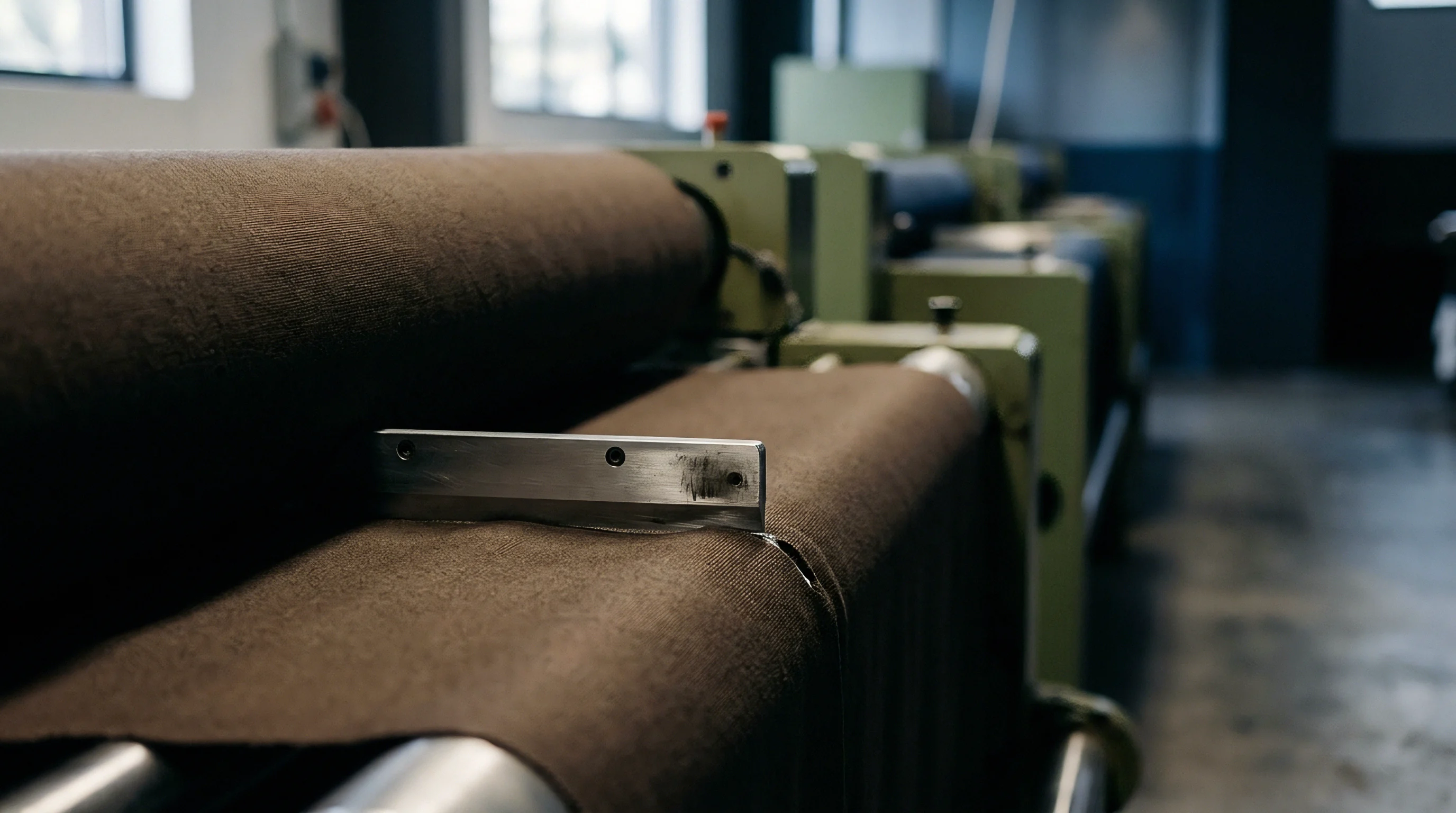
Verifying a continuous open-width desizing and washing line demands physical walk-throughs across all wet compartments. Water temperature profiles must hit specified targets: enzyme desizing compartments require 65 to 70 degrees Celsius, scouring compartments run at 95 to 98 degrees Celsius, and post-scour rinse boxes maintain 80 degrees Celsius before descending to a cold overflow rinse. Lower temperatures prevent complete removal of polyvinyl alcohol or starch sizing agents, leaving stiff chemical residues that elevate dry bending rigidity and block fiber relaxation.
Wet processing shifts pick spacing.
The auditor must examine the vacuum slot extractors placed prior to the drying cylinders. High vacuum pressures distort the damp web by pulling the center down into the slot, inducing diagonal bowing across the weft yarns. Vacuum slot differential pressure should never exceed 0.25 bar on goods under 200 grams per square meter.
Excessive vacuum pull stretches the warp, undoing the dimensional relaxation achieved in the preceding steam chambers.
Overfeed Calibration across Stenter Drying Zones
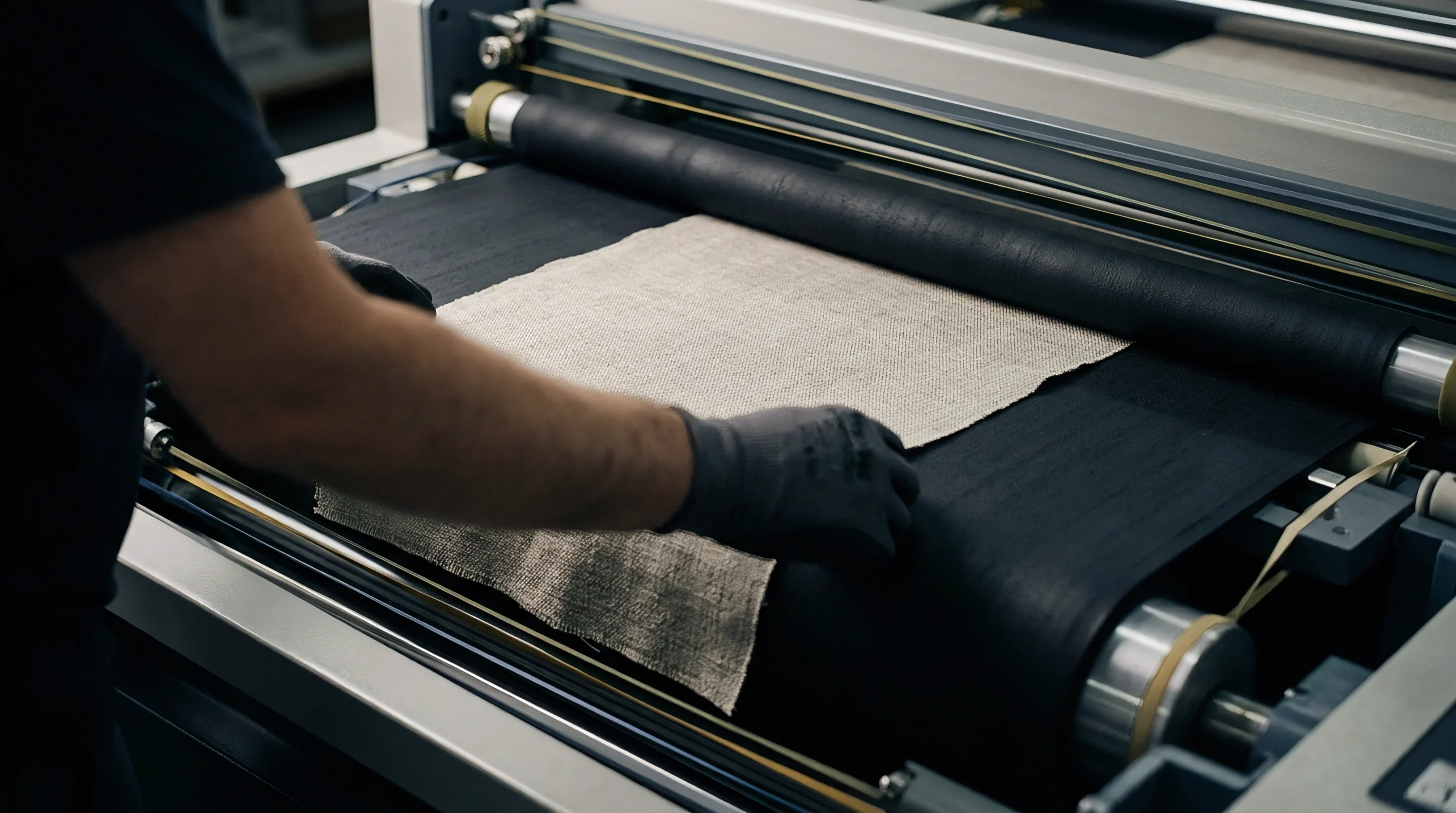
Calibrating overfeed systems on the stenter frame requires measuring the speed ratio between the entry overfeed pinning wheels and the main transport chains. Plants frequently claim twenty percent overfeed capability, but practical pinning limits depend on cloth weight and sett density:
- Pinning wheel engagement verifies that mechanical brushes firmly press the damp selvages onto the brass pin plates without creating localized scalloping or edge tears.
- Chamber temperature zoning tracks gradual thermal descent from 160 degrees Celsius in zone one down to 110 degrees Celsius in the final chamber to prevent case-hardening of the surface fibers.
- Rail convergence settings dictate a progressive narrowing of the lateral width track by two to three centimeters across the drying zones to permit natural transverse crimp development.
- Air nozzle velocity balance checks that upper and lower air nozzle pressures remain equal within five percent to prevent the web from floating off the pins or rubbing against nozzle lips.
Overfeed prevents downstream garment twisting. When drying finishes without adequate rail convergence and balanced airflow, latent strain remains unevenly distributed between the face and back of the cloth. Skipping verified overfeed calibration directly produces torque-skewed apparel panels that twist irreversibly around side seams after the first customer wash.


Margin
Fabric purchasing agreements traditionally treat dimensional stability as an isolated laboratory compliance metric rather than a primary driver of finished unit cost. When a sourcing office buys greige goods at 160 centimeters width and issues finishing instructions for a targeted 140 centimeters finished width, the conversion involves an implicit 12.5 percent width shrinkage and a corresponding 8 to 10 percent warp crimp contraction. This length loss represents lost billable meters.
A mill purchasing 10,000 meters of greige cloth yields only 9,100 finished meters after complete hydrothermal biaxial energy minimization. Greige measurements deceive unseasoned buyers.
Mills frequently manipulate drying line tension to artificially suppress warp crimp, delivering 9,600 meters instead of 9,100 meters from that same greige lot. The buyer receives an apparent windfall of 500 additional linear meters. This unrelaxed cloth enters the garment cutting room carrying six to eight percent latent warp shrinkage.
When the cut panels undergo automated steam pressing or garment washing, parts shrink unevenly across sizes, skewing marker layouts and resulting in severe cutting room panel rejections.
| Processing Route | Greige Input (m) | Finished Output (m) | True Yield (%) | Cost per Linear Meter ($) | Downstream Cut Loss (%) |
|---|---|---|---|---|---|
| High-Tension Run (Unrelaxed) | 50,000 | 48,200 | 96.4 | 3.12 | 8.5 |
| Standard Stenter (Partial Relax) | 50,000 | 46,500 | 93.0 | 3.23 | 3.8 |
| Full Hydrothermal Equilibrium | 50,000 | 45,100 | 90.2 | 3.33 | 0.5 |
Commercial Penalties of Unrelaxed Yarn Strain
Garment sewing factories face catastrophic margin erosion when working with inadequately relaxed piece goods. Automated spreading machines lay up tensioned cloth under nominal tension, but as plies rest on the cutting table overnight, relaxation occurs spontaneously under ambient humidity. Plies contract along the length, causing bottom layers to differ in dimension from top layers.
Cut parts no longer match graded pattern profiles. Pattern matching across plaids fails completely. Warp ends absorb initial shrinkage.
The landed cost calculation must reflect the true yield of stable cloth rather than the initial invoice price per linear meter. Purchasing fully relaxed cloth at $3.33 per meter yields stable panels with under one percent table loss, whereas buying stretched goods at $3.12 per meter incurs an effective landed cost exceeding $3.45 per meter once cutting floor recuts, garment shrinkage rejects, and shipping delays enter the ledger.
Every percentage point of unrelaxed warp tension concealed by the mill converts directly into cutting room panel shrinkage on the spreading table.
Tolerance Schedules within Supply Agreements
Master supply agreements must abandon generic commercial tolerances and specify dimensional stability thresholds tied to strict testing methodologies. Purchase orders should stipulate performance under ISO 5077 incorporating ISO 6330 wash cycle 4N at 40 degrees Celsius with tumble drying, establishing acceptable dimensional change limits at plus or minus 2.0 percent for both warp and weft directions.
Furthermore, technical specifications must mandate testing for relaxation shrinkage separate from felting or progressive shrinkage. If incoming inspection reveals that a delivered roll displays more than 2.5 percent warp shrinkage on the first wash cycle, the supplier contract must trigger a mandatory chargeback covering the lost cutting yield. Mill contracts must explicitly state that delivered yardage is invoiced based on fully relaxed, conditioned dimensions according to ISO 139 rather than hot roll-up meterage taken directly off the stenter delivery batcher.
Section 8.2 of the standard international fabric procurement agreement mandates that any delivery showing post-wash dimensional distortion above three percent entitles the purchaser to debit the conversion house for all downstream cut-and-sew manufacturing labor incurred prior to defect discovery.