Predicting Non Linear Viscoelastic Crimp Interchange Dynamics under Biaxial Thermal Stenter Extension Forces
Biaxial thermal stenter extension alters yarn crimp balance through coupled viscoelastic relaxation and Peirce geometry shifts, dictating final fabric dimensional stability.
Coupling

Geometric Strain Partitioning in Continuous Woven Matrices
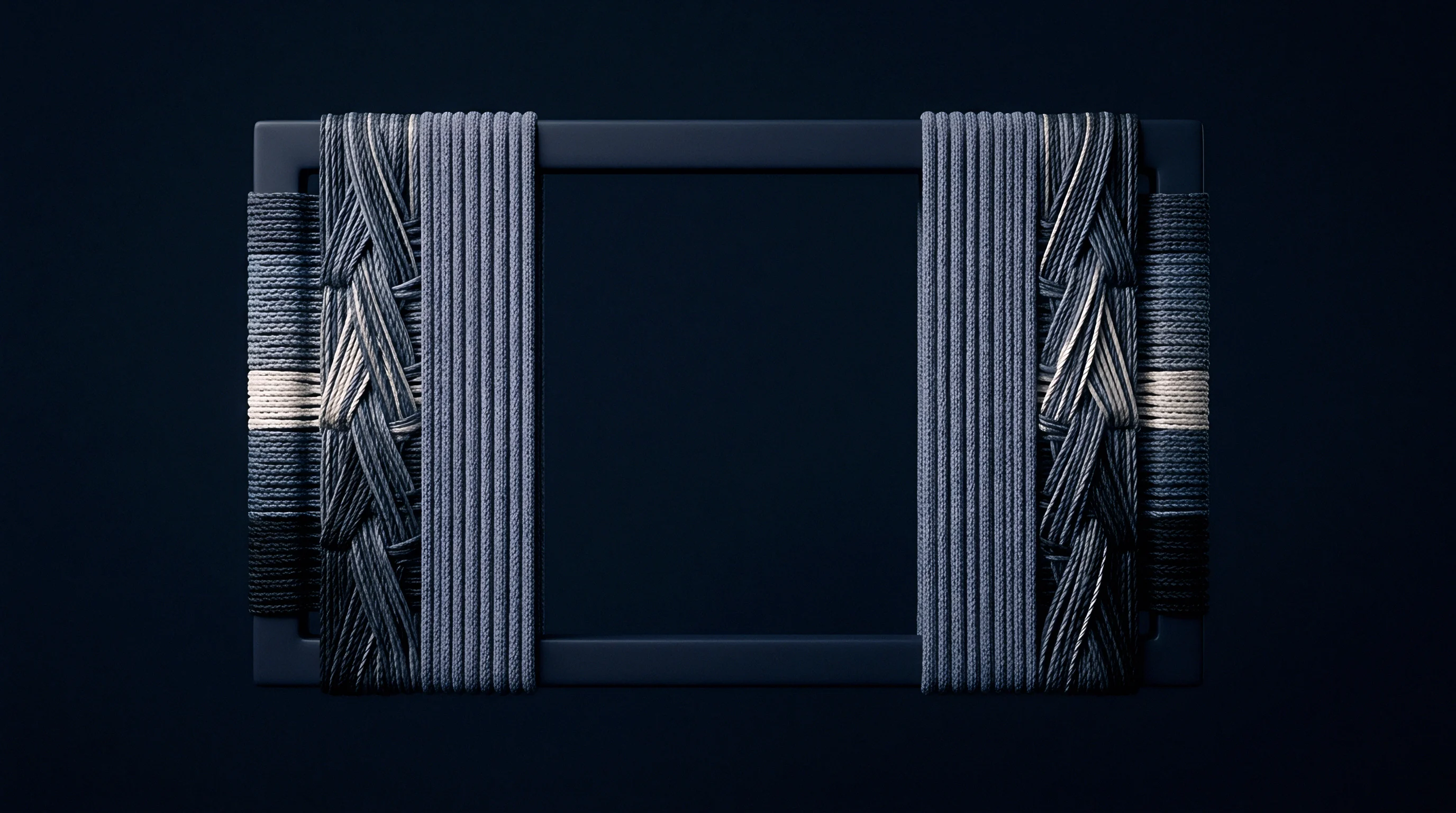
Applying tensile force to a primary yarn system redistributes mechanical energy throughout orthogonal threads. In a plain or twill weave, warp and weft yarns do not exist as straight lines. They wrap around each other in a series of repeating undulating loops defined by classical elastica geometry.
When a thermal stenter grips fabric selvedges and pulls the web laterally in the cross-machine direction, that external crosswise force does not merely stretch the weft polymer chains. The applied lateral extension pulls the undulating weft threads flatter. As weft yarn height decreases under crosswise tension, it forces the intersecting warp yarns to bend further around the flattening weft threads.
This structural interaction represents crimp interchange.
Yarns rearrange under load. The mechanical phenomenon operates through strict geometric constraints. Increasing tension along one yarn axis causes crimp transfer into the perpendicular direction, forcing an increase in thread density along the non-extended axis unless longitudinal tension prevents thread motion.
When thermal energy enters the system inside a stenter chamber, the structural stiffness of synthetic filaments drops dramatically as polymer temperatures cross the glass transition threshold. Non-linear viscoelasticity accelerates this geometric transformation. Polymer molecular chains inside the filaments relax their internal stress while the yarn geometry bends into new equilibrium configurations.
Predicting the resulting dimensional changes demands a model that treats polymer viscoelasticity and fabric geometry as simultaneously coupled variables. Standard linear elastic calculations fail because yarn bending resistance changes continuously as filaments slide past each other and compaction alters yarn cross-sectional ellipticity. Under stenter heating, yarn cross sections flatten from circular profiles into race-track or elliptical geometries.
This cross-sectional flattening reduces the distance between yarn centers, modifying the maximum theoretical crimp that the perpendicular system can absorb. Consequently, predicting fabric width, warp shrinkage, and pick density after heat setting requires mapping the non-linear viscoelastic modulus of the yarn alongside the instantaneous Peirce crimp balance equations.
| Fabric Construction | Initial Warp Crimp (%) | Initial Weft Crimp (%) | Dominant Strain Mechanism | Interchange Sensitivity |
|---|---|---|---|---|
| Plain Weave (150 GSM PET) | 7.5 – 9.0 | 5.0 – 6.5 | Viscoelastic bending relaxation coupled with rapid crimp transfer | High |
| 2/1 Twill (210 GSM PA66) | 10.0 – 12.5 | 3.5 – 4.5 | Asymmetrical segment rotation and filament shear sliding | Moderate |
| 4/1 Satin (280 GSM PET) | 12.0 – 15.0 | 2.0 – 3.0 | Long float axial extension with localized junction crimp sink | Low |
| Ripstop Light (80 GSM PA6) | 5.5 – 7.0 | 4.0 – 5.0 | High-tension grid constraint with pocket crimp amplification | Very High |
Crosswise clip extension drives warp threads straight while pushing weft picks into higher structural loops.

Orthogonal Load Transfer via Viscoelastic Crimp Equilibrium
Perceiving yarn height reduction as a solitary structural change ignores simultaneous polymer network reorientation inside individual filaments. Biaxial extension force fields in a stenter frame create complex stress states at yarn crossover points. The contact pressure between intersecting warp and weft yarns spikes as tension pulls one system tight against the other.
This local contact pressure generates high transverse compression stresses on heating, driving localized viscoelastic creep in the synthetic polymer. As the yarn flattens laterally, inter-filament friction rises, locking the new crimp configuration in place as the fabric exits the heating zones and cools below its glass transition temperature.
The rate of orthogonal load transfer depends heavily on yarn bending rigidity, yarn linear density, and surface friction coefficients. High-filament-count yarns exhibit lower individual filament bending moduli, permitting rapid crimp interchange at lower cross-machine extension forces. Coarse monofilament or low-dpf textured yarns resist loop bending, storing elastic strain energy that manifests as uncontrolled thermal residual shrinkage if heating durations fall short of full stress relaxation.
Modeling this response mandates numerical integration of non-linear creep compliance functions over the exact duration of thermal exposure inside the stenter zones.
- Inter-yarn junction clamping prevents sliding when transverse contact forces exceed filament surface friction thresholds during lateral web expansion.
- Filament alignment shift alters the effective cross-sectional moment of inertia, softening yarn bending resistance non-linearly under thermal loads.
- Orthogonal crimp imbalance creates persistent internal torque within twill and satin structures, causing post-finishing diagonal fabric skewing.
- Thermal strain localized relaxation reduces permanent yarn orientation in high-crimp zones compared to straightened longitudinal yarn segments.
Finishing mills frequently attribute cross direction width loss to raw yarn lot variability rather than uneven biaxial clip chain expansion profiles.
Kinetics

Nonlinear Stress Relaxation Moduli across Thermal Zones
Polymer chain mobility jumps when ambient temperature crosses the primary glass transition boundary. Inside a multi-zone thermal stenter, synthetic continuous filament fabrics pass through rapid heating gradients, rising from ambient shop temperatures to over two hundred degrees Celsius in under ten seconds. The viscoelastic behavior of polymers like polyethylene terephthalate or polyamide 6,6 under these dynamic conditions cannot be accurately described by linear Maxwell or Kelvin-Voigt mechanical models.
Instead, non-linear stress relaxation equations incorporating strain-dependent Eyring rate theory must be applied to predict the decay of tensile force under sustained biaxial extension.
Temperature alters polymer mobility. The relaxation time spectrum shifts toward faster timescales as thermal energy breaks intermolecular hydrogen bonds and van der Waals attractions within amorphous yarn regions. Under high initial biaxial extension strains, high stress levels accelerate polymer chain slippage, shortening the characteristic relaxation time.
This strain-acceleration effect means that initial stenter rail expansion zones induce disproportionately fast stress decay. If the stenter speed is too fast for the thermal conductivity of the fabric weight, yarn core temperatures lag behind surface temperatures, generating a steep viscoelastic modulus gradient across the yarn cross section.
Biaxial strain alters geometry. As warp and weft yarns compete for structural space during heat treatment, the non-linear relaxation modulus E(t, varε, T) dictates how much force transfers to the clip chains versus how much force dissipates through internal polymer flow. Integrating dynamic differential equations allows engineers to calculate the instantaneous tension at any point along the stenter rail profile.
Calculating these stress fields prevents machine over-driving, which causes selvedge unpinning, pin hole tearing, or structural warp thread breakage during heat setting.
Polyester filament yarns at two hundred degrees Celsius exhibit a fifty percent reduction in relaxation modulus within eight seconds of biaxial strain application.
- Temperature-dependent shift factors determine the horizontal acceleration of stress relaxation curves along the logarithmic time axis.
- Nonlinear strain activation volume dictates how external biaxial forces lower the energy barrier for molecular chain slippage.
- Asymmetrical modulus decay creates structural tension imbalances when warp and weft yarns experience differing thermal ramp rates.
- Residual stress retention occurs when fabric exits the stenter heating chamber before relaxation reaches ninety-five percent completion.
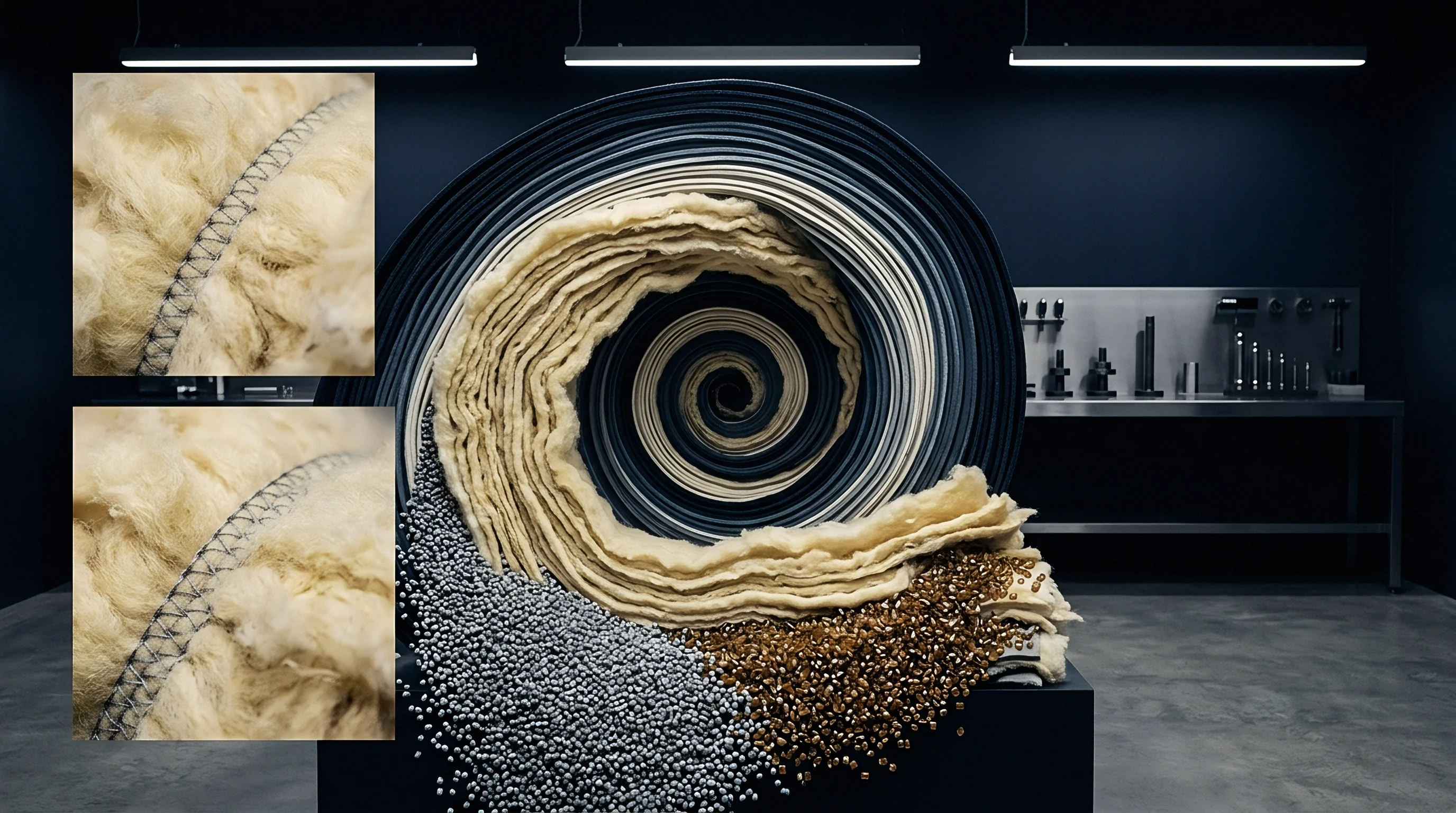
Can Dynamic Overfeed Models Prevent Bowing Defects?
Differential pin speeds introduce spatial variations in longitudinal strain across the working chamber. Bowing and skewing arise directly from non-uniform crimp interchange dynamics across the usable width of the stenter. Because fabric edges are clamped mechanically by pins or clips while the fabric center is held only by yarn-to-yarn mechanical interlock, cross-machine tension distributions are inherently parabolic.
The center of the fabric web sags longitudinally under aerodynamic air nozzle pressure, pulling weft picks into a parabolic arc unless longitudinal machine direction overfeed compensates for center-to-edge strain variations.
Predicting the exact overfeed required to maintain straight weft alignment demands dynamic modeling of viscoelastic strain recovery during the cooling phase. Machine direction overfeed delivers excess warp length onto the stenter pins, deliberately introducing warp crimp before lateral rail divergence begins. As the lateral rails expand, cross-machine extension forces consume this excess warp length through crimp interchange without generating excessive longitudinal warp tension.
When overfeed ratio, rail divergence profile, and thermal relaxation kinetics align precisely, weft threads remain perpendicular to the selvedge throughout the thermal cycle.
The mathematical formulation requires setting the rate of warp crimp increase equal to the weft crimp reduction driven by lateral rail expansion. The weave axis rotates. If warp tension is kept near zero via controlled positive overfeed, weft crimp interchange proceeds without inducing center-line longitudinal stress spikes.
Overfeed rates typically range from plus one percent to plus six percent depending on loom crimp structural state, yarn thermal shrinkage potential, and target finished fabric mass per unit area.
Whether non linear Eyring stress relaxation parameters measured under uniaxial lab conditions hold true during multi zone rapid thermal transitions remains open to investigation.
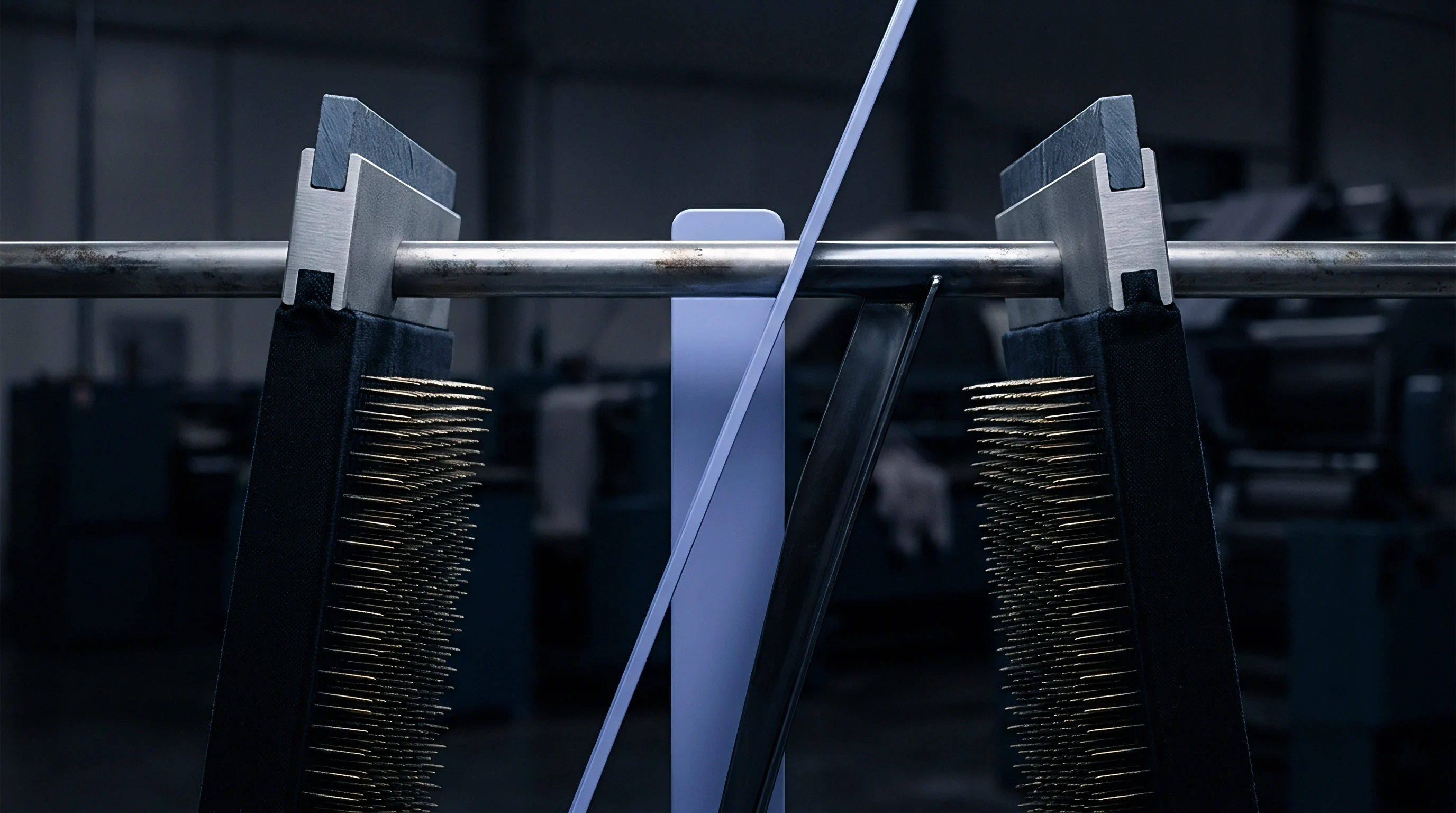

Heat
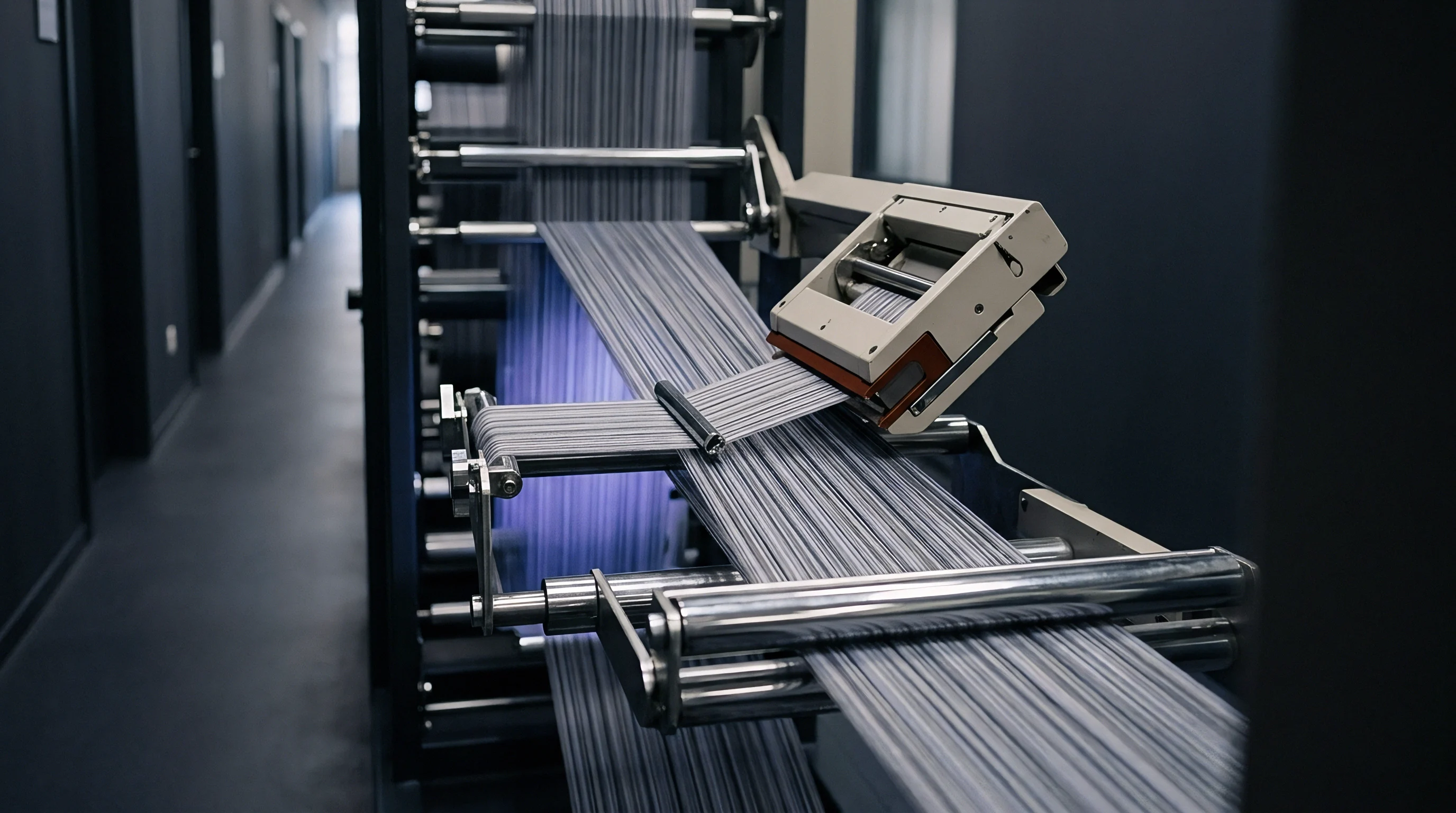
Thermal Boundary Conditions in Biaxial Extension Chambers
Hot air impingement at twenty metres per second establishes intense surface convection along the moving textile web. Efficient heat transfer is vital to elevate yarn temperatures above Tg within the first two chambers of a modern stenter. Standard production stenter ranges feature four to eight discrete thermal zones, each capable of independent temperature and air velocity control.
The temperature profile must match the non-linear viscoelastic softening curve of the specific polymer continuous filament build being processed.
Glass transition dictates speed. For polyester fabrics, heating zones are staged from one hundred sixty degrees Celsius at the entry zone up to two hundred five degrees Celsius in the primary heat-setting zones, followed by controlled cooling zones. If the thermal energy input is insufficient to reach the target polymer temperature, yarn bending stiffness remains elevated, resisting crimp interchange and causing high residual tension in the finished roll.
Conversely, excessive thermal exposure degrades filament molecular weight and causes thermal yellowing or dye affinity changes across the fabric width.
Air velocity profile across top and bottom nozzle arrays governs convective heat transfer rates. Symmetrical air pressure balances the floating web, minimizing mechanical distortion. Symmetrical thermal delivery prevents differential shrinkage between the top and bottom faces of twill or satin weaves, which otherwise causes fabric curling and flat-bed cutting table misalignments downstream.
| Polymer & Build | Stenter Chamber Temp (°C) | Dwell Time (s) | Overfeed Range (%) | Lateral Rail Expansion (%) |
|---|---|---|---|---|
| PET Plain 75D/72f | 195 – 205 | 25 – 30 | +2.0 to +3.5 | +3.0 to +4.5 |
| PA66 Micro-Twill 40D | 180 – 190 | 20 – 25 | +1.5 to +2.5 | +2.0 to +3.0 |
| PET/Spandex 4-Way Stretch | 185 – 195 | 30 – 40 | +5.0 to +8.0 | +8.0 to +12.0 |
| PTT Soft Weave 100D | 170 – 180 | 25 – 35 | +3.0 to +4.0 | +2.5 to +3.5 |
| Data calibrated for convective air-nozzle stenter frames operating at nozzle velocities between 18 and 22 m/s under standard atmospheric density. | ||||
Inadequate thermal chamber dwell time freezes residual strain into yarn microstructures before crimp interchange reaches thermodynamic equilibrium.
Mechanical Overfeed Control for Crimp Restoration
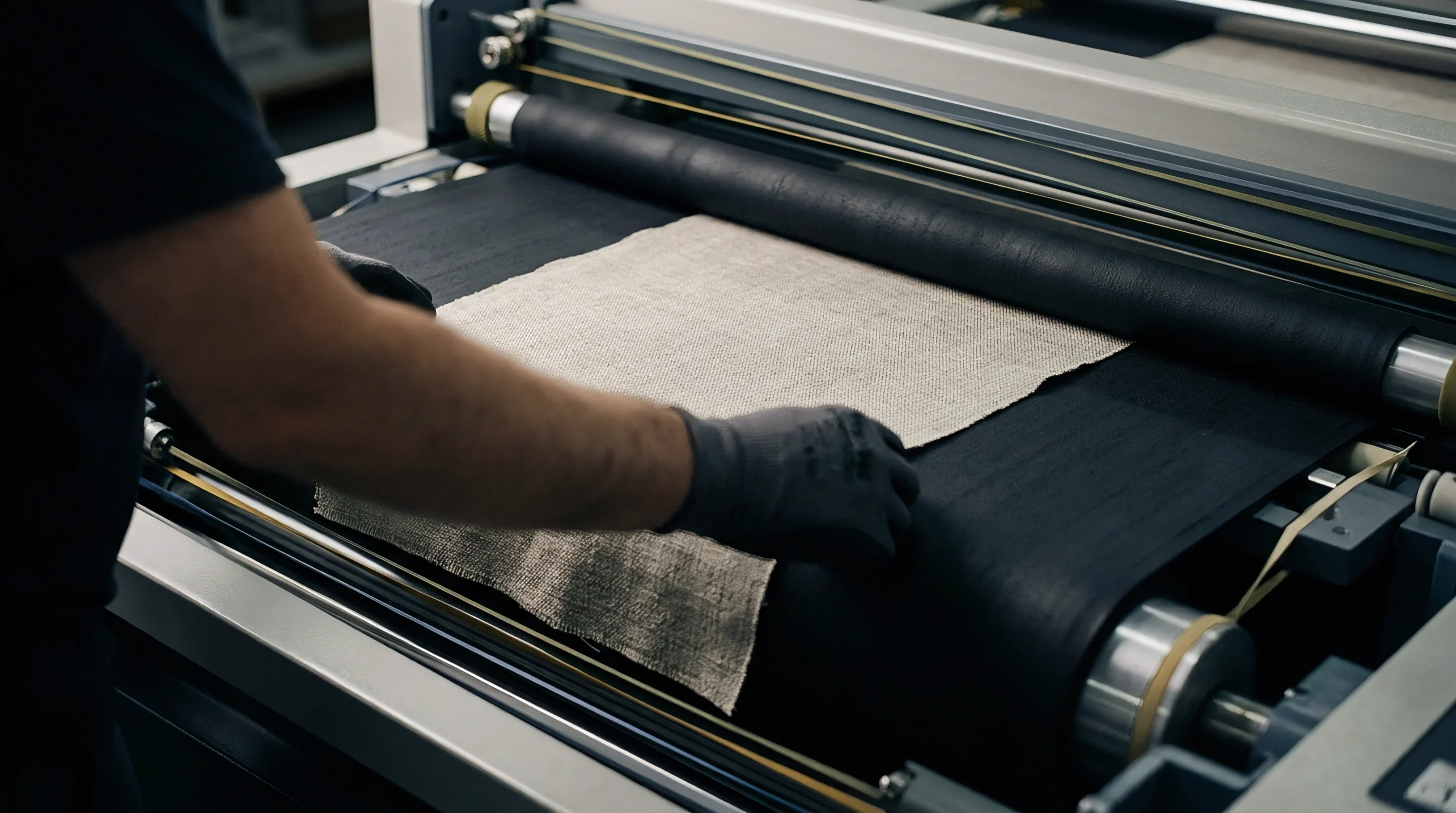
Inflow roll speed differentials regulate the quantity of longitudinal yarn length delivered onto entering stenter pins. Overfeed systems utilize precision servo-driven feed rollers operating above the main chain velocity to introduce microscopic wave loops into the warp threads as pins engage the fabric selvedge. This positive feeding counteracts the natural tendency of lateral stenter extension to pull warp crimp completely flat.
Chain width dictates draft. Overfeed setting governs final fabric weight and thread count density. When lateral extension flattens weft crimp, picks per centimetre increase automatically due to longitudinal geometric compaction.
If the overfeed rate is insufficient, warp tension rises excessively, driving warp crimp to near zero. A fabric finished with zero warp crimp suffers from severe dimensional instability, exhibiting high laundry shrinkage in the warp direction when subsequent washing allows polymer chains to recoil back into low-energy states.
- Measure incoming greige fabric warp crimp, thread count per centimetre, and mass per unit area in accordance with ISO 3801 conditioning standards.
- Calculate target finished pick density and cross-machine width expansion ratio required to achieve specified weight per square metre.
- Set stenter entry overfeed speed percentage to match calculated longitudinal compaction allowance plus expected yarn thermal dry heat shrinkage.
- Adjust thermal zone temperatures to ensure polymer core temperature reaches glass transition within the first one-third of overall chamber length.
- Configure exit cooling zone air blowers to drop web temperature below glass transition before clip release to lock in crimp balance geometry.
Matching the clip chain divergence rate to the polymer softening rate prevents edge tears and maintains uniform pick density.
Calibration

Biaxial Tensile Testing under Controlled Thermal Transients
Cruciform fabric specimens loaded inside environmental test enclosures yield coupled force responses along orthogonal axes. Measuring non-linear viscoelastic crimp interchange dynamic properties requires specialized testing apparatus capable of subjecting cruciform samples to simultaneous, independent warp and weft strain profiles while applying rapid thermal ramps up to two hundred twenty degrees Celsius. Standard uniaxial tensile testers conforming to ISO 13934 fail to capture orthogonal force transfer and crimp migration mechanisms.
Fabric width contracts rapidly. Uniaxial tension testing allows lateral contraction to occur freely, masking the true biaxial load-deformation coupling that occurs inside a clamped stenter frame. Biaxial force sensors positioned on each arm of a cruciform test fixture track real-time stress evolution during heating and stretching phases.
Test data reveals that cross-machine force requirements depend non-linearly on instantaneous longitudinal strain state, proving that single-axis material models significantly underestimate required stenter clip holding forces.
Consider a numerical prediction example for a 150 GSM polyester plain weave fabric subjected to thermal stenter extension. Assume an initial warp crimp c1 = 0.080 (8.0%) and initial weft crimp c2 = 0.050 (5.0%), with an initial pick density of 24 picks/cm and end density of 28 ends/cm. The fabric enters a stenter zone at 195 °C with a machine overfeed rate of +3.0% (reducing longitudinal warp tension) and an applied lateral clip chain expansion of +5.0% strain in the weft direction.
Under these thermal conditions, the viscoelastic relaxation modulus of the PET filament drops from an unheated E0 = 3.5 GPa to an effective transient setting modulus E(t) = 0.42 GPa after 15 seconds dwell time.
Applying Peirce crimp interchange geometric equations, the lateral strain reduces weft crimp height h2, forcing an increase in warp crimp height h1. The total thread axis length remains conserved over the yarn paths. The calculated final weft crimp drops from 5.0% down to c2′ = 2.1%, while warp crimp increases from 8.0% up to c1′ = 9.8%.
This shift increases finished warp-wise pick density from 24.0 picks/cm to 25.2 picks/cm, increasing finished fabric weight by 4.8% relative to unconstrained dimensions. Dynamic load cells record a peak lateral tension of 145 N/m of web width during initial expansion, decaying non-linearly to 38 N/m at the chamber exit as polymer relaxation stabilizes the newly forced crimp geometry. This worked model highlights how viscoelastic decay and crimp interchange dynamically split total input work into recoverable elastic strain and permanently set fabric geometry.
Testing under ISO 5077 after five wash cycles reveals dimensional instability whenever post stenter warp crimp sits below three percent.
In Line Strain Sensing and Image Correlation
High resolution optical cameras placed above stenter exit points track speckle pattern shifts across moving fabric surfaces. Non-contact digital image correlation provides real-time mapping of strain fields across the full working width of the web during processing. Optical measurement eliminates physical contact errors inherent to mechanical feeler arms, capturing local crimp interchange variations caused by uneven thermal distribution or local air nozzle jet turbulence.
Relaxation rates govern recovery. Non-contact optical sensing systems calculate instantaneous warp and weft thread pitch, converting spatial density variations into dynamic strain maps. When local strain anomalies appear, automated control loops feed corrective signals directly to individual stenter rail drive motors, altering local rail divergence rates to maintain target crimp balance across center, left, and right zones of the fabric web.
Failing to capture non linear crimp interchange during thermal setting produces systemic off shade shading and severe garment panel twisting after industrial laundering.
Margin
Commercial Yield Optimization and Scrap Reduction
Misjudging finished width potential creates significant monetary losses across high volume textile converter contracts. Sourcing practices and finishing plants operate on slim margins where a two percent loss in usable fabric width converts profitable bulk orders into unviable production runs. When stenter operators guess overfeed and rail divergence settings based on empirical trial-and-error rather than predictive viscoelastic crimp models, fabric often finishes under-width, off-weight, or dimensionally unstable.
Clip forces shift balance. If a mill over-stretches fabric crosswise to achieve a required finished width without compensating via warp overfeed, the resulting crimp imbalance causes high residual laundry shrinkage. When garment makers cut panels from this unstable cloth, post-wash garment distortion leads to full chargebacks and lot rejections.
Predictive software tools integrating viscoelastic crimp interchange kinetics calculate optimal greige loom width, entry overfeed, rail divergence profile, and chamber speed before setting up the finishing machine, ensuring first-pass compliance with finished buyer specifications.
| Defect Mechanism | Physical Root Cause | Yield / Financial Impact | Corrective Engineering Action |
|---|---|---|---|
| Width Collapse | Insufficient heat setting dwell time resulting in incomplete viscoelastic strain relaxation | 3.5% to 6.0% loss in saleable fabric width; cut-plan panel shortfalls | Increase chamber heating temperature or reduce line speed by 12-15% |
| High Warp Shrinkage | Excessive longitudinal drag force flattening warp crimp to near zero | Bulk lot rejection under ISO 5077 standards (> 3.0% wash dimensional change) | Increase entry roll positive overfeed by +2.0% to restore warp crimp loop height |
| Center-to-Edge Shading | Parabolic cross-machine pick density variation driven by uneven lateral crimp migration | Garment shade sorting required; 8% to 12% scrap rate at cutting table | Re-profile stenter rails to non-linear parabolic expansion profile |
| Pin-Hole Tearing | Excessive lateral rail expansion forcing crimp interchange past geometric jamming limit | 100 mm selvedge trim loss per side; increased edge waste scrap allowance | Reduce cross-machine extension ratio by 1.5% and step up thermal pre-heating |
Contractual Dimensional Tolerance Limits in Bulk Supply
Purchase agreements specifying strict domestic washing shrinkage thresholds depend directly on stable crimp configuration. When specifying fabric specifications for high-performance apparel or technical industrial textiles, technical buyers write explicit dimensional stability requirements into supply agreements, typically referencing standards such as ISO 5077 or AATCC 135. Achieving less than two percent dimensional change across three wash cycles requires that warp and weft crimp levels sit at their thermodynamic equilibrium point following stenter heat setting.
Excessive draft causes rupture. When bulk lots fail shrinkage audits, disputes focus on whether greige construction or finishing execution caused the non-compliance. Integrating predictive crimp interchange models into technical dossiers establishes clear parameters for greige width, grey pick density, and stenter processing conditions.
Documenting these parameters protects buyers and finishers by defining exact operational envelopes required to deliver specified weight, width, and stability targets without sacrificing commercial yardage yield.
Inserting ISO 3759 dimensional stability compliance clauses with a maximum two percent residual shrinkage limit shifts financial liability for width collapse back to the finishing plant.