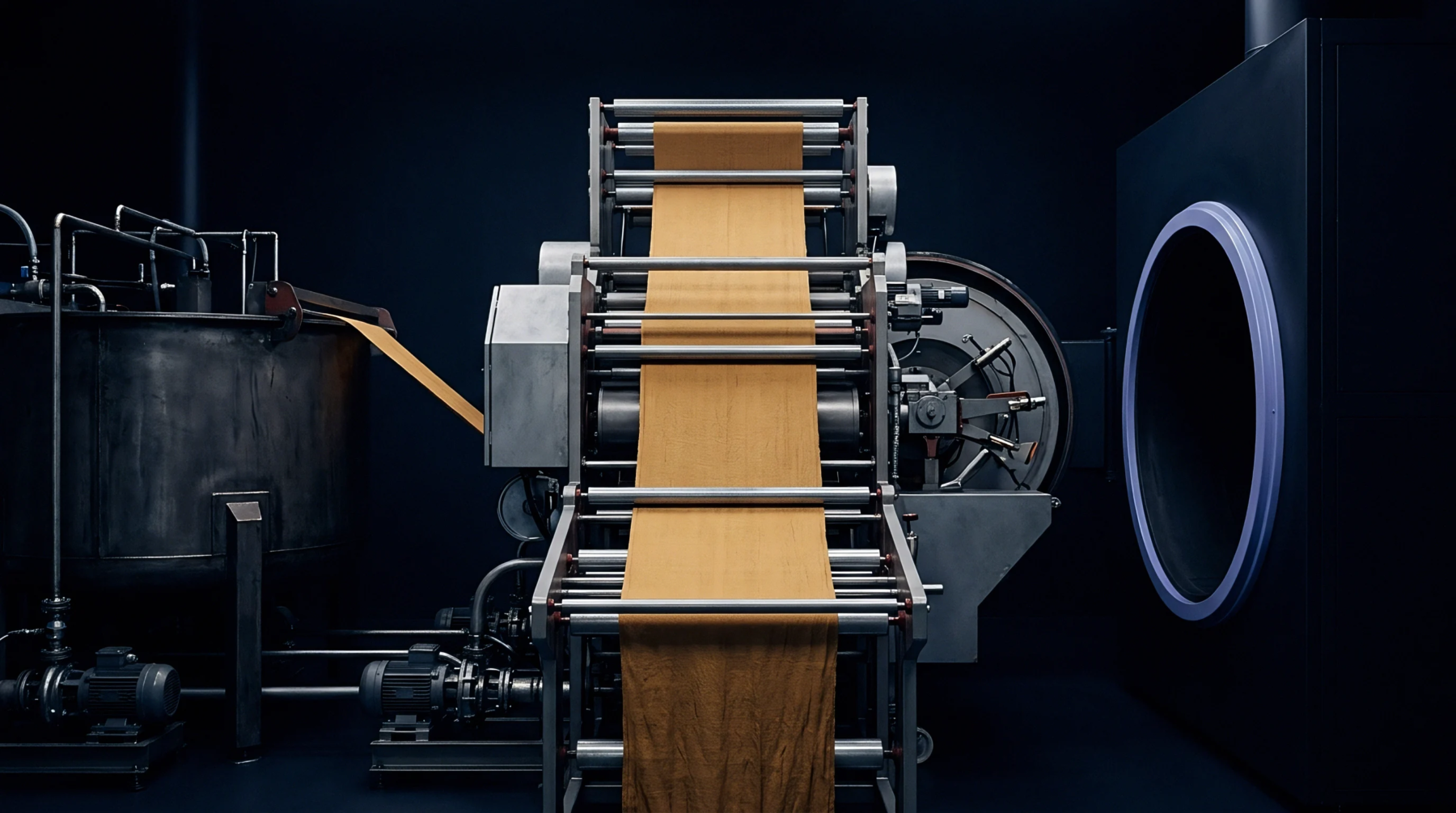
Controlling Continuous Dyeing Particulate Migration across Thermal Intermediate Dryers
Intermediate drying needs balanced radiative heat, controlled convection air speed, and pseudoplastic antimigrants to eliminate dye migration across woven fabric.
Charged polymeric chains maintain their structural configuration under specific environmental stress by resisting dissociation during aqueous processing within industrial textile finishing. This polyelectrolyte stability determines the effective binding duration of fixation agents applied to cellulose fibres during reactive dyeing operations. Ionic crosslinks break when fluctuations in local pH or conductivity exceed predetermined thresholds for the molecular backbone.
Manufacturers monitor these variations to prevent premature precipitation of fixing components within the liquor tank. Coagulation happens when the electrostatic repulsion between chains diminishes below a physical limit defined by salt concentration. Constant monitoring of this equilibrium prevents batch variations that degrade colour fastness in finished fabrics.
Fixing agents rely on internal cohesion to survive the shear forces exerted by industrial paddle or jet dyeing machines. Polyelectrolyte stability provides the frame for these long chains to remain anchored to the fibre surface while circulating at high velocity. External mechanical stress strips the agents from the substrate if internal interactions fail to counteract fluid drag.
Engineers calibrate the concentration of electrolytes in the bath to match the charge density of the polymer. Polymers with inadequate strength lose their affinity for the fibre during the scouring stage. Uniform adherence depends on maintaining the chemical integrity of the chain throughout the entire dyeing cycle.
High heat exposure during the subsequent tentering process alters the hydration layer surrounding the charged segments of the polymer. The degree of polyelectrolyte stability dictates whether the applied finish will migrate or sublimate when fabrics reach temperatures required for setting synthetic blends. Excess heat promotes chain scission if the backbone lacks thermal protection against oxidative degradation.
Humidity controls also influence this resistance because water molecules facilitate the movement of segments that remain loosely tethered. Excessive moisture softens the polymer matrix and reduces the physical density of the film formed on the textile surface. Laboratory testing at elevated heat cycles verifies the threshold where the finish loses its structural coherence.
Accurate calibration of temperature remains the primary method for maintaining the integrity of the chemical barrier.
Textile mills confirm the efficiency of finishing chemicals by measuring the discharge of solids in the effluent stream after the rinsing phase. Low polyelectrolyte stability manifests as a high concentration of unreacted species in the wastewater because the chains failed to remain attached to the fibre matrix. Technicians measure the turbidity of these rinse waters to infer the binding quality achieved during the main processing step.
Strong chains remain locked in the fabric structure even when wash cycles contain aggressive surfactants designed to remove surface debris. Consistent molecular alignment prevents the migration of finish onto roller surfaces during the final drying phase. Higher retention rates signify a successful application of the chemical treatment because the finished goods retain the desired hand and colour performance metrics.
The persistence of these chains during laundering cycles confirms the underlying chemical endurance of the final textile product.
Intermediate drying needs balanced radiative heat, controlled convection air speed, and pseudoplastic antimigrants to eliminate dye migration across woven fabric.
Expertise is a utility, not a secret. sentiention™ publishes its working knowledge as open reference: intelligence layer covering the materials it sources, the markets it enters, and the reference that serves both.