Longitudinal Slack Delivery
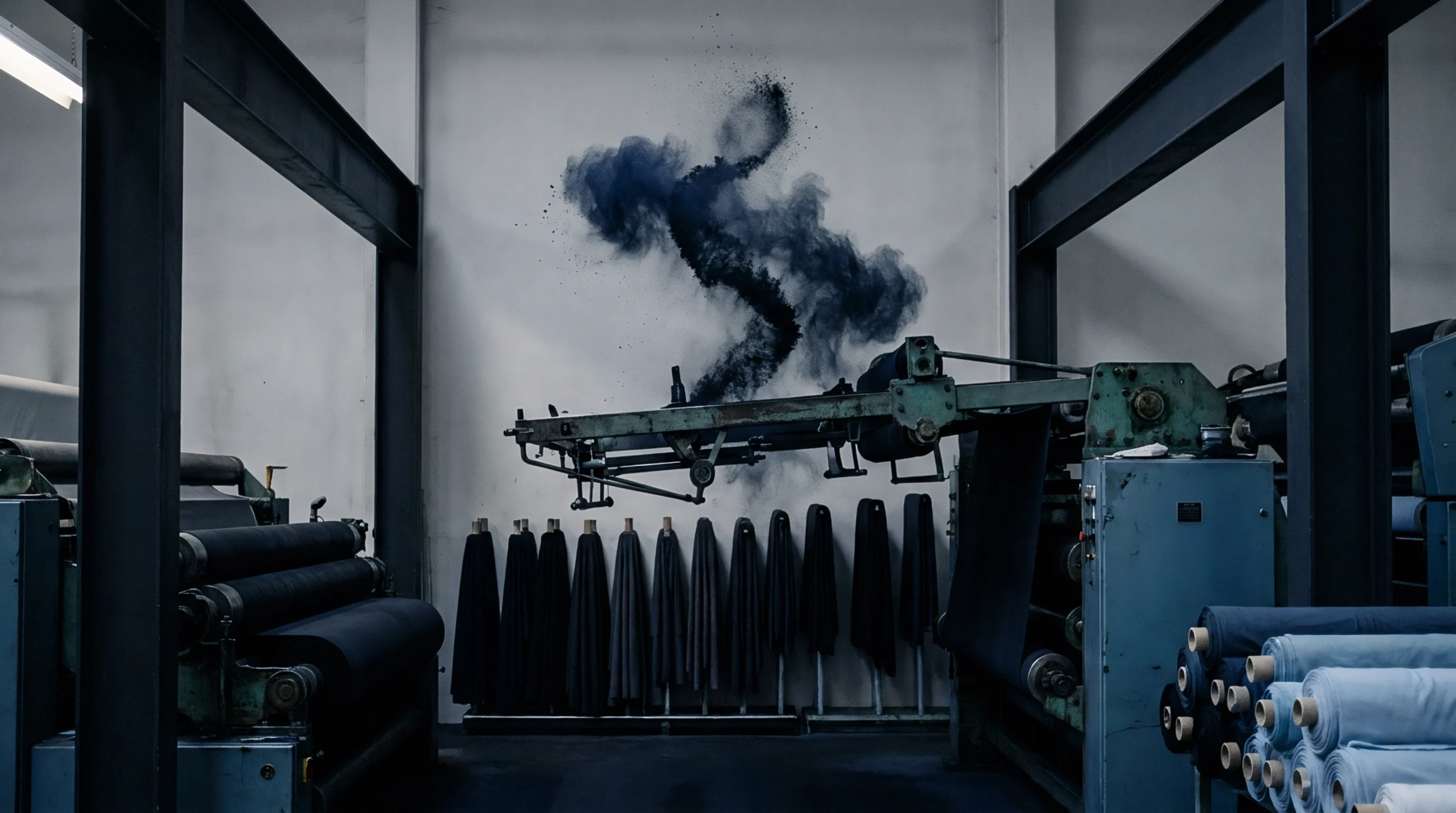
Positive mechanical acceleration applied to continuous fabric yardage feeding onto stenter pin or clip chains compensates for length contraction during drying and heat-setting. Driven delivery rolls run faster than the advancing transport rails to establish stenter chain overfeed across the entry field of an industrial finishing frame. Inserting excess fabric length allows warp yarn crimp to form naturally while moisture evaporates and thermofixation sets the structure.
The influence of overfeed ceases the moment pins pierce the selvage edge and lock fabric dimensions within the heated oven chambers.
Dimensional Stability Control
Greige goods enter preparation lines stretched flat by scouring, bleaching, and padder nip pressures that artificially pull the warp ends taut. Unchecked relaxation during post-wash consumer laundering causes uncontrolled garment shrinkage if not pre-empted on the stenter frame. Setting a stenter chain overfeed of five to fifteen percent introduces controlled slack that contracts under hot air impingement.
Yarns recoil into a relaxed geometric balance while weft threads pull inward to achieve target finished thread counts.
Overfeed Ratio Tuning
Fabric weight, fiber elasticity, and stitch geometry dictate the percentage of overfeed required for each production lot. Heavy knit structures demand substantial longitudinal overfeed, sometimes reaching forty percent, to offset severe loop elongation generated during high-speed dyeing cycles. Woven goods require moderate settings calculated from wash-wheel shrinkage test data gathered from lab batch swatches.
If the overfeed ratio drops too low, residual lengthwise shrinkage remains in the cloth, failing buyer technical quality manuals. Setting excessive overfeed produces baggy fabric ripples, sagging edges, and poor pin retention inside the oven.
Residual Shrinkage Testing
Quality control laboratories evaluate lot stability using commercial washing machines and flat-bed tumble dryers according to ISO 6330 test standards. Dimensional markings applied across the warp direction before washing reveal whether the chosen overfeed neutralized residual tensile stresses. Technicians fine-tune the digital roll drive speed differentials at the stenter control console based directly on these physical lab wash logs.
Correctly tuned stenter chain overfeed delivers finished broadcloth that maintains square grain line alignment and reliable dimensional metrics across cut-and-sew operations.