Quantifying Resin Crosslinking Density Variance across Variable Speed Short Run Stenter Heat Setting Operations
Dynamic airflow throttling and exit pyrometry prevent severe crosslink density spikes and catastrophic tear loss during stenter speed transitions.

Flux
Thermal energy transfer inside an eight-chamber convection stenter governs the exact point where aqueous moisture leaves cellulosic fibres and thermosetting reactants polymerize. In continuous long runs exceeding five thousand metres, airflow impingement and chamber air temperature equilibrate with web speed. The evaporation line stays pinned to the third chamber, leaving the downstream chambers to hold the dry substrate at peak curing temperature for an exact dwell interval.
Short run production disrupts this equilibrium. When a finishing line processes lots between three hundred and twelve hundred metres, machine operators continually alter haul-off velocity to accommodate seam stitching, batch changeovers, head-end feeding, and width adjustment. Convective heat coefficients between the circulating air nozzles and the moving sheet fluctuate violently across these velocity transitions.
Dwell time drops immediately. Air boundary layer dynamics govern heat conduction into the damp core of the textile. At a nominal operating speed of forty-five metres per minute, cloth enters the drying zone with seventy percent wet pick-up, reaches the dry point within twenty-two seconds, and experiences twenty-eight seconds of cure at one hundred sixty-five degrees Celsius.
When the operator decelerates the stenter to fifteen metres per minute during a seam transition, total oven residence expands from fifty seconds to one hundred fifty seconds. Convective heat delivery does not scale downward proportionally with line deceleration. Chamber air temperatures held by heavy gas burners or circulating thermal oil radiators possess substantial thermal inertia.
The air volume within the stenter enclosure remains charged with thermal energy that the decelerated web absorbs continuously.
Web surface temperature spikes twenty-two degrees Celsius above target within twelve seconds of a fifty percent speed reduction.
Surface temperature governs resin condensation rates. During standard steady-state production, water vaporization absorbs latent heat and holds the internal web temperature near seventy-five degrees Celsius until moisture levels decline past eight percent. Once moisture evaporates, fiber temperature climbs toward chamber ambient.
Under prolonged dwell caused by line deceleration, the substrate reaches the target curing temperature within the second chamber instead of the fifth. Chemical crosslinking reagents experience extended thermal exposure at peak activation temperatures. The chemical reaction shifts from controlled bifunctional crosslinking into excessive polycondensation and severe thermal embrittlement.
Moisture content resets the curing clock. When line speed accelerates back to nominal velocity after seam transit, the opposite dislocation occurs. Cold wet cloth moves rapidly through the chambers.
Latent heat consumption during water removal consumes the available thermal energy across the first four chambers. The dry line shifts deep into the seventh chamber. The textile exits the final cooling zone without completing the required dwell period above activation threshold.
Crosslinking reactions abort midway through condensation. Finished rolls produced across these short runs demonstrate distinct bands of over-cured and under-cured yardage along their linear length.
Localized over-curing damages cellulosic polymer backbones while under-curing causes garment panels to collapse structurally during post-tailoring commercial laundering.
Bond
Cellulose crosslinking operates through covalent ether linkages forged between secondary and primary hydroxyl groups on adjacent anhydroglucose units and polyfunctional N-methylol or polycarboxylic chemical resins. Dimethyloldihydroxyethyleneurea, modified with diethylene glycol to reduce volatile formaldehyde emissions, serves as the benchmark chemical finish for easy-care and anti-wrinkle finishing on cotton and cotton-rich blends. Crosslinking density represents the concentration of effective crosslink bridges established per unit volume of amorphous cellulose.
In crystalline cellulose regions, tight intermolecular hydrogen bonding prevents resin penetration; chemical reaction occurs exclusively within accessible amorphous domains and the surfaces of microfibrils. Magnesium chloride catalysts, often accelerated with citric acid, activate N-methylol groups by generating carbonium ion intermediates. These ions condense with cellulose hydroxyls under thermal driving forces between one hundred fifty and one hundred seventy-five degrees Celsius.
Acid catalysts lower activation energy. When the stenter holds nominal speed, the chemical formulation delivers uniform bifunctional ether links. Inter-chain bonds limit segmental motion of cellulose polymer chains when exposed to aqueous swelling forces during home laundering.
If the stenter decelerates, excessive residence time drives secondary reactions. N-methylol groups undergo self-condensation, generating bulky, stiff polymethylene urea networks within the inter-fibrillar spacing. These self-condensed resin oligomers do not anchor adjacent cellulose chains effectively.
They occupy void spaces, restrict fiber mechanical compliance, and trigger severe localized stiffening.
- Foulard padder immersion deposits an aqueous finish containing three hundred fifty grams per litre of modified DMDHEU and thirty-five grams per litre of activated magnesium chloride catalyst onto the greige twill.
- High-pressure nip squeezing extracts surplus liquor to lock wet pick-up at exactly sixty-five percent before the cloth meets stenter entry pins.
- Chamber evaporation purges water molecules from the fiber core, concentrating non-volatile reactants within amorphous cellulose zones.
- Active thermal dwell promotes protonation of the resin methylol entities, initiating nucleophilic attack by cellulose hydroxyl oxygens to create covalent diether networks.
- Exit chilling quenches residual chemical reactivity through chilled water rollers, arresting polymer formation before winding onto the take-up frame.
Covalent ether crosslinks resist boiling water. Polycarboxylic acids such as 1,2,3,4-butanetetracarboxylic acid react through an alternative cyclic anhydride intermediate mechanism, catalyzed by sodium hypophosphite. The resulting ester crosslinks impart outstanding wrinkle recovery properties without generating formaldehyde off-gassing.
Polycarboxylic systems exhibit heightened sensitivity to thermal setting duration. Extended exposure times trigger thermal yellowing through unsaturated polycarboxylic decomposition and initiate cellulose chain scission under acidic conditions. Short run operations that fluctuate in velocity alter the ratio between mono-ester grafting and di-ester true crosslinking.
When speed increases, mono-ester adducts predominate, wasting expensive chemical add-on without stabilizing the weave.
| Resin Chemistry | Catalyst System | Nominal Dwell (s) | Set Temp (°C) | Target Crosslink Density (mol/kg) | Formaldehyde Release (ppm) |
|---|---|---|---|---|---|
| Modified DMDHEU | MgCl₂ with Citric Acid | 45 | 165 | 0.28 to 0.35 | below 75 |
| Non-methylated DMDHEU | Latent Zinc Nitrate | 50 | 160 | 0.32 to 0.40 | 120 to 220 |
| BTCA | Sodium Hypophosphite | 60 | 175 | 0.22 to 0.30 | zero |
| Melamine Formaldehyde | Ammonium Chloride | 40 | 155 | 0.45 to 0.58 | 280 to 450 |
Mill technical directors maintain that automated stenter burner modulations instantly equalize heat output to match incoming line speeds without generating crosslinking deviations.

Solvent
Direct quantification of resin crosslinking density requires analytical methodologies capable of isolating chemical bridges from physical fiber entanglements. Cupriethylenediamine hydroxide dissolution analysis establishes crosslink density by measuring the insoluble cellulosic residue that survives complexation. Untreated cotton dissolves completely in a 0.5 molar aqueous solution of cupriethylenediamine through the formation of copper-amine-cellulose coordination compounds.
Covalent diether bonds generated by DMDHEU or ester bonds from BTCA prevent the solvent from separating cellulose macro-chains. The mass fraction of insoluble residue remaining after thirty minutes of mechanical shaking at twenty-five degrees Celsius directly correlates with the concentration of intermolecular crosslinks.
Even heating prevents localized tender spots. Cuene insolubility testing reveals profound deviations along the length of a single continuous roll treated during variable-speed operations. Sections processed at nominal speed exhibit an insoluble mass fraction between sixty-two and sixty-eight percent.
Yardage exposed to twenty-five seconds of excess dwell during line deceleration jumps to ninety-two percent insoluble residue. This elevated value indicates extreme network consolidation. Conversely, yardage cleared through the stenter during line acceleration drops to thirty-four percent insolubility.
The reagent failed to achieve minimal crosslinking thresholds.
Under standardized ISO 5351 protocol, untreated cellulosic fibers yield zero percent cupriethylenediamine residue while over-cured variable-speed segments exceed ninety percent insoluble mass.
Elemental nitrogen determination through Kjeldahl digestion or combustion chromatography quantifies the total mass of N-methylol resin bound to the textile. The specimen undergoes thorough Soxhlet extraction with deionized water at one hundred degrees Celsius for four hours prior to analysis. This pre-extraction eliminates unreacted resin monomers, unreacted catalyst salts, and soluble oligomers.
Nitrogen percentages obtained from Kjeldahl analysis reflect true covalent incorporation into the cellulose matrix.
FTIR peak ratios deliver rapid non-destructive estimation of crosslink density. The infrared spectrum of crosslinked cotton displays a sharp carbonyl absorbance band at approximately 1720 cm⁻¹ for modified DMDHEU and 1735 cm⁻¹ for BTCA ester links. Ratioing this carbonyl absorbance against the skeletal glucopyranose ether band at 1030 cm⁻¹ generates an empirical crosslinking index.
Calibrating this index against gravimetric cuene insolubility values establishes an accurate profile of chemical variance across the run.
Will Speed Shifts Alter Cellulose Crosslink Uniformity?
Speed changes transform chemical uniformity across the running direction. When a stenter slows down, the convective boundary layer thins across the nozzle field, boosting the local Nusselt number and driving thermal energy into the core of the yarn bundles. Cellulose chains at the yarn periphery crosslink prematurely, forming an impenetrable, highly crosslinked outer crust.
Resin liquor trapped in the yarn interior lacks the necessary thermal activation before water leaves, or experiences migration toward the heated surface via capillary wicking. Cross section microscopy coupled with micro-FTIR reveals that decelerated cloth suffers from pronounced radial core-to-sheath crosslinking gradients. Yarn cores demonstrate minimal insoluble content, while yarn surfaces display excessive embrittlement.
| Test Method | Target Metric | Sampling Requirements | Precision (CV%) | Turnaround Time |
|---|---|---|---|---|
| ISO 5351 Cuene Dissolution | Insoluble Mass Fraction (%) | 2.0 g conditioned cloth | 3.2 | 4 hours |
| Kjeldahl Digestion (ISO 16634) | Bound Nitrogen (wt%) | 1.5 g extracted yarn | 1.8 | 6 hours |
| FTIR Ratio (1720 / 1030 cm⁻¹) | Carbonyl Index | Swatches (5 locations) | 4.5 | 15 minutes |
| AATCC 66 Wrinkle Recovery | WRA Total (Degrees W+F) | 10 conditioned specimens | 5.8 | 2 hours |
| Methods require Soxhlet pre-extraction with deionized water to eliminate non-bound resin components. | ||||
The unresolved question remains whether non-destructive inline near-infrared sensors can achieve the spectral resolution needed to differentiate between functional inter-chain crosslinks and non-functional resin self-condensation in real time.

Rupture
Resin crosslinking imposes a direct mechanical tax on cellulosic structures. Every covalent bridge introduced between cellulose chains locks the macromolecular network into a fixed spatial conformation. When an external tensile force acts upon uncrosslinked cotton, individual microfibrils and cellulose chains align along the fiber axis, distributing tensile stresses evenly through cooperative molecular slipping.
Covalent ether crosslinks prohibit this alignment. Applied mechanical stress concentrates abruptly on crosslinked tie molecules, rupturing covalent bonds at significantly lower gross energy absorption levels. Wrinkle recovery angles and dimensional stability improve at the immediate expense of tensile strength, tearing resistance, and flex abrasion endurance.
Over-cured cotton loses tearing resistance rapidly. Consider a 3/1 twill woven bottomweight cloth specified at two hundred forty grams per square metre, constructed from combed ring-spun cotton with an initial greige warp tensile strength of eight hundred fifty Newtons and weft strength of six hundred Newtons. The technical specification targets a total wrinkle recovery angle of two hundred sixty degrees (warp plus weft) with an allowable tensile strength loss capped at thirty percent.
Under steady-state stenter operating conditions at forty metres per minute, the finishing line delivers a crosslink density of 0.31 moles per kilogram of cellulose. This yields a tensile strength retention of seventy-two percent and a wrinkle recovery angle of two hundred sixty-four degrees. Tearing strength drops by twenty-eight percent, falling inside allowable quality limits.
Short yardages multiply transitional scrap volume. During a speed drop to sixteen metres per minute across a four-hundred-metre run, crosslink density spikes to 0.48 moles per kilogram in the yardage held within chambers four through eight. Insoluble cuene residue reaches ninety-four percent.
The wrinkle recovery angle rises marginally to two hundred seventy-six degrees, but warp tensile retention plummets to forty-nine percent. Tearing strength collapses by fifty-two percent. The textile tears under hand tension along the selvage edges.
- Localized tear failure manifests during garment pocket stitching due to severe fiber needle cutting across over-crosslinked yarn segments.
- Flex abrasion abrasion rot strips outer fiber sheaths within five home launderings when the amorphous cellulose matrix loses viscoelastic compliance.
- Shade lightening occurs on reactive-dyed lots exposed to elevated thermal dwell as crosslinking resin matrices displace adsorbed dye complexes and alter surface light scatter.
- Post-wash cockling develops across garment front panels when adjacent pattern pieces cut from different linear positions across a speed-transient roll exhibit disparate washing shrinkage rates.
Woven cotton stiffens under high crosslinking. When crosslinking density variance spans more than 0.12 moles per kilogram within a single finished dye lot, garments tailored from the cut roll fail inspection frames. One sleeve panel exhibits complete wrinkle resistance with low tear strength; the matching body panel wrinkles heavily after domestic washing due to under-curing.
The chemical reaction cannot be undone once covalent ether bonds cure.
Clause 8.4 in international wet processing supply contracts permits immediate lot rejection if tearing resistance along any continuous ten-metre segment falls more than twenty percent below the approved pre-shipment strike-off.
Stripping crosslinking resins through hot acid washes degrades cellulose chains irreparably, leaving disposal as the only commercial recourse.

Ramp
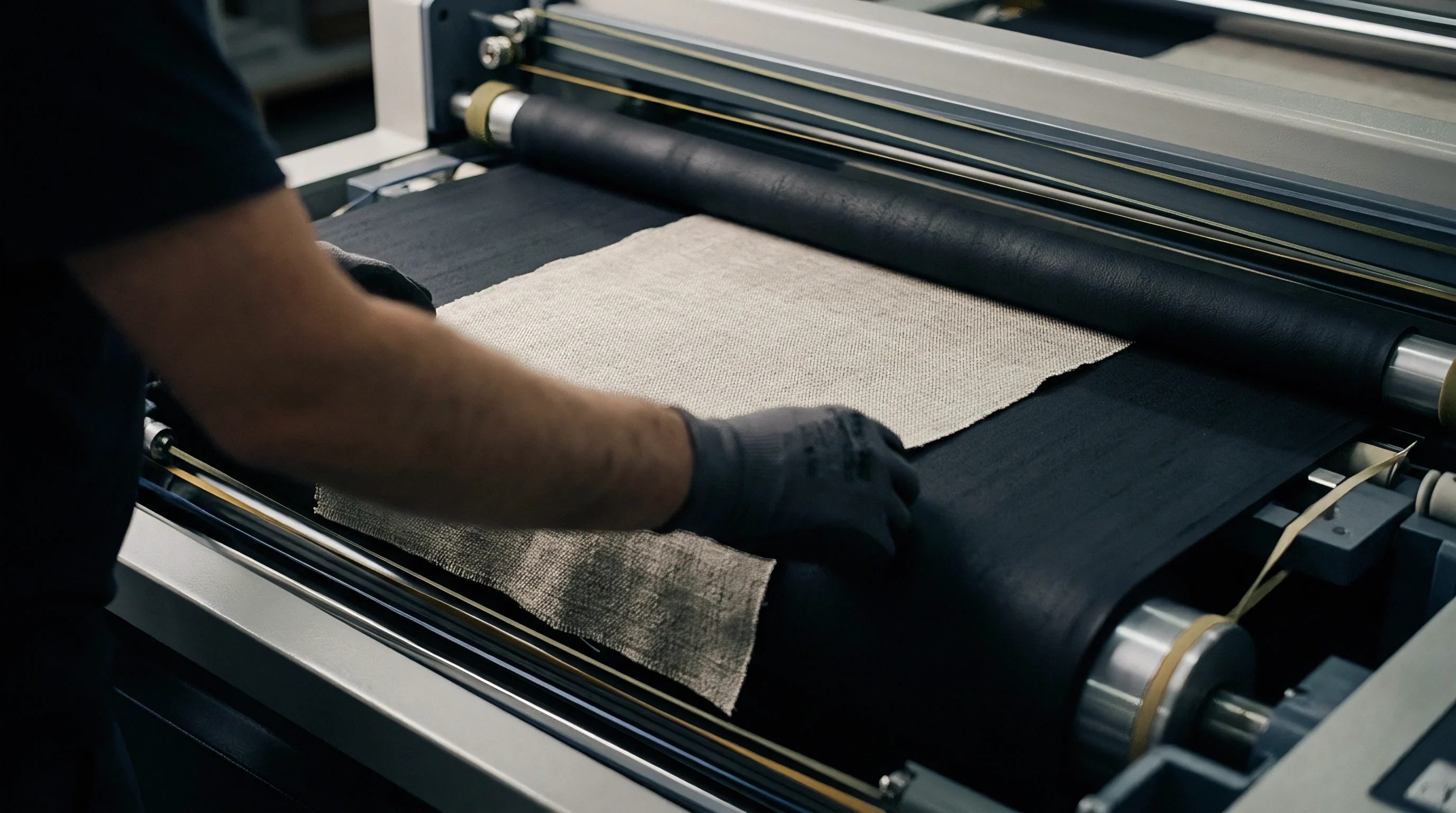
Variable speed finishing in short run stenter environments demands automated physical and thermal control loops to stabilize chemical reaction density. Finishing plants operating on fast-turnaround business models cannot discard three hundred metres of cloth during every seam junction or roll changeover. Modern stenter equipment must integrate real-time web temperature pyrometry directly with variable frequency circulating fan drives and rapid-response gas burner systems.
When line speed drops, convective energy delivery must decline instantaneously to prevent substrate over-curing.
Pyrometers register surface emission changes instantly. Measuring air temperature alone inside the chamber provides insufficient control fidelity. Evaporative cooling keeps the textile significantly cooler than ambient air until all moisture departs.
An intelligent heat-setting controller monitors fabric surface temperature via optical pyrometers positioned at the exit of each individual chamber. The system calculates the exact physical location of the dry line. As speed decreases, convective air circulation fans drop from twenty-eight hundred revolutions per minute to twelve hundred revolutions per minute within five seconds.
This reduces nozzle air pressure and lowers the convective heat transfer coefficient. Burner flame modulation steps down in synchronization with line drive encoders.
Is Direct Pyrometry Sufficient during Thermal Transients?
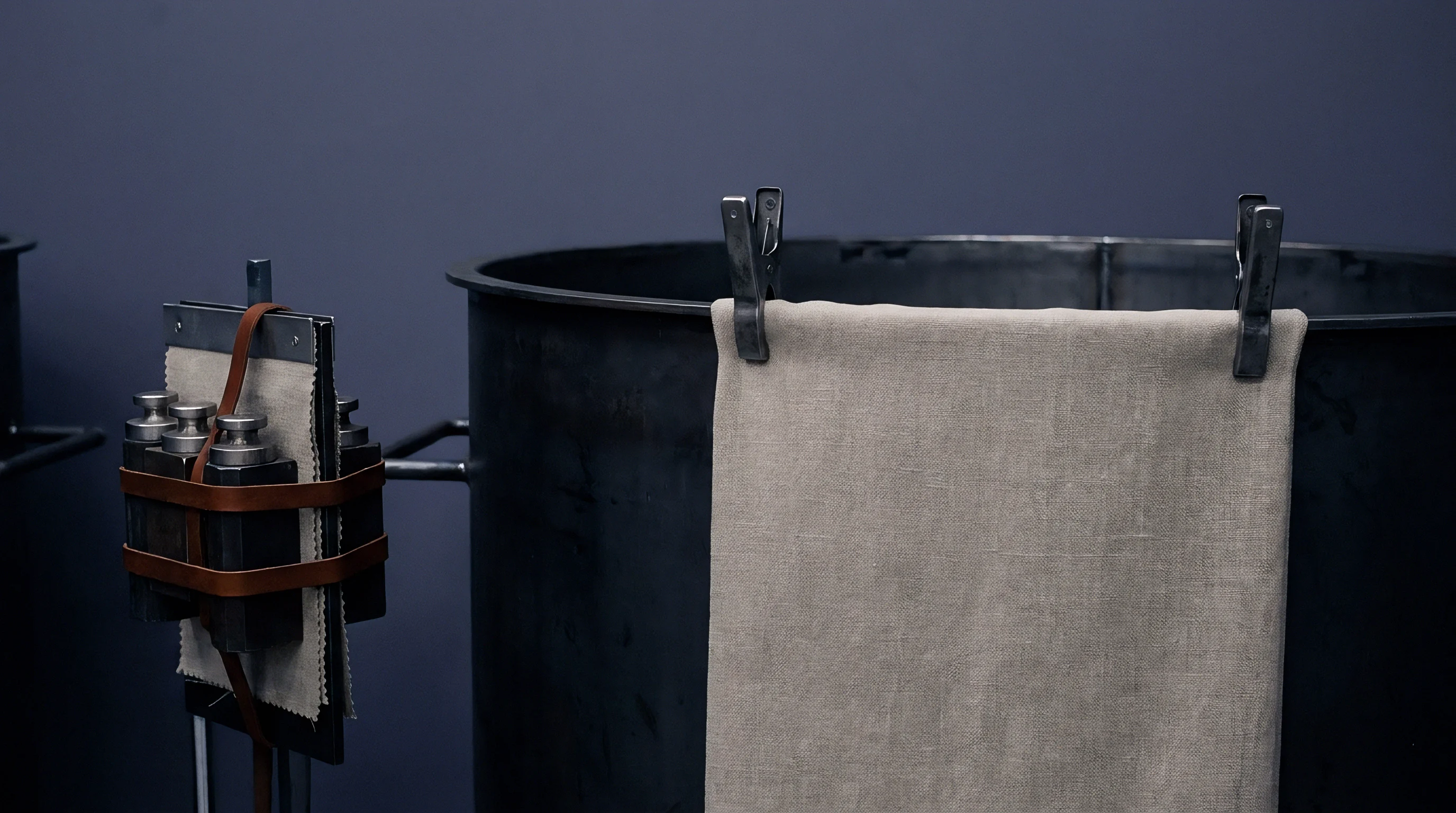
Surface infrared pyrometers measure only the outer face of the moving web. On heavyweight twills, heavy drills, and canvas weaves exceeding three hundred grams per square metre, the temperature profile across the cross-section displays thermal lag. While the surface registers target curing temperature, the internal core may retain moisture.
If burner output drops purely on surface pyrometer feedback, the internal core remains under-cured. Modern lines incorporate microwave moisture resonators immediately preceding the curing zones to decouple drying feedback from curing temperature control.
| Batch Length (m) | Speed Range (m/min) | Transitional Yardage (m) | Crosslink Density Range (mol/kg) | Mechanical Rejection Rate (%) | Surcharge per Metre ($) |
|---|---|---|---|---|---|
| 300 | 15 to 45 | 140 | 0.18 to 0.49 | 22.4 | 0.85 |
| 600 | 20 to 50 | 155 | 0.22 to 0.44 | 14.1 | 0.48 |
| 1,200 | 30 to 55 | 160 | 0.25 to 0.38 | 6.2 | 0.22 |
| 3,000 | 45 to 60 | 180 | 0.28 to 0.34 | 1.8 | 0.08 |
Exhaust air humidity alters evaporation efficiency. Circulating exhaust air humidity inside the stenter determines the drying rate before curing commences. Automated humidity control dampers maintain water vapor concentration at approximately one hundred fifty grams per kilogram of dry air.
This controlled environment standardizes drying rates regardless of incoming textile moisture shifts or ambient climatic shifts.
- Feedforward speed-linked airflow dampers mechanically throttle impingement nozzle air volume before thermal inertia can elevate sheet surface temperature.
- Infrared preheating boosters positioned at stenter entry adjust instantaneous power input to bring incoming wet cloth to vaporization temperature within six seconds.
- Automated seam bypass routing lifts nozzle fingers or shifts burner baffles clear of the slow-moving seam passage to prevent over-heating the joint.
- Differential tension monitors compensate for overfeed adjustments during velocity shifts, preserving dimensional relaxation parameters across transitional zones.
Short run economics require realistic allocation of transitional scrap costs. When a buyer places short run yardage orders with resin finishing specifications, the quoting model must incorporate dedicated lead-end and tail-end buffer cloth. Attempting to harvest finished, compliant garments from the transitional yardage produced during speed decelerations invariably introduces catastrophic downstream garment quality rejections.
Speed changes dictate heat transfer adjustments before the cloth enters the curing zone.