Decoupling Fiber Maturity from Linear Density in High Speed Ring Spinning Blends
Decoupling maturity from linear density prevents high-speed ring spinning ends-down and dye resist neps by specifying double airflow and individual fiber optics.

Airflow
Differential pressure readings across a compressed fibrous plug record specific surface area rather than isolated geometric thickness. Standard pneumatic testers determine permeability by forcing ambient air through a five-gram specimen confined within a fixed cylindrical chamber. The resulting scale value conflates ribbon width with secondary wall development.
A coarse fiber with an arrested secondary wall presents the identical surface area per unit mass as a mature fiber with a naturally narrow perimeter. High-speed ring spinning frames operating past twenty thousand spindle revolutions per minute pull these two morphological states into radically different drafting geometries.
Cellulose deposition in the secondary cell wall establishes intrinsic fiber maturity. During boll maturation, daily concentric rings of cellulose fill the interior lumen, shifting the circularity coefficient toward unity. Linear density measures the mass per unit length, expressed commercially in millitex or micrograms per inch.
When a spinner relies on single-stage pneumatic measurements, an undetected immature lot creates drafting failure.
Double-compression pneumatic testing isolates specific surface area at two compaction states to separate fiber perimeter from cell wall development under ASTM D1442 test conditions.
Dual-stage airflow instruments introduce two distinct mechanical packing densities to solve the permeability equation for two independent variables. The first compression stage operates at a loose packing density of roughly 0.18 grams per cubic centimeter, where Darcy flow regimes dominate. The second compression stage increases plug density to 0.38 grams per cubic centimeter, altering pore tortuosity and exposing differences in fiber perimeter collapse.
The instrument measures pressure drops across both stages to compute the maturity ratio and linear density simultaneously through empirical calibrations established against cross-sectional microscopy.
Single-stage instruments produce an arbitrary value that conceals fatal disparities in cell wall thickness. Two cotton lots measuring 3.8 on a traditional pneumatic scale display divergent structural profiles when examined through multi-stage airflow systems, as demonstrated in operational laboratory tracking data.
| Lot Designation | Single-Stage Reading | Maturity Ratio | Calculated Fineness | Circularity Value |
|---|---|---|---|---|
| Lot A (Giza 86 Egyptian) | 3.80 | 0.94 | 142 mtex | 0.72 |
| Lot B (West African Upland) | 3.82 | 0.71 | 188 mtex | 0.49 |
| Lot C (US Memphis Territory) | 4.20 | 0.88 | 165 mtex | 0.66 |
| Lot D (Greek Regional Crop) | 4.18 | 0.77 | 192 mtex | 0.54 |
Lot A presents an exceptionally fine fiber displaying complete wall development, creating stable cohesive forces during high-draft attenuation. Lot B presents an immature, coarse-perimeter fiber with thin, collapsed cell walls that rupture during mechanical carding. The supplier insists that the shipment complies fully with contract specifications because the gross scale reading matches the delivery docket.

Comb
Mechanical tooth penetration through a fibrous web exerts localized shear stresses exceeding forty centinewtons per square millimeter. Mature cotton fibers withstand licker-in wire impacts and cylinder clothing actions without structural buckling. Immature fibers contain empty lumens and thin cellulose sheaths that lack bending stiffness.
Under mechanical interaction with revolving flats, these hollow tubes collapse into flat ribbons, entangle with adjacent filaments, and produce dense mechanical neps. Seed coat fragments torn during aggressive ginning attach to these thin-walled entanglements, resisting mechanical extraction in the blowroom.

Could Dual Pressure Airflow Isolate Wall Thickening?
Pneumatic separation techniques evaluate resistance changes between loose and compact sliver plugs to monitor wall thickening across preparatory stages. When sliver passes into carding, mature structures retain dimensional recovery, maintaining open channels for trash ejection. Weak fibers crush into permanent knots.
Combing machines set with an eleven-millimeter gauge extract a portion of these defects into noil, yet flat neps smaller than fifty micrometers escape between half-lap needle gaps. These escaped defects pass directly into drawing slivers, where subsequent spinning drafts stretch them into elongated blemishes.
Thin cell walls generate identifiable defects during mechanical processing:
- Mechanical Neps formed by the structural buckling of thin-walled filaments under cylinder wire engagement. These entanglements jam drafting zones and elevate ends-down counts on high-speed ring spinning frames.
- Dye Resist White Specks caused by low cellulose density within flattened fiber clumps. Secondary wall cellulose remains insufficient to bind reactive or direct dyestuffs, leaving pale specks visible on finished dark surfaces.
- Roller Lapping Tendencies triggered by high static generation and moisture absorption shifts on exposed primary wall pectins. Broken filaments adhere tightly to synthetic cots, producing continuous roller wraps.
- Excessive Noil Extraction resulting from fiber fragmentation across circular comb sectors. Thin tubes shatter into short fragments under mechanical impact, shifting processing waste upwards by four percentage points.
Failing to identify immature raw materials before high-speed spinning operations generates costly fabric rejections, uneven dyeing streaks, and massive ring frame downtime from broken ends.

Draft
Attenuating a sliver into fine roving requires precise frictional cohesion between individual filaments under the control of front and back drafting rollers. Roller delivery speeds in modern ring spinning systems reach twenty-five meters per minute, generating intense centrifugal force and drafting zone acceleration. Fiber linear density dictates the absolute number of individual filaments present within any yarn cross-section at a specified count.
Coarser fibers yield fewer filaments per cross-section, reducing internal frictional contact points. Mature fibers contribute structural resilience, while immature fibers create unconstrained floating mass within the drafting zone.
Does High Drafting Speed Magnify Immature Wall Collapse?
Rapid roller rotation generates localized aerodynamic turbulence that destabilizes unsupported fibers positioned between drafting aprons. Thin-walled fibers exhibit low flexural rigidity. Under drafting tensions exceeding twelve grams, these flexible ribbons fail to follow mechanical control aprons, accelerating early and creating thick-and-thin sliver imperfections.
Mass variance spikes across the sliver. Intimate mixtures containing polyester or modal require precise alignment between synthetic linear density and natural fiber linear density to prevent uncontrolled fiber migration toward the yarn core.
High drafting speed amplifies tension variance whenever thin-walled cellulosic tubes lack the flexural rigidity required to bridge roller nip points.
Synthetic components present uniform perimeters and constant linear densities. Polyester cut staple produced at 1.33 dtex provides uniform flexural rigidity. When combined with cotton measuring 1.88 dtex in gross linear density but suffering a 0.70 maturity ratio, mechanical mismatch occurs within the drafting field.
The synthetic filaments grip the apron surfaces, whereas the collapsed cotton ribbons slide freely between them. This drafting slippage shows clearly in laboratory measurements across varied blend ratios and delivery speeds.
| Mixture Composition | Cotton Maturity Ratio | Cotton Linear Density | Yarn Unevenness (CVm %) | Tenacity (cN/tex) | Ends-Down per 1000 Spindle Hours |
|---|---|---|---|---|---|
| 60 Cotton / 40 Poly (1.3 dtex) | 0.92 | 145 mtex | 12.4 | 22.8 | 18 |
| 60 Cotton / 40 Poly (1.3 dtex) | 0.74 | 182 mtex | 16.8 | 17.1 | 68 |
| 50 Cotton / 50 Poly (1.3 dtex) | 0.90 | 148 mtex | 11.8 | 24.2 | 14 |
| 50 Cotton / 50 Poly (1.3 dtex) | 0.71 | 195 mtex | 17.5 | 16.4 | 82 |
High speed drafting behavior follows strict sequence controls during processing:
- Bale Plucker Extraction removes fiber tufts systematically across thirty distinct bale positions to level out field maturation variations.
- Carding Web Consolidation sets cylinder clothing clearances at 0.12 millimeters to gently straighten immature filaments without excessive tensile fragmentation.
- Comber Lap Preparation establishes optimal fiber orientation, extracting short broken fragments generated by mechanical action on thin-walled cell structures.
- Drawframe Sliver Equalization aligns synthetic carrier filaments with natural cell structures under controlled mechanical roller pressure.
- Ring Frame Drafting Delivery maintains apron tension to restrain floating mass as delivery speeds surpass twenty meters per minute.
Fine yarn counts require consistent filament populations in the drafting zone to maintain spinning stability.
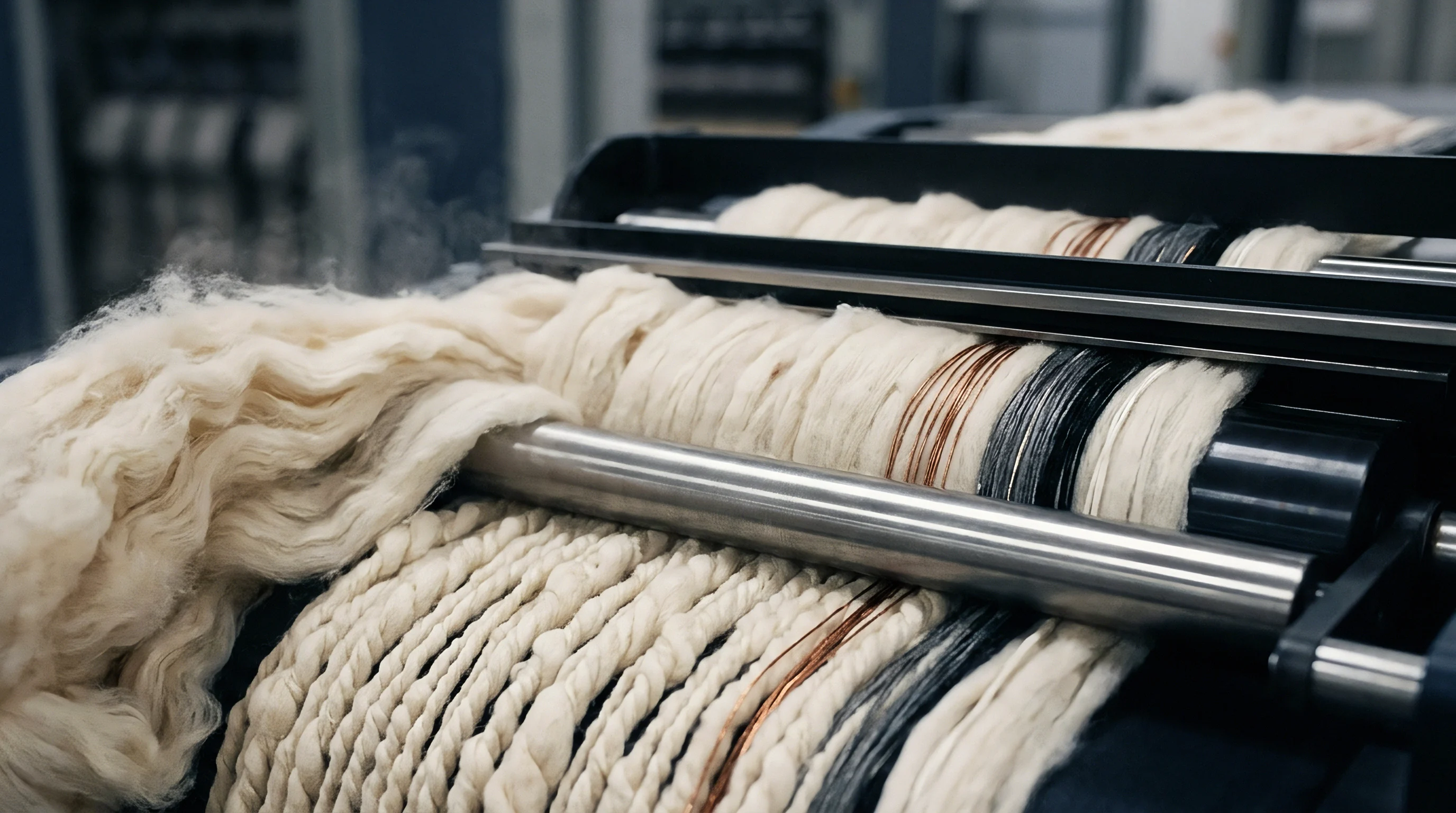
Spectroscopy
Near-infrared absorption bands capture chemical bond vibrations associated with cellulose crystallinity and total mass. Spectroscopic sensors measure reflectance at specific wavebands between 1400 and 2400 nanometers. Absorbance at the 2100 nanometer band correlates with hydroxyl group density in crystalline cellulose, providing direct measurement of secondary cell wall volume.
Unlike pneumatic methods, optical reflectance separates the physical mass of the fiber from its external geometric surface area. Advanced automated image analysis platforms complement this chemical data by measuring thousands of individual cross-sections using polarized light microscopy.
Polarized light utilizes the birefringent properties of crystalline cellulose. As polarized light passes through the cell wall, the organized cellulose fibrils shift the optical interference colors. Fully mature fibers display high birefringence, generating second-order yellow and green interference spectra.
Immature wall sections display first-order red and purple shades, while empty tubes remain optically extinguished. Individual fiber testing systems scan individual fibers through optical sensors to generate precise distribution profiles of linear density and circularity.
Optical attenuation across single-fiber sensors differentiates perimeter width from wall thickness within sixty seconds per test specimen.
Quality assurance protocols require strict laboratory controls before releasing cotton lots into synthetic intimate mixing lines:
- Maturity Ratio Minimums established at 0.88 via AFIS or Shirley FMT to prevent dyeing defects in finished woven goods.
- Immature Fiber Content Thresholds capped at 5.5 percent of the total specimen population to prevent nep formation during aggressive carding.
- Linear Density Limits calibrated between 135 and 155 millitex to match synthetic component dimensions within drafting zones.
- Moisture Equilibrated Conditioning conducted under ISO 139 standard atmospheres for twenty-four hours to stabilize optical and pneumatic readings.
Analytical instruments establish absolute mass per unit length with exceptional precision, yet physical laboratories continue to debate how regional climatic variances during the final twenty days of boll growth alter secondary wall crystalline density without changing gross perimeter dimensions.

Settlement
Commercial contracts governing raw cotton procurement frequently rely on standard international merchant rules that treat single-stage pneumatic readings as definitive fineness ratings. When a spinning mill receives bales that match the contractual range of 3.8 to 4.2 but discover high immature fiber fractions in production, standard merchant arbitration mechanisms offer minimal recourse. The raw material conforms to the single-stage scale, yet processing costs escalate.
Mill managers absorb production losses through elevated card waste, spinning ends-down, and fabric dye rejects.
Classers miss thin cell walls. Customs tariffs and international import documentation further complicate procurement strategies. Under Harmonized Tariff Schedule Chapter 52, cotton staple is classified by staple length and origin rather than secondary wall maturity.
When mills spin mixed yarns classified under Chapter 55 for synthetic staple combinations, import duty rates shift based on the chief weight of the finished yarn. An unexpected rise in card waste from immature cotton can shift the blend ratio by two percentage points, altering the tariff heading from cotton-rich to synthetic-predominant at the port of entry.
| Cost Component | Lot A (MR 0.91, 145 mtex) | Lot B (MR 0.72, 185 mtex) | Operational Variance |
|---|---|---|---|
| Raw Cotton Delivered Cost ($/kg) | $2.15 | $1.95 | -$0.20 |
| Card and Comber Waste Cost ($/kg) | $0.26 | $0.44 | +$0.18 |
| Spindle Downtime and Labor ($/kg) | $0.12 | $0.31 | +$0.19 |
| Fabric Dye Reject Surcharge ($/kg) | $0.00 | $0.28 | +$0.28 |
| Net Landed Yarn Cost ($/kg) | $2.53 | $2.98 | +$0.45 |
Contractual specifications must define maturity limits independently from traditional airflow scales. Incorporating specific clauses that mandate dual-compression testing under ISO 10306 and establish price penalties for maturity ratios below 0.85 shifts financial liability back to the merchant, protecting the spinner against hidden processing losses.