Staple Length against Pilling Life in a Combed Cotton Order
Combing long-staple cotton to eighteen percent noil suppresses short fibers below six percent, locking ends into yarn cores to secure Grade 4 pilling life.

Comb
High volume instrument testing isolates the longest fifty percent of fibers in a specimen. That upper half mean length defines the physical envelope for the entire spinning line. If an order calls for combed cotton jersey, the raw lint specification settles the finished garment’s surface endurance well before carding begins.
Running a shorter staple forces mills to hike twist multipliers just to keep the strand intact, which stiffens the fabric hand while leaving short fiber tips free to work outward during laundering.
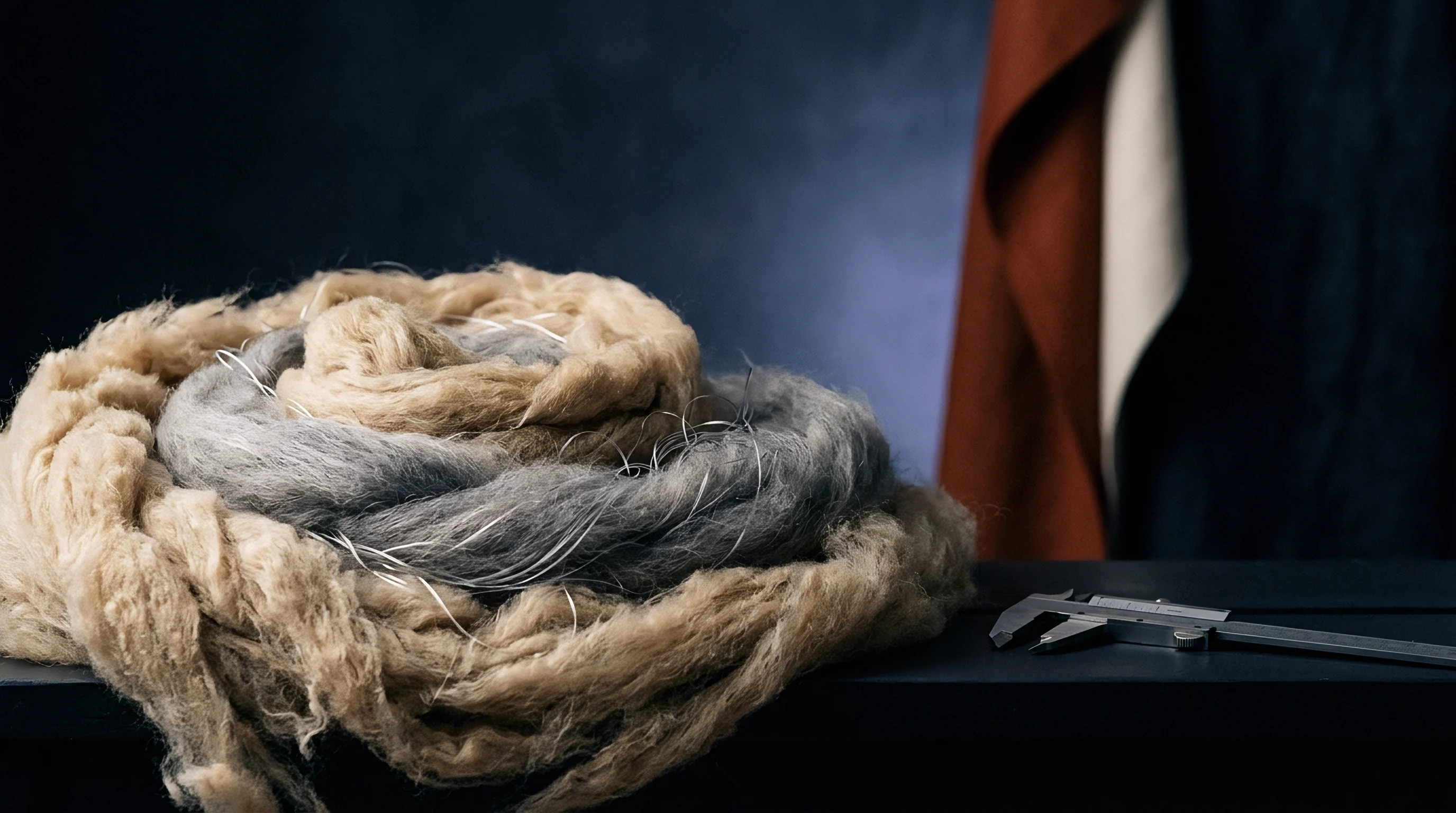
The mechanical action of the comb cylinder pulls short lint away from the longer, spinnable mass, casting off the short fraction as noil. Mills producing carded cotton leave fibers under twelve millimeters in the sliver, introducing dozens of unanchored tail ends along every millimeter of spun yarn. In a combed program, setting the nippers for eighteen percent noil extraction clears out those short elements, allowing parallel fibers to settle tightly into the core during draft.
Span length measured on high volume instruments establishes raw staple limits. A classer reads staple length in thirty-seconds of an inch or millimeters to see how fiber populations distribute across the sliver cross section.
| Cotton Variety | Upper Half Mean Length (mm) | Short Fiber Index (%) | Combing Noil Target (%) | Resulting Zweigle S3 (per 100m) |
|---|---|---|---|---|
| Upland Carded | 27.5 to 28.5 | 10.5 to 13.0 | 0.0 | 1200 to 1800 |
| Upland Combed Medium | 28.5 to 30.0 | 6.5 to 8.5 | 14.0 to 16.0 | 450 to 750 |
| Long Staple Combed | 31.0 to 33.0 | 4.5 to 6.0 | 18.0 to 20.0 | 180 to 320 |
| Extra Long Staple | 35.0 to 37.0 | 3.0 to 4.2 | 20.0 to 22.0 | 40 to 90 |
Carded slivers carry weak, immature fibers that break apart during opening and carding, driving up the short fiber index ~ the share of fibers shorter than one half inch. When that index climbs past nine percent in the roving, finished knits develop noticeable fuzzing after ten household wash cycles.
Combing raw cotton past eighteen percent noil extraction reduces short fibre content below six percent, cutting yarn hairiness by roughly thirty percent at forty-count ring spinning.
Pills begin with loose surface ends, making physical incoming lint criteria critical across every bale lot:
- Upper Half Mean Length establishes the baseline staple category, where extra long staple Pima or Giza lots exceed thirty-four millimeters, offering superior core binding compared to standard upland grades.
- Short Fiber Index measures the true culprit behind fuzz formation, since any reading above eight percent indicates elevated breakage during ginning.
- Micronaire Value balances maturity against fineness, with readings between 3.8 and 4.2 offering optimum wall thickness without introducing rigid coarse fibers that resist spinning twists.
- Uniformity Index calculates the ratio between mean length and upper half mean length, revealing whether the bale contains a tight distribution or an erratic mix of lengths.
Combing reshapes the fiber length profile, though disputes persist over whether slight staple shortening reflects seasonal field conditions or aggressive ginning speeds.
Anchor
Ring frames twist roving strands into dense circular profiles that turn fiber ends inward. The radial depth of a fiber tip inside the yarn bundle determines whether mechanical friction can pull it loose. In conventional ring spinning, the broad spinning triangle at the delivery roller lets edge fibers drift free of the primary twist, creating exterior hairs of three millimeters or longer.
These wild ends rub against adjacent garments during domestic washing, tangling into spherical knots.
Does Yarn Hairiness Correlate Directly with Staple?
Longer staple cotton provides greater contact surface within the core. With a thirty-four millimeters fiber, the body of the filament stays anchored beneath adjacent wraps while only the tip shows. A twenty-two millimeter fiber lacks the embedded length needed to withstand frictional drag, allowing routine laundering to pull the entire fiber from the yarn matrix.
Compact spinning systems bypass this open triangle by applying pneumatic suction over a perforated drum or apron right after the front roller nip, drawing loose tails into the main bundle before twist enters the strand.
- Condense the draft sliver across a vacuum zone operating at negative thirty-five millibar pressure to align divergent edges.
- Feed the aligned strand into the clamping nip where true twist locks parallel fibers directly into the central core.
- Wind the compacted yarn onto bobbins under calibrated tension to prevent mechanical abrasion against the ring traveler.
- Check hairiness indices on capacitive testing equipment, confirming that protruding ends longer than three millimeters remain below seventy counts per hundred meters.
The resulting compact ring yarn demonstrates a dramatic reduction in Zweigle S3 values compared to standard ring spun lots. Fewer surface hairs yield fewer entanglements when finished knitwear rubs against itself inside a laundry drum.
Fibre ends anchored deeply within the yarn core resist frictional withdrawal during laundering cycles.
Spinners monitor hairiness using capacitance testers, noting that fibers bound firmly within the core structure resist migrating outward under laundering stress.


Friction
Normal wear and laundering exert planar stress across circular knit loops. As garments tumble in dryers or endure underarm abrasion during daily use, cotton fibers experience repeated cyclic shear. Initial surface breakdown begins with fiber migration, where loose ends lift from the yarn structure to form a visible fuzz layer.

Will Higher Combing Noil Prevent Surface Fuzzing?
Extracting eighteen percent waste at the nippers strips out immature seed-coat fragments that serve as physical nucleation points for loose lint. When an abrasive face rubs a fabric knit from carded yarns, free fiber tips gather around these microscopic anchor nits, forming mature pills within two hundred rubbing cycles.
Where fibers possess high tensile strength and long staple, pills remain tethered to the ground structure by three to five tie fibers. Weak, short-staple cotton pills break off cleanly and wash away, leaving a worn, thin knit structure. High-tenacity long-staple cotton holds the pill tenaciously against the surface, degrading the garment appearance permanently unless mechanical de-pilling occurs.
Finishing mills remain divided over whether chemical enzyme washes can permanently secure fiber tips without degrading bursting strength.
Tumbler
Standardized bench instruments reproduce domestic laundering abrasion under controlled chamber conditions, allowing sourcing teams to gauge surface pilling before cutting production yardage. The three main methods ~ the Martindale pill tester, the ICI pilling box, and the random tumble pilling cylinder ~ each subject the knit to distinct mechanical paths.

Visual Scales versus Photographic Standards
Trained inspectors evaluate surface wear under standardized D65 daylight viewing conditions. Following ASTM D3512, ISO 12945-1, or ISO 12945-2 protocols, they assign ratings from grade five down to grade one, where grade five denotes an unblemished face and grade one represents dense pill clusters across the specimen.
| Yarn Construction | Staple Classification | Martindale 500 Cycles | Martindale 1000 Cycles | Martindale 2000 Cycles | Martindale 5000 Cycles |
|---|---|---|---|---|---|
| Ne 30/1 Carded Ring | Upland (28 mm) | Grade 3.5 | Grade 2.5 | Grade 1.5 | Grade 1.0 |
| Ne 30/1 Combed Ring | Upland (29 mm) | Grade 4.0 | Grade 3.5 | Grade 3.0 | Grade 2.0 |
| Ne 30/1 Combed Compact | Long Staple (32 mm) | Grade 4.5 | Grade 4.0 | Grade 3.5 | Grade 3.0 |
| Ne 30/1 Combed Compact ELS | Pima (36 mm) | Grade 5.0 | Grade 4.5 | Grade 4.0 | Grade 3.5 |
| Testing conducted on 160 gsm single jersey bleached knit under 9 kPa head pressure using standard wool abradant cloth. | |||||
While random tumble chambers agitate specimens in liquid baths, buyers generally require full Martindale documentation before clearing containers for export:
- Conditioning Log Sheet confirms that all fabric test specimens spent a minimum of four hours resting flat under controlled atmosphere at twenty degrees Celsius and sixty-five percent relative humidity.
- Revolutions Calibration Certificate proves the Martindale drive plate rotates at forty-seven point five revolutions per minute without bearing chatter or uneven orbital drift.
- Photographic Grade Assessment provides high-resolution digital imagery taken under standardized ninety-degree incident illumination alongside the official five-step visual rating swatches.
Testing under ISO 12945-2 at two thousand cycles exposes inferior staple selections before apparel reaches commercial distribution.
A contract line specifying ISO 12945-2 evaluation at two thousand revolutions with a minimum grade four requirement forces the spinning mill to certify bale noil extraction percentages before release.
Penalty
Supply contracts set yarn quality boundaries through strict statistical thresholds. When delivered yarn falls short on staple length or combing depth, the resulting knit pills early, exposing the manufacturer to substantial losses across the entire cutting plan.

Commercial Recourse for Premature Pilling Failures
Independent laboratory reports showing substandard surface durability trigger formal debit memos back to the spinner. Consider a forty-tonne combed yarn contract at six dollars and twenty cents per kilogram delivered, where a mill swaps in a twenty-eight millimeter staple instead of the agreed thirty-one millimeter fiber to pocket forty cents per kilogram on raw lint. That substitution drives short fiber content from seven percent to eleven percent, dropping comb noil extraction from eighteen percent down to fourteen percent.
The resulting single jersey knit rates at grade 2.5 after two thousand Martindale cycles instead of the contractually mandated grade 4.0 minimum, leading the apparel brand to reject the entire run of forty tonnes. Commercial recourse under this failure encompasses three separate claims:
- The garment maker files an immediate debit note for the raw yarn invoice value, claiming two hundred forty-eight thousand dollars.
- Knitting and finishing costs of one dollar and eighty cents per kilogram are debited back to the spinning mill, adding seventy-two thousand dollars in unrecoverable processing losses.
- Air freight surcharges of three dollars per kilogram apply to rush replacement yarn spun from genuine thirty-two millimeter combed lint from an alternative domestic mill.
Buyers inspect mill test logs before shipment, withholding release approvals whenever fiber metrics diverge from contract terms.
Commercial mills offset elevated lint costs by introducing carded strippings into combed lots when purchase orders omit specific noil verification terms.
Ignoring staple length uniformity in purchase contracts causes widespread garment returns and destroys gross margin across whole seasonal production runs.