Matrix Matched Buffer Standardization for Industrial Reactive Dye Bath Ph Control
Matrix-matched buffer standardization eliminates sodium and junction errors in high-salinity reactive dye baths, securing pH accuracy and color reproducibility.

Drift
Potentiometric pH measurements taken inside a dye vat containing 60 grams per liter of sodium sulfate routinely record readings 0.35 pH units lower than true hydrogen ion activity at 60°C. Standard commercial aqueous calibration buffers operate at low ionic strength, typically below 0.1 moles per kilogram. Industrial reactive dyeing requires substantial salt charges to force anionic dyes out of solution and onto cotton fibers.
Laboratory calibrations rely on IUPAC-traceable phosphate or phthalate standards. Moving a standard combination pH electrode straight from these aqueous buffers into a concentrated dye bath introduces three distinct errors: ionic strength divergence, reference junction potential shifts, and glass membrane sodium error.

Electrochemical Potential Alteration in Concentrated Dyebaths
High ionic strength alters activity coefficients, directly affecting Nernstian response in glass combination electrodes ~ where electromotive force shifts by 66.1 millivolts per pH unit at 60°C.
Standard buffers assume a hydrogen ion activity coefficient near unity. Adding 30 to 80 grams per liter of sodium sulfate or sodium chloride depresses that coefficient significantly. Because the glass membrane responds to activity rather than concentration, a sensor calibrated in low-ionic-strength reference solutions reads this depression as a pH shift, establishing a systematic error before alkali dosing even starts.
Liquid junction potential shifts introduce further bias. In a standard reference electrode, a porous diaphragm separates internal potassium chloride-saturated gel from the process liquor. While potassium and chloride ions diffuse at nearly identical rates in pure water, high background concentrations of sodium and sulfate disrupt this balance, creating an unwanted boundary potential across the junction diaphragm.
Alkaline Sodium Error Mechanisms
Alkaline conditions accelerate ion exchange across the glass membrane. Above pH 10.5, hydrogen ion concentration drops below one micromole per liter, while sodium ion concentration can exceed one mole per liter.
When hydrogen ion activity drops this low, the glass membrane begins exchanging sodium ions instead. The electrode responds to sodium as if it were hydrogen, generating an artificially high negative potential that causes the meter to display a reading lower than the actual bath alkalinity.
Standard aqueous buffer calibration guarantees measurement precision only in pure water, leaving process control blind to high-salinity diaphragm potential drops.
In an 80 g/L sodium sulfate matrix at 60°C, potentiometric cell measurements against a double-junction sleeve reference electrode show a liquid junction potential offset of 0.18 pH units. Raising the electrolyte concentration to 100 g/L or the bath temperature to 80°C widens this offset to 0.26 pH units.
| Electrolyte Matrix Charge | Process Temperature | Nominal Process pH | Measured pH Standard Buffer | Electrochemical Bias |
|---|---|---|---|---|
| 30 g/L Sodium Sulfate | 60°C | 10.80 | 10.62 | -0.18 pH |
| 60 g/L Sodium Sulfate | 60°C | 11.20 | 10.88 | -0.32 pH |
| 80 g/L Sodium Sulfate | 60°C | 11.50 | 11.12 | -0.38 pH |
| 50 g/L Sodium Chloride | 80°C | 10.50 | 10.28 | -0.22 pH |
Operators trying to correct these artificially low readings often over-dose alkali, driving the actual liquor pH into ranges where dye hydrolysis outpaces fixation.
- Interfacial Potential Shifts develop when high background salt concentrations destabilize the liquid junction potential across the ceramic reference diaphragm.
- Activity Coefficient Depressions lower effective hydrogen ion activity below stoichiometric concentration in high-salinity liquors.
- Sodium Error Interference leads glass sensing membranes to register sodium ions as hydronium above pH 10.5.
- Thermal Compensation Lag occurs when static temperature compensation algorithms fail to track non-Nernstian equilibrium shifts in reactive dye auxiliaries.
Uncorrected sensor errors lead directly to excessive sodium hydroxide consumption, poor dye fixation, off-shade colors, and failed wash fastness across entire production runs.

Probe
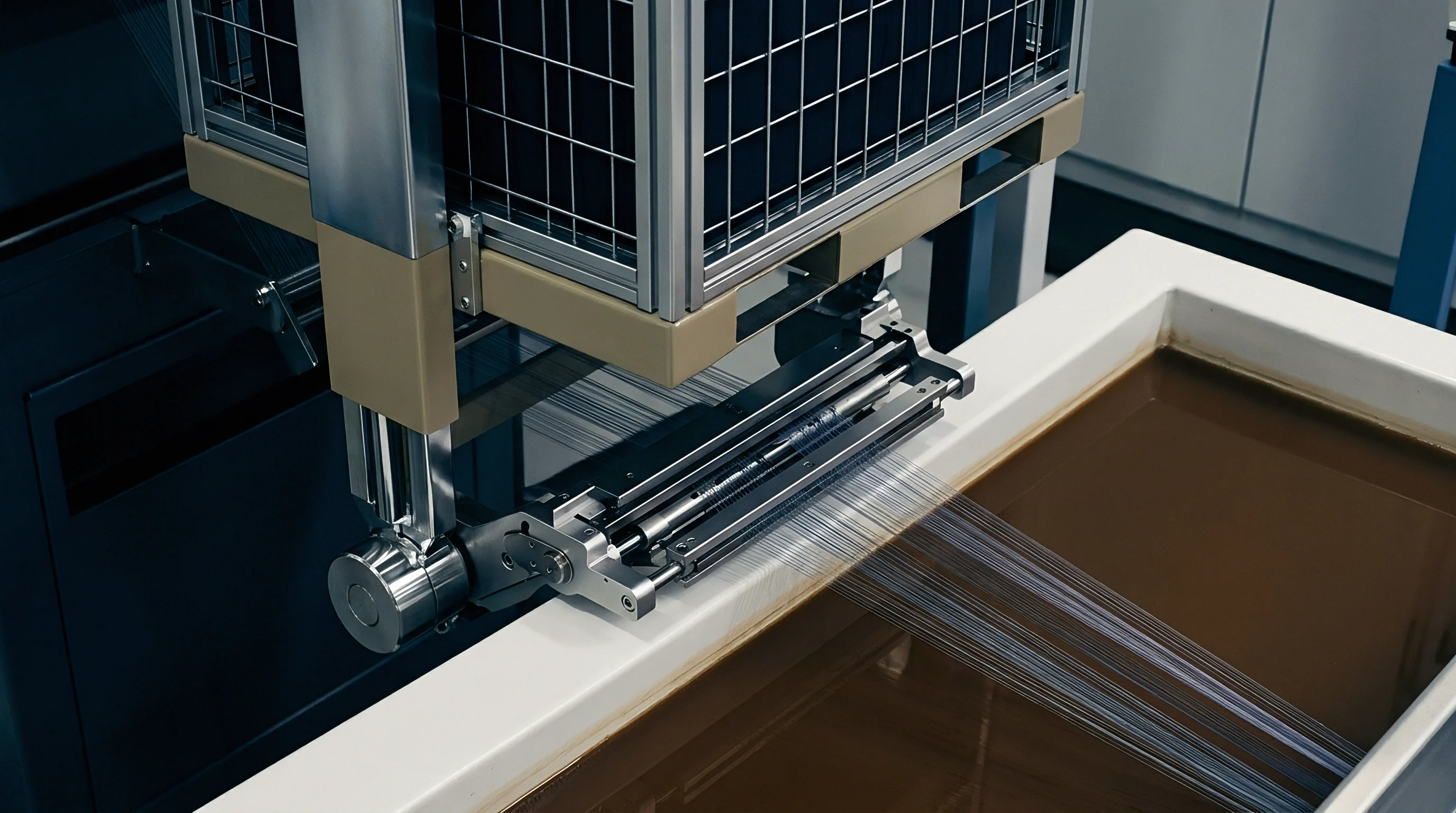
Choosing the right potentiometric hardware prevents severe drift during alkaline fixation. Standard laboratory sensors with single ceramic junctions fail quickly on dye house production lines, as dye molecules, surfactants, and precipitated salts clog fine porous frits within hours.

Diaphragm Architecture and Liquid Junction Geometry
Reference electrodes built for high-salinity dyebaths rely on specialized junction designs. Annular ground-glass sleeves and open-aperture polymer gel interfaces resist particle clogging far better than porous ceramic discs.
Ground-glass sleeve junctions maintain a continuous, microscopic outflow of internal electrolyte, preventing dye liquor, hydrolysates, and levelling agents from creeping into the reference chamber. Open-aperture designs use solid-state polymer reference materials saturated with potassium chloride, eliminating the physical frit and preventing surface fouling.
Electrolyte drift corrupts titration profiles, while proper sensor grounding prevents electrical noise from interfering with the measurement signal.
Glass Membrane Glass Formulation for High Alkali
Glass formulation determines how well a sensing membrane resists alkaline error. Standard high-sensitivity glass relies on lithium or sodium silicate structures that undergo rapid cation exchange at higher bath temperatures.
High-alkali glass replaces standard alkali metals with heavy rare-earth oxides like lanthanum and zirconium. These additions form a dense, selective hydrated surface layer that resists sodium ion penetration up to pH 14 and temperatures as high as 100°C.
ISO 10523 Annex B compliance mandates ionic strength equalization within 10 percent of sample conductivity for potentiometric measurement accuracy exceeding 0.05 pH units.
Combination electrodes built with low-resistance glass membranes respond faster during dynamic alkali dosing. Sluggish sensor response causes dosing controllers to overshoot setpoints, adding excess alkali before the instrument registers the true change in equilibrium.
- Annular Sleeve Junctions maintain continuous electrolyte outflow to prevent dye particle ingress and diaphragm fouling.
- Rare-Earth Glass Formulations limit alkali metal ion exchange, suppressing sodium error above pH 10.5.
- Double-Junction Enclosures protect the primary silver/silver chloride reference wire from sulfur-containing levelling agents and dyebath contaminants.
- Pressurized Internal Reservoirs drive outward electrolyte flow, maintaining stable junction potentials despite fluctuations in bath pressure.
Standard automatic temperature compensation probes do not automatically reconcile non-Nernstian dyebath measurement errors, despite being connected to modern transmitters.

Recipe
Formulating matrix-matched calibration standards requires adding background salts directly to reference solutions. Standard IUPAC buffers made with only potassium hydrogen phthalate or potassium dihydrogen phosphate cannot match the chemical background of a reactive dyebath.
High-salinity electrochemistry presents the same challenges seen in desalination brines and estuarine monitoring, where shifting ionic backgrounds render standard freshwater calibrations inaccurate. Mill-floor control systems face these exact thermodynamic limits when dosing concentrated dye baths.
Matrix Matching Ionic Strength and Background Electrolytes
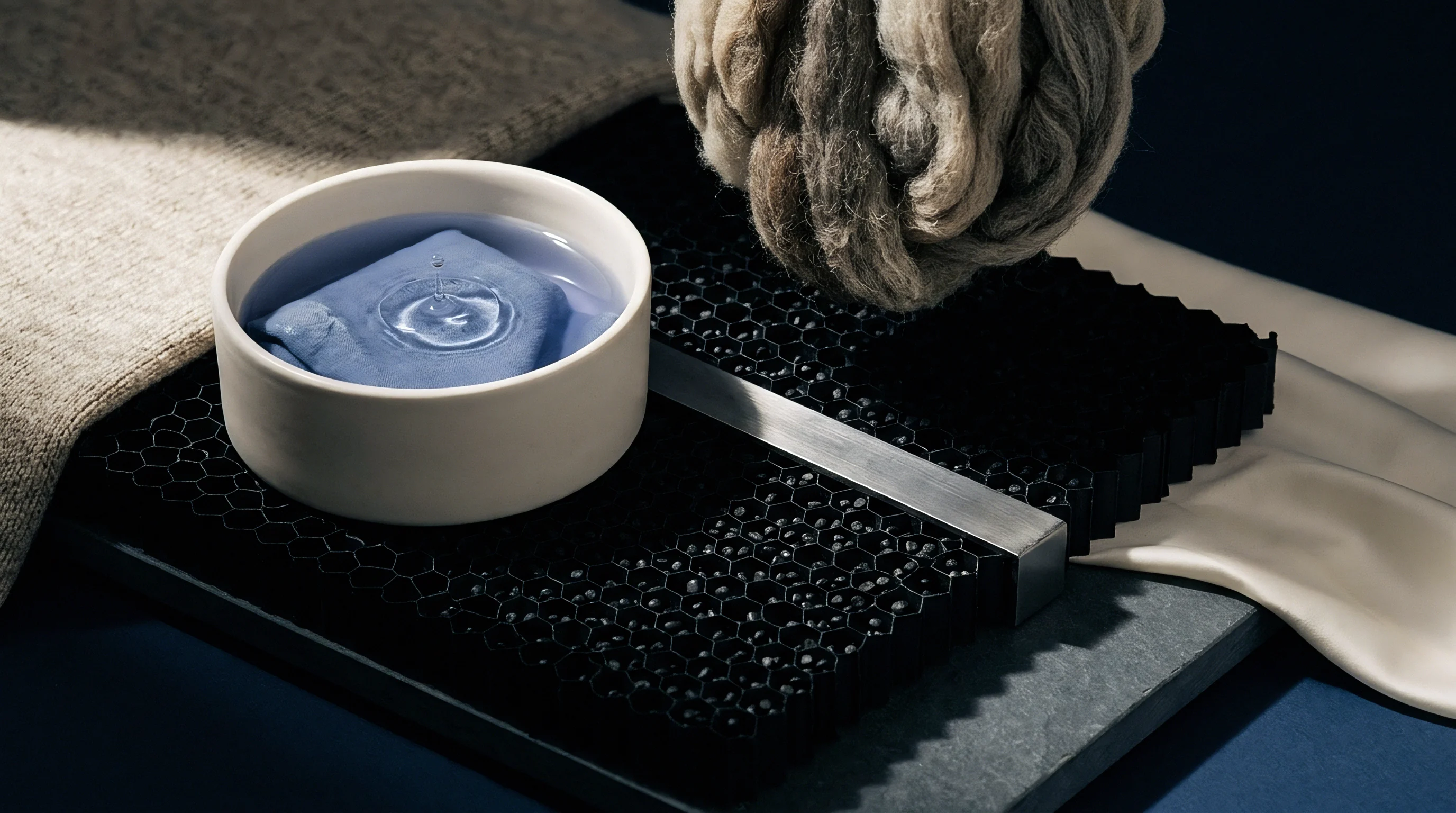
Adding background electrolyte equalizes hydrogen ion activity coefficients between calibration standards and process liquors. Dissolving anhydrous sodium sulfate directly into pH 7.00 and pH 10.01 buffers aligns standard ionic strength with the process bath.
A matrix-matched calibration set uses secondary buffers prepared with the exact salt charge specified in the dye recipe. If a dye bath contains 60 grams per liter of sodium sulfate, the standards are prepared by dissolving 60 grams per liter of analytical grade sodium sulfate straight into certified buffer concentrates.
Which Matrix Salts Minimize Reference Junction Potential Errors?
Sodium sulfate is the primary matrix salt in reactive dyeing because of its widespread use in exhaust processing. Matching the bath’s salt composition eliminates liquid junction potential bias.
| Buffer Standard Type | Primary Chemical Constituents | Matrix Salt Addition | Target pH at 20°C | Target pH at 60°C |
|---|---|---|---|---|
| Aqueous Reference Buffer 7.0 | Disodium Phosphate / Monopotassium Phosphate | None (I = 0.05 M) | 7.00 | 6.98 |
| Matrix Buffer 7.0 (Sulfate) | Disodium Phosphate / Monopotassium Phosphate | 60 g/L Sodium Sulfate | 6.74 | 6.58 |
| Aqueous Reference Buffer 10.0 | Sodium Carbonate / Sodium Bicarbonate | None (I = 0.05 M) | 10.01 | 9.68 |
| Matrix Buffer 10.0 (Sulfate) | Sodium Carbonate / Sodium Bicarbonate | 60 g/L Sodium Sulfate | 9.62 | 9.24 |
Matrix adjustment factors vary predictably with temperature. Temperature probes must continuously monitor liquor conditions to update secondary calibration slope calculations in real time.
- Dissolve 0.025 molal disodium hydrogen phosphate and 0.025 molal potassium dihydrogen phosphate in 800 milliliters of deionized water.
- Add the exact mass of sodium sulfate calculated from the target dye bath recipe to the liquid mixture.
- Dilute the solution to exactly one liter using deionized water inside a volumetric flask at 20°C.
- Verify solution conductivity against calculated process dye liquor conductivity using a calibrated conductivity cell.
- Measure pH value across temperature steps from 20°C to 80°C to establish a primary temperature lookup curve for process transmitter configuration.
Under ISO 17025 accredited protocols, matrix-matched calibration standards maintain certification only when stored in sealed, fluorinated high-density polyethylene containers at 20°C for no more than ninety days.

Fixation
Fixing reactive dyes to cellulose requires controlled alkali additions to generate nucleophilic cellulosate ions along the cotton fiber. Dosing sodium hydroxide or sodium carbonate converts hydroxyl groups into cellulosate, which then reacts with dye functional groups through nucleophilic substitution or addition.
Kinetic Rate Constants of Covalent Bonding and Hydrolysis
Nucleophilic reaction rates depend directly on cellulosate ion concentration. Low bath alkalinity slows fixation kinetics, leaving unreacted dye in the liquor.
High alkalinity accelerates hydrolysis. Hydroxyl ions in the water attack the dye’s electrophilic center, converting active dyestuff into inactive hydroxylated species that cannot form covalent bonds with cellulose, leading to wasted dye and poor light fastness.
Vinyl sulfone reactive dyes require a narrow alkaline window. At 60°C, they need a steady pH between 11.2 and 11.5. If uncorrected sodium error makes a reading of 10.8 look like 11.2, fixation efficiency drops sharply.
The 68 percent fixation efficiency benchmark for vinyl sulfone dyes at pH 11.5 comes from exhausted liquor absorbance ratios at 580 nanometers under a 1:10 liquor ratio. Dropping the liquor ratio to 1:6 increases dye aggregation, cutting fixation efficiency to 59 percent even if pH targets are met.
An uncorrected sodium error of 0.35 pH units at pH 11.2 and 60°C reduces vinyl sulfone dye fixation efficiency from 78 percent to 52 percent.

Dosing Profiles and Titration Curve Non-Linearity
Dosing controllers feed alkali along progressive, linear, or logarithmic profiles. Dye houses often favor progressive dosing to prevent premature hydrolysis and uneven dye aggregation during initial contact.
| Dye Chemical Class | Fixation Temperature | Optimal pH Range | Hydrolysis Hazard Above pH | Shade Risk Below pH |
|---|---|---|---|---|
| Dichlorotriazine (DCT) | 30°C – 40°C | 10.2 – 10.5 | 10.8 | 9.8 |
| Monochlorotriazine (MCT) | 80°C – 85°C | 10.8 – 11.2 | 11.5 | 10.4 |
| Vinyl Sulfone (VS) | 60°C | 11.2 – 11.5 | 11.8 | 10.8 |
| Fluorotriazine (FT) | 40°C – 50°C | 9.2 – 9.6 | 10.0 | 8.8 |
Non-linear buffering capacity complicates control loop tuning. Adding sodium carbonate creates a strong bicarbonate/carbonate buffer zone near pH 10.0, requiring substantial alkali volumes to move the pH higher until the buffer breaks down, causing a sudden pH spike.
- Progressive Alkali Dosing feeds alkali in small increments to maintain uniform dye bonding across dense fabrics.
- Linear Dosing Profiles risk localized dye precipitation during early fixation stages when buffer capacity is low.
- Logarithmic Dosing Regimes match dosing rates to the exponential rise in cellulosate ion concentration.
- Multi-Stage Dosing Controls use inline feedback loops calibrated against matrix-matched buffer curves to prevent setpoint overshoot.
What chemical feedback loop parameters prevent localized hydrolysis spikes when dosing high-concentration sodium hydroxide into compact package dyeing machinery?


Fastness
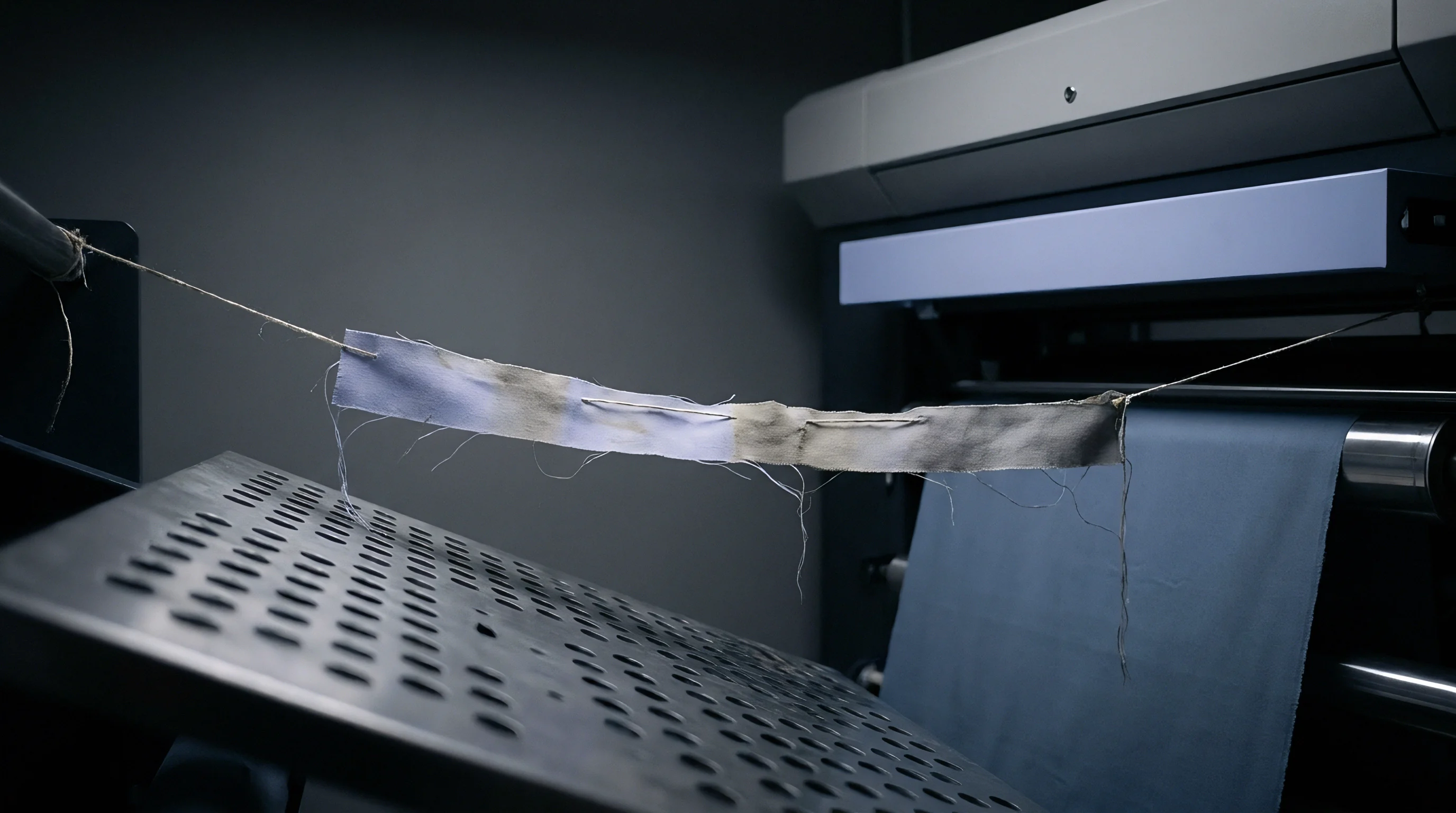
Shade fastness failure is the main commercial symptom of poor pH control. Unfixed, hydrolyzed dye trapped inside the swollen fiber bleeds during laundering or perspiration exposure, leading to batch rejections, export claims, and audit failures.

Wash Fastness Failure Modes and Hydrolyzed Dye Residues
Incomplete fixation leaves substantial amounts of hydrolyzed dye inside the fiber core. Standard wash-off routines rely on boiling baths and chelating agents to strip out this unfixed material.
Unbound hydrolyzed dye shows high affinity for cellulose during cool wash cycles, staining adjacent white test swatches during ISO 105-C06 testing. When sensor errors cause alkali under-dosing, overall fixation falls below commercial limits, forcing dye houses to run extended wash cycles that consume excessive water and energy.

Quality Assurance Dossiers for Brand Compliance Audits
Brand compliance programs require verifiable process records for sensitive reactive shades. Importers routinely demand batch logs before authorizing shipment release from overseas dye houses.
Laboratory audit data shows an average 14 percent wash fastness failure rate from uncorrected pH drift during alkali dosing, with cross-mill variance spanning 4 percent to 32 percent depending on salt concentration. Given this variability, buyers require batch-level pH logs alongside transaction certificates for high-density colorways before releasing payment.
Audit dossiers that lack matrix-matched calibration logs leave mills open to chargebacks under brand QA agreements. Documenting standard buffer usage alone will not satisfy technical auditors investigating shade variance across production batches.
Calibrating inline sensors against matrix-matched standards eliminates shade variance and ensures fastness compliance across reactive colorways.