Cross Sectional Dye Penetration Mechanics and Progressive Electrolyte Phase Control in Dense Duck Processing
Dense duck dyeing demands progressive salt dosing to suppress surface strike, allowing complete cross-sectional penetration before alkali fixation.
Pore
Heavy plied cotton canvas presents an extreme structural barrier to aqueous dye liquor movement. Number 8 duck, constructed from double-end 10/2 ring-spun cotton yarns in both warp and weft, achieves an aerial mass exceeding 600 grams per square metre with warp cover factors exceeding 28 and weft cover factors above 22. When packed tightly on a plain weave matrix, the inter-yarn interstitial voids contract below 5 micrometres upon initial hydration.
Cotton fibers swell up to 14 percent in diameter upon absorbing water, which closes inter-fiber capillaries inside the plied yarn bundles. This rapid spatial contraction converts the open textile network into a compacted cellular structure with extremely low hydraulic conductivity.

Hydrodynamic Resistance in Heavy Canvas
Liquor migration through heavy woven structures depends on hydraulic pressure gradients and capillary action. Capillary forces drive early liquid uptake.
The fluid velocity through dense yarn capillaries follows Darcy law governing flow through porous media. Warp and weft yarn twist factors above 4.2 twist multiplier tighten internal fiber alignment, creating high tortuosity paths that slow liquid displacement. Fluid passing through an un-scoured duck fabric faces high hydrophobic energy barriers caused by natural cotton waxes and pectin layers residing in the primary fiber walls.
An un-scoured double-end #8 cotton duck exhibits an aqueous contact angle exceeding 110 degrees at room temperature before wetting agents reduce interfacial tension below 30 mN/m.
Desizing and scouring remove surface waxes, yet the spatial restriction within inner yarn cores remains. Yarn twist restricts chemical movement. When high molecular weight dye molecules enter the wet capillary network, boundary layer resistance at the fiber surfaces generates a concentration drop across the yarn radius.
Outer fibers absorb dye rapidly from the surrounding bath, depleting solute concentration in the fluid attempting to reach the inner bundle center. Without forced liquor circulation or controlled exhaustion kinetics, this concentration gradient yields severe ring-dyeing where external fibers absorb the entire dye load while core fibers remain completely un-pigmented.
Capillary Tortuosity and Fiber Swelling
Aqueous immersion alters the cross-sectional geometry of heavy duck construction. Primary fiber swelling reduces effective pore diameter from 12 micrometres in dry state down to less than 1.5 micrometres in fully saturated state. This reduction accelerates fluid drag exponentially.
Dye molecules aggregate rapidly.
Hydrodynamic radius measurements of reactive dyes range from 1.2 to 2.8 nanometers depending on molecular weight and degree of sulfonation. Although single dye molecules remain smaller than swollen capillary pores, electrolyte addition triggers molecular aggregation, forming clusters exceeding 20 nanometers in radius. These aggregates become physically trapped inside outer fiber interstices, causing localized surface filter-out.
Controlled processing requires balancing fiber hydration rates against dye aggregation kinetics to maintain flow channels into the yarn interior. Dyeing dense plied canvas demands slow temperature escalation to allow uniform liquor ingress before salt addition.
Dose
Electrolyte additions regulate the electrostatic repulsion between anionic dye molecules and negatively charged cotton fibers in aqueous baths. Unmodified cellulosic fibers acquire a negative zeta potential ranging from negative 15 to negative 30 millivolts in neutral water due to hydroxyl ion adsorption and carboxyl group ionization. Reactive and direct dyes carry multiple negative sulfonic acid groups (SO3-), generating strong electrostatic repulsion that prevents dye molecules from approaching within reaction distance of the fiber surface.
Salt suppresses surface repulsion.
Ionic Strength Modulation and Debye Length
Dissolved inorganic salts provide cations that compress the electrical double layer surrounding cellulosic fibers. Sodium ions (Na+) from sodium sulfate (Na2SO4) or sodium chloride (NaCl) screen the surface charge, reducing the Debye length from several nanometers down to sub-nanometer dimensions. This double-layer compression enables dye molecules to approach within range of short-range dispersion forces and hydrogen bonding mechanisms.
Core penetration requires controlled diffusion.
Rapid salt introduction collapses the electrostatic barrier instantaneously across outer fiber surfaces. Dye molecules in the immediate vicinity of outer yarn bundles exhaust onto the cellulose before migrating into the interior yarn channels. Progressive electrolyte phase control regulates ionic strength over extended time intervals, maintaining a lower exhaustion rate that permits un-bound dye to diffuse through inner capillary networks before surface adsorption locks the chemistry in place.
Linear versus Progressive Salt Injection
Linear electrolyte dosing delivers constant salt increments over set time frames. High-density duck constructions suffer under linear dosing because early additions cause massive surface exhaustion while the fabric interior lacks sufficient dye concentration.
| Dosing Profile Method | Initial Salt Conc. (g/L) | Final Salt Conc. (g/L) | Core Penetration Index (%) | Levelness Index (delta E) |
|---|---|---|---|---|
| Single Bolus Addition | 60.0 | 60.0 | 31.4 | 2.85 |
| Linear Dosing (40 min) | 0.0 | 60.0 | 58.2 | 1.42 |
| Progressive Exponential Dosing | 2.0 | 60.0 | 88.7 | 0.38 |
| Stepped Phase Dosing | 10.0 | 60.0 | 72.1 | 0.91 |
Progressive exponential salt injection starts at minimal electrolyte concentrations, maintaining high Debye screening lengths during initial liquor circulation passages. Salt levels increase slowly in early stages and accelerate toward final exhaustion, matching the gradual migration rate of dye into the dense yarn bundles. Migration precedes chemical fixation.
High-density duck constructions demand continuous liquor agitation throughout the electrolyte ramp to prevent localized dye aggregation inside tight yarn interstices.
In high-density canvas processing, bath conductivity monitoring verifies electrolyte concentration trajectories in real time. Standard target conductivity slopes maintain migration rates above 0.05 color units per minute across the dye batch. Excessive electrolyte addition rates cause localized dye precipitation, leading to severe streakiness and unrecoverable crocking failure.
Fixation
Alkali introduction drives the chemical reaction between reactive dye functional groups and cellulosic hydroxyl groups. Raising bath pH converts cell-OH groups into nucleophilic cell-O- anions, which attack reactive dye sites through nucleophilic substitution or nucleophilic addition mechanisms. Alkali triggers covalent bonding.
Alkali Trajectory and Reaction Kinetics
Vinyl sulfone dyes require pH thresholds between 11.0 and 11.5 for efficient cell-O- addition, whereas monochlorotriazine chemistries demand pH levels between 11.8 and 12.2 under elevated temperatures. Introducing alkali before dye achieves uniform spatial distribution across the yarn cross-section causes permanent covalent fixation exclusively on outer fiber layers.
- Load greige canvas onto the jig under calibrated roll tension.
- Perform continuous desizing and scouring to reach an absorbency sink time under 3 seconds.
- Prepare dye bath at initial temperature of 40 degrees Celsius with non-ionic penetrating surfactants.
- Inject electrolyte progressively across four passages according to an exponential curve.
- Dose alkali linearly over six passages to raise bath pH to 11.2 without triggering surface precipitation.
- Wash thoroughly with hot overflow rinse before soaping at 98 degrees Celsius.
Controlling pH progression via linear or progressive dosing buffers the fixation rate against diffusion capacity. Hydrolysis reduces overall color yield. Dye molecules that react with water hydroxyl ions (OH-) form hydrolyzed dye incapable of bonding with cellulose.
Hydrolyzed dye remains trapped inside outer yarn interstices unless removed by hot rinsing, impairing wet rubbing fastness scores.
Preventing Hydrolysis in Slow-Diffusion Matrixes
Bifunctional reactive dyes combining dichlorotriazine and sulfatoethylsulfone functional groups provide flexible fixation windows for slow-diffusing textiles. The different activation energies of each reactive site enable secondary fixation phases after core migration finishes.
Jig dyeing machinery processes heavy duck at low liquor ratios ranging from 3:1 to 5:1. Low liquor volume accelerates chemical reaction rates by increasing bath concentration, intensifying the risk of surface fixation. Maintaining temperature control within 1.0 degree Celsius tolerances across the jig roll prevents differential reaction speeds between roll edges and core windings.
Mills frequently attribute core ring-dyeing defects to variations in raw cotton fiber maturity across blended yarn lots.
Crosscut
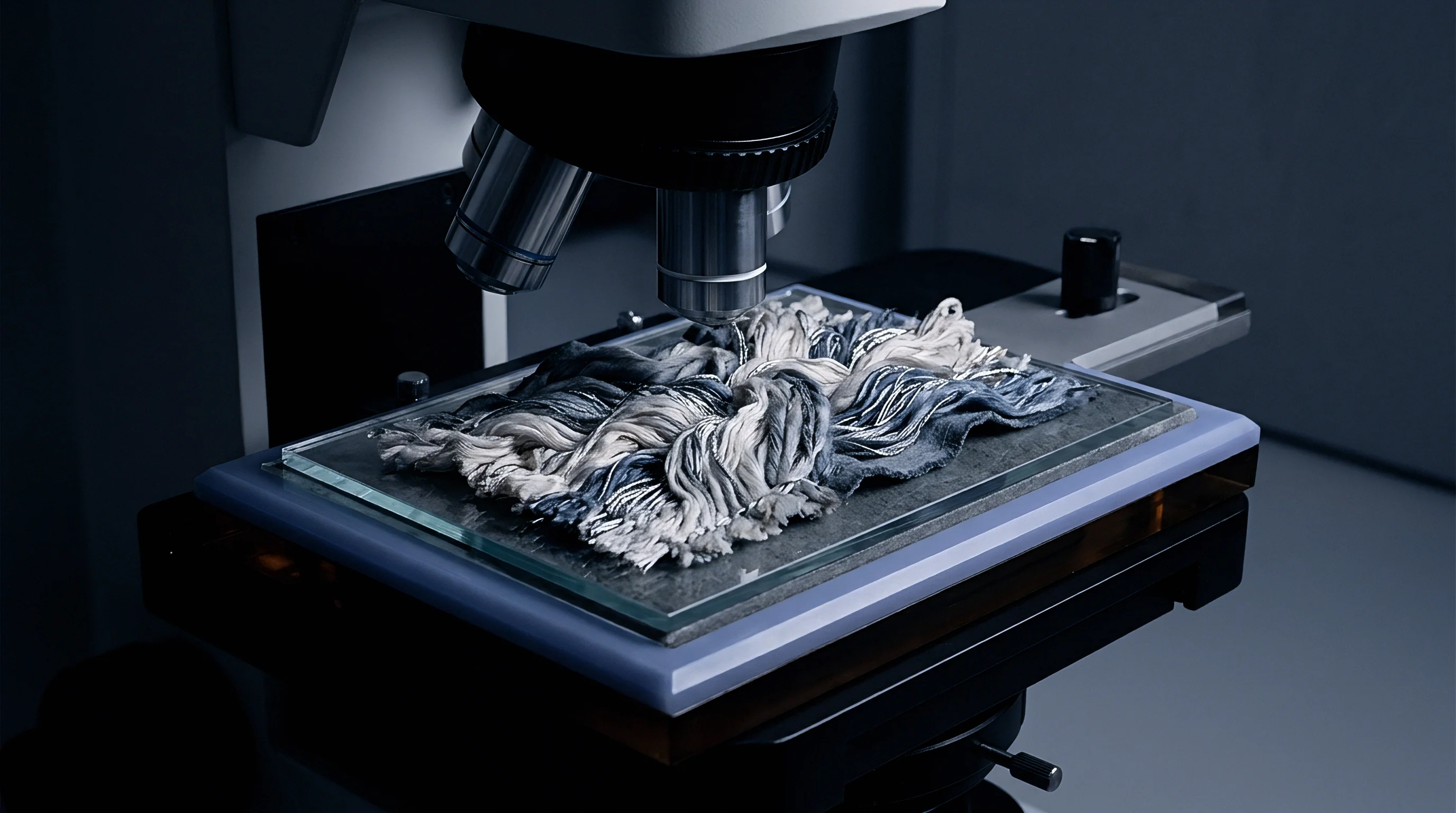
Verification of dye distribution across individual yarn bundles demands cross-sectional microscopic evaluation. Cross-sectional microtome preparation cuts 10-micrometre slices across warp and weft yarns, allowing digital image analysis to compute color density gradients from the yarn outer boundary to the central core. Optical density drops internally.
Microscopic Ring Dyeing Quantification
Quantification of core penetration uses the Ring Dyeing Index (RDI), expressed as the percentage ratio of pigmented yarn cross-sectional area against total yarn cross-sectional area. Microscopic cross cuts reveal un-dyed cores.
RDI values below 60 percent signal severe surface-only ring-dyeing, leading to premature color fading when abrasive wear removes outer fiber layers during garment service life. Microtome analysis measures spectral absorbance at 50-micrometre intervals across the yarn radius using micro-spectrophotometry.
| Duck Spec / Mass | Dyeing Machinery Method | Ring Dyeing Index (%) | Dry Crock Fastness (ISO 105-X12) | Wet Crock Fastness (ISO 105-X12) |
|---|---|---|---|---|
| #10 Duck (450 gsm) | Atmospheric Jig (Bolus Salt) | 42.5 | Grade 3.0 | Grade 1.5 |
| #10 Duck (450 gsm) | Progressive Jig (Exponential Salt) | 86.1 | Grade 4.5 | Grade 3.5 |
| #8 Duck (600 gsm) | Continuous Pad-Steam | 74.3 | Grade 4.0 | Grade 3.0 |
| #4 Duck (800 gsm) | Cold Pad-Batch (Extended Dwell) | 68.9 | Grade 4.0 | Grade 2.5 |
Cropping fastness reflects surface depth. High surface dye concentrations produce poor rubbing fastness grades because unfixed or surface-adsorbed dye transfers easily under friction.
Does High Ring Dyeing Index Guarantee Fastness Compliance?
Achieving an RDI value above 85 percent ensures that dye molecules inhabit inner yarn voids, yet color fastness compliance relies equally on removing unfixed hydrolyzed dye fragments. Heavy canvas holds unfixed reactive dye inside yarn core capillaries during post-fixation rinsing phases. Failure modes in dense duck finishing stem directly from procedural breakdowns during wet processing:
- Core Strike Deficit occurs when electrolyte concentration rises before dye molecules migrate into inner yarn bundles.
- Surface Aggregation Flaw stems from premature alkali dosing causing rapid covalent binding at yarn boundaries.
- Moiré Shade Banding arises from uneven hydraulic pressure distribution across the beam or jig roll faces.
- Differential Frosting Erosion appears after abrasive wear exposes un-dyed internal cotton fibers during garment usage.
According to ISO 105-X12 testing specifications, a dry crocking rating below Grade 3.5 triggers immediate lot rejection for commercial workwear canvas.
Shade matching demands steady temperature. Cold rinse cycles fail to remove unfixed chemistry from deep capillaries. Efficient clearance requires high-temperature soaping passages at 98 degrees Celsius with non-foaming polymeric dispersants that keep hydrolyzed dye in suspension.
Standard purchase contracts under ISO 105 specification require cross-sectional penetration depth to exceed seventy percent of total yarn bundle thickness for commercial acceptance.

Yield
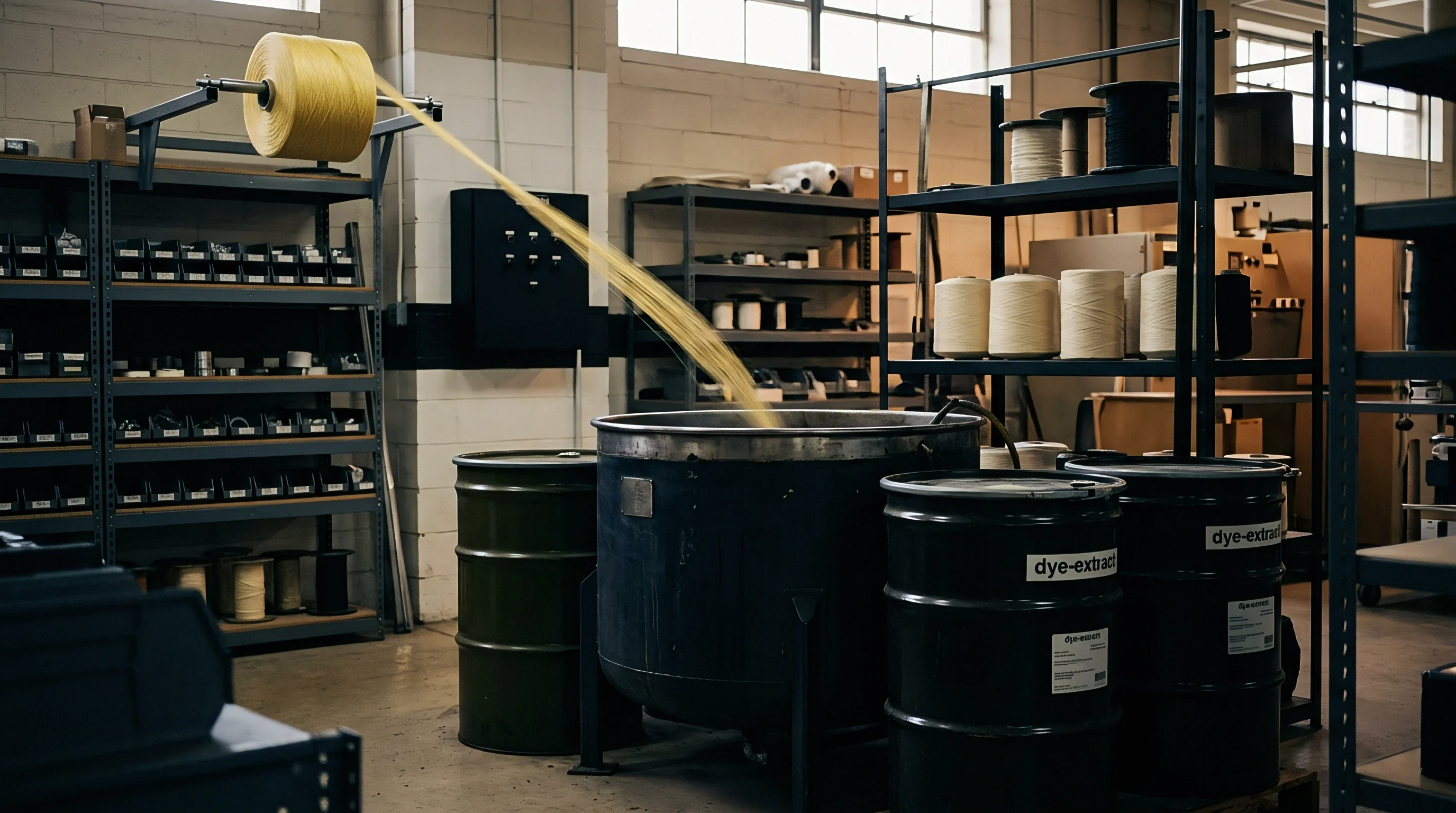
Machinery route selection governs unit production cost and chemical efficiency in heavy duck processing. Jig dyeing provides flexible batch size options but consumes long cycle times ranging from 6 to 10 hours per 1,000-metre roll. Continuous pad-steam routes process fabric at 30 to 50 metres per minute, drastically lowering thermal energy consumption per finished metre.
Equipment Selection and Commercial Mechanics
Continuous pad-steam lines demand high initial setup yardage to compensate for tailing losses during chemical bath equilibration. For small or medium lot orders below 3,000 metres, jig dyeing remains the viable route despite higher labor costs.
Cold pad-batch (CPB) processing presents an alternative low-energy route for dense canvas. Impregnating fabric with dye and alkali mixtures at room temperature followed by batch rotation for 16 to 24 hours permits slow, uninterrupted dye diffusion into dense yarn cores without thermal hydrolysis. Batch cycles take extended time.
Continuous pad-steam processing reduces wet treatment time for heavy duck canvas by eighty percent relative to atmospheric jig dye cycles.
Consider a commercial run of 15,000 metres of #10 cotton duck canvas (450 gsm) processed across three candidate wet routes. On an atmospheric jig running at 100 metres per minute with 8 passages for dye exhaustion and 6 passages for soaping, production speed nets roughly 120 metres per hour, totaling 125 machine hours. At a machine operational cost of 45 USD per hour, total machinery overhead equals 5,625 USD, or 0.375 USD per metre.
Thermal energy consumption for heating 4,500 litres of dye bath across multiple passages adds 0.14 USD per metre, and chemical expenditure including electrolyte and reactive dye sums to 0.42 USD per metre, landing the total wet treatment cost at 0.935 USD per metre.
In contrast, a continuous pad-steam route running the same 15,000-metre order operates at 40 metres per minute, completing the run in 6.25 operating hours including setup. Machine overhead at 220 USD per hour yields 1,375 USD, or 0.091 USD per metre. Thermal energy for continuous steaming at 102 degrees Celsius equals 0.052 USD per metre.
Chemical formulation requires higher dye concentrations in low-volume pad troughs, raising chemical costs to 0.48 USD per metre, yet total wet treatment cost lands at 0.623 USD per metre. Process speed dictates unit cost. Heavy duck absorbs dense chemistry.
Route selection depends on commercial boundaries established during pre-production qualification:
- Liquor Ratio Thresholds determine whether continuous pad-steam or batch jig machinery maintains chemical exhaustion efficiency.
- Fabric Density Limits force the selection of ultra-low tension jigs when processing weights exceeding 500 grams per square meter.
- Rework Cost Allocation dictates that shade corrections require complete chemical stripping rather than simple top-up additions.
Reworking off-shade dense duck canvas incurs severe financial penalties. Stripping reactive dyes requires sodium hydrosulfite and sodium hydroxide treatments at 95 degrees Celsius, degrading cotton tensile strength by 12 to 18 percent and doubling energy expenditures. Whether continuous ultrasonic bath cavitation can replace multi-stage salt dosing in ultra-heavy duck finishing remains an unanswered question for high-speed mill operations.