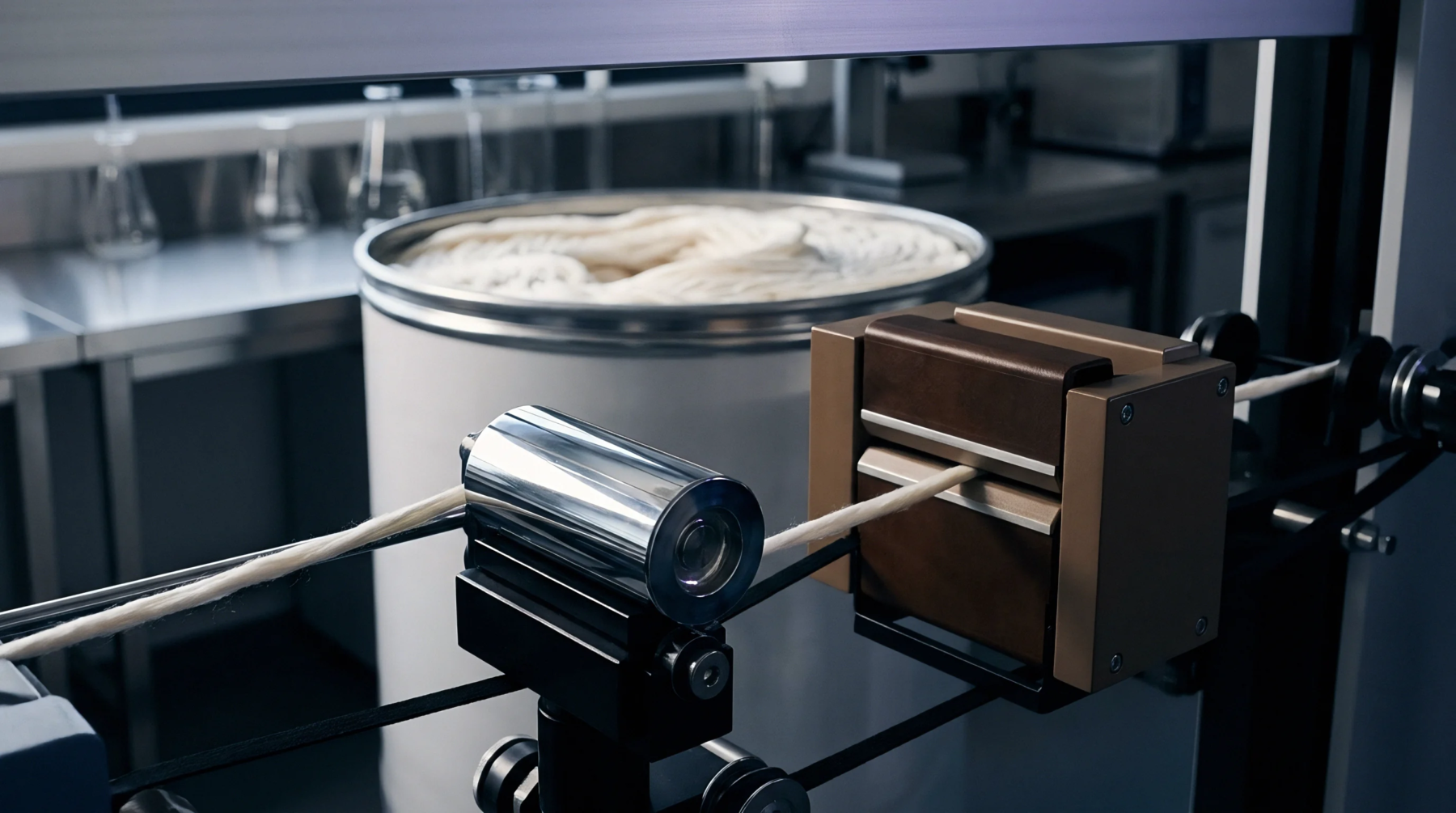
Polarized Test
Quantitative assessment of cellulose wall development across raw cotton samples utilizes the optical interference colours produced by birefingent polymeric chains under cross-polarized light. Under the testing regimen of ASTM D3818, an operator mounts combed, parallelized cotton specimens in a liquid medium of specified refractive index between crossed polarizers equipped with a first-order red retardation plate. Mature fibres containing thick, dense layers of crystalline cellulose shift the optical retardation into second-order yellow, purple or green shades.
Thin-walled, immature fibres display first-order red, indigo or violet colours because their inadequate secondary cell wall structure retards light waves to a lesser degree. This standard provides an optical maturity percentage without requiring caustic swelling solutions or cross-sectional cutting.
Microscopic Examination
Birefringence originates from the spiral arrangement of crystalline cellulose fibrils oriented along the axis of the growth layers. When viewed according to ASTM D3818, the specimen displays colour shifts strictly proportional to the path length of the light travelling through the cell wall material. Technicians record the observed colours against standard visual reference groups to categorize each individual fibre into mature or immature groupings.
Sodium hydroxide treatments are entirely omitted, preserving the original crimp, twist and convolution geometry of the dry raw lint. The test protocol requires counting hundreds of fibres per slide to establish a statistically defensible maturity index. Human fatigue and slight variations in specimen alignment introduce operator error into optical classification counts.
Instrument Calibration
Modern computerized optical analyzers use the foundational principles codified in ASTM D3818 to establish mathematical baselines for automated maturity image analysis. High-volume testing lines cannot afford the thirty-minute slide preparation time demanded by manual polarized light inspections. Cotton merchant contracts rely primarily on double-compression airflow resistance instruments rather than this optical retardation method.
ASTM D3818 serves as the verification standard when airflow readings confuse fine-fibred mature lots with coarse-fibred immature lots. Independent textile testing laboratories deploy polarized microscopy to resolve warranty claims regarding undocumented changes in cotton origin or variety.
Fabric Defect
High counts of immature fibres determined through ASTM D3818 correlate with severe visual and mechanical defects in dyed apparel textiles. Thin-walled fibres lack the physical mass to absorb reactive or direct dyes at the same optical depth as normal cotton, creating light-toned specks across dark fabrics. These low-retardation fibres break during aggressive carding, forming core nuclei for mechanical neps that resist yarn spinning draft controls.
Finished fabrics woven from yarn lots containing abnormal counts of first-order purple fibres abrade prematurely during garment laundering. Verifying fibre maturity via optical polarization isolates raw material deficiencies before spinning and dyeing investments occur.