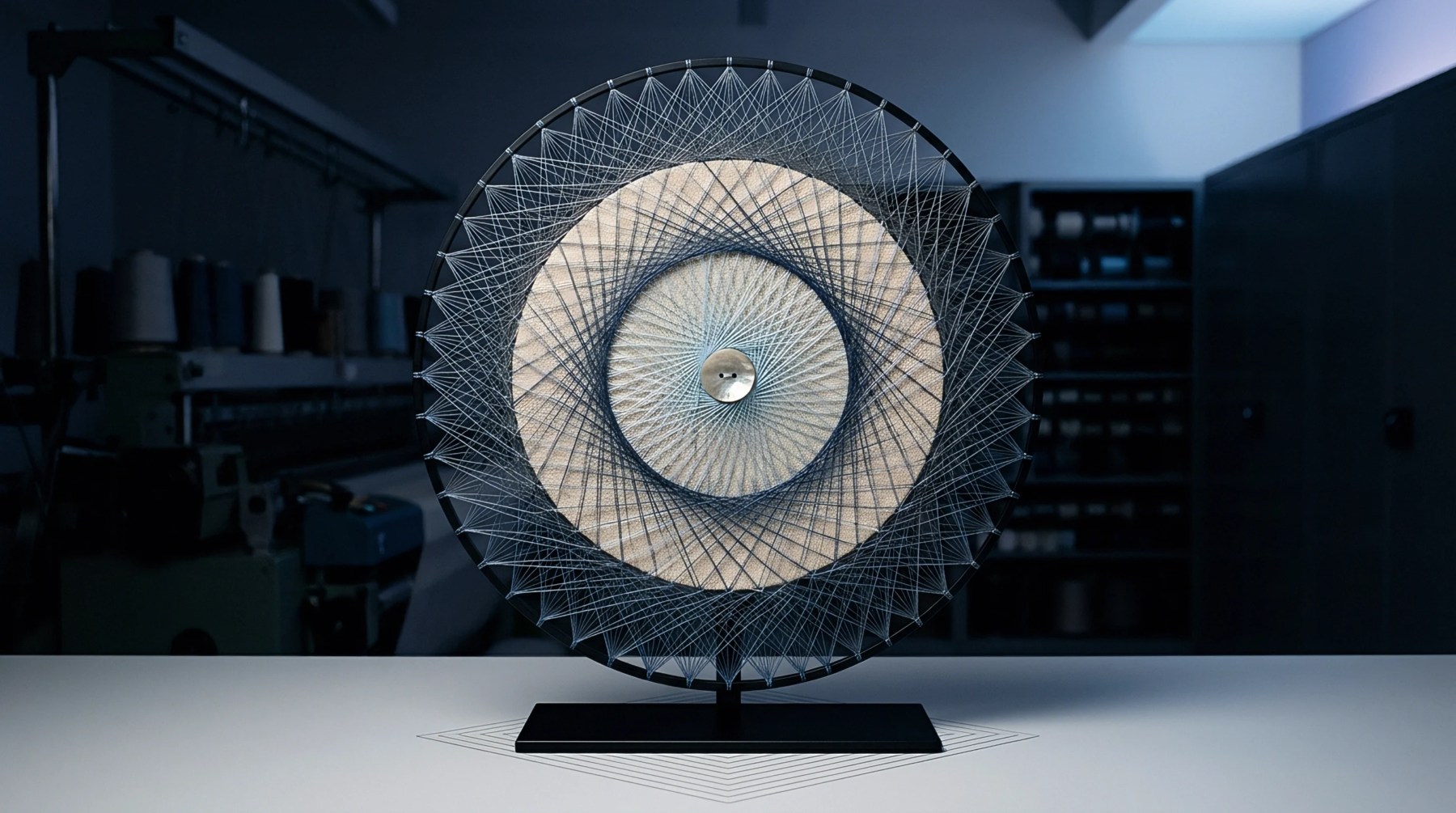
Velocity Profile
Aerodynamic friction along the internal air channel of a commercial stenter frame creates dynamic boundary layer turbulence during high speed fabric heat setting operations. Mill engineers calculate this aerodynamic variable to predict thermal transfer coefficients between the circulating hot air and the wet textile substrate passing below the nozzles. Air molecules decelerate sharply upon direct contact with the moving woven fabric surface, forming a thin shearing zone where velocity drops to zero at the immediate solid boundary.
Momentum exchange inside this microclimate dictates the actual heat flux reaching the moving material. Operators adjust exhaust dampers and blower frequencies when the shear stress profile destabilizes, correcting uneven moisture evaporation across the width of the open width goods. Flow separation occurs immediately downstream of protruding yarn intersections whenever nozzle pressure exceeds standard calibration limits for synthetic blends.
Thermal Transfer
Heat penetration through the core of a dense cotton twill depends entirely upon the disruption of stagnant laminar air films resting directly on the outer yarn arrays. Thermal efficiency drops significantly when smooth boundary layers insulate the fabric, preventing forced convection currents from penetrating the interstitial spaces between warp and filling yarns. Convective heat transfer coefficients remain proportional to the intensity of eddy generation occurring inside the gaseous boundary region.
Technicians measure temperature differentials between the supply plenum and the fabric face to verify that adequate fluid mixing takes place inside the drying chamber. Stagnant zones develop adjacent to heavy selvedges, causing localized under curing of thermosetting resin finishes unless nozzle geometry forces localized vortex formation.
Shear Stress
Frictional drag exerted by high velocity gas streams against moving filament yarns generates mechanical surface forces that can distort delicate knit loops during continuous dyeing range drying. Fabric tension regulators maintain strict dimensional stability to prevent the fluttering action caused by localized pressure fluctuations inside the drying duct. Shear forces escalate rapidly when fan speeds increase to compensate for heavy moisture loads driven off heavy wool suiting materials.
Laboratory technicians measure tensile distortion on conditioned samples pulled from the exit accumulator to confirm that mechanical drag stayed within acceptable mill tolerances during processing. Excessive shear stress deforms loop architecture in open structure tricot fabrics, creating permanent optical irregularities that fail final inspection audits before packaging.
Boundary Control
Air jet impingement angles govern the physical boundaries where laminar flow breaks down into chaotic eddy currents directly above the fabric surface. Production managers tune nozzle height settings to optimize the momentum transfer required for rapid moisture removal without causing mechanical damage to delicate silk substrates. Fluid dynamics dictate that nozzle spacing must match the specific mass per unit area of the processed goods to maintain consistent turbulence intensity across the entire stenter width.
Laboratory audits verify finishing uniformity by comparing residual moisture content sampled from both margins and the center line of the finished roll. Proper turbulence management prevents localized overheating on synthetic filament yarns, ensuring consistent dye fixation and predictable hand feel in finished commercial apparel fabrics.