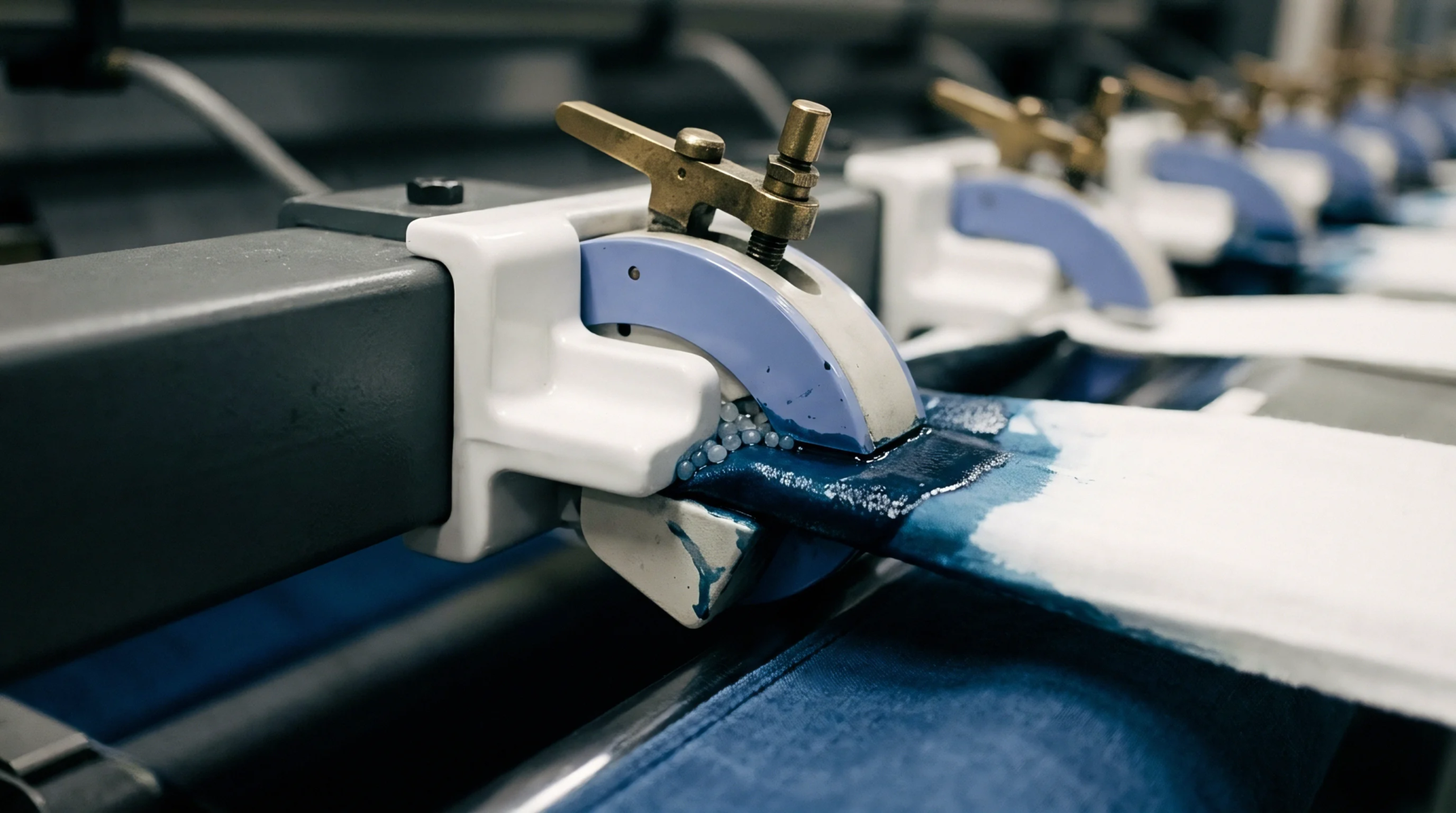
Selvedge Removal
Mechanical cutting operations sever non-uniform woven selvedges, pin-tenter holes, or knitter edge-curls from finished fabric webs to establish a precise cross-direction usable width. Operating at the delivery end of stenters, compactors, or continuous inspection frames, fabric width trimming ensures clean, dimensionally stable margins suitable for automated garment markers. The physical application of this procedure ends where structural body yardage begins, never intruding into the nominal cuttable width specified by garment pattern parameters.
Trimming Operation
Rotary slitting knives or high-speed oscillating blades engage the fabric web against hardened anvils under controlled longitudinal tension. Ultrasonic slitters simultaneously cut and seal raw thermoplastic edges on synthetic fabrics to eliminate edge fraying during downline unwinding. Vacuum collection hoods mounted adjacent to the trimming station continuously extract severed edge trim ribbons directly into scrap collection hoppers.
Misalignment of photoelectric web guidance sensors results in blade wander, inadvertently slicing into usable body yardage or leaving damaged pin marks within the finished width.
Usable Width Assurance
Garment cutting markers demand a continuous, dependable width boundary across the entire roll length to maximize pattern yield per linear meter. Inaccurate trimming margins create missing edge allowances on nested pattern pieces, inducing structural flaws in cut panels. Post-finishing inspections measure usable width from inside edge to inside edge, ignoring trimmed fringes according to ASTM D3774 procedures.
Mill quality control rejects rolls showing wavy trim edges, missed slitting zones, or edge curling triggered by dull cutting blades. Usable width verification guarantees seamless feeding across automated single-ply and multi-ply cutting tables.
Mechanical Execution
Blade sharpness monitoring prevents micro-tears across delicate knit structures that could otherwise unravel under lateral spreading forces. Edge-tracking optical eyes adjust slitter positions within fractions of a millimeter to match shifting web dimensions dynamically. Clean cut lines protect downstream sewing lines from loose yarn tangling and edge fraying.
Precise trimming practices optimize cutting room marker efficiency while preserving the structural integrity of fabric edges.