Direct Unit
Linear mass density representing one milligram per kilometer of individual filament or single fibre provides an ultra-fine metric for microdenier categorisation. The unit millitex belongs to the direct decimal system of yarn numbering, scaling the standard tex measure down by a factor of one thousand. Synthetic fibre producers employ this parameter to specify ultra-fine split filaments, meltblown nonwoven webs and high-efficiency filtration fibres.
The scale terminates where structural continuity ends, having no functional application for short discontinuous staple clumps, non-fibrous additives or finished composite structures.
Fibre Manufacture
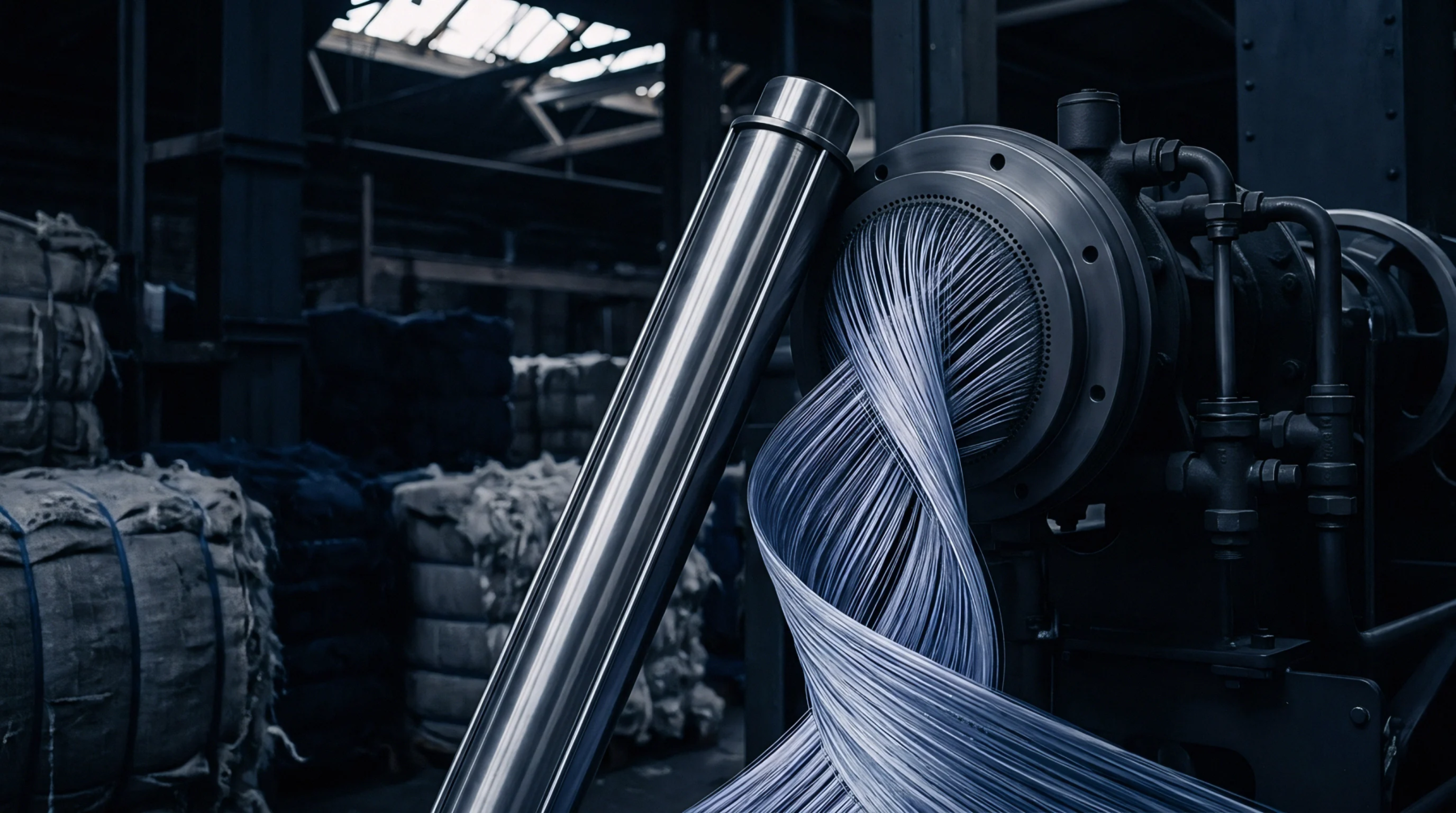
Extrusion lines produce conjugate bicomponent filaments designed to split into components registering values under one hundred millitex per strand. Precision metering pumps meter molten polyester and polyamide through segmented pie or islands-in-the-sea spinneret geometries at microscopic throughput rates. Hydroentanglement downstream splits the matrix polymer from the primary filaments, releasing the ultra-fine structure.
Verifying cross-sectional dimensions during spinning checks that filament drawing ratios remain stable across every individual spin-pack orifice.
Performance Characteristic
Ultra-fine microfibres create fabrics with low flexural rigidity, yielding soft hand feel and dense, windproof constructions without resin coatings. Because surface area increases inversely with linear density, fabrics constructed from filaments measuring below five hundred millitex display high capillary wicking dynamics. This geometry accelerates surface evaporation, making such yarn assemblies suitable for technical activewear and cleanroom wiping materials.
The massive specific surface area demands higher dye concentrations to achieve target visual depths, increasing dyestuff recipe costs during shade matching.
Inspection Protocol
Quality checkpoints quantify filament linear density using gravimetric cut-and-weigh methods under regulated environmental moisture conditions. Technicians mount bundles of known strand counts onto precision wrap reels, measuring skeletal length under precise pretension loads before mass verification on analytical microbalances. High filament counts render mechanical separation difficult, prompting mills to employ vibroscopic resonance techniques governed by ASTM D1577 standards.
Deviations exceeding five percent from specification trigger spinning adjustments to prevent barre defects in subsequent circular knitting lots.