Mathematical Modeling of Micro Periodicity Mass Variance in Short Length Filament Unraveling Protocols
Dynamic Fourier decomposition of high frequency mass spectra isolates mechanical unraveling artifacts from true filament periodicity defects to prevent barré.


Gauge
Mass variance across short-length yarn sections is governed by draw-frame drafting waves, spindle eccentricities, and dynamic take-off mechanics during deconstruction. When automated processing equipment unravels a high-performance woven preform or a knitted structural package to recover or analyze constituent filaments, high-frequency mass swings register as systematic periodic errors. Optical capacitance sensors and high-speed linear mass detectors quantify these fluctuations as linear density variations, expressed in grams per kilometer or dtex, across millimeter-scale cut lengths.
Linear density mass variance along a continuous multifilament tow follows a composite waveform. Long-wavelength variations stem from sliver doubling discrepancies and roving irregularities, while micro-periodicity originates in mechanical drafting imbalances, eccentric delivery rollers, and intermittent slip-stick friction at the unraveling eyelet. Standard low-speed gravimetric checks flatten these micro-peaks, hiding the true variance amplitude.
Mill technicians inspecting unraveled yarn packages often observe consistent average mass readings across five-meter skeins, yet high-speed processing machines experience tension flutter, pick insertion jams, or resin impregnation voids caused entirely by sub-centimeter mass spikes.
Drafting roll eccentricity induces mass variance peaks whose fundamental wavelength equals the exact circumference of the final delivery roller.
A rigorous unraveling protocol separates true structural variance from mechanical artifacts introduced by the unwinding apparatus itself. The take-off angle, yarn balloon geometry, package surface contact pressure, and deconstruction speed each introduce harmonic signatures into the continuous mass signal. Resolving micro-periodicity requires coupled mathematical modeling that tracks mass per unit length alongside the instantaneous unraveling kinematics.
Analytical isolation of these variables prevents costly misattributions during fabric analysis and scrap yarn reclamation. A converter attributing weight spikes to filament supplier inconsistencies risks losing substantial commercial leverage if the mass deviation stems from dynamic pluck-out tension generated by their own unwinding creel.

Draft
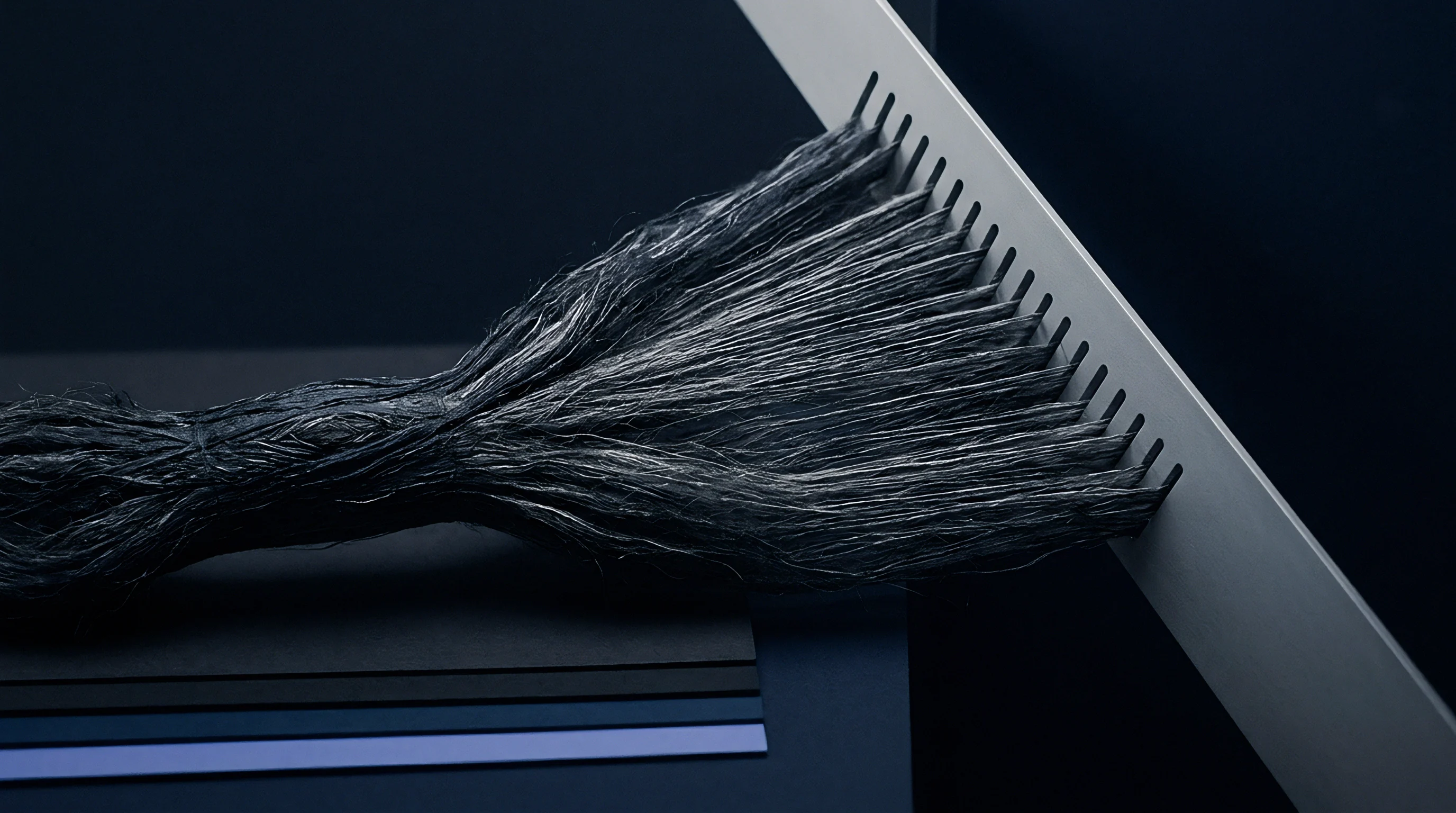
Drafting dynamics in synthetic filament yarn production and subsequent yarn unraveling protocols introduce cyclical unevenness known as micro-periodicity. When multifilament strands undergo tensioned unraveling from tightly packed fabric edges or consolidated bobbins, individual filament bundles experience differential shear stresses and cyclic slip-stick releases. These mechanical releases generate periodic mass accumulation points along the recovered yarn length.

Mechanical Sources of Wavelength Imbalance
Mechanical roller runout produces harmonic mass deviations at fixed spatial frequencies. In an unraveling rig operating with pinch-roller extraction, an out-of-round nip roller imparts a cyclic draft variation whose wavelength matches the roller circumference. For a roller radius of fifteen millimeters, the induced fundamental wavelength sits precisely at 94.25 millimeters.
Unraveling from woven salvages introduces an additional structural frequency: yarn crimp interchange. Crimp frequency is dictated by the pick count of the parent woven good, typically ranging from 8 to 28 picks per centimeter in standard industrial fabrics.
Filament bundles experience alternating compression and lateral spreading as they clear cross-over points during structural unwinding. When individual filaments snap free from the interlacing points, elastic recovery causes immediate, localized longitudinal shrinkage. This shrinkage produces localized mass accumulation zones spaced at intervals equal to the original woven weave pitch, producing distinct micro-periodic peaks in mass profile charts.

Mathematical Formulation of Mass Density Variance
The linear mass distribution of an unraveled filament bundle is modeled as a stationary random process superimposed on deterministic periodic components. Let spatial position along the yarn axis be denoted by x. The total linear mass density m(x) is expressed as:
m(x) = m_0 + sum + epsilon(x)
Here, m_0 represents the mean nominal linear density in tex, A_k is the mass fluctuation amplitude of the k-th harmonic component, f_k represents the fundamental spatial frequency in cycles per millimeter, phi_k represents the phase angle, and epsilon(x) represents stochastic mass variance conforming to Gaussian white noise. The spatial frequency spectrum is evaluated using the continuous autocorrelation function R(tau):
R(tau) = lim (L -> inf) (1 / L) integral from 0 to L of dx
When R(tau) displays undamped sinusoidal oscillations as tau increases, deterministic micro-periodicity is present. The Martindale limit of yarn unevenness defines the theoretical minimum irregularity achievable in a strand of randomly distributed staple fibers or texturized filaments:
CV_lim = 100 / sqrt(n)
The variable n represents the average number of individual filaments in the yarn cross-section. For a 167 dtex polyester yarn composed of 48 individual filaments, the limiting coefficient of variation CV_lim is 14.43 percent. Continuous filament flat yarns exhibit lower baseline random irregularity, making any periodic variance amplitude above 1.5 percent an operational defect.
| Periodic Source | Typical Wavelength Band | Dominant Driving Variable | Signal Character |
|---|---|---|---|
| Parent Weave Pitch | 0.35 mm to 1.50 mm | Loom Pick Density | Sharp triangular peaks |
| Delivery Pinch Roller | 50.0 mm to 125.0 mm | Roller Diameter Eccentricity | Pure sinusoidal harmonic |
| Creel Balloon Collapse | 200.0 mm to 800.0 mm | Package Diameter and Traverse | Asymmetric saw-tooth drift |
| Eyelet Stick-Slip Friction | 2.0 mm to 15.0 mm | Dynamic Boundary Lubrication | Pseudo-periodic pulse trains |
| All measurements referenced under standard tension of 0.50 cN per tex at 20 degrees Celsius and 65 percent relative humidity. | |||
When unraveled yarns are fed into high-speed tufting or knitting machines, cyclic mass errors coincide with cyclic tension shifts. Feed rollers deliver variable physical lengths per rotation, generating barré effects across the surface of finished goods.
A supplier often excuses this visible striping as an unpreventable consequence of normal filament extrusion variance. Rigorous frequency decomposition proves otherwise by tracing the wavelength directly to the geometry of their conversion machinery.


Friction
Filament-to-guide contact points along an unraveling path introduce nonlinear boundary conditions that amplify underlying mass irregularities. When unlacing filaments at linear velocities exceeding two hundred meters per minute, yarn contact over ceramic eyelets, tension discs, and guide bars does not conform to classical Amontons-Coulomb friction. Viscoelastic fiber deformation and hydrodynamic spin-finish shear dominate yarn behavior.

Dynamic Tension and Viscoelastic Damping
Frictional tension amplification around curved guide surfaces follows the modified Capstan equation incorporating yarn bending stiffness and finish film shear:
T_2 = T_1 exp(mu theta + k_s B / r^2)
The variable T_1 represents incoming unraveling tension, T_2 represents exit tension, mu is the dynamic coefficient of friction, theta represents total wrap angle in radians, B is the flexural rigidity of the filament tow, r is guide radius, and k_s is a mechanical contact constant. At boundary zones where spin finish has migrated or evaporated, mu fluctuates between static and kinetic values, triggering high-frequency tension oscillations.
These rapid tension spikes elastically strain the yarn, momentarily reducing its effective cross-sectional mass under constant volumetric density. The instantaneous linear density m_dyn relates to nominal unstrained linear density m_0 and instantaneous tension T via yarn axial modulus E and core cross-sectional area A:
m_dyn = m_0 / (1 + T / (E A))
Tension variations induced by stick-slip friction manifest directly as dynamic mass variations in downstream mass sensing gates. When the unraveling velocity matches a natural harmonic of the yarn guide support arm, mechanical resonance amplifies these mass drops tenfold.
A ten-centinewton spike in unraveling tension induces a measurable linear mass drop of 0.4 percent in semi-crystalline polyamide tows before permanent plastic deformation begins.
A rigorous specification establishes strict parameters for yarn unwinding friction tests. Standard ISO 11576 defines yarn-to-solid friction measurement protocols, requiring a polished chromium-plated or ceramic cylinder surface with a surface roughness Ra between 0.2 and 0.4 micrometers. Testing is conducted at ambient conditions of 20 degrees Celsius and 65 percent relative humidity.
Tension monitoring pins positioned before and after the principal unraveling guides isolate frictional stick-slip from intrinsic pre-existing mass errors. Without synchronous dual-point tension recording, an analytical system cannot differentiate whether mass drops originate from raw material draw variations or mechanical brake flutter.

How Does Spin Finish Depletion Alter High Frequency Mass Profiles?
Boundary lubricant distributions dictate the stability of micro-length unraveling operations. Synthetic filaments rely on spin finishes composed of lubricating oils, antistatic agents, and emulsifiers, deposited at nominal levels between 0.6 and 1.5 percent by weight of goods.
Spin finish evaporates or migrates across prolonged storage periods, particularly when packages endure elevated temperatures during international ocean transit. When finish extraction analysis yields total fatty matter below 0.35 percent, boundary friction spikes precipitously.
- Boundary film rupture occurs when extraction tensions compress raw polymer surfaces directly against ceramic eyelets without an intermediate oil layer.
- Localized frictional heating raises contact temperatures past the secondary transition temperature of the polymer, inducing surface shear smearing and filament fusion.
- Intermittent sticking cycles seize individual outer filaments while internal core filaments continue moving, distorting the spatial arrangement of the bundle.
- Periodic pluck-release cycles discharge accumulated elastic energy, launching short filament loops into the detection field that read as false mass spikes.
Unwinding unlubricated yarn yields an uneven, ragged mass spectrogram characterized by broad energy humps instead of discrete frequency lines. The buyer who ignores spin-finish extraction percentages risks accepting yarns that behave erratically in automated creels despite pristine laboratory tensile certificates.

Transit
High-speed unraveling protocols generate complex spatial trajectories between the take-off package and the primary nip point. Centrifugal forces, aerodynamic drag, and Coriolis accelerations cause the moving filament bundle to generate an unconstrained rotating envelope termed the unwinding balloon. The geometry of this balloon governs mass variability during delivery.
Balloon stability during over-end unwinding is mathematically expressed using the equations of motion for a flexible string moving through space under tension T and linear density m. In cylindrical coordinates (r, theta, z), the steady-state balloon equations balance inertia, tension gradients, and air drag:
m = d / ds – F_drag,r
m = (1 / r) d / ds – F_drag,theta
m = d / ds – F_drag,z
The variable s is the arc length along the yarn, and F_drag represents velocity-squared aerodynamic resistance. When package unwinding progresses from outer layers to the empty bobbin core, the radius of take-off diminishes, increasing rotational frequency from 100 radians per second to over 800 radians per second at constant line extraction speeds.
As the balloon collapses and expands, cyclic tension waves propagate along the yarn line toward the sensor array. These standing waves generate apparent mass shifts by periodically cycling the yarn through the detection field at off-axis angles, altering the apparent optical cross-section. Sensor channels calibrated exclusively for perpendicular transit register artificial mass surges as a consequence of yarn path tilting.
A five-degree off-axis angular tilt inside a capacitive detection slot introduces a false positive mass variance of 0.38 percent on flat yarns.
Controlling this mechanical transit error demands active balloon-limiting rings and short free-span lengths between take-off points and the primary mass transducer. Restricting the unguided yarn span to under 150 millimeters dampens standing-wave amplitudes and eliminates low-frequency parasitic harmonics from the mass spectrogram.
Operating without stabilized transit geometry invalidates mathematical variance models. The data records machinery vibrations rather than the intrinsic structural quality of the filament package.


Matrix
Discrete mass signals captured during short-length yarn extraction require structured computational protocols to isolate true material defects from mechanical instrumentation noise. Raw mass data acquired via high-frequency capacitive arrays operates at sampling rates up to 100 kilohertz, producing massive serial arrays representing linear density variations across millimeter-scale spatial segments.
Digital Filtering and Fourier Domain Decomposition
Continuous spatial mass streams are discretized into finite vectors. A digital spatial filter isolates signal bands into long, medium, and short wavelength spectra. The discrete Fourier transform decomposes spatial linear density data into constituent harmonic components:
X(k) = sum from n=0 to N-1 of x(n) exp(-i 2 pi k n / N)
The index k corresponds to spatial frequency, and x(n) represents localized mass samples taken at discrete spatial intervals delta_x. Power spectral density computation converts these harmonics into variance spectrograms, graphing the amplitude of mass unevenness against spatial wavelength on logarithmic axes.
Periodic mechanical faults produce discrete vertical spikes atop the baseline curve. A spike exceeding the random variation floor by more than fifty percent designates a localized mechanical drafting error or periodic yarn structural deformity.
| Peak Wavelength (mm) | Bandwidth Delta Lambda | Attributed Root Defect | Corrective Mill Action |
|---|---|---|---|
| 0.85 | +/- 0.05 mm | Warp Knitted Stitch Loop Entanglement | Adjust fabric take-off tension rake |
| 12.50 | +/- 0.40 mm | Unwinding Guide Eyelet Grooving | Replace cracked alumina eyelets |
| 47.10 | +/- 0.20 mm | Drafting Nip Roller Flat Spot (15 mm dia) | Grind or replace polyurethane cot |
| 157.00 | +/- 1.50 mm | Intermediate Drive Gear Eccentricity | Inspect gear teeth for backlash and runout |
| 628.00 | +/- 5.00 mm | Bobbin Chuck Spindle Unbalance | Dynamically balance high-speed wind-off spindle |

Worked Variance Verification Model
Verification protocols depend on establishing rigorous variance tolerances. The following worked calculation defines the operational rejection boundary for an unraveled continuous filament tow subjected to industrial weaving.
Assume an unraveled high-tenacity polyester tow with a nominal linear density m_0 of 1100 dtex, composed of 280 individual filaments. The extraction protocol runs at an unraveling speed v of 300 meters per minute. A capacitive sensor samples mass at a rate f_s of 10 kilohertz, yielding a spatial sampling interval delta_x of 0.50 millimeters.
Total recorded data length L covers 100 meters, corresponding to N = 200,000 discrete mass points. Analysis proceeds across the following operational steps:
- Compute the global mean mass across all discrete samples to verify overall specification compliance.
- Subtract the global mean from all data points to isolate pure mass deviation values.
- Calculate total coefficient of variation across the sample set to establish baseline bulk irregularity.
- Segment the discrete data vector into 20 sub-arrays of 10,000 points each to facilitate Welch power spectral density estimation.
- Apply a Hanning window function across each sub-array to suppress spectral leakage artifacts.
- Compute the discrete Fourier transform for each windowed segment and average the resulting periodograms.
- Calculate the signal-to-noise ratio of any discrete spectral peaks against the surrounding random variance floor.
The mathematical equations governing this validation sequence are:
Mean Mass: m_bar = (1 / N) sum from n=1 to N of m_n
Overall Variance: sigma^2 = (1 / (N – 1)) sum from n=1 to N of (m_n – m_bar)^2
Coefficient of Variation: CV = (sigma / m_bar) 100
If analysis reveals a sharp spectral peak at a wavelength of 47.1 millimeters with an amplitude of 2.8 tex above the random floor, this represents an isolated periodic defect of 2.54 percent of nominal mass. The theoretical random variance limit for this 280-filament strand is:
CV_lim = 100 / sqrt(280) = 5.98 percent
While the overall sample CV sits comfortably at 2.1 percent—well below the random limit for broken filaments—the presence of an isolated, undamped harmonic peak at 47.1 millimeters demonstrates machine roller damage. A buyer accepting yarn on bulk CV metrics alone will incur severe warp streak rejects on the loom floor.
The purchase specification must state: Discrete periodic mass variations exceeding 1.2 percent of nominal linear density across spatial wavelengths between 1.0 millimeter and 500 millimeters, as resolved by Fourier spectrogram peak analysis, constitute grounds for commercial lot rejection.
Yield
Uncontrolled micro-periodicity carries severe financial liabilities across downstream weaving, knitting, and composite manufacturing operations. When high-performance yarns exhibiting unresolved mass periodicity pass into commercial production, equipment operators experience structural dropouts, yarn breakages, and uncorrectable optical anomalies that drop finished fabric values below landed cost.

Conversion Machine Efficiency Losses
Mass peaks correlate directly with localized yarn diameter expansions. In air-jet weaving operations, where filling insertion depends on aerodynamic drag applied along the filament length, an unanticipated mass peak disrupts the velocity profile of the inserted yarn. The pick slows down, fails to clear the opposite selvage shed within the insertion window, and triggers an immediate loom stoppage.
On high-speed rapier looms running at 650 insertions per minute, repeated cyclic mass drops lower yarn tensile breaking force at isolated points. Dynamic tension spikes instantly sever the yarn at low-mass nodes. A loom stopping three times per hour due to periodic weak spots loses seven percent of shift efficiency, adding fifteen cents per linear meter directly to weave-room overhead.

Defect Manifestation in Finished Cloth
Structural defects induced by periodic mass shifts cannot be rectified during scouring, dyeing, or finishing. In plain weave and satin fabrics, cyclic mass additions generate optical banding known commercially as barré. When dyed with tension-sensitive disperse dyes, areas of structural compression absorb dye molecules at altered diffusion rates, creating permanent horizontal streaks.
In warp knit structures destined for structural reinforcement, micro-periodicity generates resin channeling during vacuum infusion processes. Excess mass restricts resin flow through tight spots while low-mass channels encourage dry spots and resin-rich pockets, undermining mechanical laminate properties.
- Optical Barré Banding manifests across the fabric width when periodic yarn mass anomalies align with repeat widths of the loom harness sequence.
- Localized Filament Pilling develops rapidly in low-density zones where reduced twist cohesion allows loose filaments to migrate and bundle under abrasive wear.
- Aperture Non-Uniformity in filtration meshes occurs when periodic yarn thickness shifts distort calibrated pore dimensions, failing microscopic mesh certification.
- Tensile Delamination Points emerge in carbon and aramid structural textiles when resin flow rates vary around erratic filament cross-sections during infusion.
Procurement teams attempting to reclaim defective yarn through discounted purchase orders face compounded losses when weaving mills bill back loom downtime and scrap warp allowances. The actual material savings are quickly erased by secondary processing penalties.
Failure to capture micro-periodicity before creeling yarn shifts financial liability entirely to the cut-and-sew converter, who cannot recover costs once greige goods enter commercial dye baths.