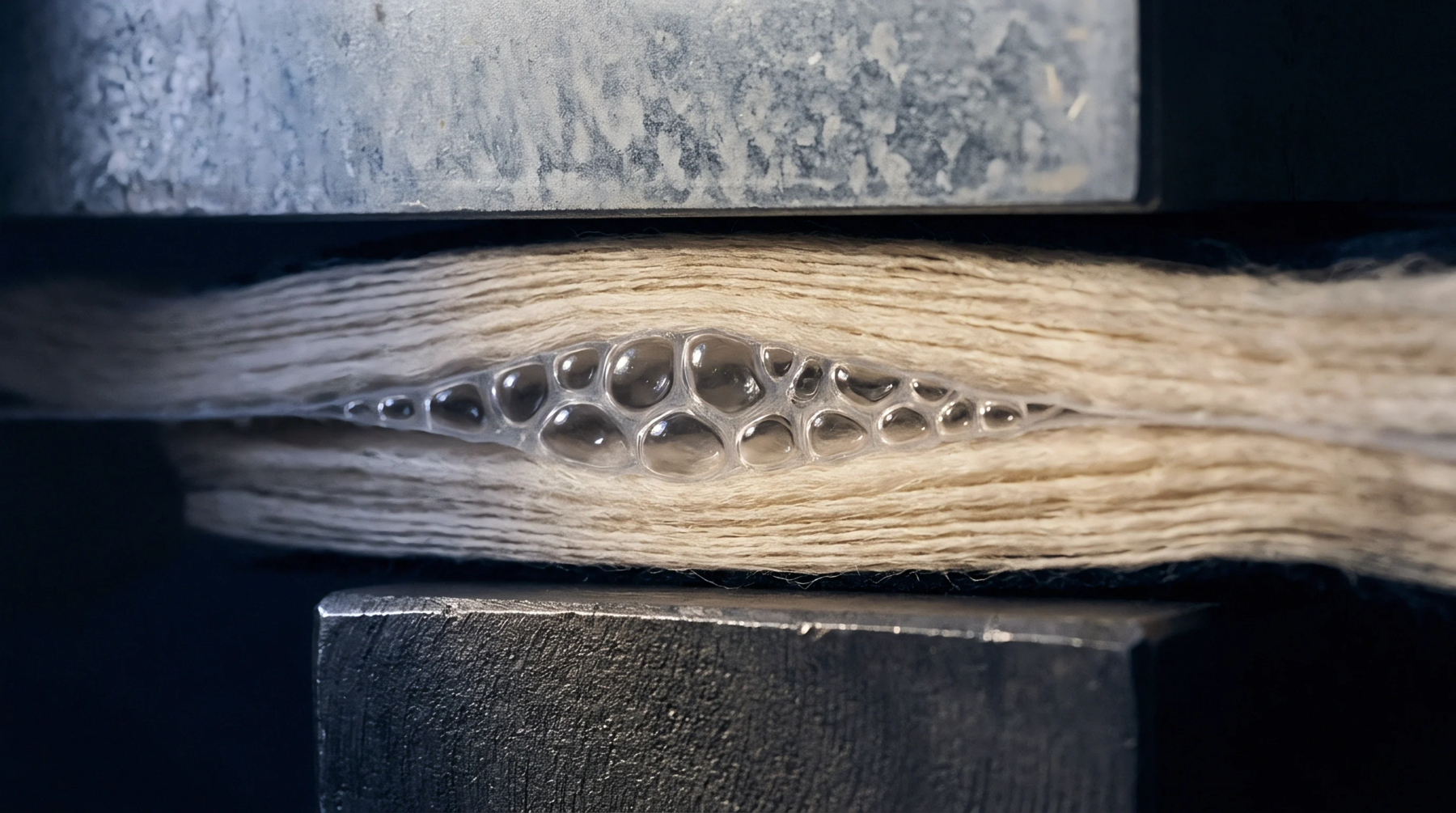
Micro Shed Dusting Accumulation Dynamics inside Air Jet Relay Nozzles under High Humidity
Humid air plasticizes sizing dust into sticky cakes inside relay nozzle bores, distorting airflow profiles and causing costly pick insertion stops.
Dimensionless ratios comparing actual measured mass flow through a fluid restriction against the theoretical mass flow calculated from idealized frictionless isentropic expansion define an orifice’s discharge efficiency. The pneumatic discharge coefficient characterizes the operational performance of air-jet weaving nozzles, relay orifices and pneumatic distribution valves. It accounts for real-world fluid friction, boundary layer growth and the physical contraction of the fluid jet known as the vena contracta.
Its numerical value remains strictly less than unity in practical applications. The metric stops applying when fluid velocities drop into low-Reynolds laminar domains where viscosity completely overrides momentum-driven orifice expansion, or when fluid medium changes from compressible gases to incompressible hydraulic liquids.
Determining flow efficiency requires precise laboratory measurement under controlled pressures and temperatures. Upstream pressure, stagnation temperature and differential pressure across the constriction are captured simultaneously with mass flow rate meters. The theoretical mass flow is derived using ideal gas equations for choked or sub-choked flow through an equivalent geometric area.
The pneumatic discharge coefficient emerges directly as the real mass flow divided by this theoretical ideal. Boundary layer friction against internal nozzle bore walls and turbulent eddy formation at the sharp entry edges force the effective aerodynamic flow path to contract below the physical hole dimensions. Modern nozzle geometries use radiused entry chambers, polished bore transitions and conical exits to suppress fluid separation, driving this coefficient toward higher operational values.
Weaving machinery performance relies directly on maintaining predictable pneumatic discharge dynamics across thousands of operational cycles. A low discharge coefficient indicates significant internal energy loss, requiring loom supply systems to provide elevated line pressures to achieve the mass flow required for yarn transport. This directly increases electrical power consumption at centralized compressor stations.
In high-speed fabric manufacturing, variations in the pneumatic discharge coefficient between adjacent relay nozzles cause uneven airflow pulses along the sley profile. Irregular pulses generate localized yarn deceleration, pick flutter and snarls. Furthermore, as nozzles undergo orifice wear or fouling over continuous production runs, the shift in discharge coefficient alters air consumption patterns and degrades yarn arrival consistency, causing fabric faults and unexpected loom stops.
Quality assurance protocols for weaving component manufacturing establish strict tolerance bands for discharge coefficients across replacement nozzle sets. Component testing benches utilize calibrated laminar flow elements to benchmark discharge ratings prior to mill deployment. Precision automated milling, electro-discharge machining and micro-abrasive polishing guarantee smooth bore transitions that minimize turbulence and preserve high flow efficiency.
Industrial testing standards require verifying that discharge values remain stable over millions of pressure pulse cycles. Monitoring this metric allows plant engineers to optimize relay nozzle firing durations and lower line pressures, capturing significant energy reductions while maintaining stable pick insertion and consistent fabric surface quality across commercial weave sheds.
Humid air plasticizes sizing dust into sticky cakes inside relay nozzle bores, distorting airflow profiles and causing costly pick insertion stops.
Expertise is a utility, not a secret. sentiention™ publishes its working knowledge as open reference: intelligence layer covering the materials it sources, the markets it enters, and the reference that serves both.