Binary Staple Fiber Transport Aerodynamics in Pneumatic Blowroom Conduit Systems
Aerodynamic slip velocity differences sort binary fiber stocks in pneumatic lines, causing card-to-card blend drift that triggers costly customs reclassification.

Drag
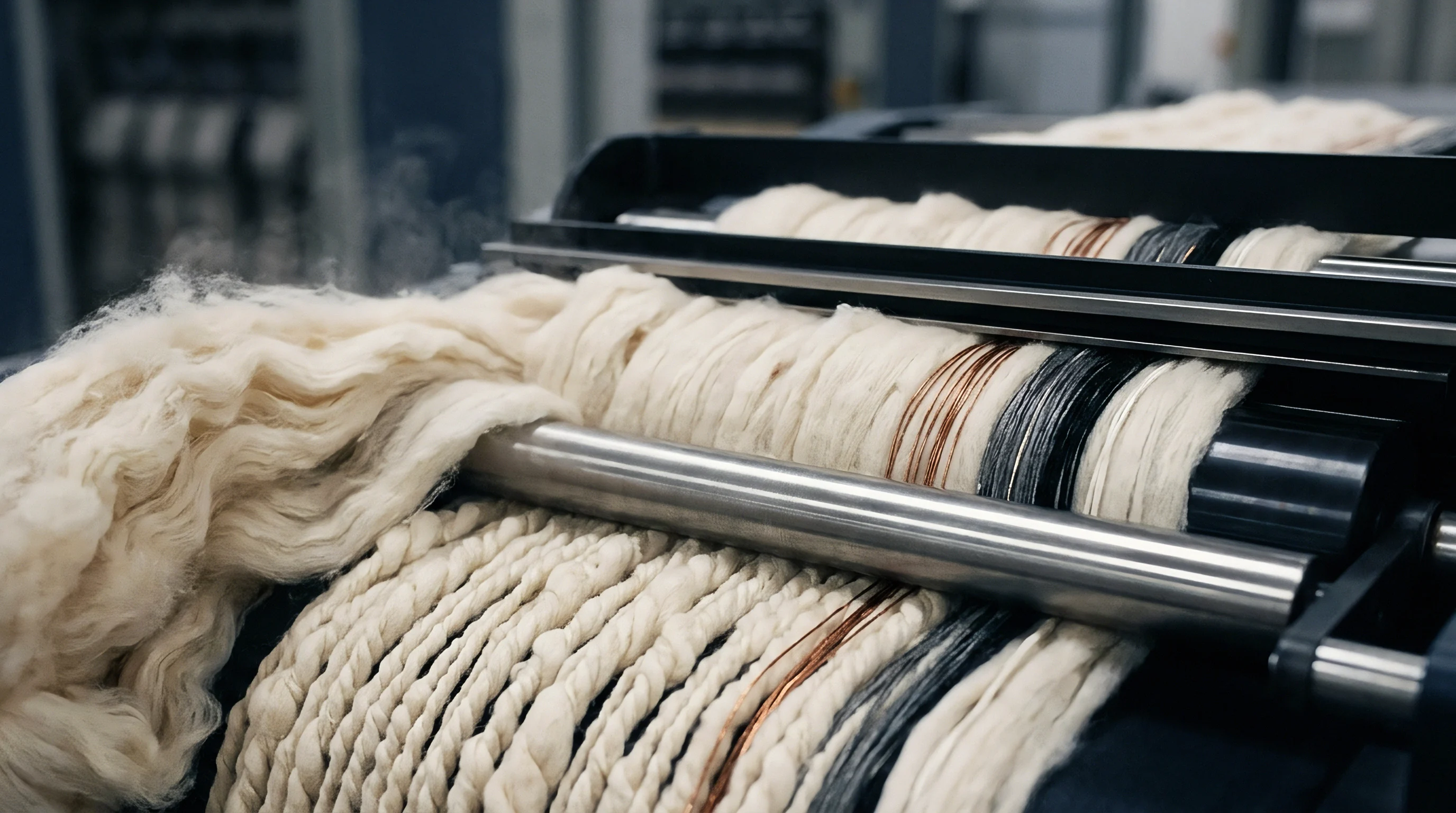
Terminal settling velocity determines how individual tufts distribute across an airstream during pneumatic transfer. In a binary opening line moving polyester and upland cotton, aerodynamic behavior diverges because raw material properties differ across density, shape factor, and specific surface area. A fine polyester tuft of 1.3 dtex at 38 mm presents a dense, cylindrical geometry with smooth surface morphology.
A cotton tuft of equivalent mass, classed at 4.2 micronaire, presents an open, convoluted cellular envelope with irregular exterior boundaries. When both components enter the pneumatic line through the primary condenser at conveying velocities between 12 and 18 meters per second, the instantaneous aerodynamic force exerted on each constituent responds to distinct boundary mechanics.
The standard expression for aerodynamic resistance on an entrained particulate body governs this behavior:
F = 0.5 ρ v2 A Cd
In this equation, ρ represents conveying gas density, v is relative slip velocity between air and staple clusters, A is projected frontal surface area, and Cd is the drag coefficient. For spherical particles in creeping flow, Stokes mechanics dictate a fixed drag relation. Fiber tufts do not behave as spheres.
A fluffy cotton cluster expands under low static pressure, inflating its frontal area A by up to 45 percent relative to a compact polyester clump of identical weight. This surface difference shifts the drag coefficient upwards, creating disparate slip ratios inside the conveyance pipe.
Polyester clusters exhibit a slip ratio 18 percent lower than upland cotton tufts under conveying velocities of 14 meters per second.
Particle Reynolds numbers for fiber aggregates inside industrial conduit networks typically span from 80 to 450. Within this intermediate flow regime, wake separation occurs behind the porous boundary of each tuft. Viscose clusters, characterized by high moisture regain and high dry polymer density (1.51 grams per cubic centimeter), yield a small frontal area per unit mass.
Cotton displays a raw fiber density near 1.54 grams per cubic centimeter, but its uncompressed tuft bulk density averages 0.025 grams per cubic centimeter in an active duct. Polyester sits lower in solid density at 1.38 grams per cubic centimeter, yet its mechanical crimp produces tight, resilient clumps that resist aerodynamic expansion.
These geometric differences dictate that the two materials decouple under equal aerodynamic drag. Air pulls harder against cotton tufts than against dense synthetic clusters. The cotton decelerates rapidly when air velocity drops and accelerates quickly when static pressure falls across pipe contractions.
Heavier synthetic tufts maintain mechanical momentum, resisting instantaneous velocity changes in the transport gas.
Centrifugal fans and material separators generate turbulence that complicates this interaction. When the blower wheel discharges stock into the primary transfer duct, fluctuating pressure gradients deform loose natural tufts while synthetic bundles retain their compressed profiles. The resulting differential displacement alters the spatial distribution of the two constituents across the conduit cross-section.
Slip velocity differences continuously sort the two components throughout the conveying line.


Duct
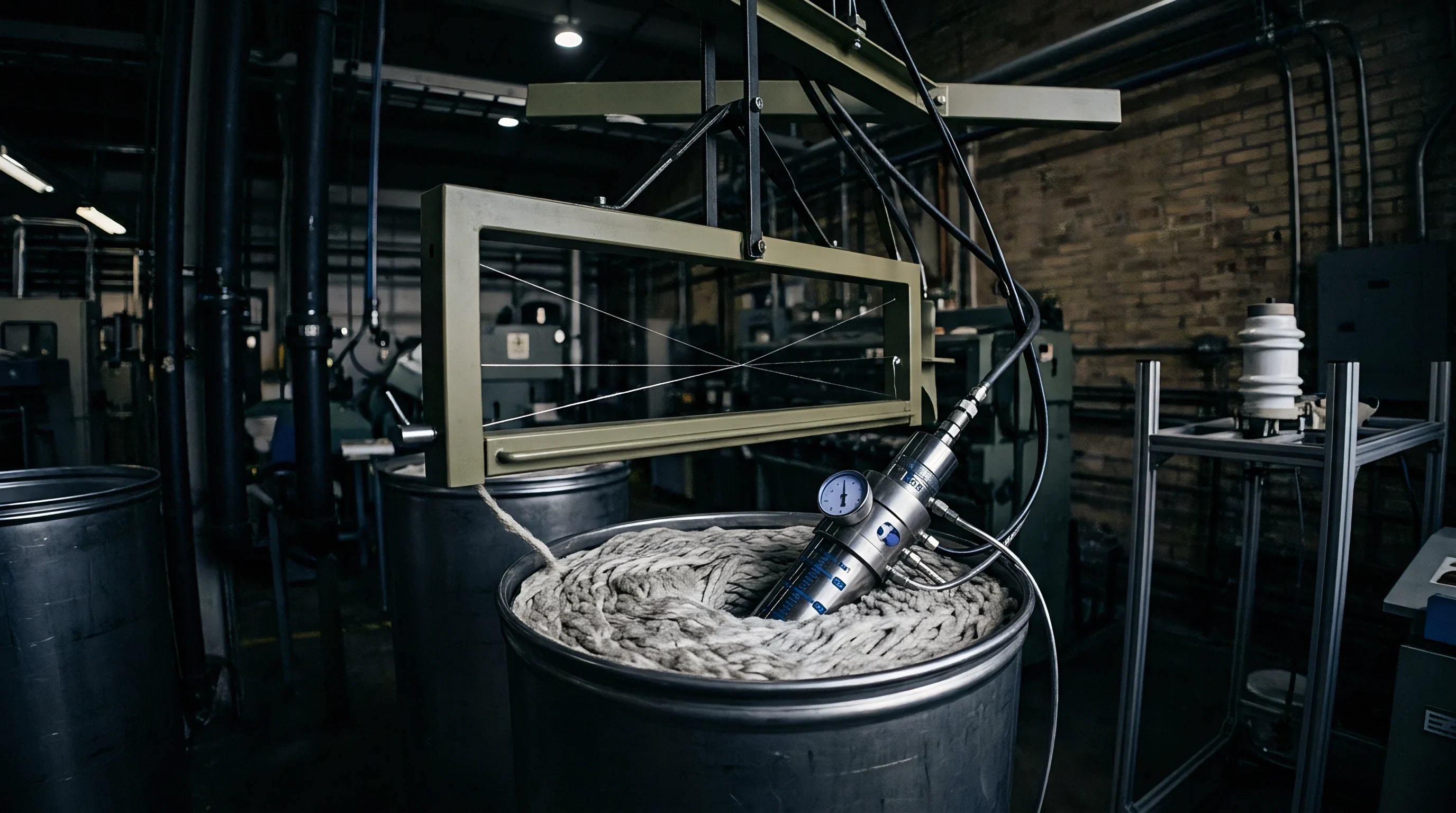
Conduit layout and boundary-layer physics govern whether a mixed fiber stock remains homogeneous during longitudinal conveyance. In straight horizontal galvanized piping with internal diameters from 300 to 450 millimeters, fully developed turbulent flow establishes a logarithmic velocity profile. Fluid velocity reaches its maximum along the pipe centerline and decreases sharply toward zero at the conduit perimeter.
Fiber aggregates do not stay centered in this velocity profile. Gravity forces dense clusters down toward the slow-moving boundary layer, while aerodynamic lift forces generated by velocity gradients push expanded clusters back toward the duct center.

What Drives Radial Demixing along Conduit Walls?
Lift forces generated by shear gradients act unevenly across binary components. Saffman lift forces depend on the relative velocity difference across the particle profile and the fluid shear rate at that radial position. Because cotton tufts have larger effective radii than equivalent polyester clusters, they experience stronger shear-induced lift forces.
These forces drive cotton tufts toward the duct core where air speeds exceed 16 meters per second. Polyester clusters remain in the lower velocity profile near the bottom invert of the pipe, subject to gravitational settling and friction against the sheet metal.
Turbulent diffusion counteracts this sorting action to a limited degree. Velocity fluctuations in the radial direction disperse particles throughout the pipe cross-section, but this mixing effect depends on particle relaxation time. The Stokes number measures this behavior:
St = τp / τf
Here τp represents particle aerodynamic relaxation time and τf is the characteristic fluid timescale of turbulent eddies. When the Stokes number approaches unity, fiber tufts decouple from turbulent eddies and drift independently. Fine cotton fibrils show small Stokes numbers, tracking high-frequency fluid eddies across the whole pipe volume.
Compact polyester clumps show Stokes numbers well above unity, moving along ballistic trajectories determined by momentum and wall collisions.
| Fiber Type | Mean Tuft Mass (mg) | Projected Area (mm²) | Terminal Velocity (m/s) | Drag Coefficient (Cd) | Settling Saltation Limit (m/s) |
|---|---|---|---|---|---|
| Upland Cotton (Mid-Middling) | 12.4 | 148.2 | 2.15 | 1.42 | 9.8 |
| Long Staple Pima Cotton | 11.8 | 162.0 | 1.92 | 1.58 | 9.1 |
| 1.3 dtex Semi-Dull Polyester | 12.5 | 88.6 | 3.45 | 0.98 | 12.6 |
| 3.3 dtex Coarse Polyester | 13.1 | 72.4 | 4.10 | 0.86 | 14.1 |
| 1.7 dtex Bright Viscose | 12.2 | 94.1 | 3.20 | 1.05 | 11.9 |
Saltation occurs when conveying air velocity falls below the threshold required to keep particles suspended. If conveying speed drops below 12.6 meters per second, polyester settles to the duct invert while cotton continues floating forward at 10 meters per second. The synthetic component drops out of suspension and slides as a dune across the pipe bottom.
This boundary sliding introduces severe mechanical abrasion, generating melted synthetic fiber skins and hard rolling defects.
- Conduit air speed must stay above the saltation velocity of the heaviest component to avoid dune formation. Fast airflow consumes excess electrical energy.
- Duct static pressure maintains balance across secondary bypass branches to prevent negative-pressure eddy traps. Unbalanced branches accumulate static lint.
- Wall roughness height in zinc-coated conduits increases skin friction and strips perimeter fiber tufts. Smooth longitudinal seam piping reduces boundary drag.
- Pipe suspension pitch requires rigid mechanical bracing every three meters to suppress acoustic line vibration. Resonant pipe frequencies accelerate phase separation.
Clean interior conduit walls minimize differential drag along the pipe run. A rough interior collects grease, finish oils, and cotton wax, creating friction pockets that capture synthetic components while passing natural fibers unimpeded.

Elbow
Bends and directional fittings disturb the distribution of binary fiber streams through sudden momentum shifts. When an air stream carrying cotton and synthetic tufts enters a 90-degree elbow, centrifugal forces push both materials toward the outer pipe radius. Centrifugal acceleration scales with the square of fluid velocity divided by the bend radius:
ac = v2 / R
In a standard conduit elbow with a radius ratio (R/D) of 1.5, air speeds of 15 meters per second produce centrifugal accelerations exceeding 40 times gravity. Under this acceleration, dense synthetic tufts separate from the gas streamlines, impacting the outer conduit wall at high velocity.
Secondary Vortex Induction in Curved Ducts
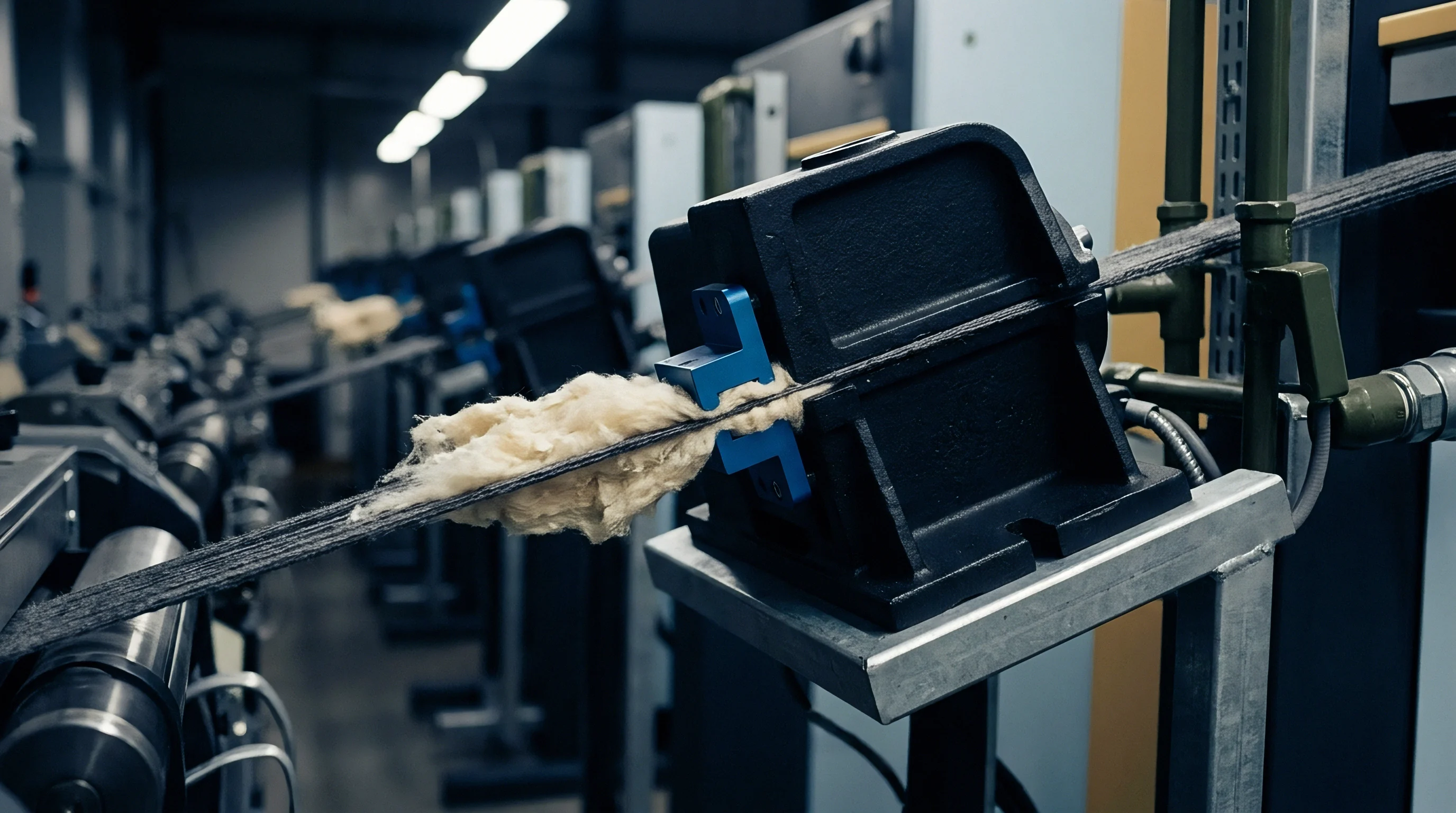
Secondary flows emerge naturally in curved pneumatic lines. Fluid along the conduit center experiences stronger centrifugal force than slower fluid near the boundary walls. This imbalance establishes a twin counter-rotating circulation known as Dean vortices.
Dean flow sweeps low-momentum air from the outer curved wall along the upper and lower duct perimeters back toward the inner radius.
Lighter cotton tufts with low Stokes numbers follow this secondary circular air path, migrating back toward the inner bend wall. Dense synthetic clumps do not follow these secondary vortices; their momentum pins them against the outer wall. This divergence splits a uniform stock into two separate streams inside a single elbow.
Cotton clusters congregate along the inner radius while synthetic clusters form a dense, sliding band along the outer perimeter.
Elbow radius ratios below 2.0 increase centrifugal segregation between synthetic and natural tufts by 34 percent.
Wall friction along the outer elbow curve degrades synthetic fibers coated with spin finishes. Polyester sliding along sheet steel under centrifugal pressure experiences rapid frictional heating, softening its exterior surface. Molten polymer coats the outer radius of the elbow, capturing passing cotton tufts and building dense mechanical plaques.
These plaques periodically break loose, introducing hard, multi-component neps into downstream opening machines.
- Material velocity drops upon wall impact, causing synthetic tufts to lag behind the gas stream. Lagging components arrive late at downstream distributors.
- Outer wall compaction increases cluster bulk density, lowering the aerodynamic drag coefficient of the synthetic fraction. Dense clusters drop quickly in vertical risers.
- Dean vortices disperse the lighter cotton component toward the inner radius, splitting the mixture cross-sectionally. Separation persists for several duct diameters.
- Re-entrainment turbulence downstream of the fitting generates chaotic flow patterns that fail to reconstitute initial blend distribution. Radial stratification remains fixed.
Split streams exiting an elbow rarely recombine into a balanced mixture. Equipment manufacturers often insist that downstream condenser screens and multi-mixer chambers homogenize segregated feeds, but practical processing reveals that physical segregation inside the conveyance pipe directly degrades card sliver uniformity.

Drift
Systematic segregation across pneumatic line components causes significant composition shifts between bale opening and finished sliver delivery. When a spinning mill opens raw bales at a specified 65/35 polyester-cotton ratio, aerodynamic drift inside conduits, diverter valves, and condenser drops alters that proportion. Long conveyance runs spanning 60 to 90 meters between the opening room and carding machinery exacerbate this separation through continuous differential slip.
By the time stock enters the chute feeds above individual cards, local mixture ratios deviate substantially from the initial laydown target.

Is Aerodynamic Segregation Recoverable at the Chute?
Chute feed separators rely on perforated screens and air exhaust baffles to condense transported tufts into a continuous batt. Cotton tufts, displaying high surface area and lower density, collect rapidly against suction screens, forming a porous initial mat. Heavier polyester clusters bounce off perforated plates, falling by gravity toward the bottom feed rolls.
In a multi-card installation fed by a single pneumatic conduit line, cards located near the line inlet receive a higher proportion of heavy polyester, while downstream cards receive air streams enriched with lighter cotton.
This aerodynamic sorting creates significant sliver composition variance across machine banks. A mill targeting 65.0 percent polyester in finished yarn may produce card sliver ranging from 61.8 percent to 67.4 percent depending on chute position. Standard testing protocols, such as quantitative chemical dissolution under ISO 1833, detect these deviations only after hundreds of kilograms pass through processing.
| Card Position | Nominal Polyester (%) | Measured Polyester (%) | Cotton Component (%) | ISO 1833 Tolerance Limit | CVm% of Delivered Sliver |
|---|---|---|---|---|---|
| Card 01 (Inlet) | 65.00 | 67.85 | 32.15 | ±1.50 | 3.85 |
| Card 03 | 65.00 | 66.40 | 33.60 | ±1.50 | 3.42 |
| Card 05 | 65.00 | 65.10 | 34.90 | ±1.50 | 3.15 |
| Card 08 | 65.00 | 63.20 | 36.80 | ±1.50 | 3.68 |
| Card 10 (Terminal) | 65.00 | 61.75 | 38.25 | ±1.50 | 4.22 |
Consider a 50-tonne yarn production order specifying a 65/35 polyester-cotton intimate mix. Raw fiber inventory is weighed at the bale plucker with precise gravimetric accuracy: 32,500 kilograms of polyester and 17,500 kilograms of upland cotton. During processing, pneumatic lines run at an unbalanced conveying velocity of 18 meters per second across nine distribution elbows.
Conveyance drift concentrates polyester at the first four cards, delivering a 67.2 percent synthetic mixture to the drawing frames. The final four cards receive a 62.1 percent mixture. When drawing slivers from these distinct machine groups are blended across the drawframe floor, cyclic mass variations arise.
Finished ring-spun yarn reveals severe shade banding after reactive and disperse dyeing. The dyed cloth exhibits broad barres caused directly by localized dye uptake differences between polyester and cellulosic fibers.
A three percent shift in synthetic fiber composition alters dispersed dyestuff absorption beyond acceptable commercial color tolerances.
Moisture regain differences amplify aerodynamic sorting mechanics. Cotton holds a standard commercial moisture regain of 8.5 percent under standard atmospheric conditions (65 percent relative humidity at 20 degrees Celsius). Polyester holds only 0.4 percent moisture.
When pneumatic systems ingest dry ambient winter air, cotton fibers surrender bound moisture, shedding weight while expanding their electrostatic charge. Electrostatic charge generates attractive forces between cotton tufts and grounded conduit walls, slowing natural fiber transport while hydrophobic polyester moves unaffected. How precisely relative humidity fluctuations alter localized slip coefficients across multi-component tuft boundaries remains an open operational question.

Penalty
Misdeclaration of binary fiber content produces immediate legal, commercial, and fiscal penalties. Customs authorities worldwide regulate imported textiles based on declared fiber mass percentages under the Harmonized System. Chapter 55 of the tariff schedule governs man-made staple fibers, while Chapter 52 classifies cotton products.
A variation of two percentage points can reclassify an entire shipment, triggering steep duty rate revisions, back-taxes, and regulatory fines.
Under United States International Trade Commission schedules, an intimate mix containing 65 percent polyester and 35 percent cotton by weight classifies under HTS heading 5509.53 as synthetic staple yarn, bearing an ad valorem duty rate between 8.0 and 12.0 percent depending on origin. If aerodynamic separation in the blowroom drops the polyester content to 49 percent at the end of the carding run, the yarn reclassifies under HTS heading 5205 as cotton-dominant yarn. Cotton yarns often face distinct duty rates, quota limits, or anti-dumping duties.
Customs laboratories verify compositions using quantitative chemical separation methods defined in ASTM D629 and ISO 1833, leaving no room for aerodynamic drift excuses.
Commercial contracts penalize composition drift with equal severity. Downstream piece goods buyers enforce strict composition tolerances, routinely permitting variance of no more than plus or minus 1.0 percent from specification. When a finished woven lot certified as 65/35 polyester-cotton tests at 62/38 upon arrival at an apparel cutting facility, the buyer issues an immediate claim.
The importer absorbs cargo testing fees, reclassification expenses, and customer chargebacks.
Yarn physical performance suffers when component ratios drift. Tensile strength declines. Ring spinning setups calibrated for a specific synthetic ratio produce excessive end-breakage rates when feeding cotton-rich sliver.
Rotor spinning setups face rapid rotor groove loading from dislodged cotton wax when natural fiber fractions spike unexpectedly. Fabric hand changes completely. High cotton fractions increase dimensional shrinkage during laundering, failing post-wash stability audits.
Prevention requires disciplined aerodynamic engineering throughout the pneumatic line. Fan speeds must use variable frequency drives linked to differential pressure sensors across the duct network. Conduit layouts must limit total bend counts, utilizing large-radius elbows with R/D ratios greater than 3.0.
Card distribution ducts must operate closed-loop reverse-air balance systems to equalize tuft delivery kinetics across every chute in the line.
Contractual agreements must incorporate explicit aerodynamic tolerances that hold spinning mills accountable for sliver homogeneity across all producing machines. A standard clause specifying that every card within a multi-chute line must deliver sliver within a plus or minus 1.0 percent composition window under ISO 1833 chemical dissolution forces spinning plants to balance transport aerodynamics before shipping yarn.