Non Linear Moisture Regain Variance in Degradation Affected Synthetic Fiber Classifications
Degraded synthetics exhibit non-linear regain increases that distort commercial mass and skew customs tariff declarations when tested against virgin baselines.
Isotherm
A titration flask confirms 64 milliequivalents of terminal carboxyl groups per kilogram on an aged polyethylene terephthalate tow, double the 32 milliequivalents measured on the virgin spinning lot. Standard commercial moisture regain tables published in ASTM D1909 assign polyethylene terephthalate a flat value between 0.40 percent and 1.50 percent, while international shipping rules under ISO 6741 fix commercial allowance figures at 3.00 percent for staple and 1.50 percent for continuous filament. These standard baselines rest entirely on pristine, high-molecular-weight polymer chains possessing uniform crystalline-to-amorphous ratios.
When synthetic polymers endure solar irradiance, heat history during extrusion, or environmental moisture, macromolecular chains break apart.
Water molecules seek polar chain ends. Every ester cleavage in polyethylene terephthalate yields one carboxyl and one hydroxyl end group. In polyamide 6 and polyamide 6,6, photolytic and hydrolytic reactions sever the amide linkage, generating paired carboxylic acid and aliphatic amine terminals.
These polar groups alter the chemical nature of the amorphous phase. Moisture sorption isotherms across undamaged synthetic polymers follow a classic Type II or weak Type III shape under the Brunauer-Emmett-Teller classification, displaying minimal moisture pickup below 50 percent relative humidity followed by gradual multilayer sorption. Degraded synthetics deviate violently from this baseline.
Sorption isotherms shift upward. The initial monolayer sorption capacity expands because the density of accessible hydrogen-bonding points increases across the broken polymer backbones.
Polyethylene terephthalate tow aged beyond 600 hours of ultraviolet exposure exhibits an equilibrium moisture regain of 2.15 percent at 65 percent relative humidity compared to 0.40 percent in pristine polymer.
The 0.40 percent baseline moisture regain for virgin polyethylene terephthalate under ASTM D1909 rests on dry-room gravimetric sorption data standardized in 1968 using 50-gram filament hanks at 21 degrees Celsius and 65 percent relative humidity; it would move upward if modern micro-denier spinning finishes were evaluated without pre-scouring. Enthalpic penalties drop rapidly. Hydrophilic terminals bind ambient water vapor at relative humidity levels as low as 15 percent.
This initial chemisorption gives way to a secondary mechanism at intermediate moisture levels. The newly formed polar complexes disrupt the intermolecular cohesion of neighboring polymer segments, lowering the local glass transition temperature. Chain scission yields hydrophilic end groups.
Moisture plasticizes these localized amorphous domains, accelerating the diffusion of water vapor deeper into the filament core.
Thermodynamic Regimes across Degraded Synthetic Chains
Laboratory gravimetric analyses conducted across controlled vapor chambers demonstrate that regain variance in weathered polymers is distinctly non-linear across the relative humidity spectrum. Virgin polyethylene terephthalate absorbs moisture in an almost linear relation between 20 percent and 70 percent relative humidity, retaining roughly 0.20 percent water at 35 percent relative humidity and reaching 0.45 percent at 65 percent relative humidity. Weathered samples show an abrupt upward inflection point above 55 percent relative humidity.
Water uptake accelerates along an exponential curve, climbing past 2.00 percent at 75 percent relative humidity and exceeding 3.80 percent at 90 percent relative humidity. Commercial regain values assume virgin polymer.
| Polymer Type | Degradation Pathway | Virgin Regain at 65% RH | Degraded Regain at 65% RH | Degraded Regain at 90% RH | Primary Sorption Mechanism |
|---|---|---|---|---|---|
| Polyethylene Terephthalate | Ultraviolet Photo-Oxidation | 0.40% | 1.85% | 3.65% | Terminal carboxyl chemisorption |
| Polyamide 6,6 | Hydrolytic Scission | 4.10% | 6.90% | 11.40% | Amine-end hydration and microvoid filling |
| Polyamide 6 | Thermal Oxidation | 4.50% | 7.35% | 12.80% | Amorphous plasticization and clustering |
| Polyacrylonitrile | Ultraviolet Weathering | 1.50% | 3.20% | 5.80% | Nitrile hydrolysis to carboxylic groups |
| Polypropylene | Photo-Oxidative Aging | 0.05% | 0.75% | 1.95% | Surface carbonyl and hydroperoxide bonding |
| Values measured gravimetrically at 20 degrees Celsius following standard desiccation under ASTM D2654, with degraded samples exposed to 500 hours xenon-arc radiation per ISO 4892-2 methods. | |||||
The 6.25 percent commercial moisture allowance for polyamide 6 under ISO 6741-2 rests on historical round-robin desiccation trials conducted across European spinning mills in 1987; the allowance would drop by nearly 0.8 percent if testing occurred on modern low-oligomer continuous filament yarns dried at 105 degrees Celsius under nitrogen flow. Polymer suppliers frequently overlook how thermal degradation during mechanical recycling shifts these curves. When post-consumer or post-industrial synthetic waste is remelted, thermal shear shortens average chain length, lowering intrinsic viscosity from 0.72 deciliters per gram to 0.60 deciliters per gram.
This degradation leaves behind millions of active chain ends that pull atmospheric moisture into the yarn structure during overseas ocean transit. Whether secondary crystalline reorganization can permanently passivate these newly formed sorption sites under ambient container transit conditions remains an open technical controversy.
Void
Electron micrographs of weathered polyhexamethylene adipamide filaments reveal surface fissures penetrating three micrometers beneath the primary skin layer. Chemical degradation rarely confines itself to molecular end-group proliferation. When radiant energy or chemical attack severs polymer chains in the oriented amorphous zones between crystalline lamellae, the relieved internal stress triggers spontaneous chain contraction.
This contraction opens physical microvoids, nano-cracks, and sub-micron cavities throughout the fiber cross-section. The presence of these physical cavities introduces capillary condensation governed by the classical Kelvin equation.
Void volume alters vapor sorption. Capillary condensation takes place inside tiny pores at vapor pressures significantly lower than the saturation vapor pressure of free water. In virgin synthetic filaments, internal porosity is negligible, restricting moisture uptake strictly to solid-state dissolution and surface adsorption.
In degradation-affected polymers, microvoid networks with radii between one and ten nanometers act as water sinks. Kelvin condensation fills microcavities rapidly. The physical condensation of water vapor within these internal spaces explains why moisture regain climbs steeply once the ambient relative humidity crosses 60 percent.
Desorption curves track higher than absorption.
Damaged synthetic filament bundles retain capillary water along microcracks long after ambient relative humidity drops.
The capillary retention mechanism permanently widens the moisture hysteresis loop. When virgin synthetic fiber desorbs water as ambient humidity falls, the desorption boundary curve tracks close to the absorption curve, exhibiting a narrow hysteresis gap. In degraded synthetics containing extensive microcavity systems, water trapped within narrow-necked pores cannot desorb until ambient vapor pressure drops far below the condensation threshold.
The meniscus formed at the pore opening pins the internal water volume. Moisture content remains artificially elevated during dry-down testing protocols.
Are Weathered Polyamide Filaments Prone to Hysteresis Inversion?
Sorption curves generated via automated gravimetric vapor sorption show distinct separation between adsorption and desorption branches across damaged nylon matrices. In pristine polyamide 6,6, the desorption curve returns smoothly to zero mass gain under continuous nitrogen drying at standard room temperature. Weathered polyamides retain between 1.20 percent and 2.50 percent non-desorbable moisture under identical dry gas purges.
Surface carboxyl groups attract moisture. Chemical and physical modifications act cooperatively, altering the mechanical response of the yarn lot.
- Chemi-Crystallization Stress drives localized density increases while simultaneously opening inter-lamellar cracks that channel moisture directly into the filament center.
- Photo-Oxidative Surface Etching creates irregular pits that expand total geometric surface area by up to four hundred percent.
- Oligomer Leaching during wet scouring washes out low-molecular-weight fractions, leaving open internal channels that fill with ambient humidity.
- Amide Cross-Linking restricts polymer chain mobility in degraded nylons, forming rigid micro-cages that trap clustered water clusters against standard drying cycles.
Impurities accelerate degradation kinetics. Metallic catalyst residues remaining from primary polymerization speed up the formation of free radicals under sunlight. The industry-circulated claim that outdoor weathering increases polyester moisture regain by precisely 0.85 percent across twelve months of sunlight exposure lacks standardized verification across varying solar irradiance levels; under this uncertainty, the prudent procurement officer insists on empirical desiccation testing of container arrivals rather than accepting published weathering adjustments.
Whenever surface cracking visible under optical magnification accompanies chain cleavage, vapor adsorption outpaces bulk desorption across every subsequent atmospheric exchange.
Swell
Solvent retention measurements taken after centrifugal extraction illustrate how solvent molecules penetrate damaged filament bundles. Virgin synthetic fibers display exceptionally low diametric swelling in water. Pristine polyethylene terephthalate swells less than 1.0 percent in diameter when submerged, while virgin polyamide 6,6 exhibits a transverse swelling coefficient between 2.0 percent and 3.0 percent.
When internal microvoids and hydrophilic chain terminals proliferate, the swelling dynamics change completely. Trapped moisture pushes apart broken amorphous chains, forcing the transverse fiber diameter to expand unpredictably during conditioning.
Secondary crystallization expels bound water. This dimensional expansion alters the physical geometry of yarn packages wound onto perforated dye tubes or spinning cops. As degraded fibers absorb humidity from shipping air, the individual filaments expand radially while contracting axially.
Package density spikes, clamping inner yarn wraps against the cone core. Moisture distribution across the yarn package ceases to be uniform. The exterior wraps reach equilibrium with maritime humidity, while the inner wraps remain desiccated or trap moisture along pinched contact lines.
Bale core temperatures exceeding forty degrees Celsius indicate ongoing exothermic moisture adsorption inside weathered synthetic packaging.
Classing technicians who draw cores from compressed staple bales see this behavior firsthand. When a sampling probe penetrates a bale of degraded recycled synthetic staple, the core barrel often jams due to localized swelling pressure. The physical resistance inside the bale does not match the clean glide experienced when coring pristine virgin fiber.
The fiber web feels gummy to the touch. Spinning technicians processing this degraded stock through opening and carding rooms report static electricity anomalies alternating with cylinder loading, directly tracing back to erratic moisture distribution across the bale mass.
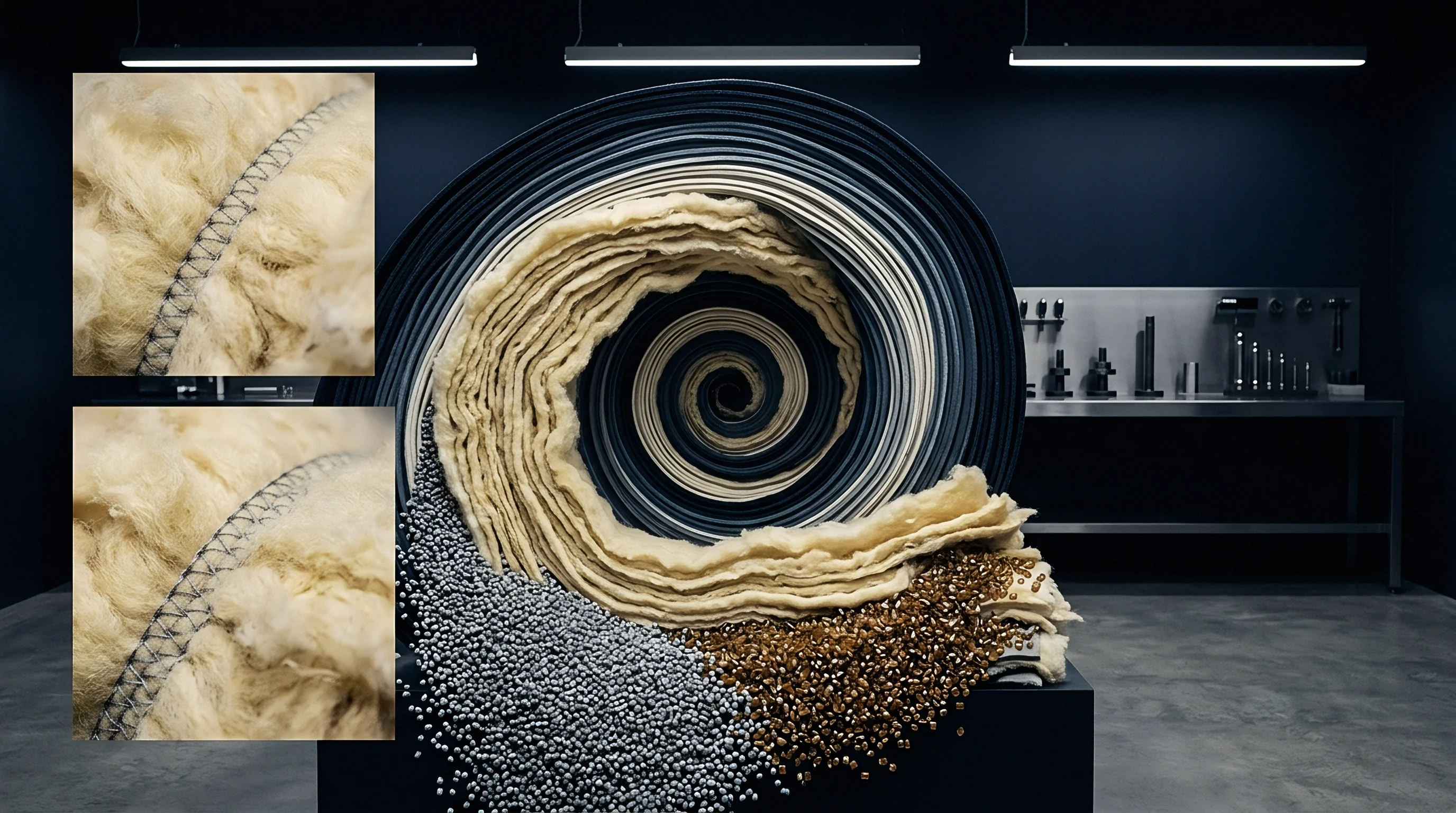
Physical Entanglement and Capillary Trapping Mechanics
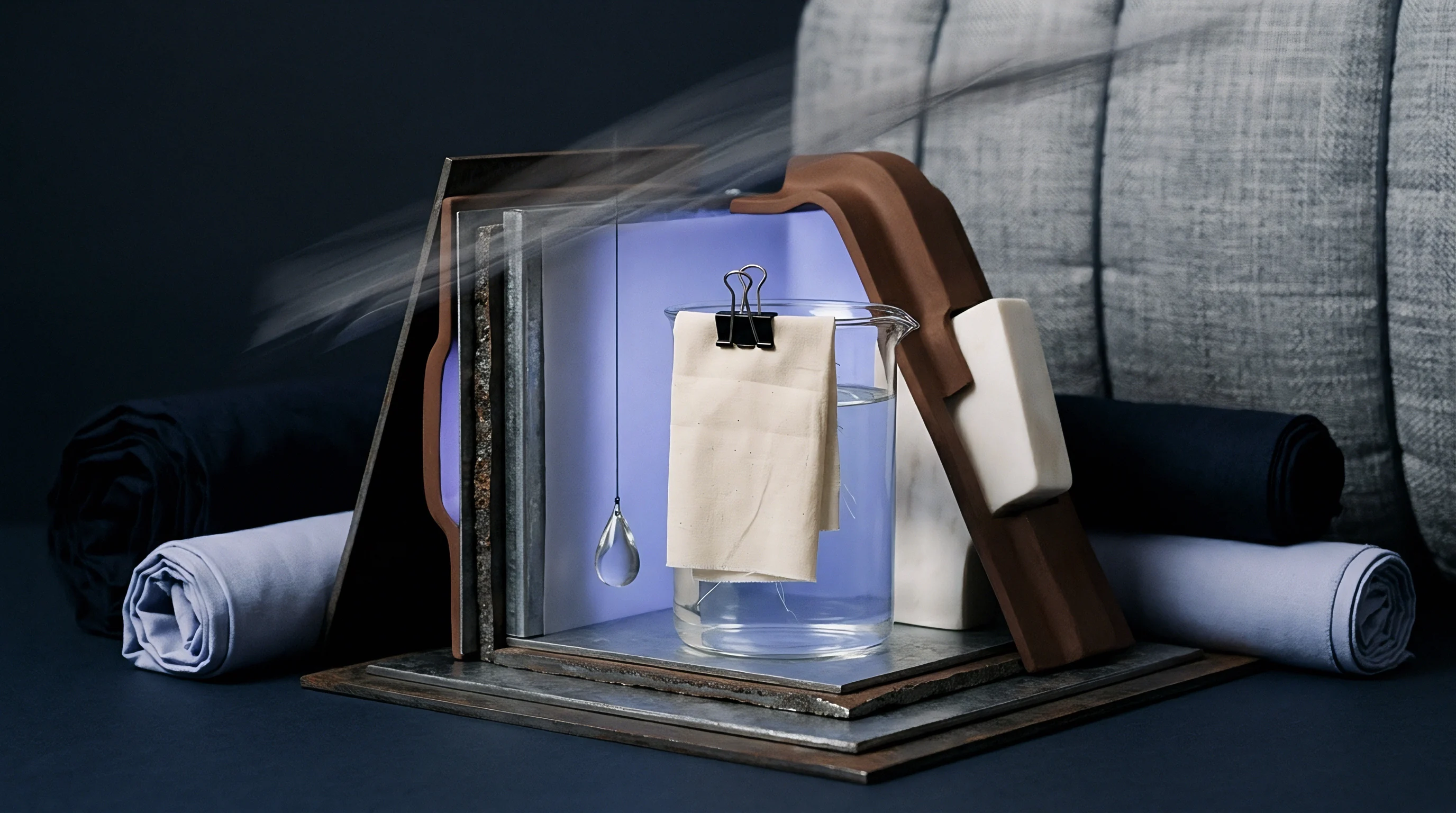
Bale sampling across long-stored inventory demands a sequential methodology to verify whether elevated moisture stems from external water damage or internal polymer degradation. The laboratory uses a five-stage verification sequence to establish physical lot condition:
- Outer Package Inspection confirms whether packaging film tears have exposed exterior fiber layers directly to liquid sea water or warehouse condensation.
- Core Sample Extraction pulls twenty-millimeter cylindrical sections from three distinct depths to verify whether moisture concentration runs uniformly through the bale.
- Immediate Sealed Gravimetry isolates drawn fibers in airtight aluminum canisters to lock in the true as-received weight prior to room exposure.
- Oven-Drying Desiccation heats the specimens to 105 degrees Celsius under forced airflow until consecutive weighings agree within 0.05 percent.
- End-Group Titration Verification correlates total measured weight loss against terminal carboxyl or amine group concentrations to prove chemical degradation.
Overseas spinning mills routinely argue that localized moisture spikes reflect maritime transit humidity rather than intrinsic polymer decomposition across the warehouse lot.
Classification
Customs valuation officers at northern entry ports apply standard commercial allowances from ISO 6741 without testing whether imported staple fibers have undergone outdoor weathering. Tariff determination under the Harmonized System depends strictly on fiber weight percentages. Chapter 54 governs synthetic filament yarn, Chapter 55 covers synthetic staple fibers, and Chapter 52 classifies cotton combinations.
Note 2 to Section XI of the Harmonized Tariff Schedule establishes that goods containing two or more textile materials classify as if consisting wholly of that one textile material which predominates by weight over every other single textile material.
Dry mass governs every invoice. When commercial customs entries declare an intimate mixture of combed cotton and synthetic staple, the statutory classification relies on quantitative chemical analysis under ISO 1833 or AATCC 20A. These methods dissolve one component using selective chemical reagents, such as sulfuric acid for cellulose, leaving the synthetic component as insoluble residue.
The oven-dry mass of the remaining synthetic fiber is then mathematically corrected by adding the official commercial moisture regain percentage prescribed in national customs regulations. Tolerances vanish under customs scrutiny.
| Declared Mixture Ratio | Polymer Degradation State | Standard Commercial Mass | Actual Conditioned Mass | Calculated Synthetic Ratio | Customs Tariff Outcome |
|---|---|---|---|---|---|
| 52% Cotton / 48% PET | Virgin High-Tenacity | 20,000 kg | 20,010 kg | 47.9% PET | Chapter 52 (Predominance Cotton) |
| 52% Cotton / 48% PET | Aged Recycled (2.1% Regain) | 20,000 kg | 20,340 kg | 48.7% PET | Chapter 52 (Maintained Tariff Line) |
| 50.5% Cotton / 49.5% PA66 | Virgin Bright Filament | 40,000 kg | 40,050 kg | 49.4% PA66 | Chapter 52 (Predominance Cotton) |
| 50.5% Cotton / 49.5% PA66 | Weathered Tow (7.8% Regain) | 40,000 kg | 40,820 kg | 50.6% PA66 | Chapter 55 (Reclassified to Synthetic) |
| 55% Wool / 45% Acrylic | Photolytically Degraded PAN | 15,000 kg | 15,280 kg | 46.2% PAN | Chapter 51 (Borderline Retained) |
Civil engineering installations face parallel failures when buried non-woven geotextile mats absorb excessive groundwater brine; the degraded polypropylene stabilizers undergo photo-oxidation before burial, increasing polar sites that accelerate salt hydration and distort civil site load estimates. The declared tariff line collapses. A shipment declared as 50.5 percent cotton and 49.5 percent polyamide staple under tariff heading 5205 attracts a duty rate of 5.0 percent in typical regional customs schedules.
If the polyamide stock has suffered severe hydrolytic degradation during prolonged open-yard warehousing before spinning, its true equilibrium moisture regain at standard testing conditions (20 degrees Celsius, 65 percent relative humidity) jumps from the statutory 4.50 percent allowance to 7.80 percent. The physical mass of the synthetic portion expands in the testing laboratory.
Which Analytical Benchmarks Catch Divergent Sorption Regimes?
Laboratory technicians rely on quantitative dissolution methods to isolate synthetic components from natural partners in multi-fiber yarns. When calculating the commercial mass of the insoluble polyamide residue, the technician applies the statutory moisture allowance of 6.25 percent to the oven-dry weight. If the analyst simply weighs the conditioned yarn before chemical dissolution without oven-drying the components separately, the moisture-swollen polyamide tips the scale.
The synthetic component registers at 50.6 percent of the total specimen mass. The entire forty-tonne consignment flips from Chapter 52 into Chapter 55 as synthetic-predominant yarn, where duty rates frequently climb to 12.0 percent. Port laboratories retest every container.
- Differential Scanning Calorimetry Runs reveal depressed melting peaks and double-melting endotherms characteristic of degradation-induced chemi-crystallization.
- Gel Permeation Chromatography Columns separate cleaved polymer fractions to establish whether molecular weight distribution has shifted toward hydrophilic low-mass tails.
- Automated Karl Fischer Titrators measure true bound water content directly, separating moisture weight from volatile spinning finishes that skew oven-dry readings.
- Infrared Carbonyl Index Calculations compare absorbance bands at 1715 reciprocal centimeters against aliphatic reference peaks to quantify oxidative degradation.
Miscalculating oven-dry component ratios due to uncorrected regain curves triggers mandatory reclassification under customs tariff codes, bringing retroactive tariff assessments and penal demurrage charges against the importer of record.

Valuation
Financial settlements on bulk synthetic fiber contracts depend on invoice weights established at the dispatch terminal. In commodity trade, synthetic filament and staple fibers invoice on commercial mass, defined under BISFA regulations as oven-dry mass plus the agreed commercial moisture allowance. When buying prime virgin polyester staple at 1.85 dollars per kilogram, paying for 0.40 percent to 1.50 percent water represents an accepted trade reality.
If a vendor supplies weathered or off-spec recycled fiber whose true ambient moisture regain reaches 2.80 percent, the purchaser pays virgin fiber prices for pure atmospheric moisture.
Take a 100-tonne delivery of polyester staple fiber invoiced at 1,850 dollars per metric tonne. Under standard BISFA rules, the invoice assumes an oven-dry weight of 98,522 kilograms plus a 1.50 percent commercial allowance, yielding 100,000 kilograms invoiced commercial mass. If the delivered stock has suffered thermal and oxidative chain scission during recycling, the fiber arrives from the container terminal holding 2.85 percent ambient moisture.
The true oven-dry fiber content is only 97,228 kilograms. The buyer receives 1,294 kilograms less clean dry polymer than contracted. The financial loss on raw material alone equals 2,393 dollars on a single contract.
The financial exposure remains unhedged.
Invoking the commercial mass arbitration provisions of BISFA Rulebook Section 7 forces independent laboratory desiccation and voids vendor weight certificates that omit degradation testing.
The downstream consequences expand rapidly once this fiber enters production. As the yarn is spun and woven into cloth, weight per square meter calculations begin to fail specifications. Woven greige goods calibrated to finish at 145 grams per square meter drop to 141 grams per square meter after scouring and drying have stripped out the volatile moisture trapped within the degraded polymer voids.
The buyer fails brand performance specifications for cloth weight. Tensile strength drops along with mass. The finishing plant cannot reclaim the lost yield.

Contractual Allocation of Commercial Mass Discrepancies
Legal dispute resolutions in textile procurement require strict contractual wording regarding fiber moisture tolerances. Purchase agreements must tie invoice weights not to ambient arrival scales, but to standardized desiccation test procedures performed under ISO 6741-1. Sourcing contracts covering recycled or reprocessed synthetic fibers require specific clauses defining maximum allowable moisture regain variance under standard conditioning atmospheres.
Incorporating a mandatory ASTM D2654 oven-drying clause with BISFA moisture tolerance limits into purchase agreements invalidates unilateral supplier weight certificates whenever laboratory regain diverges from declared baseline allowances by more than one half of one percent.