Modeling Non Linear Fiber Segregation in Dual Nozzle Pneumatic Spinning Systems
Dual nozzle air spinning forces finer fibers into yarn sheaths, creating radial composition gradients that distort surface durability and customs declarations.

Plume
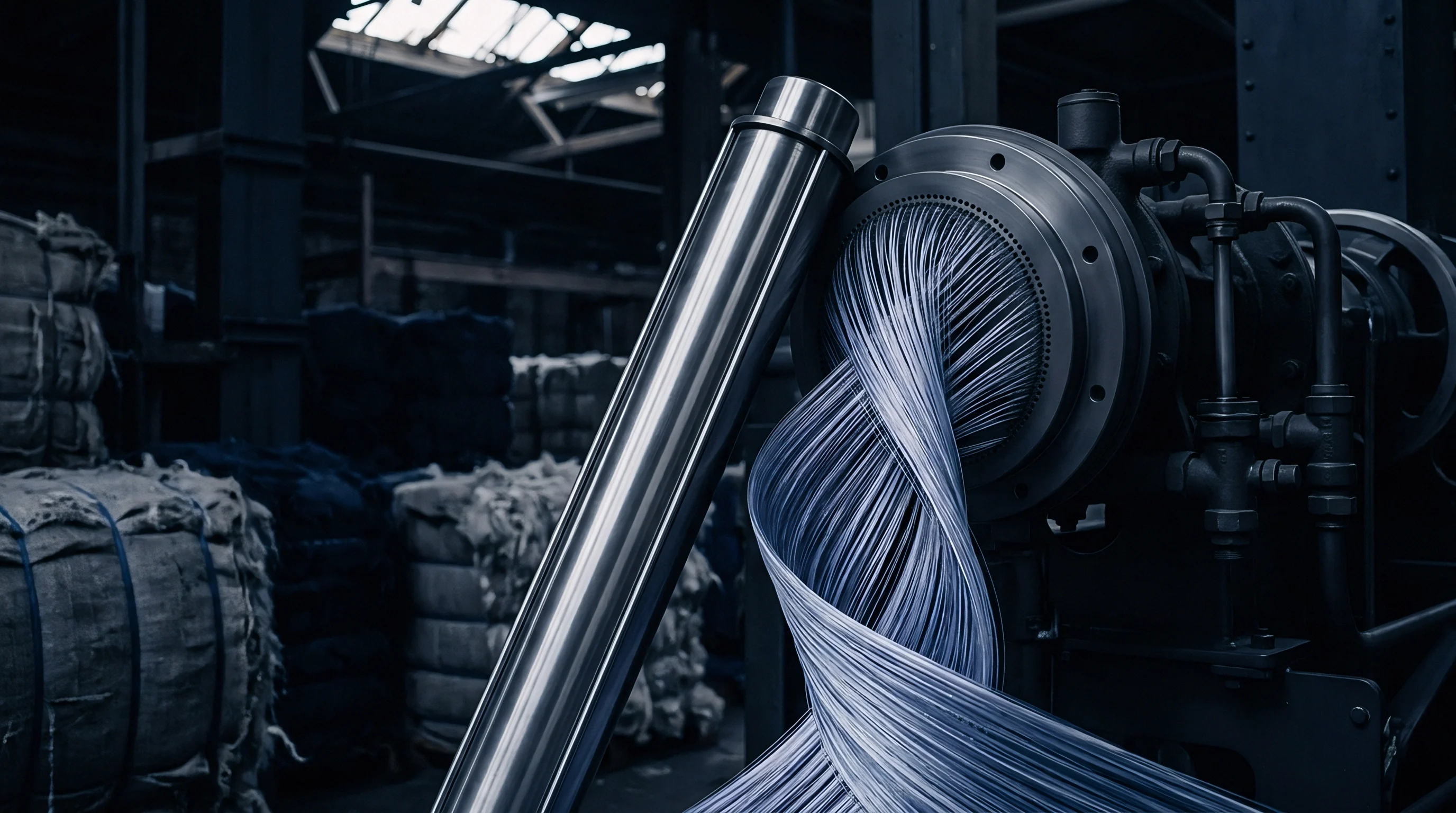
Differential static pressure across opposing air jets forces mixed staple fibres into divergent radial trajectories. In a dual nozzle pneumatic spinning unit, drawn sliver enters the primary injector where an expanding air cone strips trailing ends away from the main strand. The secondary nozzle generates a high-velocity rotational field in the reverse angular direction.
Coarser synthetic filaments, possessing higher flexural rigidity and greater linear mass, resist immediate peripheral deflection. Finer cellulosic units yield rapidly to the outer aerodynamic streamlines. The resulting yarn structure exhibits an involuntary, non-linear composition gradient between its interior core and external wrapper layers.
Quantitative cross-sectional analysis reveals substantial divergence from nominal input proportions. A sliver carded at sixty-five percent polyester and thirty-five percent combed cotton consistently reorganizes during transport through the fluid disturbance. Testing via chemical dissolution according to ISO 1833-11 establishes wrapper regions composed of fifty-four percent cotton, while the inner load-bearing core retains seventy-eight percent synthetic polymer.
Mill engineers adjusting false-twist parameters often treat this separation as random spinning waste. The segregation follows predictable fluid mechanics governed by the balance between Stokesian skin friction and centrifugal particle displacement.
Radial separation in dual-orifice pneumatic chambers alters exterior sheath composition by up to nineteen percentage points relative to input sliver specifications under four bar line pressure.
Physical yarn properties respond directly to this radial redistribution. Surface-dominated characteristics, including abrasion resistance, pilling propensity, and dye uptake, reflect wrapper chemistry rather than aggregate batch mass. When peripheral layers pack with short cellulosic fragments, Martindale cycle endurance under ISO 12947-2 drops before internal synthetic filaments experience mechanical fatigue.
The inner core retains tensile integrity while fabric surfaces degrade under light frictional wear. Sourcing specifications drafted without reference to aerodynamic segregation risk commercial rejection during retail wear assessments.
Air consumption balances against structural integrity across every spinning position on the automated rail. Operating the primary nozzle at 0.25 megapascals while driving the counter-twist unit at 0.45 megapascals accelerates rotational yarn velocity beyond two hundred thousand revolutions per minute. This shear plane detaches up to four percent of total combed cotton volume as airborne lint.
The evacuation exhaust carries away the finer natural fraction, shifting the final package yield toward the synthetic component. Buyers evaluating landed kilogram invoices absorb this material loss through elevated conversion costs.
Spinning trials demonstrate that raw cotton micronaire shifts the segregation threshold across fixed pressure profiles.

Velocity
Axial pneumatic acceleration couples with rotational shear within the five-millimetre gap separating the twin counter-rotating fluid injectors. Aerodynamic forces acting upon an individual staple entity depend on instantaneous Reynolds numbers and local swirl decay coefficients. A polyester staple measuring 1.3 decitex with a thirty-eight millimetre cut length exhibits aerodynamic drag distinct from an upland cotton staple of equivalent cut.
Heavier individual fibres experience elevated centrifugal momentum, migrating toward nozzle boundaries where wall friction arrests forward axial transit.
The mathematical formulation for radial particle velocity inside the swirling flow field incorporates drag, centrifugal acceleration, and mechanical fiber-to-fiber contact:
v_r = (d_f^2 (rho_f – rho_a) omega^2 r) / (18 mu_a) + (C_d rho_a (u_r – v_r)^2) / (4 rho_f d_f)
Within this relationship, d_f designates equivalent fiber diameter, rho_f represents fiber density, rho_a is fluid density, omega denotes angular air velocity, mu_a signifies dynamic viscosity, C_d is the drag coefficient, and u_r represents radial air velocity. The square of the fiber diameter dominates early radial migration. Coarser denier components move outwardly inside the initial ten millimetres of fluid contact.
Secondary counter-twisting reverses this profile by trapping trailing ends into tight outer helices, creating sudden inversions in structural packing density.
| Fiber Category | Linear Density (dtex) | Flexural Rigidity (nN mm²) | Radial Drift Rate (m/s) | Core Retention Ratio (%) |
|---|---|---|---|---|
| Pima Cotton G. barbadense | 1.22 | 0.042 | 1.85 | 31.4 |
| Upland Cotton G. hirsutum | 1.58 | 0.068 | 2.40 | 39.8 |
| Micro-denier Polyester | 0.89 | 0.021 | 1.15 | 22.1 |
| Standard Semi-Dull Polyester | 1.44 | 0.058 | 2.10 | 46.2 |
| High-Tenacity Polyester | 2.20 | 0.145 | 3.65 | 68.5 |
Boundary layer turbulence strips loose fibers possessing low bending modulus. Cotton fibers with high natural convolution exhibit irregular cross-sections, creating elevated drag coefficients relative to smooth, round synthetic profiles. This drag differential causes natural fibers to decelerate axially while accelerating tangentially.
The primary nozzle acts as an aerodynamic classifier, separating constituents by aerodynamic diameter rather than mass alone.
- Primary nozzle pressure reduction down to 0.20 megapascals curtails excessive trailing-end detachment while maintaining sufficient forward yarn transport through the delivery guide.
- Orifice distance adjustments between three and seven millimetres modify the transit duration during which unconstrained wrapper fibers undergo centrifugal sorting.
- Differential airflow ratios between injectors stabilize core cohesion without ejecting high-value combed cellulosic components into the waste filter box.
- Secondary injector geometry selection with forty-five-degree entry angles suppresses turbulence spikes that otherwise break fragile natural staples.
Failing to stabilize nozzle pressure ratios produces yarn packages with alternating cross-sectional composition along the continuous strand, generating barre streaks across dyed single-jersey surfaces.
Helix
Wrapper fiber formation dictates the radial distribution of tensile properties throughout the finished strand. As the consolidated core emerges from the secondary twisting chamber, free trailing ends wrap around the exterior under high tangential tension. The wrapping angle varies continuously between thirty and sixty-five degrees relative to the yarn axis.
Polyester fibers with long cut lengths form broader, flatter coils. Shorter cotton staples create tight, steep turns that compress the inner column, locking segregated polymers into distinct radial zones.
Cross-sectional mapping across two hundred yarn slices demonstrates consistent non-linear partitioning. The inner twenty percent of yarn radius contains an overwhelming concentration of rigid fibers. Moving outward toward seventy percent of total radius, the structure reaches an inflection point where natural cellulosic fibers dominate the cross-section.
The outermost ring consists almost entirely of short wrapper fragments, forming a weak exterior mantle that pills readily during laundering.
Greige yarns spun with mismatched polymer diameters peel under forty kilopascals of abrasion pressure when wrapper layers lack long binder filaments.
This structural segregation alters mechanical load distribution under tensile strain. During standard testing according to ISO 2060 and ISO 2062, exterior wrapper coils fracture before the internal core reaches fifty percent of its ultimate elongation. The sudden load transfer shocks the parallel core filaments, dropping yarn tenacity below predicted values calculated from simple rule-of-mixtures equations.
A thirty tex yarn designed for twenty-two centinewtons per tex may fail at seventeen centinewtons per tex when segregation prevents uniform strain distribution.
| Radial Zone | Fractional Radius Band | Polyester Proportion (%) | Cotton Proportion (%) | Packing Density (g/cm³) |
|---|---|---|---|---|
| Center Core | 0.00 to 0.25 | 81.2 | 18.8 | 0.68 |
| Inner Ring | 0.25 to 0.50 | 72.5 | 27.5 | 0.61 |
| Transition Band | 0.50 to 0.75 | 53.4 | 46.6 | 0.52 |
| Outer Sheath | 0.75 to 1.00 | 38.9 | 61.1 | 0.39 |
Moisture sorption behavior diverges across this radial geometry. Atmospheric conditioning under ISO 139 reveals that water molecules penetrate the porous cotton-rich sheath rapidly, while the dense synthetic core remains unaffected over short exposure windows. This differential expansion generates micro-wrinkling across circular knits during steam finishing.
Fabric finishers attempting to set width often find dimensional stability unpredictable across production rolls.
The machinery technician will state that nozzle swirl cleanout intervals cause this uneven surface texture across consecutive bobbin lots.

Audit
Customs declarations rely upon precise quantification of aggregate fiber percentages by net dry mass. When aerodynamic segregation shifts the outer surface toward natural fibers, conventional surface examination techniques mislead laboratory personnel. Attenuated total reflectance Fourier-transform infrared spectroscopy, penetrating only two microns into the yarn surface, produces false readings indicating sixty percent cotton in lots carded at sixty-five percent polyester.
Accurate verification demands full chemical dissolution according to ISO 1833-1 or ASTM D629.
Draw sliver records provide essential baseline data before mechanical transformation. Bale management protocols track incoming micronaire, trash content, and synthetic denier profiles to ensure uniform input ratios. When pneumatic spinning units operate at nine hundred metres per minute, minute deviations in raw sliver cohesion cascade into severe composition drift across automated winding units.
Testing teams pull representative skeins from ten random packages per ten-tonne carton container, verifying that aggregate dissolution matches input sliver sheets within commercial mass tolerances defined by ISO 6741.
- Chemical separation dossiers must document analytical solvent temperatures, sample dry mass before treatment, and residual tare weights to within 0.0002 grams precision.
- Cross-section microscopy mounts prepared with methyl methacrylate embedding demonstrate mechanical segregation boundaries between center core filaments and external wrapper turns.
- Wasted lint extraction logs recording collector vacuum filter weights confirm whether differential fiber loss skewed the final package ratio during high-speed spinning.
- Commercial regain correction factors established under international standards ensure declared tariff percentages account for nine percent cotton regain against 0.4 percent synthetic regain.
Commercial shipments face detention when surface reflectance testing conflicts with declared chief-weight customs tariff codes.
A worked scenario highlights commercial exposure during border clearance. A sourcing contract specifies forty metric tonnes of combed cotton and staple polyester knit yarn declared under Harmonized System code 5509.53 as other yarn of polyester staple fibers mixed mainly with cotton, carrying an import tariff of eight percent. The contract mandates sixty percent synthetic content by dry weight.
Due to aggressive injector pressures and excessive cotton loss in spinning waste, bulk shipments test at seventy-one percent polyester across entire container lots. Importers face misdeclaration penalties, delayed clearance fees, and reassessment under alternative tariff schedules.
According to standard commercial purchase conditions, yarn packages displaying compositional variance exceeding plus or minus two percentage points from agreed specifications entitle buyers to price renegotiation or full lot rejection.
Freight
Landed costs incorporate raw material pricing, spinning power consumption, sorting yields, and final logistics charges. Operating dual pneumatic nozzles requires compressed air volumes reaching thirty-five normal cubic metres per hour per spinning frame. This energy overhead adds twelve cents per kilogram compared to traditional ring spinning lines.
When aerodynamic segregation drives three percent of input cotton into waste collection bins, the raw material cost per net kilogram rises accordingly.
Finished woven and knitted yardage demonstrates the financial fallout of structural segregation. Knitted jersey produced from segregated air-spun yarns exhibits differential dye affinity during piece dyeing. Polyester disperse dyes penetrate core zones slowly, while cotton reactive dyestuffs saturate the porous exterior sheath.
If jet dyeing cycles fail to accommodate this structural gradient, finished fabric displays frosted appearances and ring marks across creases. Garment mills cutting panels from segregated lots lose up to seven percent of yardage due to uncorrectable shade banding.
A container carrying nineteen tonnes of twenty-four tex jersey yarn represents substantial capital exposure. Assuming a baseline yarn price of 3.45 dollars per kilogram, raw product value equals 65,550 dollars per container. Sea freight, customs clearance, and inland drayage append another 8,200 dollars to the port delivery sheet.
When shade variation forces a downgrade from first-quality sportswear to discounted clearance stock, finished garment margins contract by thirty-five percent across the cutting order.
The operational solution rests on establishing rigorous tolerance limits in pre-shipment purchase contracts. Buyers must link pneumatic nozzle setup parameters, specifically primary-to-secondary pressure ratios and waste sliver recovery limits, directly to technical specification sheets. Routine testing of surface abrasion using Martindale mechanics provides early warning of excessive exterior segregation before yarn winds onto shipping pallets.
Whether real-time optical sorting inside the secondary injector can dynamically suppress aerodynamic segregation across varying fiber lengths remains an open operational challenge for spinning machinery builders.