Quantifying Fiber Loss Mechanics in Dual Nozzle Spinning Systems
Differential pneumatic stripping removes short cotton fibers faster than polyester, altering yarn composition by two percent and shifting tariff lines.

Vortex
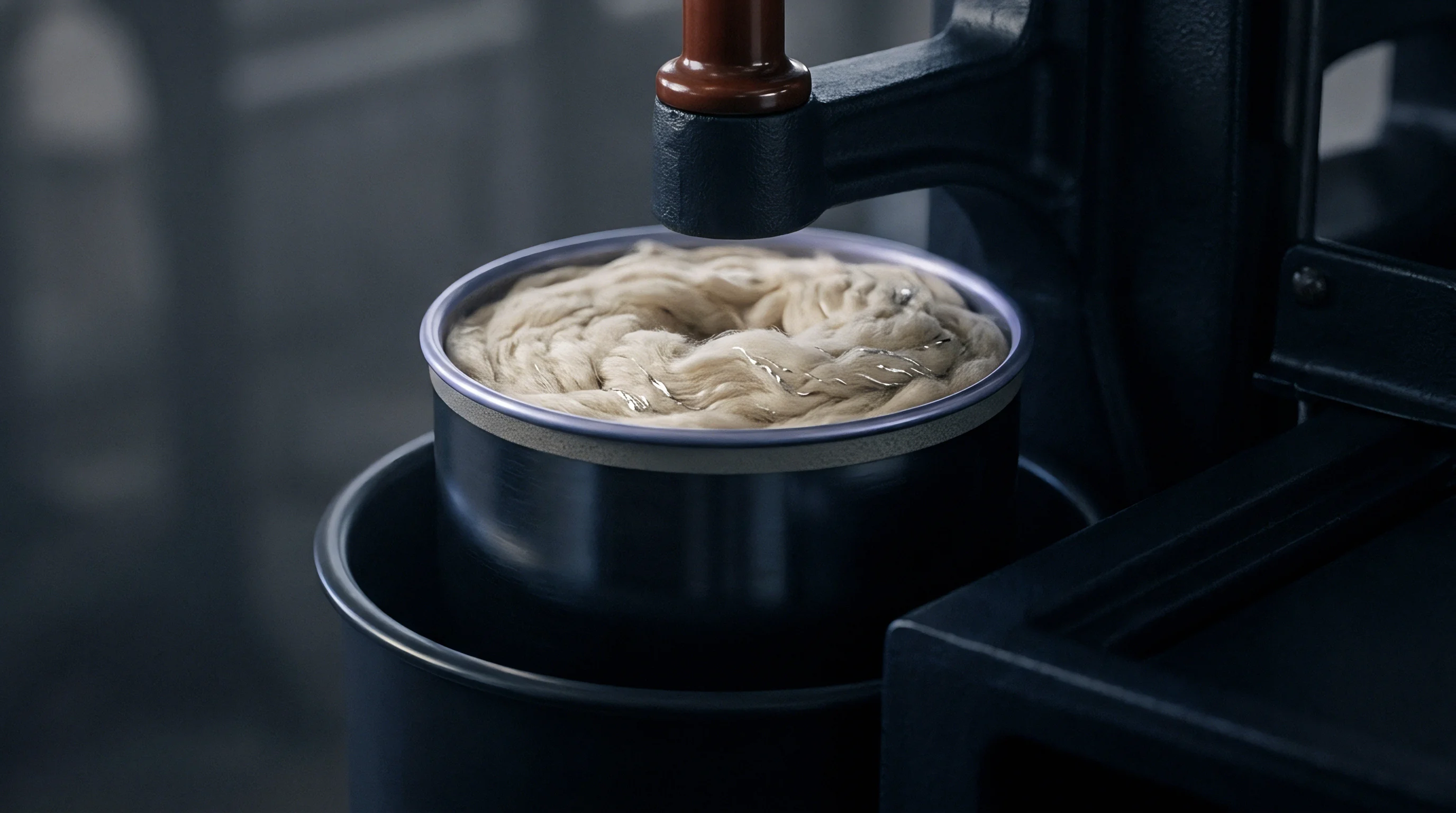
A gravimetric readout from an operational spin-line filter box shows 3.82 percent raw mass lost between the front drafting roller nip and the delivery nip at a delivery speed of 450 metres per minute. That missing volume left the strand inside two collinear pneumatic injectors spaced 28 millimetres apart. The primary injector spins clockwise at an absolute pressure of 0.25 megapascals; the counter-injector spins counter-clockwise at 0.40 megapascals.
The drafted sliver enters the first injector with almost zero mechanical twist. High-speed fluid rotation inside the primary chamber imparts an intense false twist that runs backward toward the front roller delivery line. Because mechanical twist cannot travel past a solid nip, the incoming sliver experiences violent rotational deceleration immediately before entering the chamber entrance guide.
High air velocities create steep static pressure drops along the central axis of the assembly. The peripheral airstream moves at velocities exceeding 300 metres per second near the internal injector walls, while the central axial speed stays lower. This velocity differential generates intense radial fluid shear.
Filaments traveling in the outer boundaries of the drafted ribbon encounter aerodynamic drag forces that exceed the inter-fiber frictional cohesion established during drafting. When the forward tension on an individual staple end drops below the local boundary layer drag, that end peels away from the main strand axis.
At an operating delivery rate of 420 metres per minute, an inlet pressure of 0.35 megapascals inside the second injector strips 4.1 percent of combed cotton mass through the pneumatic discharge ports.
Centrifugal acceleration inside the primary chamber pushes separated staple tips outward toward the injector walls. The core sliver advances along the center axis under positive mechanical pull from the take-up rollers. Edge fibers whose leading ends remain clamped within the advancing core become wrapper fibers once they pass into the opposing field of the second injector.
Filaments lacking sufficient embedded length inside the core cannot resist the outward radial drag. Air velocity reaches sonic thresholds. Those unanchored fibers separate completely from the traveling strand.
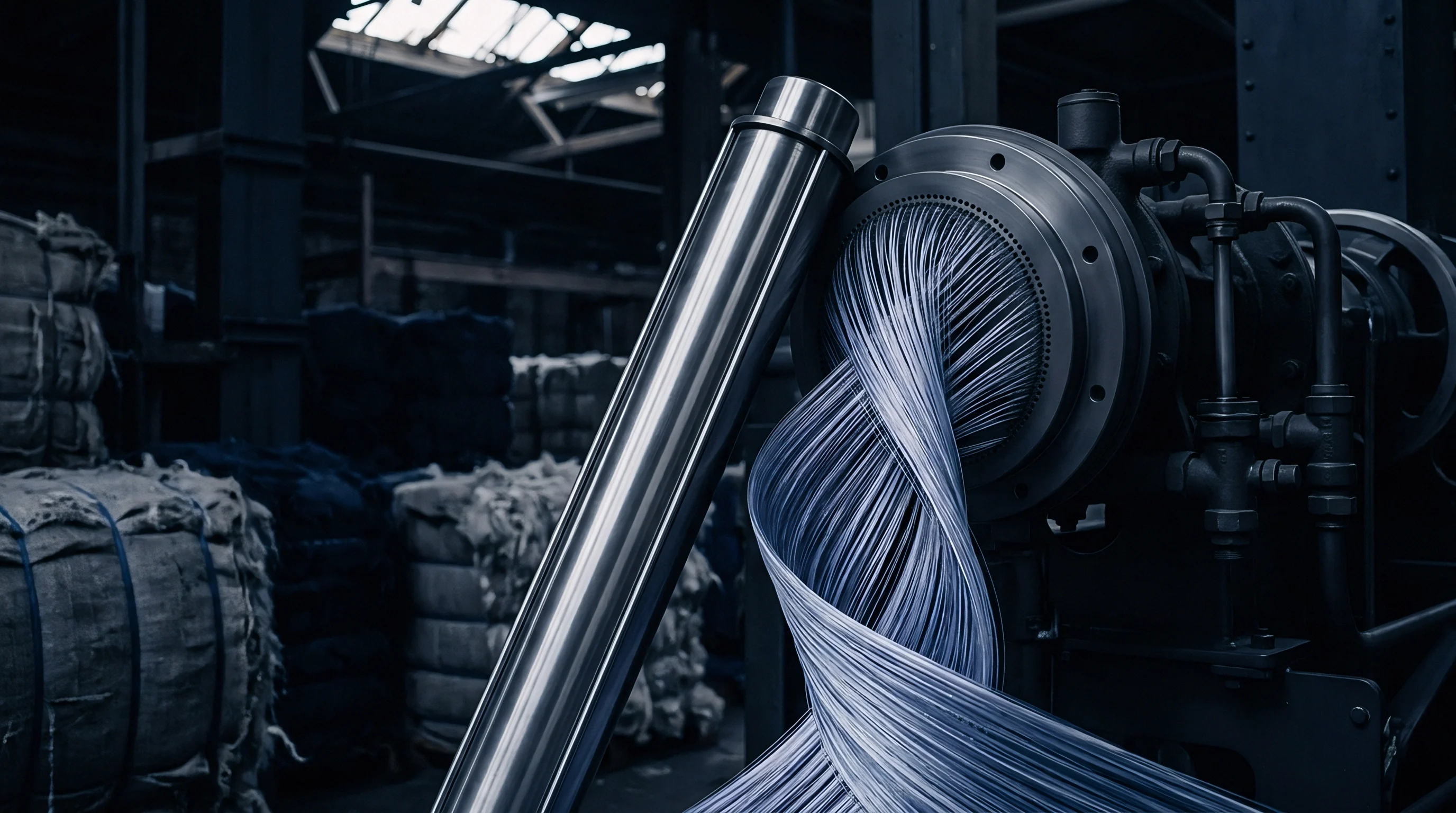
The opposing air rotation in the second injector terminates the false twist running back from the first nozzle, forcing wild wrappers to wind around the twistless core. This collision of opposite rotational vectors generates severe air turbulence at the interface between the two chambers. Uncontrolled turbulence destabilizes the ballooning strand.
Stray filaments caught in this destabilized zone shear away from the main structural axis and get entrained into the continuous exhaust air stream.
Vent
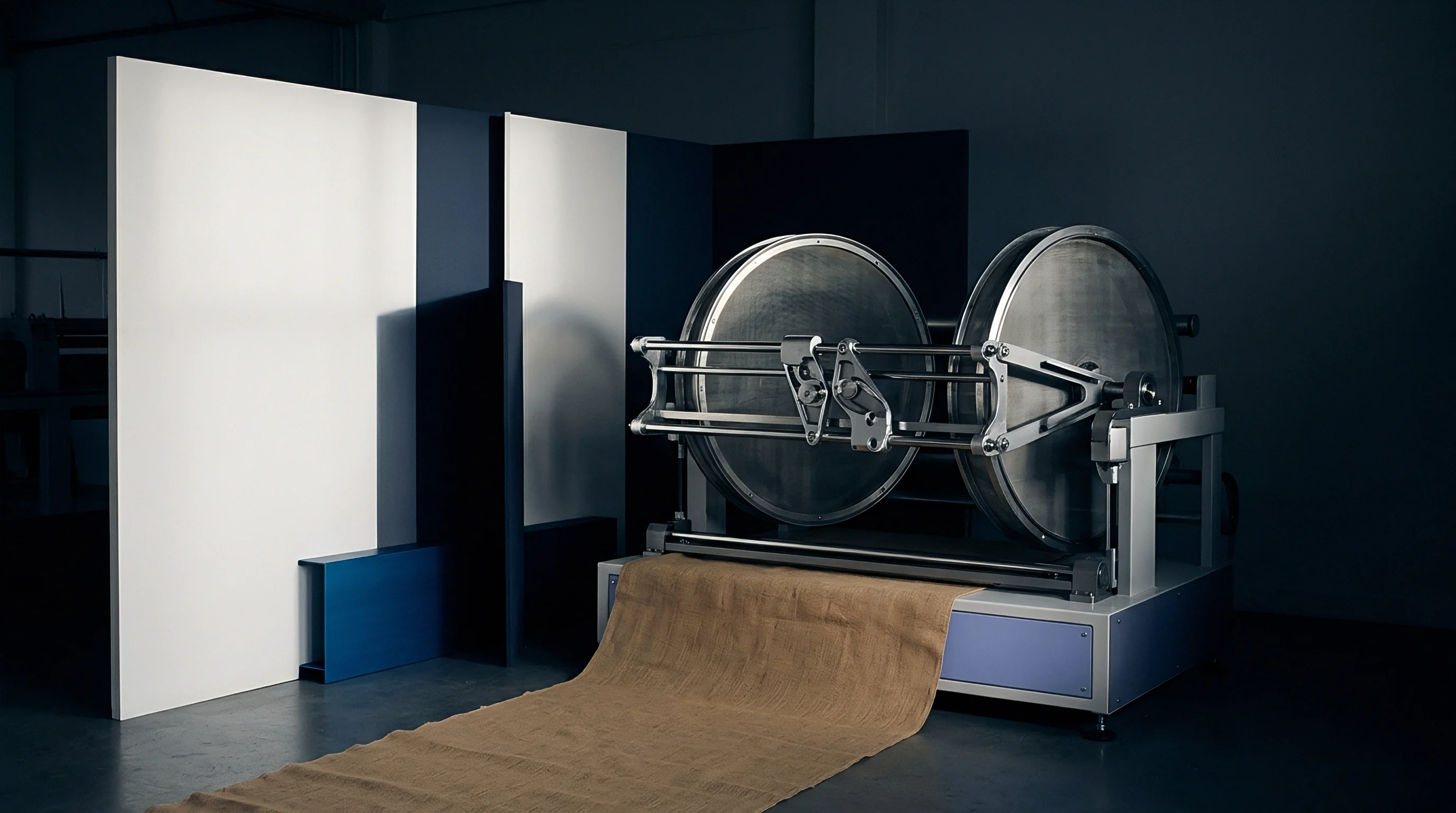
Exhaust manifolds collect detached waste fibers through negative-pressure ports machined directly into the nozzle housings. The rate of fiber extraction responds directly to the differential between the positive injector supply pressure and the negative exhaust chamber evacuation pressure. If the exhaust suction falls below negative 2.5 kilopascals, loose fibers collect on the internal injector lips instead of clearing the chamber.
This accumulation creates mechanical chokes that break the traveling strand. Suction pressure reaches three kilopascals.
The extracted material exhibits a distinctly different staple length distribution than the parent sliver. Fiber classer testing via capacitive array instruments reveals that the waste stream consists predominantly of short staple fractions. Cotton fibers measuring under 12.7 millimetres represent less than 8 percent of the incoming sliver mass, yet they constitute over 44 percent of the pneumatic filter box extraction.
Shorter staples detach without wrapping.
Turbulent air streams selectively purge short staple lengths while long structural fibers remain locked inside the advancing yarn core.
Air pressure dictates waste volume. When operating pressures rise to increase wrapping tightness and yarn tenacity, total mass ejection accelerates across all spindle positions. The table below outlines measured extraction rates across varying pneumatic pressure ratios on a 60-spindle commercial frame running 20 tex carded cotton.
| Primary Injector Pressure (MPa) | Secondary Injector Pressure (MPa) | Delivery Velocity (m/min) | Pneumatic Extraction Rate (%) | Short Staple Fraction in Waste (<12.7 mm, %) |
|---|---|---|---|---|
| 0.20 | 0.35 | 380 | 2.15 | 38.2 |
| 0.25 | 0.40 | 420 | 3.10 | 43.6 |
| 0.30 | 0.45 | 450 | 4.25 | 49.1 |
| 0.35 | 0.50 | 480 | 5.60 | 54.8 |
Aerodynamic waste extraction depends on four distinct mechanical interactions between the fluid field and the fiber ribbon:
- Aerodynamic Stripping Drag pulls exposed fiber ends toward evacuation channels whenever local fluid velocity exceeds filament forward speed by more than eighty metres per second.
- Centrifugal Balloon Expulsion forces unattached middle sections of looped fibers outward toward chamber relief slots where high-velocity air streams shear them away from the core.
- Front Nip Turbulence Scattering disrupts edge fibers before they enter the primary injector throat, casting loose filaments into peripheral suction hoods rather than through the yarn path.
- Counter Twist Untangling Ejection occurs at the boundary between opposing rotational vortices where sudden reversal of torque flings trailing fiber tails out of the twisting structure.
Spinning stability collapses past five bars. Machine makers frequently state that high pneumatic extraction reflects normal cleaning action that purges weak trash and short fuzz to upgrade the final yarn appearance.
Pluck
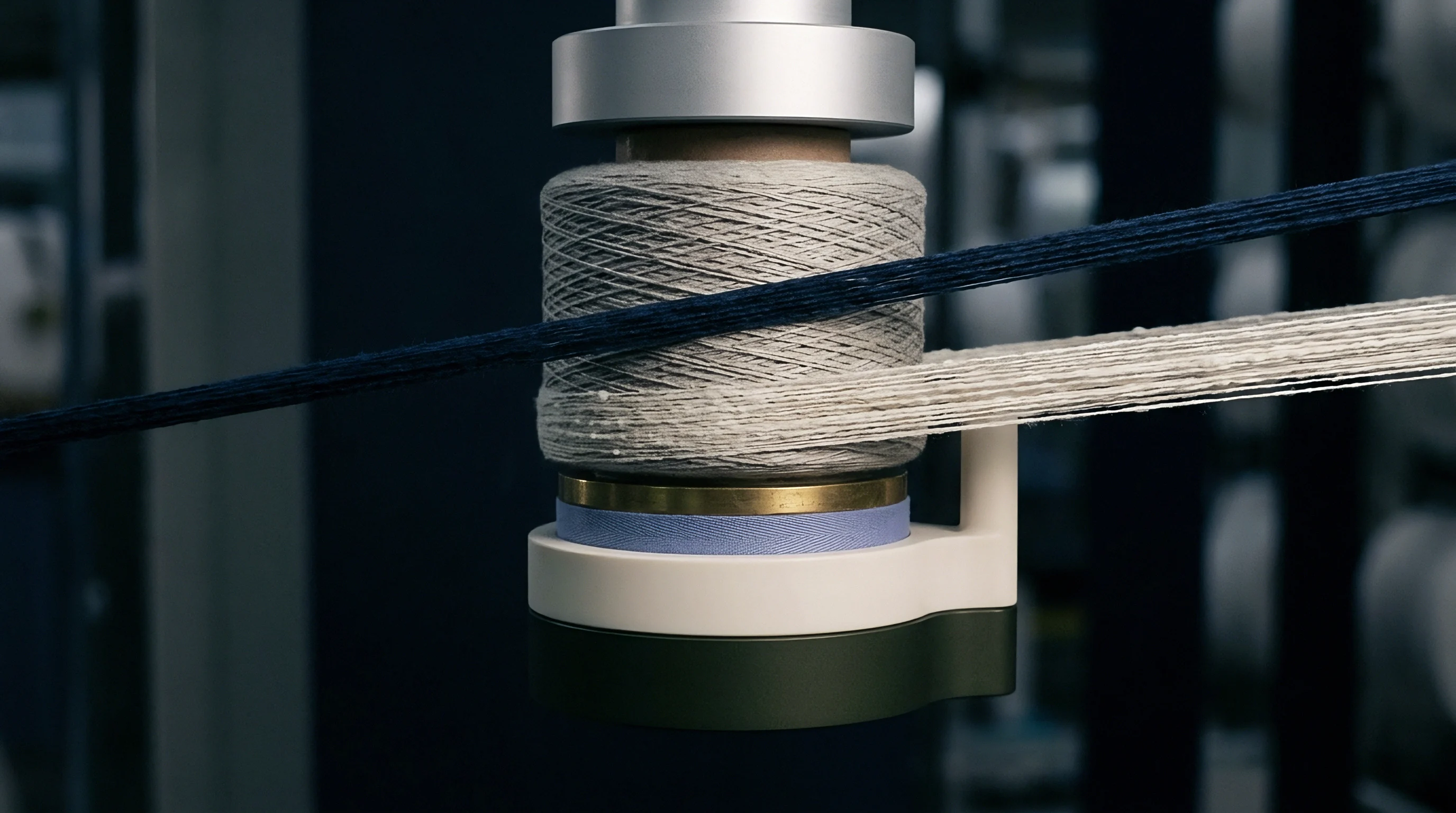
Mechanical traction between fibers inside the drafting zone dictates how many loose ends protrude into the detachment field. When cotton sliver leaves the front delivery roller, normal clamping pressure drops to zero within a distance of 1.5 millimetres. The free span between the front roller nip line and the tip of the first injector guide defines the zone of maximum vulnerability.
In this brief unguided window, filaments possess neither compressive mechanical hold nor fully formed aerodynamic twist. Sliver weight drops immediately.

Where Do Fluid Shears Sever Unanchored Filaments?
Separation forces concentrate at the outer margins of the fiber band. Edge fibers naturally experience fewer frictional contact points with neighboring filaments than core fibers. As the drafting rollers flatten the strand into a thin ribbon, width increases across the bottom roller apron.
Filaments lying outside the central 1.2-millimetre track lack the lateral support needed to withstand the incoming false-twist torque. Cotton fibers migrate outward rapidly. These perimeter fibers detach under pure fluid shear.
The detachment force depends on fiber surface morphology and cross-sectional perimeter. Synthetic polyester fibers with smooth circular profiles offer lower initial friction than convoluted cotton fibers, yet their uniform length allows them to anchor deeper into the false-twisted core. Polyester filaments resist centrifugal extraction.
Carded cotton, containing high micronaire variability and short fragments, sheds mass rapidly under identical airflow parameters. Wrapper count drops below twelve.
| Fiber Material and Specification | Mean Staple Length (mm) | Short Fiber Content by Number (%) | Calculated Air Drag on 5 mm Tail (µN) | Detachment Threshold Velocity (m/s) |
|---|---|---|---|---|
| Carded Upland Cotton (4.2 Mic) | 26.8 | 24.5 | 14.8 | 145 |
| Combed Mid-Continent Cotton (4.0 Mic) | 29.5 | 11.2 | 13.6 | 178 |
| Semi-Dull Polyester Staple (1.3 dtex) | 38.0 | 3.1 | 11.2 | 225 |
| Bright Viscose Staple (1.4 dtex) | 38.0 | 4.8 | 12.4 | 205 |
To quantify pneumatic waste during lot qualification, testing teams follow a sequence of four physical sampling steps across the spinning floor:
- Isolation of Central Suction Filters ensures that waste captured over a forty-minute run originates entirely from known active spinning positions without contamination from adjacent roving or ring frames.
- Volumetric Waste Capture Weighing establishes total dry mass loss against calibrated infeed sliver weight on precision balances accurate to 0.01 grams.
- Comb Sorter Fiber Fractionation separates extracted waste into five-millimetre length categories to identify whether the loss represents healthy spinnable staple or unwanted lint.
- Cross-Section Microscopic Analysis quantifies core-to-sheath binding geometry to verify whether remaining fibers formed structural wrappers or loose longitudinal hairs.
Cohesion deficits inside the drafting ribbon translate directly into mass loss at the injector entrance.
Whether modern high-pressure nozzles can maintain structural wrapping integrity without simultaneously pulling spinnable long staple into the suction exhaust remains an active question on modern spinning floors.

Shift
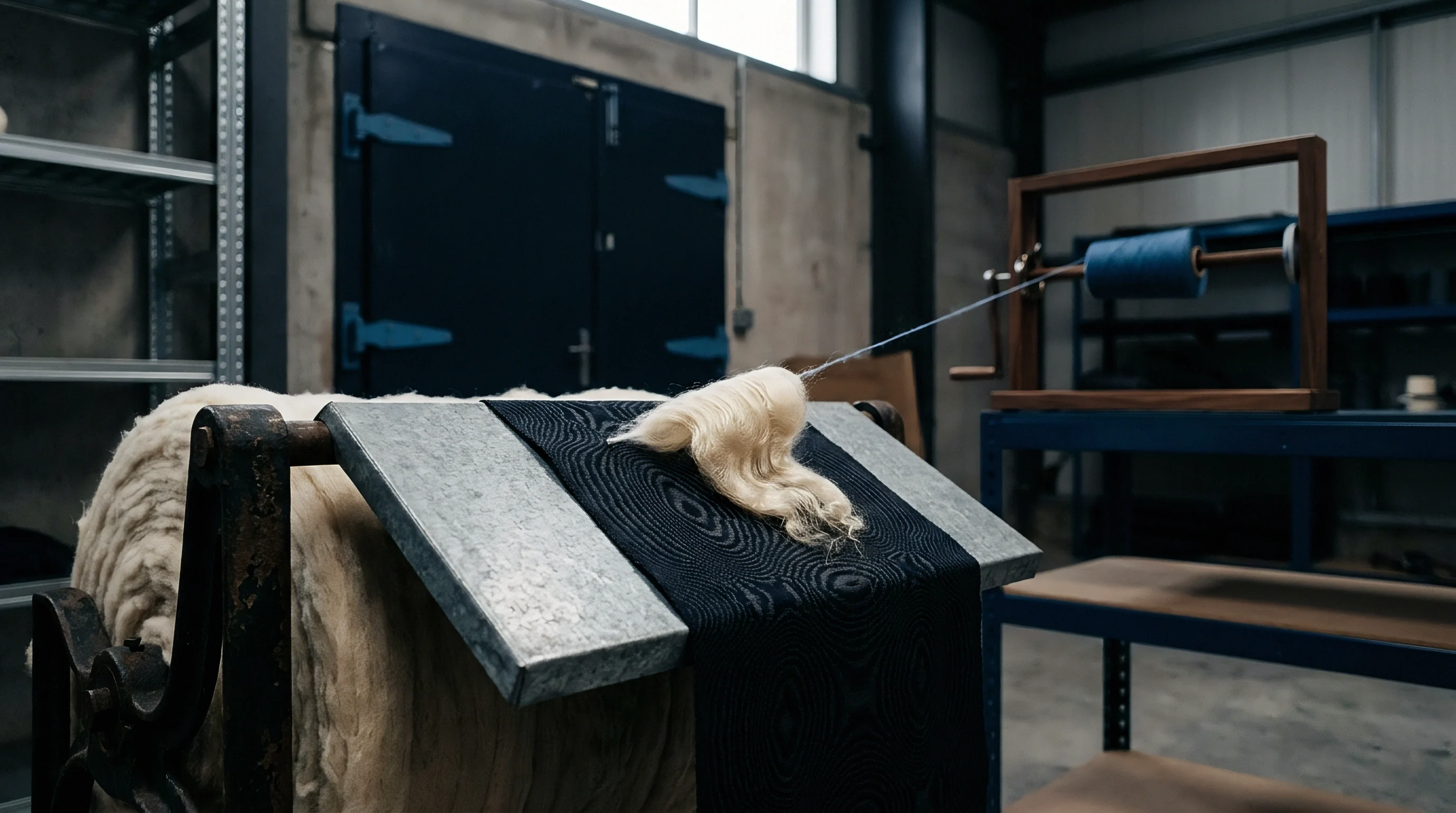
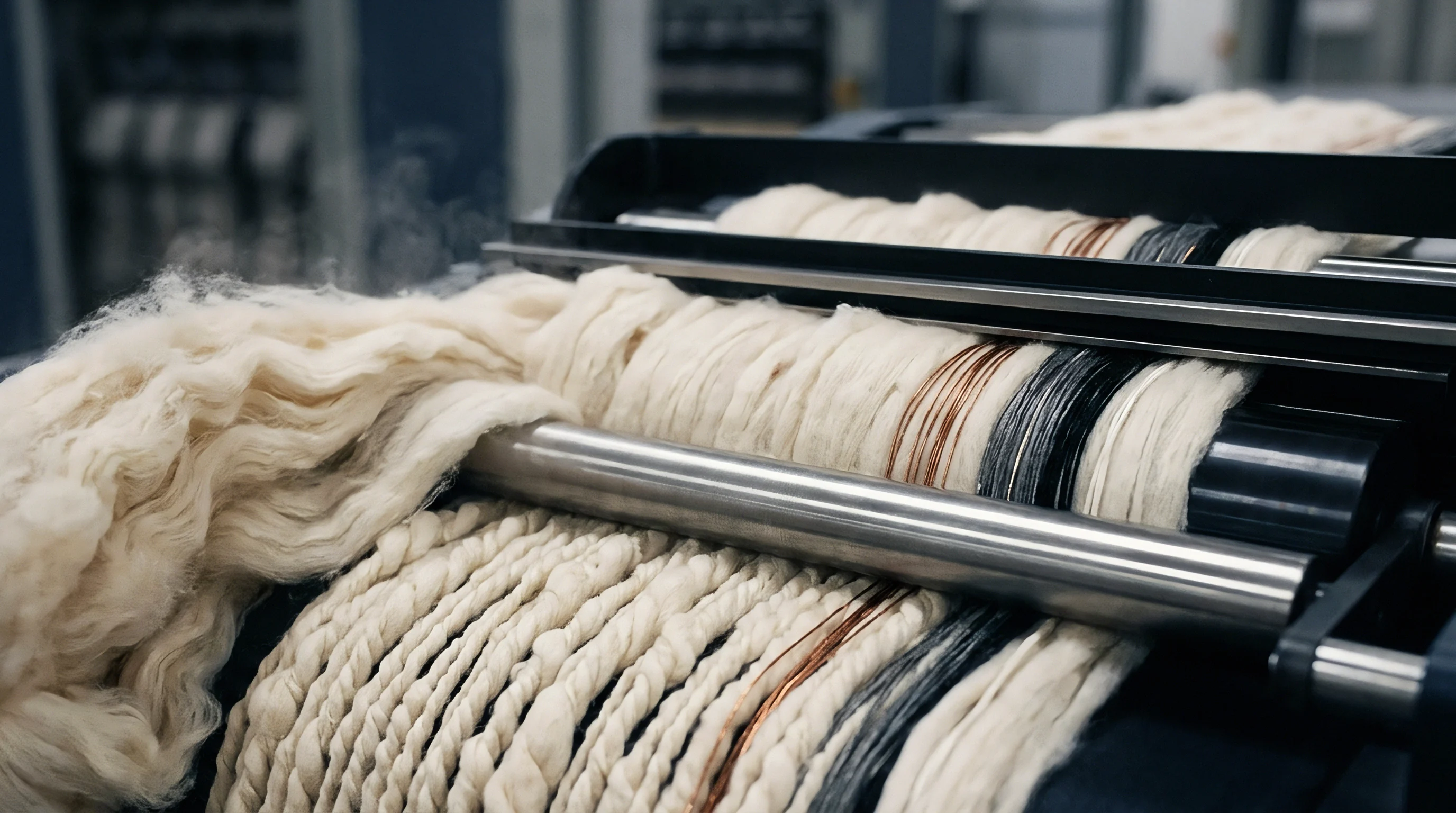
Compositional drift occurs whenever two distinct fiber types in an intimate mixture experience disparate detachment rates inside the pneumatic chambers. In an intimate mixture containing 60 percent carded cotton and 40 percent polyester staple, the pneumatic waste box collects cotton at three times the rate of polyester. The cotton component sheds short, fragile fragments under the action of the dual air vortices.
The longer, uniform polyester filaments stay embedded within the yarn core. Front roller speed hits four hundred.
What Forces Drive Binary Ratio Displacement?
Disparate mass loss stems from differences in flexural rigidity and specific gravity. Polyester fibers have a higher bending modulus and uniform length, which keeps their ends tucked inside the false-twisted matrix. Cotton ribbons exhibit low torsional stiffness when dry, causing loose tips to flare outward into the high-velocity boundary layer.
Waste collection filters reveal cotton dominance. Over a 500-kilogram spinning run, this unequal purging shifts the physical composition of the delivered yarn away from the nominal sliver recipe.
Consider a commercial run of 30 tex intimate mixture yarn targeted at precisely 60.0 percent combed cotton and 40.0 percent polyester by weight. The carding room prepares drawing sliver at exactly 60.0/40.0 with a tolerance of plus or minus 0.5 percent. The spinning frame runs at 450 metres per minute with primary nozzle pressure at 0.28 megapascals and secondary nozzle pressure at 0.42 megapascals.
Under these settings, total pneumatic loss measures 3.80 percent of sliver mass. Chemical dissolution testing under ISO 1833 reveals that the collected waste consists of 82.5 percent cotton and 17.5 percent polyester. Tenacity declines across finer counts.
| Process Stage or Stream | Total Mass (kg) | Cotton Mass (kg) | Polyester Mass (kg) | Nominal Cotton Ratio (%) |
|---|---|---|---|---|
| Infeed Drawing Sliver | 1000.00 | 600.00 | 400.00 | 60.00 |
| Pneumatic Nozzle Extraction | 38.00 | 31.35 | 6.65 | 82.50 |
| Delivered Spun Yarn | 962.00 | 568.65 | 393.35 | 59.11 |
| Values based on 1000 kg input sliver at 65% relative humidity and 20 degrees Celsius. Mass analysis via ISO 1833 chemical separation using 75% sulfuric acid dissolution. | ||||
The delivered yarn in this run contains 59.11 percent cotton and 40.89 percent polyester. If the spinning frame runs higher secondary pressures to compensate for low tensile strength, total extraction rises to 5.2 percent with cotton representing 85 percent of the purge. In that stressed scenario, delivered cotton content falls to 58.63 percent.
Customs inspectors retest every tenth container.
Product developers specifying technical yarn orders verify bulk delivery compliance using four specific documentation steps:
- Chemical Gravimetric Dissolution under ISO 1833 Method 1 determines absolute component mass fractions after removing spin finishes and moisture regain allowances.
- Incoming Sliver Lot Certificates verify that drawing frame blending ratios matched target declarations before air nozzles induced differential fiber stripping.
- Extraction Log Reconciliation compares total machine filter box waste weights against delivered yarn net weights to establish actual floor yield.
- Differential Regain Correction calculates commercial mass using official regain figures of 8.5 percent for cotton and 0.4 percent for polyester under ISO 6741 standards.
A two percent shift in fiber composition reclassifies shipments across international tariff borders and invalidates customer specifications.
When spinning plants fail to account for selective cotton loss in the pneumatic chambers, delivered yarns drift outside agreed legal tolerance bands, resulting in cancelled import documents, customs seizures, and heavy re-sorting expenses at destination ports.

Settlement
Commercial invoices reflect mass paid, not mass delivered on the yarn cone. A mill calculating production costs on dual nozzle frames must factor aerodynamic waste directly into raw material consumption formulas. If a ring spinning line runs at 1.5 percent pneumatic waste while a dual nozzle line runs at 4.2 percent on identical sliver, the air system consumes 27 kilograms of additional raw fiber per thousand kilograms of yarn produced.
Tariff rates jump six percent.
This yield deficit hits intimate mixtures harder than pure synthetic lots. Carded cotton priced at 2.10 dollars per kilogram and polyester staple priced at 1.35 dollars per kilogram yield an infeed raw material cost of 1.80 dollars per kilogram for a 60/40 mix. When preferential cotton loss drives total waste to 4.5 percent, actual raw material cost per kilogram of finished yarn escalates.
The table below details this financial progression across different waste percentages on a 50,000-kilogram yarn contract.
| Nozzle Waste Rate (%) | Sliver Required for 50,000 kg Yarn (kg) | Raw Material Infeed Cost (USD) | Pneumatic Loss Value (USD) | Raw Fiber Cost per kg Yarn (USD/kg) |
|---|---|---|---|---|
| 1.50 | 50,761 | 91,370 | 1,370 | 1.827 |
| 3.00 | 51,546 | 92,783 | 2,783 | 1.856 |
| 4.50 | 52,356 | 94,241 | 4,241 | 1.885 |
| 6.00 | 53,191 | 95,744 | 5,744 | 1.915 |
A four-cent difference in fiber cost per kilogram alters profit margins across large weaving programs. On a purchase order of one million metres of finished twill cloth consuming 220 grams of yarn per metre, that raw material shift adds 8,800 dollars to manufacturing costs. Buyers who negotiate yarn pricing without specifying nozzle waste tolerances absorb this cost through hidden spinning surcharges or downgraded fiber quality.
Classification rules under the international Harmonized Tariff Schedule depend on chief weight. Under Chapter 52, cotton-predominant yarns containing less than 85 percent cotton carry different duty rates than Chapter 55 synthetic-predominant yarns. If differential cotton loss pushes a borderline 51/49 cotton-rich sliver down to a 49.5/50.5 polyester-rich yarn, the legal heading flips from 5205 to 5509.
In many jurisdictions, this crossing triggers a duty jump from 4.8 percent to 8.0 percent or higher. The landed cost changes instantly.
Standard purchase contracts for dual nozzle yarns protect buyers by inserting explicit compositional drift clauses tied to ISO 1833 chemical verification: any lot whose delivered cotton content drops more than 1.0 percentage point below the specified drawing sliver recipe permits the buyer to deduct the duty differential directly from the final mill settlement invoice.