Deriving Non-Linear Price Discount Matrices for High-Treachery Honeydew Lots in Rotor Spinning
Non-linear honeydew discounts offset rotor speed reductions and cleaning downtime when trehalulose levels exceed critical sticky thresholds.


Gum

Insect Exudate Chemistry and Molecular Treachery
Insect infestation in open cotton bolls deposits complex carbohydrate secretions that alter processing behavior on high-speed yarn production equipment. The primary culprits, Aphis gossypii (cotton aphid) and Bemisia tabaci (sweetpotato whitefly), feed on phloem sap and excrete a sugary discharge directly onto exposed seed cotton lint. Plant sugars naturally synthesised by the cotton boll consist predominantly of symmetrical, non-sticky monosaccharides such as glucose and fructose, alongside small quantities of sucrose.
Insect digestion converts these simple plant sugars into highly asymmetric disaccharides and trisaccharides that exhibit extreme hygroscopicity and low softening temperatures.
Whitefly excretion contains a high concentration of trehalulose, an isomer of sucrose characterized by an alpha-1,1 glucosidic linkage to fructose. Trehalulose absorbs ambient atmospheric moisture at relative humidity levels as low as 45 percent, transforming dry crystalline deposits into viscous, tacky surface films at ambient mill room temperatures. Aphid secretions yield significant fractions of melezitose, a trisaccharide that creates hard, glass-like crystalline nodules under low humidity but softens under mechanical shear inside carding and drafting zones.
The ratio of trehalulose to total sugar mass defines the physical treachery of a raw lot, as low total sugar percentages with high trehalulose fractions cause far more mechanical disruption than elevated levels of pure plant sucrose.
Relative humidity levels above 55 percent convert crystalline trehalulose deposits into aggressive adhesive films that coat mechanical surfaces.
When raw lint undergoes mechanical opening, individual cotton fibres pull across contaminated surfaces, transferring liquid exudate droplets onto metal teeth and transfer rolls. Thermomechanical friction generated during rapid fibre separation elevates local temperatures beyond 40 degrees Celsius, dropping the dynamic viscosity of trehalulose and melezitose mixtures rapidly. The softened carbohydrate mass coats natural wax layers on adjacent clean cotton staples, creating localized fibre-to-fibre capillary bonds that alter drafting tension and cause severe nep formation prior to silver formation.

Microscopic Moisture Mechanics and Softening Profiles
Atmospheric conditioning inside the blowroom determines the physical state of carbohydrate residues. Standard cotton processing environments maintained at 65 percent relative humidity and 21 degrees Celsius provide sufficient moisture to dissolve trehalulose fractions completely. Lowering ambient relative humidity below 45 percent hardens simple sucrose deposits, but insect disaccharides absorb residual capillary moisture directly from the cotton lumen, maintaining a tacky state across a wide humidity spectrum.
Thermal friction inside mechanical opening zones converts semi-solid sugar drops into continuous films. As cotton tufts move through high-speed feed rollers, localized pressure forces liquid honeydew into the micro-grooves of wire clothing. Subsequent tufts strip partial films from the wire, spreading contamination evenly across entire production batches and converting localized bale deposits into broad processing hazards.
Failure to identify high-trehalulose cotton before opening results in contaminated wire clothing, ruined card sliver uniformity, and expensive emergency downtime across the entire blowroom line.

Rotor

Opening Roller Shear and Sugar Transfer Dynamics
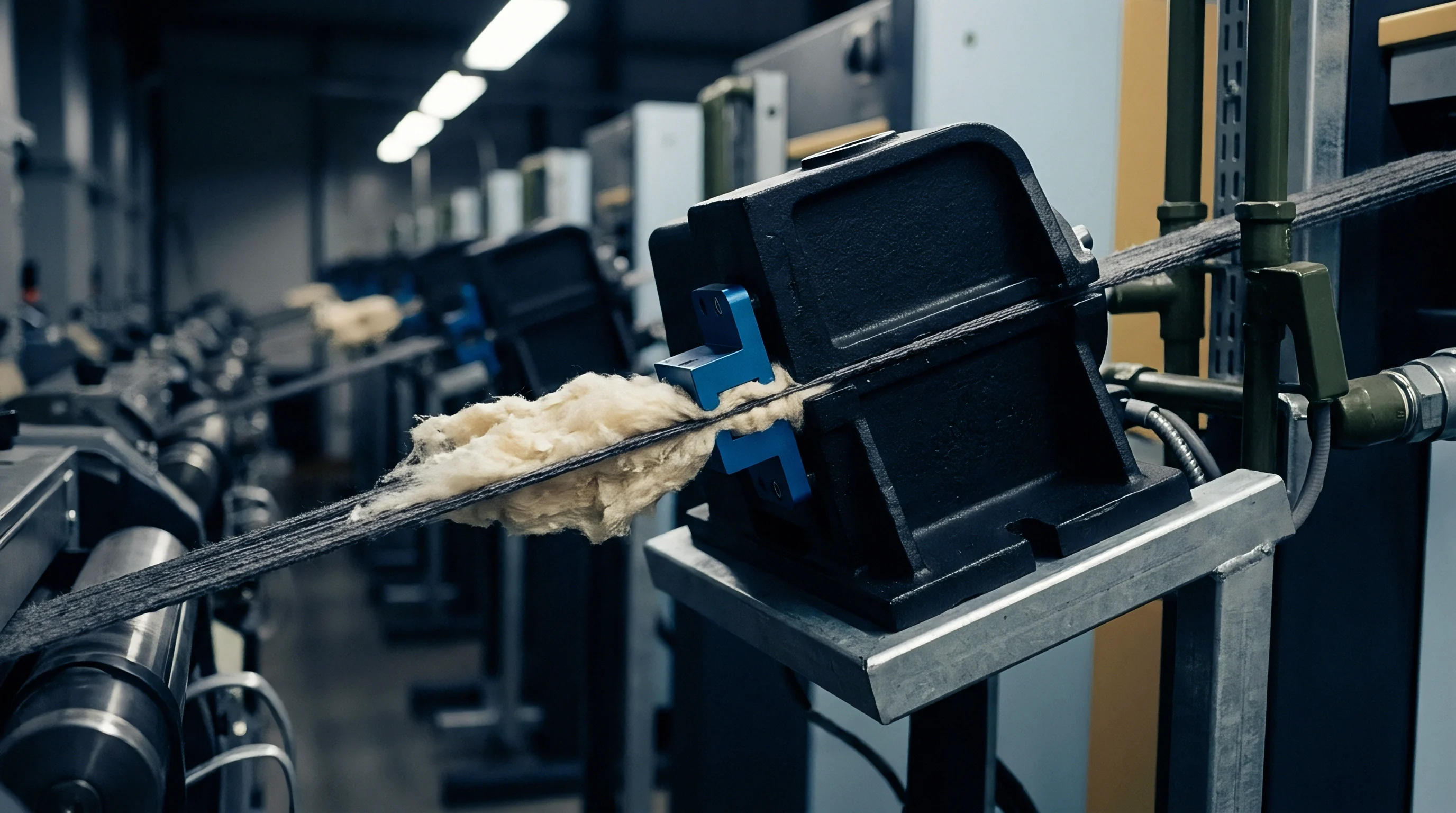
Drafting operations in open-end spinning expose raw staple fibres to extreme mechanical forces that magnify the impact of surface contaminants. Compressed sliver feeds into the opening unit where a saw-toothed opening roller rotating between 7,000 and 10,000 revolutions per minute combs individual fibres out of the feed fringe. High centrifugal forces press sticky staple surfaces directly against the tooth faces and housing walls, transferring microscopic coatings of trehalulose and melezitose onto the metal components.
Friction between the opening roller housing and high-velocity fibres generates localized surface temperatures exceeding 50 degrees Celsius. Heat lowers the structural viscosity of insect exudates, turning film deposits into persistent tacky residues. Fibres passing through the opening zone adhere momentarily to contaminated tooth tips, causing uncontrolled drafting waves, damaged staple alignment, and immediate fibre shortening.
Polymerized sugar coatings trap micro-dust and trash particles on the housing wall, building abrasive ridges that alter the air transport channel geometry.

Groove Compaction and Dynamic Centrifugal Buildup
Pneumatic transport channels carry individual fibres from the opening roller into the spinning cup, where centrifugal acceleration reaching 100,000 times gravity forces incoming material into the peripheral collecting groove. Sugar-coated staple ends lodge in the apex of the groove, trapping microscopic trash, bark dust, and seed coat fragments. Continuous rotation compacts this mixture into a dense composite ring that narrows the effective groove radius and smooths its texturing geometry.
Groove contamination disrupts normal yarn twist insertion. As the spinning open end rotates inside the groove to collect incoming staple, smooth sugar deposits reduce surface friction, causing localized twist slippage and erratic dynamic tension spikes. Unbalanced tension profiles lead directly to yarn end-breaks, elevated yarn count variability, and catastrophic drops in yarn elongation at break.
| Sugar Species | Primary Origin | Hygroscopic Point (% RH) | Viscosity Profile Under Shear | Rotor Failure Mechanism |
|---|---|---|---|---|
| Glucose / Fructose | Plant Physiology | 75 | Low stickiness below 60% RH | Minor dust accumulation in transport tube |
| Sucrose | Plant Physiology | 65 | Moderate friction softening | Localized opening roller tooth loading |
| Melezitose | Aphid Exudate | 50 | High shear softening above 35°C | Navel groove loading and twist blocking |
| Trehalulose | Whitefly Exudate | 40 | Extreme persistent tacky film | Rotor groove compaction and ends-down spikes |

Operational Degrations and Maintenance Escalation
Accumulated sugar in the cup groove requires physical intervention by automated piecing units or human operators. Automated piecing systems struggle to clear compacted sugar rings, leading to repeated piecing failures and automatic spindle lockouts. Manual cleaning cycles increase from once per 24-hour shift on clean cotton to once every two hours on sticky lots, consuming excessive labor hours and driving down machine utilization rates.
Contaminated draw-off navels compound twist irregularity. Softened honeydew transfers from the spinning yarn to the ceramic navel surface, forming rough carbonized ridges under thermal friction. These ridges strip surface fibres from the passing yarn structure, generating excessive fly waste, increasing yarn hairiness, and severely degrading yarn tensile strength CV percentage.
- Navel Glazing ceramic components collect baked sugar deposits that cause rapid twist failure and hairiness expansion.
- Groove Compacting fine dust mixes with sticky exudates to fill the rotor apex, causing immediate yarn breakage.
- Roller Wrapping opening clothing accumulates sticky tufts that strip carded sliver and stop feed rolls.
- Tube Clogging pneumatic transport pipes collect internal sugar scale that destabilizes air draft velocity.
A fourfold increase in manual rotor cleaning frequency reduces overall open-end machine efficiency below 82 percent.
Suppliers frequently maintain that sticky raw lots perform acceptably when processed under dry ambient air, ignoring the reality that excessive low humidity introduces static electrical charges that cause severe fibre lap-ups on drafting rolls.

Assay

Chromatographic Quantification versus Rapid Thermal Screening
Determining true processing risk requires quantitative chemical separation rather than subjective physical screening. High-Performance Anion-Exchange Chromatography with Pulsed Amperometric Detection (HPAEC-PAD) isolates specific carbohydrate species down to parts-per-million thresholds. HPAEC-PAD profiling calculates the absolute mass percentages of glucose, fructose, sucrose, melezitose, and trehalulose, allowing technical managers to isolate the exact insect origin and potential stickiness of incoming raw lots.
Thermodetector sticky spot testing (SCT) provides a physical count of adhesive points across a standardized lint web. Samples pressing between heated aluminum plates at 35 degrees Celsius generate sticky spots on a silicone-coated paper backing. While SCT spot counts reflect general contamination density, thermal spot counts fail to differentiate between large, localized drop spots and finely dispersed trehalulose films that cause systemic machine blockage.
- Draw representative 50-gram lint samples from ten percent of bales across the incoming shipment lot using a staggered mechanical sampler.
- Condition drawn samples at 20 degrees Celsius and 65 percent relative humidity for 24 hours to standardize moisture content before testing.
- Pass a 2.5-gram conditioned specimen through a laboratory minicard to generate a uniform web over a standardized hot-plate press.
- Execute thermodetector pressing cycle at 35 degrees Celsius under a three-kilogram load for precisely two minutes.
- Cool the pressed specimen paper for ten minutes at room temperature, then peel away lint mass carefully.
- Count visible sticky spots under ultraviolet light, categorizing spots by diameter into minor and major stickiness classes.
Why Does High-Performance Liquid Chromatography Outperform Rapid Spot Tests?
Chromatographic methods quantify non-sticky plant sugars alongside aggressive insect disaccharides, eliminating false positives caused by harmless physiological sugar surges. High physiological glucose readings often trigger alarm under simple chemical reduction tests, such as Benedict reagents or Brix colorimetry, yet cause zero mechanical adhesion during high-speed drafting. HPAEC-PAD targets the trehalulose mass percentage directly, providing a precise metric for non-linear price adjustment calculations.
Minicard rating systems rank stickiness on a numeric scale from one to four based on web breaking and cylinder loading. Grade one indicates zero stickiness, while grade four signifies unspinnable material that wraps card cylinders within seconds. While minicard trials simulate actual production stresses, results depend heavily on operator technique and ambient room fluctuations, introducing up to 20 percent test variance between independent laboratories.
How testing laboratories account for internal sugar migration inside densely compressed export bales under high heat shipping transit remains a fundamental open dispute between commercial counterparties.

Matrix

Derivation of Non-Linear Threshold Models
Linear price discount formulas fail because mechanical performance degradation in rotor spinning follows a parabolic decay curve. Below a baseline threshold of 0.18 percent total sugar with a trehalulose fraction under 15 percent, open-end spinning machinery operates at full efficiency with standard cleaning intervals. Once contamination crosses this critical boundary, machine performance drops rapidly.
Minor increases in sticky disaccharide content produce exponential spikes in yarn end-breaks, requiring steep step-downs in rotor speed to maintain running continuity.
Financial valuation models must capture both direct yield losses and indirect labor expenses. The mathematical derivation of the non-linear discount matrix incorporates total sugar mass percentage, trehalulose content ratio, expected rotor speed reduction, elevated ends-down rate penalties, and manual cleaning labor overhead. The non-linear discount factor calculates as follows:
Total Price Discount ($/kg) = Base Discount + Scale Discount Factor
Base Discount = C_0 (S – S_0) for S > S_0
Scale Discount Factor = K ( T / S )^1.5 ( S – S_0 )^2.2
Where C_0 is the linear base adjustment rate ($0.12 per kg per percentage point), S is total sugar percentage measured by chromatographic analysis, S_0 is the acceptable non-penalty baseline (0.18 percent), K is the mill operational friction multiplier ($1.85 per kg), and T/S is the ratio of trehalulose mass to total sugar mass. When total sugar remains below S_0, the entire price discount equals zero.
| Total Sugar S (%) | Trehalulose Ratio T/S | Sticky Spots (SCT) | Rotor Speed Drop (%) | Yield Loss Penalty ($/kg) | Final Net Discount ($/kg) |
|---|---|---|---|---|---|
| 0.12 | 0.08 | 3 | 0.0 | 0.000 | 0.000 |
| 0.22 | 0.18 | 8 | 4.5 | 0.015 | 0.012 |
| 0.32 | 0.28 | 16 | 12.0 | 0.058 | 0.064 |
| 0.45 | 0.38 | 28 | 22.5 | 0.142 | 0.187 |
| 0.60 | 0.48 | 42 | 38.0 | 0.295 | 0.428 |
| 0.80 | 0.55 | 65 | 55.0 | 0.510 | 0.815 |
Worked Valuation Case on High-Treachery Bale Deliveries
To demonstrate matrix application on commercial shipments, take a 40-tonne lot of Middling 1-1/8 inch upland cotton priced at a base rate of $2.10 per kilogram. Laboratory testing via HPAEC-PAD reveals a total sugar content S of 0.45 percent, with a trehalulose mass fraction T of 0.171 percent. This yields a trehalulose ratio T/S of 0.38.
SCT sticky spot testing returns an average count of 28 spots, placing the shipment in a severe operational threat band.
Calculating baseline surplus sugar yields S – S_0 = 0.45 – 0.18 = 0.27 percent. The linear base discount evaluates to $0.12 0.27 = $0.0324 per kilogram. Inserting parameters into the scale factor equation yields $1.85 (0.38)^1.5 (0.27)^2.2 = $1.85 0.2343 0.0560 = $0.0243 6.35 = $0.1544 per kilogram.
Summing linear base and non-linear scale factors produces a final total discount of $0.1868 per kilogram, rounded commercially to $0.187 per kilogram. Across the 40-tonne lot, the net landed price invoice deduction equals $7,480.
Exponent values above 2.0 inside penalty matrices reflect the steep financial cost of unrequested machine stops and lost yarn tonnage.
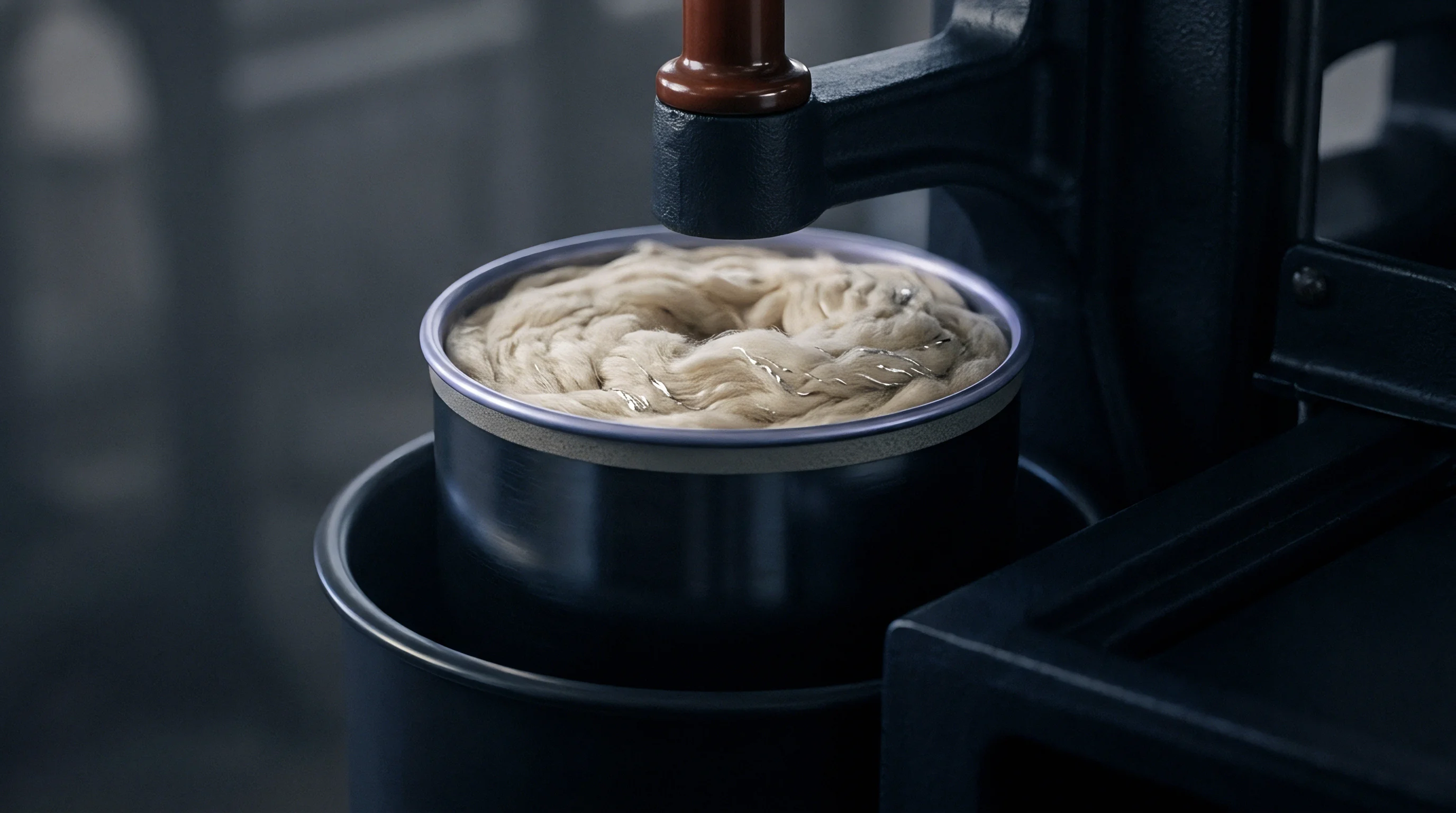
Operating open-end machinery on sticky stock requires balancing price deductions against mechanical mitigation costs. Chemical spray application in the blowroom using specialized hydrocarbon or silicone-based anti-stick lubricants reduces surface tension, allowing mills to process moderately sticky lots at reduced speed. Chemical dosing adds $0.04 per kilogram in material and maintenance costs, setting a floor on discount acceptance thresholds.
| Mitigation Strategy | Direct Processing Cost ($/kg) | Rotor Tonnage Efficiency (%) | Yarn Quality Degradation Risk | Net Commercial Viability |
|---|---|---|---|---|
| Raw Price Discount Acceptance | 0.000 | 78.0 | High Variability | Optimal for steep discount matrices |
| Blowroom Lubricant Injection | 0.042 | 91.0 | Moderate Fastness Risk | Viable for medium trehalulose levels |
| Bale Laydown Dilution (1:4) | 0.015 | 96.5 | Low Impact | Preferred when clean stock is available |
| Thermal Pre-treatment Wash | 0.185 | 98.0 | Negligible | Commercially unviable for open-end yarn |
A simple practical benchmark holds that any raw lot exceeding 30 sticky spots on thermodetector screening demands a minimum 8 percent price discount to offset mandatory blowroom laydown blending and reduced rotor rotational speeds.

Terms

Contractual Execution and Sampling Protocols
Commercial execution of non-linear discount matrices demands explicit contractual incorporation prior to bale opening. Standard commodity contracts governed by generic cotton association rules lack precise adjustments for specific sugar species, relying on vague rejection clauses for unspinnable lint. Buyer specification dossiers write HPAEC-PAD testing conditions and thermodetector spot limits directly into contract addendums, defining exact penalty schedules and independent arbitration testing houses.
Contamination sampling procedures write strict acceptance boundaries into purchase orders. Sampling clauses mandate drawing specimen cores from 10 percent of bales per lot, specifying seal-tight moisture barrier bags to prevent atmospheric humidity changes during transit to testing facilities. Contracts stipulate that if independent HPAEC-PAD verification shows trehalulose fractions exceeding 25 percent of total sugar mass, the buyer retains the sole right to apply the non-linear discount matrix or reject the lot entirely at supplier freight expense.
The decision framework for accepting or rejecting contaminated shipments requires systematic commercial evaluation across four distinct operational gates.
- Verification Gating incoming laboratory certificates must present chromatographic sugar speciation alongside standard High Volume Instrument physical properties.
- Capacity Assessment clear mill capacity to execute 1-to-5 bale laydown dilution using clean, sugar-free inventory before commitment.
- Dosing Qualification verification of operational blowroom chemical injection systems for application of lubricant sprays on moderately sticky stock.
- Invoice Adjustment automatic deduction of calculated matrix penalties directly from letter of credit drafts upon presentation of failed assay certificates.

Arbitration and Final Invoice Settlement
Disputes over sugar testing variance arise frequently between origin shippers and destination spinning mills. Destination testing often reports higher sticky spot counts than origin certificates due to thermal compaction and moisture distribution changes inside ship hold container environments. Contractual terms mandate that destination laboratory assays from accredited independent testing facilities govern settlement, provided samples were drawn within 14 business days of container discharge at the port of destination.
Standard purchase addendums incorporate explicit claim enforcement language: If independent HPAEC-PAD analysis reveals total sugar content exceeding 0.35 percent by weight or a trehalulose ratio exceeding 0.25, the invoice settlement value adjusts automatically according to the non-linear discount matrix in Section 4, with testing fees and local re-handling costs charged directly to the seller account.