Spin Finish Oxidation Mechanics during Long Term Storage
Oxidized spin finish forms cross-linked insoluble varnishes during storage, elevating yarn friction and causing irreversible resist spots in wet processing.


Ester
Synthetic filament yarns wound onto packages carry liquid process aids formulated around aliphatic lubricants, polyoxyethylene emulsifiers, and phosphate antistatic salts. The formulation deposits as an ultra-thin boundary film across each individual filament surface, typically between 0.5% and 1.5% oil-on-yarn by weight. Atmospheric oxygen reacts directly with the hydrocarbon chains and polyoxyethylene ether segments during ambient warehouse storage.
The reaction follows a free-radical autoxidation pathway that initiates long before the greige package reaches a warp beam or a circular knitting feeder. Transition metal traces from upstream polymerization catalysts, residual moisture, and ambient temperature shifts act as catalysts for hydroperoxide generation.
Storage environments without active climate controls expose package outer layers and bobbin shoulders to continuous air exchange. Hydrogen abstraction occurs at the methylene carbons located alpha to polyoxyethylene ether linkages or adjacent to unsaturated ester bonds. The resulting carbon-centered alkyl radical reacts with molecular oxygen at near diffusion-controlled rates, forming an alkylperoxy radical.
This peroxy species abstracts a hydrogen atom from an adjacent surfactant molecule, yielding an organic hydroperoxide and a fresh radical center. Peroxide values rise steadily.

Autoxidation Sequences on Synthetic Yarn Packages
Primary oxidation products remain unstable within the tightly packed filament bundle. Cleavage of the weak oxygen-oxygen bond in hydroperoxides generates alkoxy and hydroxy radicals, triggering secondary degradation chains that split long-chain lubricants into lower-molecular-weight organic acids, aldehydes, and ketones. Volatile fractions generate rancid off-odors inside packed cartons.
Concurrently, polyoxyethylene surfactant segments undergo oxidative cleavage and cross-coupling reactions, forming branched, high-molecular-weight polyether networks.
- Hydroperoxide Formation marks the primary induction phase where oxygen binds to activated methylene carbons without noticeable changes in film viscosity or yarn running tension.
- Ether Bond Scission breaks the hydrophilic segments of polyoxyethylene condensates into free volatile aldehydes and short-chain carboxylic acids.
- Radical Recombination joins polyoxyethylene fragments into dense, insoluble polyether networks displaying elevated molecular weight and decreased water solubility.
- Acid Value Escalation generates free fatty acids that lower package pH and corrode downstream steel knitting elements during dry conversion.
Ambient oxygen transforms thin aliphatic lubricant coatings into high-molecular-weight cross-linked networks across extended warehouse hold periods.
The progression moves from an initial induction phase into an exponential degradation stage. Antioxidant packages blended into the spin finish formulation, specifically sterically hindered phenols and organic phosphites, consume initial peroxy radicals to delay this transition. Once storage exceeds the sacrificial capacity of the stabilizer package, autoxidation proceeds unchecked across the outer yarn wraps.
The liquid film solidifies.


Wax
Cross-linked polyether networks transform the original fluid coating into an immobile resin. As volatile fractions evaporate and reactive fragments undergo condensation, the boundary lubricant changes from a Newtonian liquid into a high-viscosity, varnish-like deposit. The change alters the interfacial contact mechanics between the yarn surface and metallic guides on creels, winders, and knitting machines.
Filament cohesion increases, which prevents smooth package unwinding.

What Triggers Boundary Lubrication Failure in Storage?
Liquid films operate by separating the running filament from ceramic and metal friction pins through hydrodynamic and boundary lubrication mechanisms. Fresh spin finish maintains a dynamic friction coefficient between 0.18 and 0.22 on chrome-plated friction pins at 100 metres per minute. Oxidized finishes lose boundary-slip efficiency because resinous cross-linked domains adhere directly to contact surfaces.
Yarn-to-metal friction spikes above 0.40, causing severe stick-slip oscillations. Tension spikes break filaments.
Boundary lubrication performance collapses when fluid spin finish films polymerize into sticky adhesive layers.
Knitting needles clog rapidly. The oxidized coating sloughs off the yarn under high mechanical shear, collecting within needle tricks, sinker tracks, and yarn brake discs as a sticky, yellow residue. Accumulated debris increases mechanical resistance, elevating needle operating temperatures and promoting premature latch failure.
On weaving warpers, elevated friction induces tension variability across the warp sheet, producing dense streaks of broken filaments, loose ends, and dropped stitches.
| Storage Duration (Months) | Viscosity at 25°C (mPa·s) | Yarn-to-Metal Friction (25°C) | Viscosity at 40°C (mPa·s) | Yarn-to-Metal Friction (40°C) |
|---|---|---|---|---|
| 0 | 35 ± 3 | 0.19 ± 0.01 | 35 ± 3 | 0.19 ± 0.01 |
| 3 | 42 ± 4 | 0.21 ± 0.01 | 78 ± 6 | 0.26 ± 0.02 |
| 6 | 68 ± 5 | 0.25 ± 0.02 | 210 ± 15 | 0.34 ± 0.03 |
| 12 | 195 ± 12 | 0.33 ± 0.02 | 680 ± 45 | 0.46 ± 0.04 |
| 24 | 540 ± 35 | 0.44 ± 0.03 | 1850 ± 120 | 0.58 ± 0.05 |
Uncontrolled friction shifts during beaming generate non-uniform package densities that distort yarn elongation properties before the fabric ever meets wet processing. High unwinding tension stretches filament bundles past their yield points, permanently altering residual boil-off shrinkage values. Warp breakage halts production.
Weaving operations suffer continuous loom stops, fabric defects, and dropped picks when feeding greige yarn stored past its chemical stability window.
Scour
Standard alkaline wash baths running at 70 degrees Celsius cannot disperse cross-linked, oxidized oils. Fresh spin finishes emulsify rapidly in warm aqueous baths using dilute non-ionic alcohol ethoxylates and mild soda ash. Hydroperoxide cross-linking converts water-dispersible surfactant fractions into hydrophobic resins that adhere tenaciously to synthetic substrates.
The altered chemical structure resists micellar capture and prevents detergent penetration.
Alkaline Extraction and Chelating Sequences
Detergent baths fail because cross-linked polyether matrices form steric barriers against surfactant diffusion. Increasing sodium hydroxide concentrations saponifies ester components, generating sodium carboxylate soaps, but leaves the polymerized polyether backbone intact upon the fiber. High temperatures in continuous scouring ranges can fuse these degraded resins deeper into amorphous regions of texturized polyester or polyamide yarns.
Standard ISO 105-C06 wash protocols fail to remove polymerized lubricant fractions that resist non-ionic surfactant extraction.
A corrective wash sequence addresses this challenge through elevated mechanical agitation, solvent-assisted surfactant mixtures, and controlled chelation steps.
- Pre-soak dry greige goods in an emulsified terpene or aliphatic ester scouring booster at 40 degrees Celsius to swell and plasticize polymerized oil films.
- Raise bath temperature to 85 degrees Celsius alongside 3.0 grams per litre fatty alcohol polyglycol ether and 2.0 grams per litre soda ash to disperse swollen residues.
- Dose 1.0 gram per litre polyacrylic acid chelate to suspend abstracted metal ions and prevent re-deposition of cracked finish soaps onto low-velocity rope zones.
- Rinse continuously at 70 degrees Celsius followed by an overflow ambient rinse to strip emulsified contaminants before thermal drop cycles begin.
| Scour Formulation Applied | Bath Temp (°C) | Dwell Time (Min) | Residual Oil (% w/w) | Emulsification State |
|---|---|---|---|---|
| Standard Non-ionic (2.0 g/L) + Soda Ash (1.0 g/L) | 70 | 20 | 0.68 ± 0.05 | Phase Separation |
| Caustic Soda (3.0 g/L) + Alcohol Ethoxylate (2.0 g/L) | 85 | 30 | 0.42 ± 0.04 | Unstable Dispersion |
| Solvent Booster (4.0 g/L) + Ethoxylate (3.0 g/L) | 85 | 30 | 0.14 ± 0.02 | Stable Micro-Emulsion |
| Solvent Booster (4.0 g/L) + Caustic (2.0 g/L) + Chelate | 95 | 45 | 0.06 ± 0.01 | Full Translucent Solubilization |
| Extraction tested via Soxhlet apparatus using dichloromethane solvent according to modified ISO 1059 procedures. Initial raw unwashed greige carried 1.15% oil-on-yarn. | ||||
Mills frequently attribute subsequent shade unevenness to uneven dye strike, asserting that incoming filament lots simply carried inherent polymer variation from the extrusion plant.

Shade
Differential dye strike occurs across areas bearing oxidized chemical deposits. Residual oxidized finish films alter the localized surface energy of synthetic fibers, creating irregular wetting dynamics during the initial phase of the dyeing cycle. In disperse dyeing of polyester, cross-linked oil spots function as hydrophobic barriers, retarding dye molecule diffusion into the fiber core.
Dye molecules bypass blocked sites. Pale resist marks appear across the fabric surface.

How Do Oxidized Esters Cause Dye Resist?
Thermomigration mechanisms compound the surface defect during high-temperature processing. When greige goods pass through stenter frames for heat setting at 180 to 200 degrees Celsius prior to scouring, residual oxidized oils undergo severe thermal degradation. Pyrolysis reactions generate dark, tar-like degradation products that bake permanently into the fiber substrate.
Degraded fatty acids create localized acidic zones on polyamide fabrics, repelling anionic acid dyes and causing pronounced shade unlevelness. Unlevelness follows immediately.
Acid values indicate advanced breakdown. The resulting shade variations resist standard chemical stripping and redyeing procedures. Disperse dyeings exhibit localized ring dyeing, lowering wet fastness and crocking resistance values below acceptable buyer specifications.
Thermal setting locks the defect.
Spectrophotometric Verification and Defect Mapping
Inspection frames equipped with dual D65 and TL84 light sources reveal oxidized oil defects as irregular, cloudy patches or sharp warp-direction bands. Instrumental color measurement using spectrophotometers confirms significant Delta E variations across the width of a single dyed roll. The defects concentrate along roll edges and outer wraps where atmospheric oxygen had unobstructed access during storage.
- Peroxide Value Titration measures primary oxidation states via iodometric titration, establishing whether greige packages exceed 10 milliequivalents of active oxygen per kilogram of extracted finish.
- Soxhlet Solvent Extraction determines total non-volatile oil content using petroleum ether or dichloromethane to verify finish consistency across lot packages.
- Thin Layer Chromatography separates cross-linked polyether fractions from native surfactant components, providing physical evidence of oligomeric polymerization.
- Attenuated Total Reflectance Spectroscopy tracks the emergence of carbonyl absorption peaks between 1710 and 1740 cm⁻¹, confirming ester breakdown and carboxylic acid formation.
Standard scouring cannot salvage resinous lots. The industry remains split between treating oxidized finish defects through aggressive, fabric-degrading solvent cleans or rejecting the entire stored greige inventory before wet processing begins.
Hold
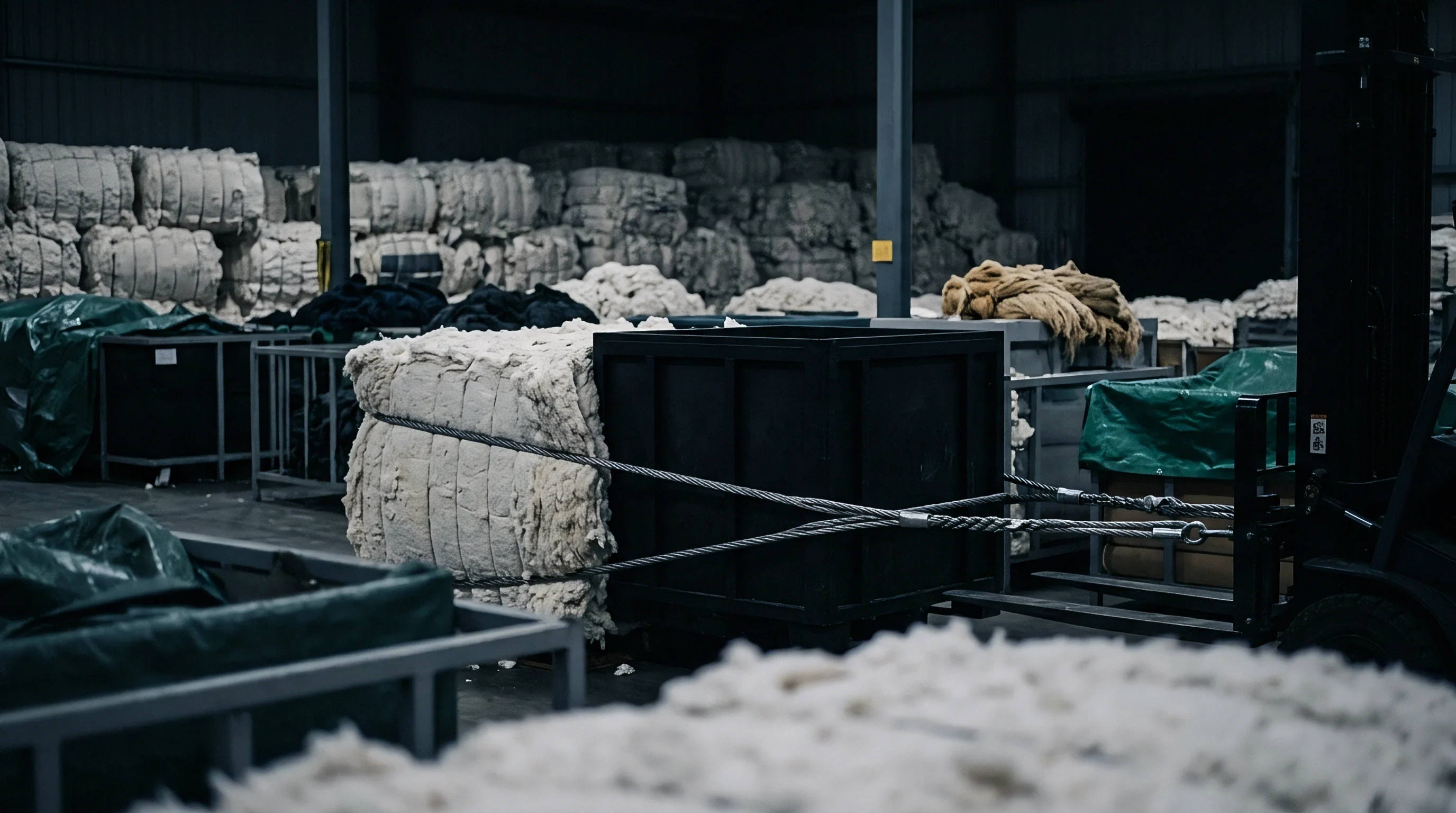
Inventory aging turns dormant capital into write-downs when yarn lots sit beyond six months. Ambient conditions inside standard distribution centers accelerate spin finish deterioration through uncontrolled thermal cycling and variable relative humidity. Pallets stored near metal roof structures experience temperatures exceeding 45 degrees Celsius during summer months, cutting chemical shelf life by more than half.
Warehouse heat accelerates degradation.

Commercial Exposure and Contract Terms
Procurement agreements must define storage parameters and finish stability thresholds to allocate financial responsibility. Most commodity yarn suppliers warrant spin finish integrity for only six months from the extrusion date under dry storage conditions maintained between 15 and 25 degrees Celsius. Sourcing practices that purchase open-market greige lots without documenting production dates absorb all commercial liability for downstream processing failures.
Bobbins suffer sloughing and tangles.
Yarn packages stored at 40 degrees Celsius display identical finish oxidation levels after four months to packages stored at 20 degrees Celsius for sixteen months.
Fabric production specifications mitigate this risk by inserting formal age limits into the purchase order. Mill delivery terms require suppliers to provide certificates of analysis stating finish chemistry type, stabilizer loading, and exact date of winding. Commercial terms stipulate that greige yarn held in transit or bonded storage for more than 180 days undergoes mandatory Soxhlet extraction and peroxide verification before release to warp creels.
The buyer retains rejection rights whenever extractable acid values rise above 5.0 milligrams of potassium hydroxide per gram of finish.