Thermodynamic Limits of Polyurea Segment Swelling during Rapid Elevated Pressure Extraction Matrix Operations
Controlled depressurization below 1 MPa per minute prevents cavitation and mass loss during elevated pressure extraction of polyurea elastomer matrix finishes.


Swell
Analytical extractions performed on elastomeric yarns target spinning lubricants, processing oils, and residual oligomers without stripping structural polyurethane or polyurea networks. Elevated fluid densities at pressures exceeding 15 MPa drive rapid mass transfer through filament bundles. Thermodynamic equilibrium governs the distribution of mobile components between dense fluids and the macromolecular network.
Pure hexane yields zero dissolution. When carbon dioxide enters a cell at 40 degrees Celsius and 20 MPa, penetrant sorption expands the flexible polyether or polyester soft blocks while leaving aromatic diurea crystalline domains intact.
Network dilation reaches a defined limit governed by elastic retraction forces described in classic rubber elasticity models. The chemical potential of the fluid inside the expanded amorphous domain balances the mechanical work required to extend polymer chains between urea hard segments. Solvent uptake increases linear dimensions.
Swelling ratios depend on fluid density, temperature, and soft-segment composition. Polytetramethylene ether glycol segments undergo greater volume dilation in compressed carbon dioxide than polycaprolactone polyester segments at identical isobaric conditions.
Dilation of crosslinked polyurea segments reaches an equilibrium volume increase of 14.2 percent under pure carbon dioxide at 25 MPa and 50 degrees Celsius.
Commercial laboratories isolating finishing oils from spandex yarns rely on pressurized liquid extraction or supercritical fluids to compress analytical cycle times from eight hours to twenty minutes. Accelerated solvent flows through dense package cores extract silicone and mineral oils effectively. The solvent bath removes finish oils.
When temperature exceeds 80 degrees Celsius, fluid penetration disrupts secondary hydrogen bonding across hard domain stacks. Extraction engineers balance oil desorption efficiency against segmental structural alteration.

Thermodynamic Equilibrium in Fluid Mixtures
Sorbed penetrant molecules lower intermolecular cohesion between adjacent polymer chains. Pressure forces the fluid inward. As mobile molecules distribute within the amorphous volume, the chemical potential of the penetrant inside the swollen network matches that of the pure compressed fluid phase.
Elastic retraction of the extended chains establishes a finite volumetric boundary, preventing infinite dissolution. The Flory interaction parameter shifts. Crosslinked networks display reversible dilation as long as processing conditions maintain the integrity of hard block crystallites.
The following sequence traces the progression of an extraction cycle where elevated fluid density acts directly on an elastomeric yarn sample:
- Chamber pressurization drives carbon dioxide or liquid solvent into the interstitial spaces of the yarn package, establishing fluid contact across every filament perimeter within forty seconds.
- Solvent penetration initiates localized segmental dilation within polyether amorphous pools without disrupting hydrogen bonds inside the polyurea hard crystallites.
- Solute partitioning transfers finishing lubricants into the mobile fluid phase as partition coefficients reach equilibrium across the five-minute static extraction period.
- Dynamic flushing carries dissolved oils into collection vials while fresh solvent maintains concentration gradients across the filament core.
- Controlled depressurization releases dissolved gas through backpressure regulators, preserving filament morphology when expansion rates remain below polymer relaxation thresholds.
Spinning mills deliver elastomeric filament spools coated with three to five percent topically applied polydimethylsiloxane emulsions. Finishing plants complain that excessive solvent penetration strips internal processing aids, causing package cling and tension spikes during high-speed warping.


Phase
Elastomeric polyurea-urethane polymers consist of alternating sequences of flexible macroglycols and rigid diisocyanate-diamine reaction products. Segmental incompatibility drives spontaneous microphase separation into soft and hard domains. Pure polyurea segments generate high melting points, often exceeding 240 degrees Celsius, supported by dense bidentate hydrogen bonding.
The hard domains resist dissolution. In contrast, aliphatic polyether soft segments retain glass transition temperatures well below minus 40 degrees Celsius, maintaining chain mobility at ambient processing temperatures.
Exposure to dense supercritical fluids depresses the glass transition temperature of the amorphous matrix. Carbon dioxide acts as a molecular plasticizer, increasing free volume and lowering the effective glass transition by thirty to fifty kelvins under moderate pressures. This plasticization increases penetrant diffusivity by two orders of magnitude compared to ambient gas diffusion.
Segmental mobility increases dramatically. Extraction temperatures above 60 degrees Celsius at 30 MPa approach the softening point of segregated urea segments, risking extraction of low-molecular-weight hard oligomers alongside surface lubricants.
Standard gravimetric extraction protocols under ISO 1833 part 12 dictate chemical separation tolerances within plus or minus one percent absolute mass.
Co-solvents added to dense fluids alter the thermodynamic affinity of the mobile phase. Pure carbon dioxide exhibits low dielectric permittivity, limiting its ability to dissolve polar species. Modifiers like ethanol, methanol, or ethyl acetate raise the mixture polarity, accelerating the extraction of polar additives.
These polar additives interact directly with the urea linkages. Hydrogen-bonding solvents swell the hard domains, loosening the structural anchor points of the elastomeric filament.
Flory Huggins Interaction Parameters
Binary interaction values quantify the thermodynamic affinity between penetrant fluids and polymeric segments. When the interaction value between fluid and soft segment drops below 0.5, extensive mixing occurs, causing substantial swelling. The value for carbon dioxide and polytetramethylene glycol segments hovers between 0.65 and 0.85 across common supercritical operating ranges.
This range ensures controlled dilation without structural breakdown. The hard domains maintain values far above 2.0, completely excluding nonpolar penetrants from the crystalline lattices.
| Extraction Pressure (MPa) | Fluid Density (g/cm³) | Swelling Ratio (V/V₀) | Soft Segment Tg Shift (°C) | Polyurea Domain Retention (%) |
|---|---|---|---|---|
| 10.0 | 0.628 | 1.06 | -14.5 | 99.9 |
| 15.0 | 0.780 | 1.11 | -23.2 | 99.7 |
| 20.0 | 0.840 | 1.14 | -31.0 | 99.4 |
| 25.0 | 0.880 | 1.18 | -38.6 | 98.8 |
| 30.0 | 0.910 | 1.23 | -44.2 | 97.5 |

Do Polar Modifiers Alter Segmental Solvation?
Alcohol additions to supercritical fluids alter the balance between soft-segment extraction and hard-segment dissolution. Ethanol additions at five molar percent increase the solubility of polar spinning waxes while elevating hard segment swelling by twelve percent. Methanol introduces severe disruption to bidentate hydrogen bonds within diphenylmethane diisocyanate hard domains.
Tenacity losses follow matrix cavitation. The analytical laboratory must choose whether complete oil removal justifies permanent structural modification of the elastomeric core.
The boundary between reversible swelling and irreversible hard-block dissolution remains uncertain when elevated pressures combine with variable moisture contents in conditioned yarn spools.


Void
Decompression marks the most hazardous stage of rapid elevated pressure extraction. Dense gas dissolved inside the swollen polyurea-urethane network expands as system pressure drops. If the decompression rate exceeds the diffusion rate of the penetrant gas out of the polymer matrix, massive internal supersaturation occurs.
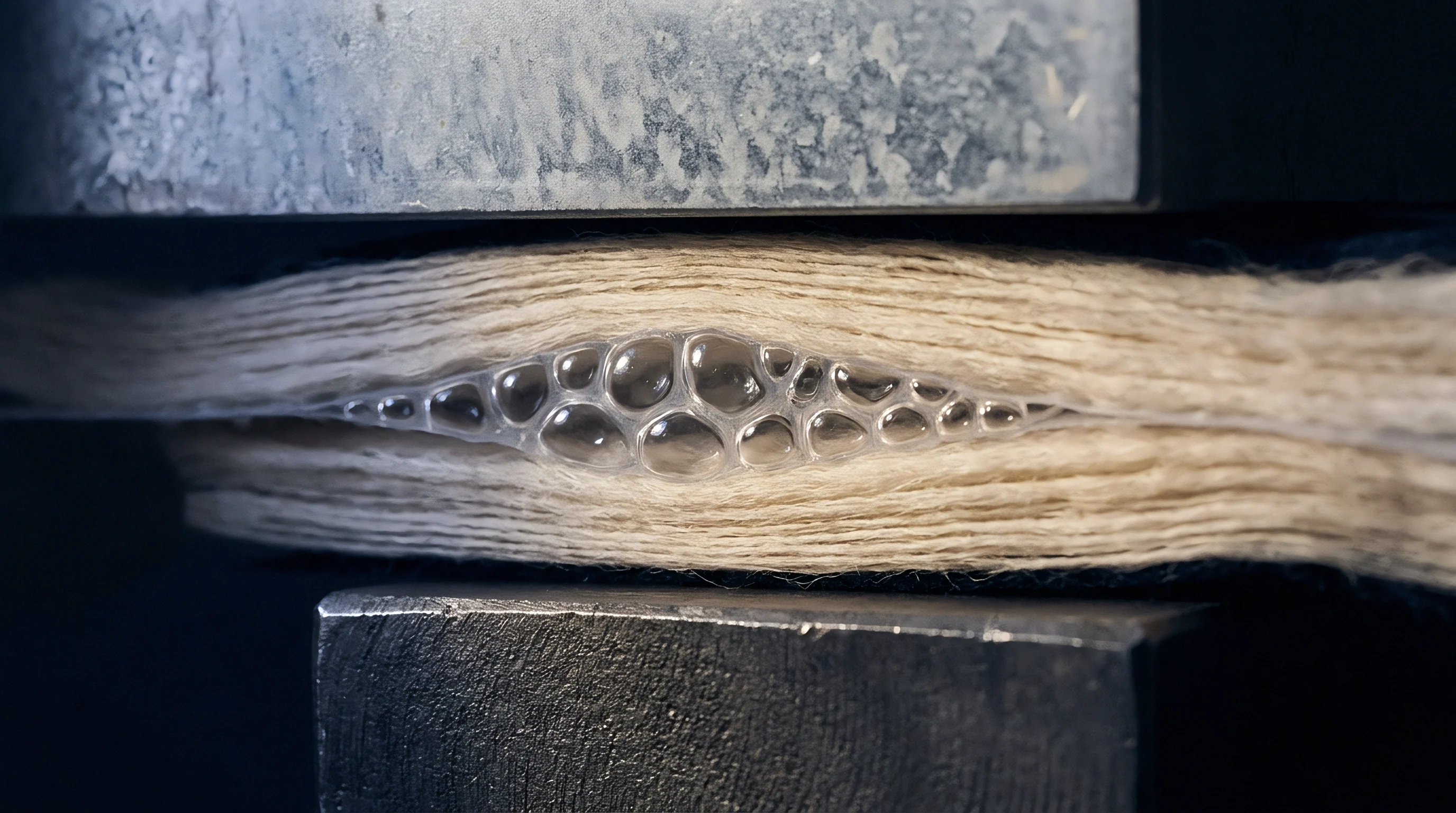
Gas nucleates into microbubbles. Thermodynamic instability drives phase separation between the concentrated polymer and the expanding gas phase, generating internal microvoids across the filament core.
Structural damage manifests as internal cavitation, surface blistering, and micro-cracking along phase boundaries. Filament cross-sections display honeycomb morphologies when depressurization occurs faster than 5 MPa per minute from extraction pressures above 20 MPa. Density drops across the specimen.
Tensile strength drops precipitously following void formation, rendering elastomeric filaments brittle. Rapid venting tears the polymer. When testing physical recovery or tensile modulus after oil extraction, cavitation skews laboratory results, mimicking chemical degradation where only mechanical rupture occurred.
Depressurization rates above 2.5 MPa per minute generate irreversible microvoiding in polyether-based spandex filaments extracted at 20 MPa.
Depressurization kinetics dictate final material integrity. Slow venting schedules allow dissolved carbon dioxide to diffuse outward along concentration gradients without exceeding the critical bubble nucleation pressure. Viscoelastic properties of the elastomeric network accommodate the dimensional contraction back to original volume.
The material recovers its original geometry when hard crystallites remain intact. In analytical laboratories where turnaround time drives throughput, technicians often vent extraction cells in ninety seconds, inducing extensive structural damage.
Does Depressurization Velocity Induce Filament Rupture?
Gas release rates govern internal stress concentration within filament bundles. Rapid depressurization turns high internal gas concentrations into localized explosive expansion centres. The following list identifies specific physical degradation manifestations encountered during uncontrolled decompression of swollen elastomeric yarns:
- Macroporous core cavitation occurs when dissolved gas clusters nucleate into voids exceeding five micrometres in diameter, severing load-bearing polyurea network chains.
- Skin delamination splits the dense outer polymer skin from the expanded core as gas accumulates beneath the less permeable filament perimeter.
- Crystalline boundary microcracking propagates fractures along the interface separating rigid diurea stacks from amorphous polyether domains, permanently reducing yarn elasticity.
- Filament fibrillation fractures individual mono-filaments into irregular longitudinal fibrils under shear stresses generated by explosive gas release.
- Elastic modulus collapse decreases recovery force by up to forty percent during cyclic elongation testing following pressurized fluid exposure.
Mechanical Integrity across Extraction Cycles
Testing laboratories assessing clean fibre mass require intact filaments for subsequent quantitative chemical analysis. A yarn bundle damaged by rapid decompression loses fine fragments during standard filtration and washing steps. Gravimetric loss increases spuriously.
Technicians misinterpret mechanical fragmentation as chemical solubility of the elastomeric component. Depressurization rates drive pore growth. Maintaining extraction cell exhaust rates below 1.0 MPa per minute prevents bubble nucleation, preserving specimen mass and physical continuity.
| Depressurization Rate (MPa/min) | Void Fraction (%) | Tenacity (cN/tex) | Elongation At Break (%) | Mass Loss From Fragmentation (%) |
|---|---|---|---|---|
| 0.5 | 0.2 | 1.18 | 490 | 0.02 |
| 1.5 | 1.1 | 1.15 | 482 | 0.05 |
| 3.0 | 4.8 | 0.98 | 430 | 0.38 |
| 6.0 | 12.4 | 0.74 | 325 | 1.45 |
| 12.0 | 22.6 | 0.48 | 210 | 3.80 |
Controlled depressurization schedules consistently maintain filament density within ninety-nine percent of raw material baselines.

Assay
Quantitative analysis of composite textiles containing elastomeric filaments demands rigorous separation protocols. Standard gravimetric determination separates polyester, polyamide, or cellulosic components from polyurethane-polyurea elastanes using selective chemical dissolution. The gravimetric residue remains unchanged.
ISO 1833 part 20 utilizes dimethylformamide to dissolve polyurethane-polyurea segments away from non-extractable polyester or cotton bases at 90 degrees Celsius. When testing laboratories substitute elevated pressure extraction to isolate spin finishes before solvent dissolution, precision depends on avoiding network degradation.
Incorrect extraction parameters alter the apparent yarn composition. If supercritical extraction strips low-molecular-weight urea oligomers alongside spin finishes, the measured finish percentage reads artificially high by up to 1.5 percentage points. Conversely, incomplete extraction leaves residual silicone oils on the fibre, underestimating elastomeric content during subsequent solvent dissolution.
Laboratory separation paths differ widely. Nitrogen analysis resolves the difference. Elemental analysis of nitrogen content provides an absolute stoichiometric cross-check against gravimetric mass balance, tracking polyurea content through diphenylmethane diisocyanate stoichiometry.
A contract specification adhering to ASTM D629 mandates chemical analysis of dry fibre mass after Soxhlet or pressurized solvent extraction of commercial finishing agents.
Analytical verification requires a systematic sequence of laboratory controls before issuing a certificate of analysis. Sourcing directors and quality managers execute specific verification checkpoints when commissioning laboratory test reports:
- Solvent purity certification confirms that extraction media contain less than ten parts per million non-volatile residue, preventing artificial mass gain on dried test specimens.
- Extraction blank runs quantify system contamination and verify that collection valves release zero residual lubricant from previous commercial samples.
- Conditioned mass verification aligns raw sample mass with dry extracted mass under controlled relative humidity of 65 percent and 20 degrees Celsius per ISO 139.
- Infrared spectral validation verifies the chemical identity of the extracted fraction, distinguishing aliphatic spin finish oils from aromatic urea degradation products.
- Elemental nitrogen titration determines exact polyurethane-polyurea mass fraction by quantifying urethane and urea nitrogen against pure polymer reference standards.

Quantitative Solvent Wash Methods
Traditional Soxhlet extraction using petroleum ether requires six hours of continuous boiling to remove polydimethylsiloxane finishes from elastomeric yarns. Pressurized fluid extraction at 10 MPa and 40 degrees Celsius achieves equivalent removal within fifteen minutes. The solvent bath removes finish oils.
The table below compares traditional ambient-pressure Soxhlet extraction against pressurized solvent extraction across identical textile blend specimens.
| Analytical Parameter | Soxhlet Petroleum Ether | Pressurized Carbon Dioxide | Pressurized Hexane (10 MPa) | |
|---|---|---|---|---|
| Extraction Time (min) | 360 | 20 | 15 | |
| Solvent Volume per Test (mL) | 150 | 25 | 35 | |
| Finish Oil Recovery (%) | 99.2 ± 0.3 | 98.9 ± 0.4 | 99.4 ± 0.2 | |
| Polyurea Mass Stripping (%) | 0.05 ± 0.02 | 0.08 ± 0.03 | 0.12 ± 0.04 | |
| Tenacity Retention (%) | 99.1 | 98.5 | 97.8 | |
| Values represent five replicate determinations on 44 dtex polyether-polyurea filament yarn. | ||||

Spectroscopic Segment Identification
Fourier-transform infrared spectroscopy distinguishes extracted processing lubricants from extracted polymer segments. Silicone spin finishes display distinctive absorption peaks at 1260 cm⁻¹ and 800 cm⁻¹ corresponding to Si-CH₃ bonds, alongside broad Si-O-Si stretching between 1020 and 1090 cm⁻¹. Urea hard segments exhibit intense carbonyl stretching bands at 1640 cm⁻¹ and secondary amine deformation at 1540 cm⁻¹.
An analytical extraction remains valid only when the infrared spectrum of the isolated finish fraction displays zero absorbance at 1640 cm⁻¹.
Section 7.3 of international standard ISO 1833 dictates that processing aids must be removed by extraction prior to quantitative chemical separation, shifting all mass calculation baselines to clean, dry fibre mass.
Duty
Customs classification across major trading jurisdictions depends directly on fibre composition percentages by weight. Under the Harmonized System nomenclature, textile classifications pivot around five percent and fifteen percent elastomeric filament thresholds. Customs classifications follow total weight.
A knit textile containing ninety-six percent polyester and four percent elastane classifies under heading 6006, attracting specific duty rates. If laboratory extraction error reports ninety-four percent polyester and six percent elastane, classification shifts to heading 6004, altering the base tariff rate.
Consider a commercial scenario involving fifty thousand kilograms of dyed circular knit cloth declared at an entered customs value of 12.00 US dollars per kilogram. Take an import volume subject to European Union external tariffs. Heading 6006 carries a most-favoured-nation duty rate of 8.0 percent, yielding a duty obligation of 48,000 US dollars.
Under heading 6004, which covers knit goods containing by weight five percent or more of elastomeric yarn, the duty rate remains 8.0 percent but triggers specific surveillance categories and trade defense measures under different trade agreements.
In the United States Harmonized Tariff Schedule, small composition shifts incur substantial financial exposure. Under Chapter 61, women’s knit tops classified under subheading 6109.90.10 carry a 32.0 percent duty rate when composed of man-made fibres containing elastane, whereas pure synthetic items classify under different statistical suffixes. Tolerances permit small manufacturing shifts.
A laboratory misdeclaration of two percentage points originating from aggressive pressurized extraction creates acute compliance exposure. Over-extracting the elastomeric component can drop a declared five-percent yarn blend to 4.2 percent, exposing the importer to civil penalties, retroactive duty assessments, and shipment seizure.

Harmonized Tariff Schedule Thresholds
Customs authorities strictly police the distinction between elastomeric filament yarns and ordinary synthetic continuous filaments. The tariff legal notes define elastomeric yarn as filament yarn that can be extended to three times its original length without breaking, and that returns within specified tolerances to its original length after release. Spandex filaments meet this definition.
Polyurea segment swelling during sample preparation directly alters the apparent mass fraction if polymer degradation fragments wash away with spin finish oils. Maintaining extraction precision prevents classification disputes at the clearance port.

Landed Cost Exposure Models
Import compliance strategies calculate landed costs based on certified laboratory test dossiers. A systematic margin of error in composition analysis ripples through the supply chain, converting profitable garment programs into loss-making ventures. Sourcing teams quantify trade exposure through formal sensitivity bands that test the boundary between adjacent tariff codes.
A calculated misdeclaration on high-volume apparel shipments triggers retroactive recalculation of customs duties, statutory late-payment interest, and severe administrative penalties that erase the operating margins of the importing enterprise.