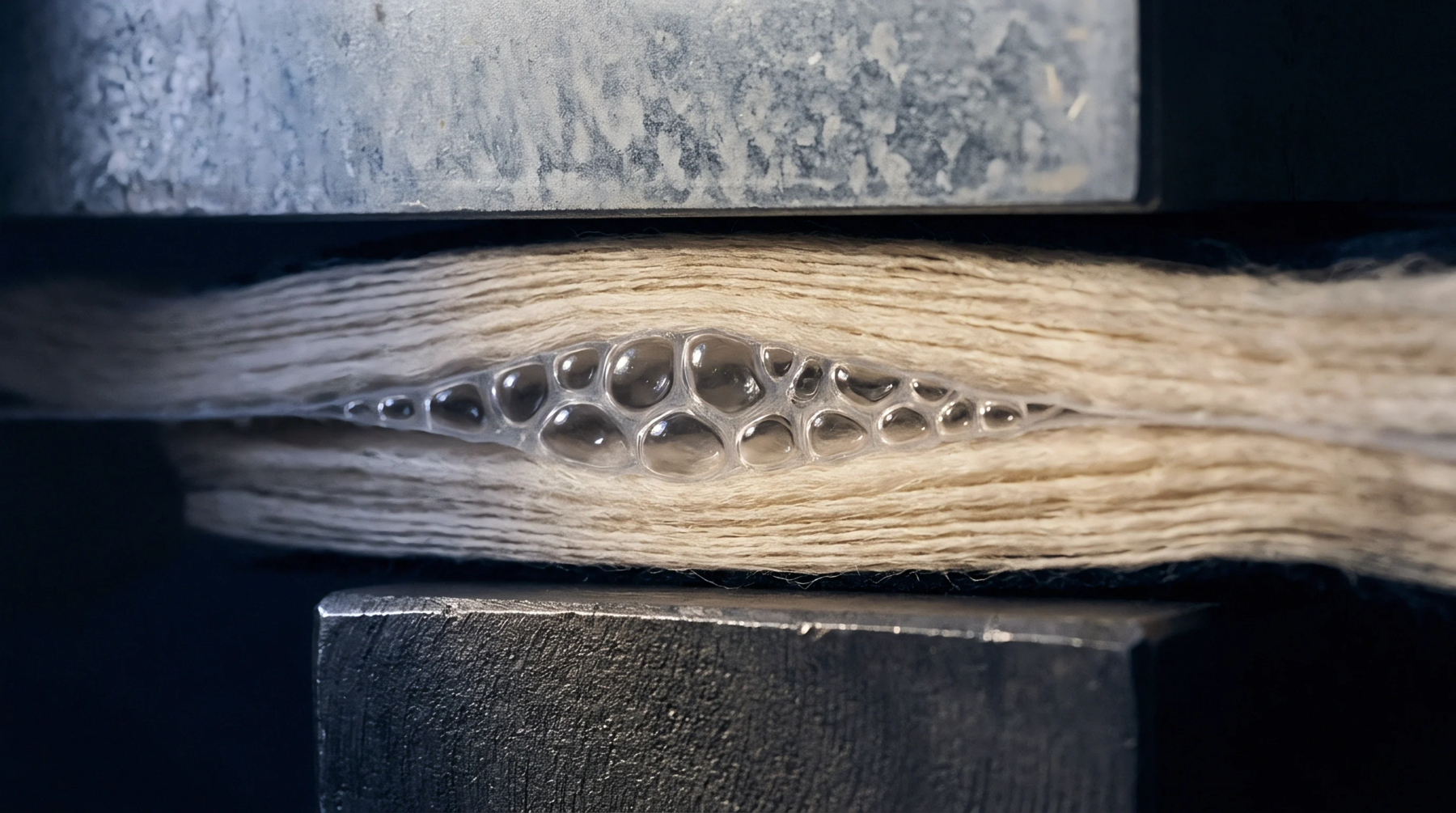
Micro Shed Dusting Accumulation Dynamics inside Air Jet Relay Nozzles under High Humidity
Humid air plasticizes sizing dust into sticky cakes inside relay nozzle bores, distorting airflow profiles and causing costly pick insertion stops.
Fluid mechanics within high-speed textile machinery defines the local separation and rotational reversal of fluid shear layers adjacent to solid boundary walls during high-velocity pneumatic transport. In air-jet insertion, boundary layer recirculation occurs along the inner boundaries of reed guide channels when primary propellant air separates from the curved dent profiles. This fluid detachment forms secondary vortex rings that counteract the downstream momentum of the travelling yarn tip.
Deceleration occurs because the reversed shear flow strips kinetic energy from the threadline. The phenomenon ceases to govern fluid behaviour once free stream air velocities fall below the Reynolds number thresholds required to maintain separated flow cavities, or when solid boundaries terminate into open atmosphere.
High-velocity air expelled from the main nozzle enters the profiled channel under extreme positive static pressure. As the expansion wave encounters successive reed dents, boundary layer recirculation generates small-scale eddies within the inter-dent gaps. These mini-vortices draw continuous air mass away from the channel core into lateral recirculation zones, producing parasitic drag on the passing yarn surface.
Friction against the yarn skin increases markedly as fiber hairs project into these reverse eddies. Measurements captured by laser Doppler anemometry demonstrate that static pressure drops precipitously along the reed length when these eddy zones expand unchecked. Consequently, auxiliary relay nozzles situated along the sley must pulse compressed air sequentially to suppress boundary reversal and replenish central jet velocity before the yarn tip stalls.
Weaving operations encounter immediate quality degradation when channel turbulence creates localized pressure deficits across the warp shed. As boundary layer recirculation intensifies, yarn tension fluctuates erratically between adjacent relay nozzle clusters, causing weft yarn buckling, snarl formation and false optical sensor cut-offs. Spun yarns spun from staple fibers suffer fiber strip-back, while filament yarns experience filament separation and inter-filament ballooning under the chaotic shear field.
Fabric inspection reveals these events as short picks, looped filling and localized warp streakiness where turbulent air disrupts warp end spacing. Weaving efficiency drops because automatic loom stops trigger on perceived yarn loss, requiring manual intervention to clear buckled weft tips from the shed.
Elimination of recirculating boundary zones relies on balancing supply air pressure against relay nozzle pitch. Increasing relay nozzle discharge pressure beyond design limits thickens the boundary layer rather than smoothing it, compounding eddy formation and wasting compressed air capacity. Installing reed dents with optimized entry tapers and non-planar concave surfaces restricts flow separation points to the extreme trailing edge.
Adjusting relay nozzle firing angles inward by two to four degrees directs the momentum vector into the reed belly, effectively washing out low-pressure recirculation pockets. A well-tuned pneumatic profile limits turbulence intensity across the shed width, establishing stable insertion velocity without inducing yarn structure disintegration.
Humid air plasticizes sizing dust into sticky cakes inside relay nozzle bores, distorting airflow profiles and causing costly pick insertion stops.
Expertise is a utility, not a secret. sentiention™ publishes its working knowledge as open reference: intelligence layer covering the materials it sources, the markets it enters, and the reference that serves both.