Bayesian Modeling of Multi-Layer Polymer Migration in Coated Fabrics
Bayesian migration models convert lab extraction data into posterior failure probabilities, letting buyers price compliance risks and catch batch non-conformity.


Kinetics
Mass transfer across multi-layer flexible composite membranes follows concentration gradient dynamics regulated by localized partition coefficients. Polymer coatings applied to woven or knitted textile backings frequently utilize distinct functional layers: a flexible topcoat, a dense tie-layer to promote interfacial adhesion, and a base coat engineered to anchor into synthetic yarns. When low-molecular-weight additives such as plasticizers, flame retardants, or UV stabilizers reside inside these layers, chemical potential differences drive molecular movement across internal boundaries.
Diffusion speed governs additive transport.
Translating transport theory to multi-layer polymer matrices requires solving Fickian second-law equations modified for heterogeneous boundaries. Equation models treat each polymer layer as a distinct spatial domain characterized by a unique diffusion coefficient and chemical solubility. The flux between adjacent polymer domains depends on the thermodynamic partition coefficient, which defines the equilibrium ratio of migrant concentration at the contact surface.
Temperature accelerates kinetic energy. Polymer chains expand under thermal loads, creating transient micro-voids that lower the activation energy required for additive molecules to jump between polymer segment sites.
| Polymer Matrix Layer | Target Additive Compound | Reference Temp (C) | Diffusion Coeff D0 (cm2/s) | Activation Energy Ea (kJ/mol) |
|---|---|---|---|---|
| Plasticized PVC Topcoat | Diisononyl Phthalate (DINP) | 23 | 1.4 x 10^-11 | 88.5 |
| Plasticized PVC Topcoat | Bis(2-ethylhexyl) Phthalate (DEHP) | 23 | 2.8 x 10^-11 | 82.1 |
| Thermoplastic Polyurethane (TPU) Tie-Layer | Tri-n-butyltin (TBT) Catalysts | 23 | 5.1 x 10^-12 | 96.4 |
| Acrylic Surface Finish | Organophosphate Flame Retardants | 23 | 8.7 x 10^-13 | 104.2 |
| Silicone Elastomer Coating | Linear Siloxane Oligomers | 23 | 3.2 x 10^-10 | 61.0 |
Arrhenius equations describe how diffusion coefficients scale when processing, storage, or environmental temperatures fluctuate. Higher temperatures increase thermal motion, raising the diffusion coefficient exponentially once temperatures cross the glass transition threshold of the specific polymer layer. In plasticized polyvinyl chloride layers, phthalate mobility increases rapidly between twenty and seventy degrees Celsius.
Conversely, aliphatic polyurethane interlayers maintain lower additive mobility due to tight hydrogen bonding between hard segments, acting as transient migration barriers until elevated thermal conditions induce soft-segment soft-chain mobility.
At 70 degrees Celsius, phthalate ester diffusion through plasticized PVC topcoats accelerates by a factor of 4.2 relative to room temperature storage.
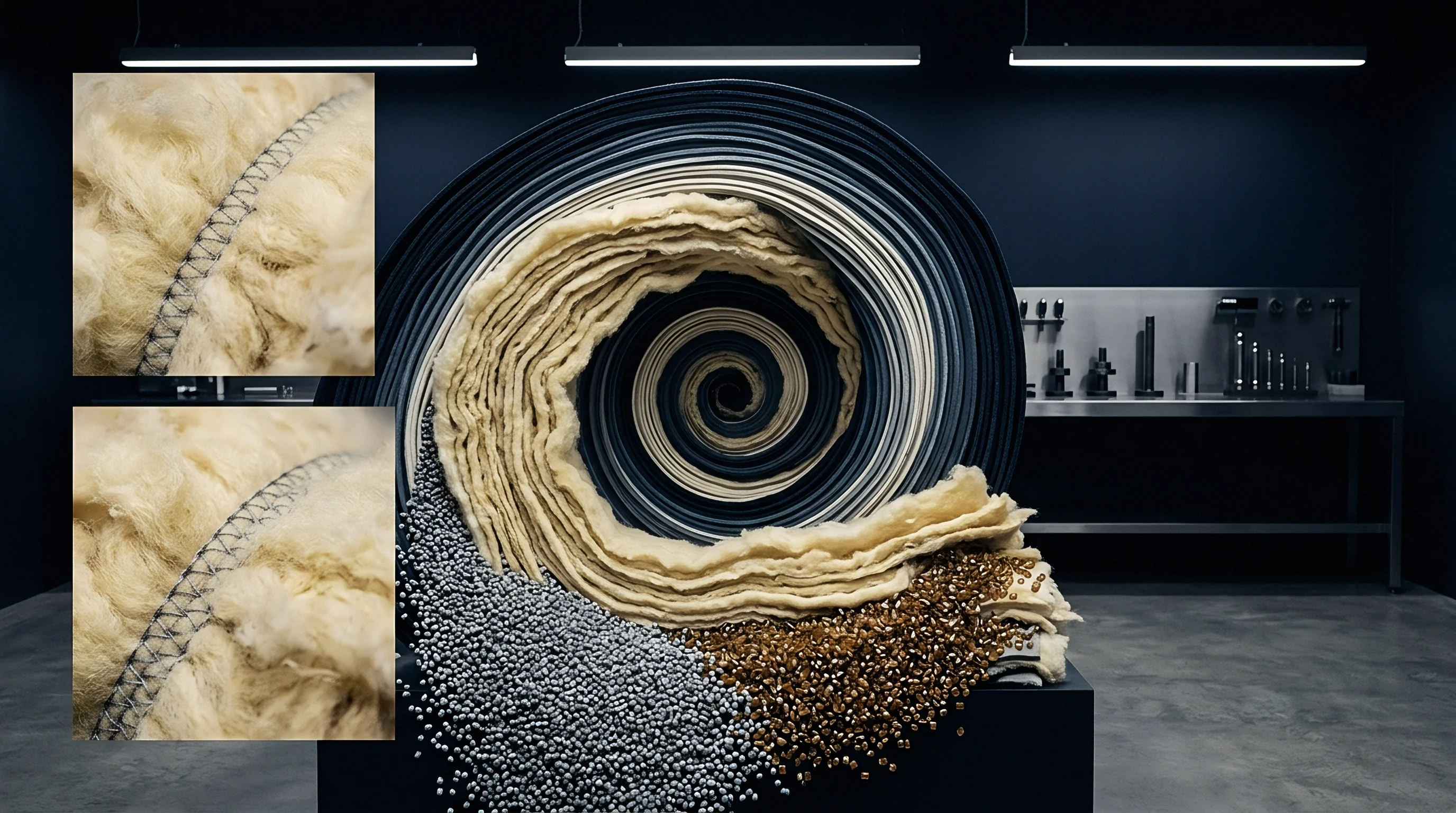
When coated fabrics undergo rolling under tension during mill packaging, pressure gradients alter localized diffusion paths. Mechanical compression reduces inter-chain void volumes, temporarily reducing diffusion rates normal to the fabric plane while forcing lateral surface exudation toward roll edges. Converter technical sheets frequently explain non-compliant surface residue as harmless processing oil exuding naturally from fresh production lots.


Pore

Interfacial Boundary Dynamics in Laminated Coatings
Phase separation between adjacent synthetic films creates localized chemical potential gradients that force low-molecular-weight additives toward outer surfaces. When a highly plasticized polyvinyl chloride layer contacts an acrylic surface lacquer or a polyurethane waterproofing film, additive concentration disparities drive mass transfer across the interface. Mobile additives accumulate at structural interfaces, weakening secondary intermolecular bonds between adhesive layers and functional topcoats.
Partition coefficients dictate liquid distribution.

Microstructural Transport Pathways across Textile Substrates
Yarn void geometry and filament packing densities govern how deeply liquid polymer formulations penetrate woven polyester carrier webs. Monofilament structures present continuous solid boundaries that force migrating chemicals into inter-yarn interstitial gaps. Multifilament bundles draw liquid plastisols through capillary forces, creating microscopic liquid channels that act as high-speed transport highways for unreacted monomers and plasticizers.
- Plasticizer Exudation Thresholds exceeded under compressive roll tension induce surface tackiness and blocking defects during high-humidity transit.
- Interlayer Adhesion Loss occurs when mobile plasticizers accumulate at the polyurethane tie-coat interface, degrading mechanical peel strength below standard limits.
- Topcoat Plasticizer Extraction driven by aqueous contact leaches additive molecules into surface fluids, accelerating film embrittlement over repeated flexing cycles.
- Substrate Delamination Pathways form as volatile additives migrate through microscopic pinholes, creating localized vapor pockets during heat aging.
Flexural fatigue during product usage generates dynamic micro-cracks across topcoat layers. Mechanical stress cycling expands internal microscopic fissures, reducing the effective diffusion path length to exterior environments. Dynamic flexing tests demonstrate that mechanical working accelerates chemical transport rates compared to static shelf-aging conditioning.
Thicker tie-layers delay chemical migration to exterior faces but double the structural stiffness of the finished composite.

Priors

Hierarchical Parameter Construction from Gas Chromatography Screening
Informative distributions for diffusion rates draw initial variance bounds from historical mass spectrometry spectral libraries. Rather than assuming uninformative flat prior distributions across parameter spaces, Bayesian models establish normal-inverse-gamma priors centered on empirical test data from raw resin suppliers. Prior distributions standardise input assumptions.
Gas chromatography mass spectrometry screens provide quantitative baseline ranges for plasticizer concentration, stabilizer weight fractions, and unreacted monomer residues within raw compounding batches. Combining historical laboratory certificates with physical property database limits bounds prior distributions for activation energies and diffusion pre-exponential factors. A hierarchical Bayesian structure nests individual coating lot parameters within broader polymer class distributions, preventing unrepresentative single-test outliers from skewing migration kinetics predictions.
Informative probability distributions built from raw material chemical testing yield tighter confidence intervals for batch acceptance than flat uninformative assumptions.

Markov Chain Monte Carlo Calibration
Likelihood evaluations incorporate experimental extraction concentrations gathered at progressive temperature time-points. Markov Chain Monte Carlo algorithms, specifically Metropolis-Hastings and Hamiltonian Monte Carlo samplers, generate posterior probability distributions for diffusion coefficients and multi-layer partition parameters. MCMC samplers calculate posterior probabilities.
Quantifying joint probability distributions between diffusion coefficients and layer partition ratios resolves mathematical estimation problems where multiple parameter combinations yield identical surface extraction values. Sampling fifty thousand iterations across multiple chains allows convergence metrics such as Gelman-Rubin diagnostics to verify stable parameter estimation. Posterior parameter distributions provide complete probability curves for migrant mass transfer rather than simple point estimates, exposing tail risks where extreme migration rates occur despite acceptable mean values.
Analytical uncertainty remains unresolved regarding how localized shear stresses during industrial calendering alter long-term probability distributions of additive migration velocity.


Assay

Standardized Analytical Extraction Protocols
Quantifying mobile compounds requires immersion conditioning inside regulated liquid stimulants under controlled thermal exposure. Analytical laboratories select food-contact stimulants or synthetic sweat solutions to measure compound exudation under standardized exposure regimes. Test parameters replicate storage, environmental wash-off, or skin contact scenarios.

How Do Temperature Spikes Alter Multi-Layer Partition Coefficients?
Thermal energy increases free volume within amorphous polymer domains, accelerating molecule movement across plasticized zones. Higher temperatures alter thermodynamic equilibrium ratios between adjacent polymer phases, shifting partition coefficients toward layers with higher solubility capacities. Iso-octane simulates organic contact.
| Standard Method | Scope and Focus | Test Stimulant Medium | Conditioning Time and Temp | Detection Bounds |
|---|---|---|---|---|
| EN 1186-13 | Volatile and semi-volatile migrants | Iso-octane / Ethanol 95% | 10 days at 40 C | 1.0 mg/dm2 |
| ISO 177 | Plasticizer loss into solid absorbent | Activated Polyethylene Disk | 14 days at 85 C | 0.01% weight fraction |
| EN 13130-1 | Specific monomer migration | Water / 3% Acetic Acid | 24 hours at 70 C | 0.05 mg/kg |
| DIN 53359 | Flex-fatigue chemical release | Synthetic Sweat Solution | 50,000 cycles at 23 C | 0.1 mg/kg |
Gas chromatography isolates chemical compounds.
- Cut three square specimens measuring ten centimeters per side from the unselvedged center of the coated roll.
- Weigh each sample on an analytical balance calibrated to one tenth of a milligram accuracy.
- Submerge the prepared swatches in iso-octane stimulant inside sealed glass testing cells held at forty degrees Celsius for ten days.
- Evaporate the solvent extract under nitrogen gas flow before injecting the residual concentrate into a gas chromatograph mass spectrometer.
- Plot peak area values against five-point calibration curves to calculate total migrated additive mass per unit surface area.
ISO 177 testing at 85 degrees Celsius for 14 days invalidates compliance claims if the receiving substrate lacks a certified barrier layer.
Analytical accuracy hinges on complete separation of surface residue from internal compound pools. Rinsing sample faces with solvent strips surface exudate without extracting internal material, providing distinct data points to calibrate multi-layer numerical models. Annex XVII Entry 51 of Regulation EC 1907/2006 limits the total sum of DEHP, DBP, BBP, and DIBP to 0.1 percent by weight of plasticized materials, forcing automated shipment rejection when laboratory extraction values breach this boundary.


Threshold

Regulatory Limits across Global Compliance Frameworks
Chemical restrictions set strict numerical boundaries for toxic additives present in consumer textiles. Market access regulations target phthalate plasticizers, organotin catalysts, flame retardants, and fluorinated surfactants due to bioaccumulation and toxicity risks. Substance limits prevent market entry.

Specific Migration Limits versus Total Substance Concentrations
Laboratory audits evaluate both absolute chemical mass in a substrate and actual compound transfer into surrounding media. Total substance limits govern heavy metals and persistent organic pollutants within the bulk polymer matrix. Specific migration limits restrict the mass of chemical migrating into skin, liquid, or ambient air per unit surface area over defined timeframes.
| Regulation Standard | Target Chemical Class | Limit Type | Threshold Value | Primary Test Instrument |
|---|---|---|---|---|
| REACH Annex XVII Entry 51 | DEHP, DBP, BBP, DIBP Phthalates | Total Weight Content | 1000 mg/kg (0.1%) | GC-MS |
| OEKO-TEX Standard 100 Class I | Organotin Catalysts (DBC, DOT) | Extractable Mass | 0.5 mg/kg | LC-MS/MS |
| CPSIA Section 108 | Restricted Phthalate Esters | Total Weight Content | 1000 mg/kg (0.1%) | GC-MS |
| EU POPs Regulation 2019/1021 | Short-Chain Chlorinated Paraffins | Total Concentration | 1500 mg/kg | GC-ECNI-MS |
Recalls destroy brand equity rapidly.
- Phthalate Ester Accumulation in synthetic topcoats triggers border detentions when cumulative concentration exceeds one thousand milligrams per kilogram of material.
- Organotin Catalyst Migration from polyurethane coatings into synthetic sweat solutions fails infant product certifications at levels above zero point five parts per million.
- Fluorinated Surfactant Exudation from oil-repellent finishes breaches persistent pollutant laws when total volatile chain fragments exceed twenty-five parts per billion.
Substrate yarn density dictates local concentration gradients near the coating interface during dynamic flex testing.
Screening programs balance testing expenses against non-compliance risk exposures. Testing costs offset compliance risk. Certificate scope verification protects buyers from unexpected customs holds when material formulas change between production lots.
Delivering non-compliant coated roll goods into European distribution networks results in mandatory product recalls, inventory destruction fees, and commercial contract termination.

Exposure
Bayesian Risk Quantitation for Batch Acceptance Decisions
Posterior distribution modeling transforms analytical lab variance into concrete financial probabilities of shipment acceptance. Importers evaluating a ten-thousand-square-meter production lot of plasticized PVC fabric establish acceptance criteria based on migration limits set by regulatory bodies. Sampling five swatches per roll provides empirical extraction data that updates prior diffusion probability distributions.
Posterior distributions refine lot risk.

Sensitivity Analysis and Compliance Financial Modeling
Varying temperature assumptions within Markov simulation runs reveals how transport speed variations impact total lot liability. Consider a batch scenario with a specific migration limit threshold of 0.10 milligrams per square decimeter. The empirical lab report shows a sample mean migration rate of 0.082 milligrams per square decimeter with a standard deviation of 0.015.
Classical hypothesis testing accepts the lot based on the mean sitting below the regulatory ceiling. Bayesian posterior calculation integrates the entire probability density function above the 0.10 limit threshold, revealing a 12.4 percent probability that unselected rolls in the container breach legal standards.
Financial risk modeling assigns monetary values to non-compliance scenarios. Multiplying the 12.4 percent posterior failure probability by the landed batch value of two hundred thousand euros plus potential recall liabilities yields an expected loss of twenty-eight thousand euros per shipment. Buying extra barrier-layer film at five thousand euros per batch reduces posterior breach probabilities below 0.1 percent, eliminating financial tail risk before port dispatch.
Importers pricing compliance risk into purchase orders utilize posterior failure probability distributions to set financial reserve funds against potential customs detentions.