Controlling Particulate Migration in Continuous Pad Dyeing Lines
Controlling particulate migration requires stabilizing pad liquor viscosity, balancing wet pick-up, and managing non-contact pre-drying below critical moisture thresholds.
Dynamics

Capillary Transport and Evaporation Fronts
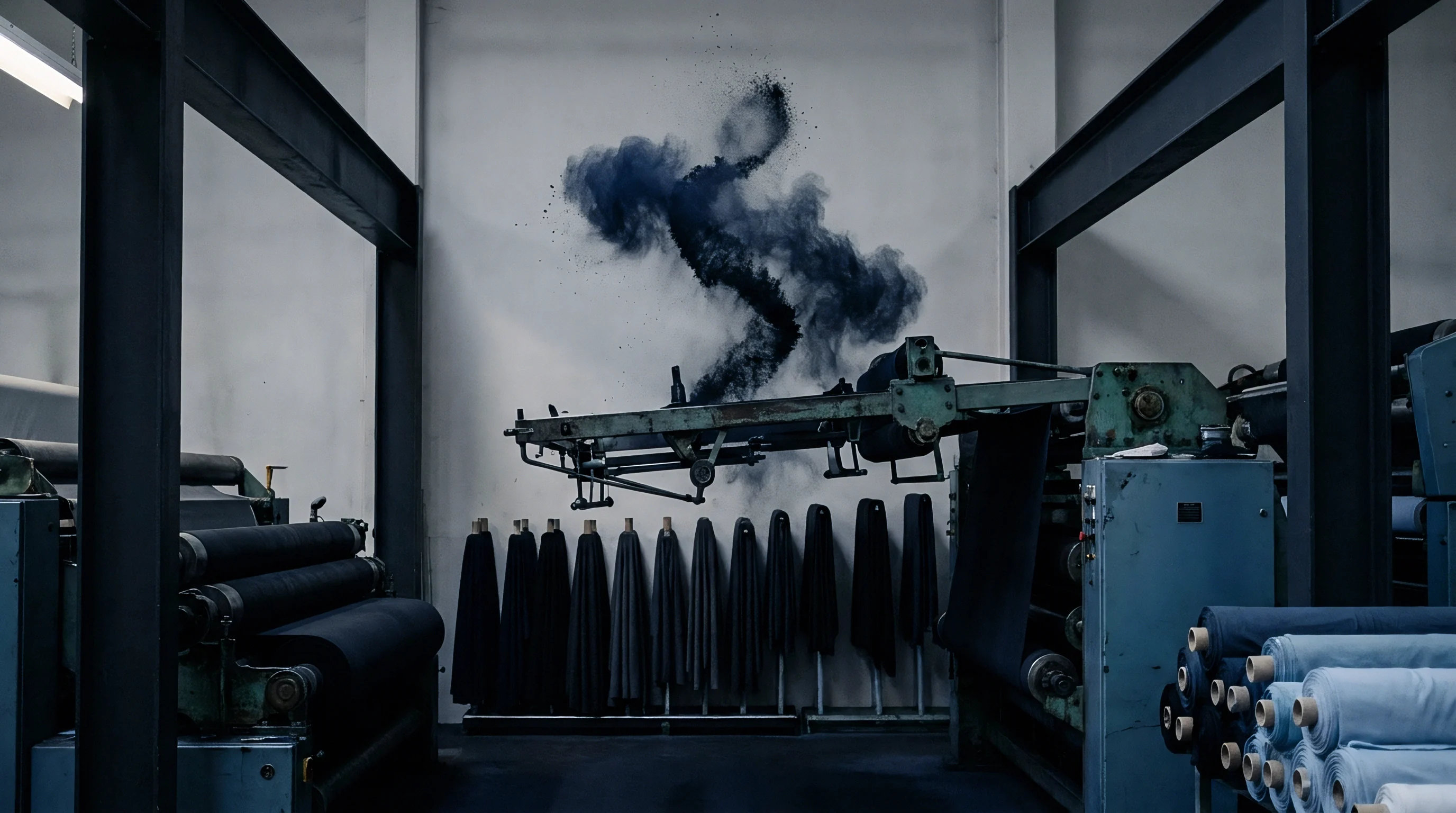
Continuous liquor application onto a moving textile web deposits dye particles, auxiliaries, and water within the capillary network formed by fiber bundles. Squeezing the saturated web through a pad mangle fixes the initial wet pick-up level, leaving fluid filled within inter-yarn and inter-fiber voids. Evaporative energy applied in subsequent drying zones converts liquid surface water into vapor at the fabric boundary.
Water evaporates from outer surfaces, creating a surface tension gradient that pulls liquid from the inner core toward the exterior faces through capillary action. Suspended dye particles, lacking chemical affinity for cellulosic or synthetic fibers in unheated pad baths, move alongside the migrating water vehicle.
Movement continues unabated until the moisture content drops below a critical threshold known as the particulate immobilization point. High evaporation rates at fabric faces accelerate liquid velocity through internal capillaries. Heavyweight fabrics carrying high wet pick-up values display severe particle accumulation at surface boundaries.
Heat accelerates evaporation. Liquid water carries disperse or vat dye pigments to the high-temperature zone, concentrating colorants on outer fiber edges while depleting the internal yarn core.
Water movement halts when capillary water volume falls below the critical moisture content of thirty percent.
Asymmetric Evaporation and Shade Skew
Unbalanced thermal energy application creates severe color variations across both surfaces of the textile web. Air velocity differentials between upper and lower drying nozzles induce faster evaporation on one face of the cloth. Dye particles migrate preferentially toward the face experiencing rapid moisture loss, yielding two-sidedness where front and back shades deviate beyond acceptable color tolerances.
Surface energy imbalance also causes listing, where fabric selvages dry faster than the center, creating side-to-center shade bands.
Liquor composition directly influences the rate of liquid movement toward evaporation zones. Surface tension, wet pick-up volume, and fluid viscosity govern particle velocity through textile pores. When wet pick-up exceeds eighty percent on continuous cotton dyeing ranges, capillary channels remain completely filled, lowering resistance to liquid flow and increasing total particulate transport before the web reaches non-contact drying stages.
The exact physical boundary where capillary fluid flow transitions into vapor-phase movement within tightly twisted ring-spun yarns remains uncertain across high-speed continuous pad lines.
Infrared
Non-Contact Evaporation Zones
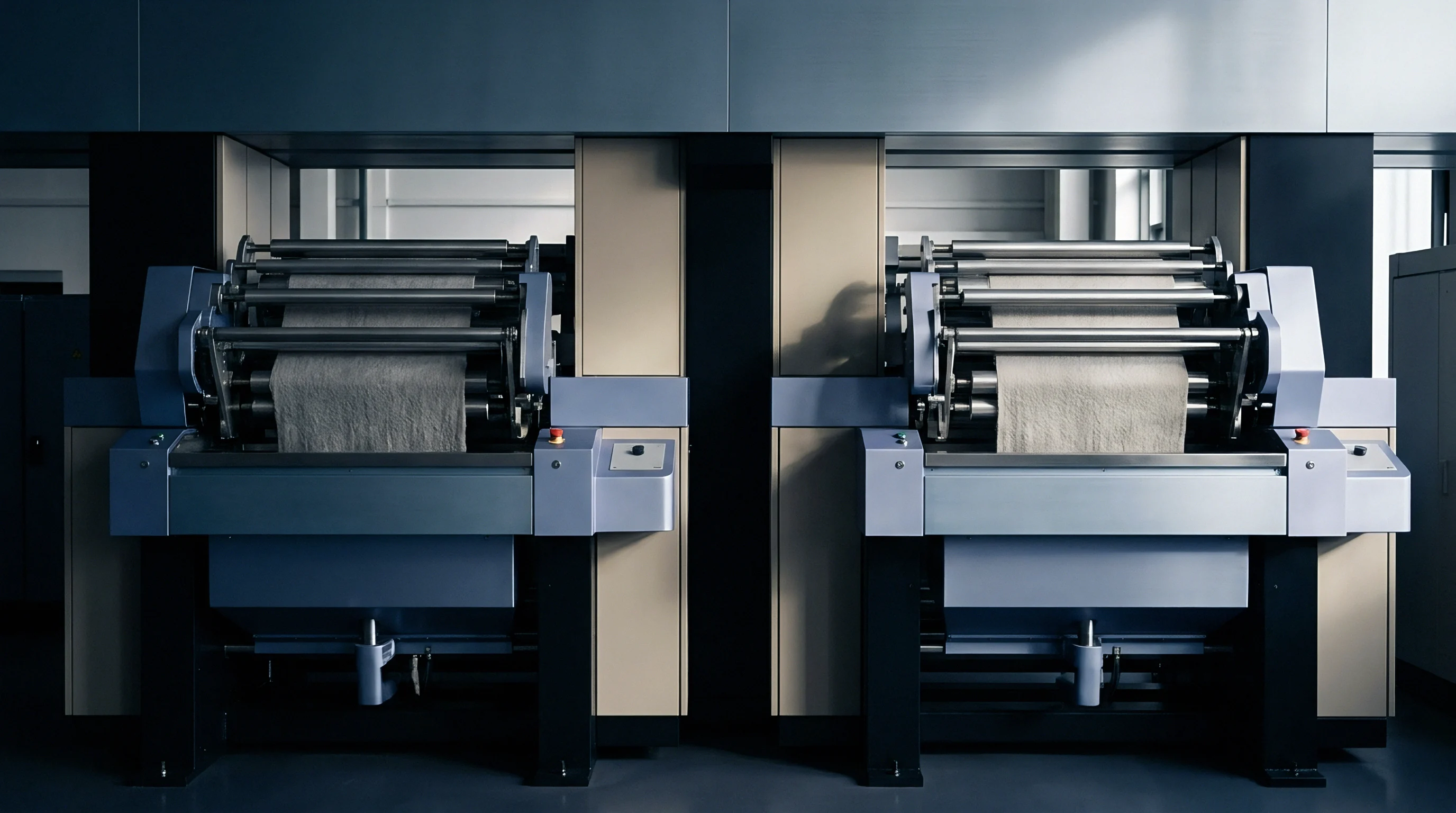
Intermediate pre-drying systems employ radiant energy fields to evaporate surface water without physical roll contact. Passing wet fabric over solid guide rollers prior to partial moisture removal causes dye pickup on metal surfaces, generating mechanical marking and streaking. Non-contact predryers operating in the medium-wavelength band between two point five and three point five micrometers transfer thermal energy directly to water molecules within the liquid film, initiating uniform evaporation across both fabric faces simultaneously.
Radiant predrying must reduce overall fabric moisture content from initial wet pick-up levels down to thirty or thirty-five percent before the web touches metal guide rolls or enters hot-flue convection dryers. Air flow velocities within intermediate pre-dryers must remain strictly balanced across top and bottom nozzles, keeping air speed below five meters per second to prevent physical displacement of wet dye liquor across the surface.
| Predrying Zone Type | Target Moisture Drop (%) | Air Velocity Limit (m/s) | Migration Risk Level | Dominant Failure Mode |
|---|---|---|---|---|
| Electric Short-Wave Infrared | 65 to 45 | 2.0 | Moderate | Surface crusting and local mottling |
| Gas-Fired Medium-Wave Infrared | 70 to 30 | 3.5 | Low | Balanced two-sided evaporation |
| Hot-Air Convection Predryer | 70 to 40 | 8.0 | High | Air-jet streaking and side-to-center listing |
| Direct Steam-Heated Cylinder | 50 to 10 | 0.0 | Severe | Roller picking and instant two-sidedness |

Radiant Emitter Balancing and Zoning
Medium-wave gas-fired emitters match the absorption spectrum of water more effectively than short-wave quartz tubes. Zoned heat adjustment across the web width corrects thermal edge-effects caused by ambient air entrainment at the line entry. Closing side dampers on infrared panels prevents accelerated drying at selvages, suppressing listing defects before the cloth enters convection units.
Nodal pyrometers track web temperature continuously, adjusting emitter power dynamically to maintain stable evaporation rates during speed adjustments.
Operating non-contact predryers at reduced power settings transfers excessive drying loads into subsequent hot-flue units, increasing particulate drift across guide rolls.
Infrared predrying units must evaporate forty percent of total fabric water weight before wet cloth touches any solid metal roller.
Non-contact drying equipment must hold equal surface temperatures across both web faces or particulate dye shifts to the hotter side instantly.
Chemistry

Polymeric Antimigrant Formulations
Liquid phase rheology modification stops dye particle movement during thermal water removal. Commercial antimigrating agents rely on high-molecular-weight water-soluble polymers, predominantly sodium alginates, polyacrylates, carboxymethylcellulose, and synthetic acrylic copolymers. These additives alter the flow characteristics of pad bath liquors, increasing liquid viscosity as temperature rises or as water concentration drops through evaporation.
Thermal gelation agents undergo a rapid structural shift at elevated temperatures, forming a three-dimensional gel network inside capillary pores. Gelation freezes dye particles within fiber interstices, locking colorants into position well before water completely vaporizes. Formulations must maintain low viscosity at ambient mixing and padding temperatures to ensure rapid, uniform capillary penetration inside the pad mangle nip.
The following failure modes indicate breakdown or incorrect dosing of polymeric anti-migration chemistry within continuous padding systems:
- Edge-to-center listing resulting from thermal gradient differentials across width combined with insufficient liquor viscosity at elevated pre-dryer entry temperatures.
- Two-sided shade deviation caused by unequal polymer deposition or asymmetrical air knife evaporation forcing low-viscosity liquid toward the top face.
- Pigment agglomeration spots arising from ionic incompatibility between high-charge synthetic polyelectrolytes and non-ionic disperse dye dispersants in the pad bath.
- Roller varnish buildup produced when excessive acrylic antimigrant concentrations deposit onto hot-flue guide rolls under high surface temperatures.

Electrolyte Interactions and Bath Stability
Polyacrylic antimigrants behave as anionic polyelectrolytes in aqueous solution, exhibiting extreme sensitivity to valence state and concentration of dissolved salts. Electrolytes introduced via unfixed dye formulations or hard process water suppress electrostatic repulsion along polymer chains, causing polymer coils to collapse and lose thickening power. Water quality monitoring keeps total hardness below fifty parts per million as calcium carbonate, preventing premature precipitation of polyacrylate molecules.
Padding baths containing disperse and reactive dyes demand balanced chemical additions to avoid viscosity loss or particulate dye coagulation. Adding non-ionic wetting agents reduces surface tension to facilitate rapid web wetting, but excessive surfactant additions undermine antimigrant performance by lowering fluid yield stress inside capillary channels. Binders added for pigment padding systems must remain chemically compatible with synthetic polyelectrolytes, preventing shearing failure inside high-speed pad mangle bowls.
Improper antimigrant selection reduces color yield by ten percent, increases surface frosting, and causes severe batch-to-batch shade variation across long production runs.

Substrate

Structural Capillarity and Yarn Geometry
Fabric structural geometry establishes the pore size distribution that dictates capillary suction forces. Woven constructions utilizing ring-spun yarns possess fine, contiguous intra-yarn capillaries that generate high capillary pressures, drawing fluid rapidly toward outer yarn surfaces during drying. Open-end rotor yarns feature disordered fiber orientation and outer wrapping fibers that disrupt continuous capillary pathways, inherently slowing fluid velocity and suppressing surface dye accumulation.
High-density woven constructions with high cover factors present restricted inter-yarn pore volumes, concentrating moisture transport within tightly packed warp yarns. Knitted structures exhibit large inter-loop voids that reduce capillary suction pressures, though high wet pick-up retention within loop intersections creates localized dye pooling if pre-drying heat application lacks uniformity.
| Fabric Build Type | Yarn Spinning System | Capillary Pore Diameter (μm) | Nominal Wet Pick-Up (%) | Migration Susceptibility Index |
|---|---|---|---|---|
| 3/1 Twill Workwear (290 gsm) | Ring-Spun Combed Cotton | 5 to 12 | 65 to 70 | High |
| Plain Weave Poplin (115 gsm) | Open-End Rotor Cotton | 15 to 35 | 55 to 60 | Low |
| Double Knit Interlock (220 gsm) | Air-Jet Textured Polyester | 20 to 45 | 60 to 65 | Moderate |
| Heavy Canvas (400 gsm) | Ring-Spun Carded Cotton | 8 to 18 | 75 to 85 | Severe |
Preparation Uniformity and Absorbency
Pre-treatment processes dictate the spatial uniformity of fabric absorbency prior to dye padding. Incomplete singeing leaves surface fuzz that acts as localized high-evaporation sites, attracting disperse dye particles and generating micro-speckling. Mercerization increases cellulose swelling, altering internal pore size distribution and improving dye affinity, but uneven caustic soda impregnation creates absorbency bands across the cloth width.
Executing systematic preparation monitoring prevents downstream shade defects caused by irregular capillary uptake across continuous pad lines:
- Measure fabric absorbency across five widthwise sampling points using ISO 9073-6 liquid wicking testing to verify capillary rise uniformity.
- Verify residual size content across the lot using AATCC Test Method 103, ensuring starch levels remain strictly below zero point two percent by weight.
- Quantify surface hairiness utilizing optical reflection analysis, confirming effective singeing prior to pad application.
- Check surface pH uniformity across the web according to ISO 3071, holding values within the range of six point five to seven point five.
Edge-to-center shade variation is frequently attributed to dye batch instability when uneven mercerization washing profiles are the actual root cause.

Verification

Standardized Migration Evaluation Protocols
Quantifying particle movement during drying demands objective, standardized laboratory testing before committing continuous production lines to bulk shade runs. AATCC Test Method 140 provides the definitive protocol for evaluating dye particle migration in padded textile fabrics. The procedure involves padding fabric swatches with test dye liquor, covering a portion of the wet swatch with a watch glass to suppress local evaporation, and subjecting the sample to controlled thermal drying.
Evaporation drives dye toward exposed zones, while the covered section retains original dye distribution.
Spectrophotometric evaluation measures the shade difference between covered and uncovered areas. Calculating color change values yields a numerical migration index where zero represents complete particle drift and one hundred indicates total particle immobilization. Spectrophotometer measurements utilizing the CIE DE2000 color difference formula provide precise objective values, eliminating human visual bias during shade evaluation.
Where Does Migration Testing Fail on Bulk Continuous Runs?
Laboratory watch-glass procedures fail to replicate line dynamics when air flow velocity and directional radiant drying differ from continuous dyehouse equipment. Static laboratory drying lacks the intense forced convection present in full-scale hot-flue dryers. Testing under laboratory conditions without air movement underestimates particulate shift on high-speed continuous ranges by up to forty percent.
Effective quality management mandates defining specific line parameters inside fabric purchase contracts to secure fastness and shade uniformity guarantees:
- Maximum permissible shade deviation between web selvages and center line shall not exceed zero point five CIE DE2000 units across any hundred meters of continuous production.
- Face-to-back color differential measured across the continuous run shall remain below zero point six CIE DE2000 units under Illuminant D65 and Horizon daylight.
- Antimigrant formulation dosing limits must be explicitly declared within wet processing dossiers, prohibiting modifications without technical re-qualification.
AATCC Test Method 140 results below eighty points correlate directly with visible listing and two-sided shade rejections on continuous Thermosol lines.
According to standard commercial purchasing specifications, any bulk dyeing lot exhibiting face-to-back shade variation greater than DE2000 zero point eight fails compliance checks and permits immediate rejection of the delivered goods.
Strategy
Economic Trade-Offs in Continuous Dyeing
Selecting anti-migration mitigation routes involves direct trade-offs between chemical additive expenditure, energy consumption, line speed, and shade rejection costs. Running continuous pad-Thermosol lines at reduced production speeds decreases surface evaporation intensity within intermediate dryers, mitigating particulate movement without increasing chemical additive costs. Lowering line speed reduces hourly plant throughput, increasing fixed overhead costs per finished meter of fabric.
Dosing synthetic polyelectrolyte antimigrants into the pad bath increases chemical costs per liter of dye liquor, but allows lines to operate at maximum mechanical speed without incurring shade defect penalties. Radiant pre-drying equipment requires substantial electrical or natural gas inputs, adding operational utility costs that scale directly with wet pick-up reduction requirements.
| Operating Parameter | Baseline (No Antimigrant) | Chemical Stabilization | Maximized IR Drying | Optimized Combined Route |
|---|---|---|---|---|
| Line Speed (m/min) | 25 | 45 | 40 | 50 |
| Antimigrant Cost ($/1000m) | 0.00 | 18.50 | 0.00 | 18.50 |
| IR Utility Energy Cost ($/1000m) | 12.00 | 12.00 | 38.00 | 32.00 |
| Production Time (Hours) | 6.67 | 3.70 | 4.17 | 3.33 |
| Estimated Rejection Rate (%) | 8.5 | 1.5 | 2.0 | 0.2 |
| Total Landed Cost ($/1000m) | 185.00 | 122.00 | 145.00 | 108.50 |

Capacity Allocation and Processing Routes
Calculating the true cost of continuous dyeing requires accounting for fabric waste, energy consumption, chemical additives, and re-dyeing capacity losses. High shade rejection rates consume line capacity, creating production bottlenecks that delay delivery schedules across downstream cutting facilities. Implementing optimized chemical anti-migration controls alongside balanced intermediate infrared drying minimizes total landed fabric costs while maintaining continuous plant velocity.
Selecting continuous pad-steam or pad-thermosol production routes over batch jet dyeing proves economically viable only when run lengths exceed three thousand meters per shade, allowing high setup costs and chemical dosing expenses to amortize efficiently over bulk volumes.
Technical qualification of continuous dyeing facilities requires verifying intermediate pre-dryer burner calibration, air velocity symmetry across nozzles, and automated antimigrant dosing systems prior to issuing bulk purchase orders.