Resolving Latent Dimensional Skew and Metamerism across Multi Stage Subcontracted Dyeing Chains
Controlling latent fabric skew and metamerism in subcontracted chains demands unified yarn torque standards, identical dye trichromies, and strict inter-mill dockets.
Torque
Continuous filament and spun yarns retain mechanical energy within their helical fiber packing when held under tension on a circular knitting machine or high-speed loom shed. This stored energy remains latent inside the greige roll until aqueous processing grants the polymer chains enough molecular mobility to relax. When a greige knit fabric enters a jet dyeing vessel, hot liquor, mechanical tumbling, and hydration combine to break temporary hydrogen bonds in cellulosic fibers or unlock amorphous regions in synthetic filaments.
The helical fibers unwind toward a lower energy state, and this internal rotation pulls adjacent course loops or weft picks out of perpendicular alignment with the selvedge, generating latent dimensional skew.
Yarn twist direction and magnitude dictate the angle of structural deformation. A single-system ring-spun yarn produced with Z-twist creates a persistent tendency to rotate clockwise as tension relaxes. When knitted into a single jersey construction, every loop incline favors the same diagonal bias.
The collective rotational force of thousands of individual loops drives the entire fabric tube or open-width roll into a spiral geometry. S-twist yarns rotate counter-clockwise with equal force. Combining S and Z twist yarns in alternating feeder arrangements neutralizes macro-level fabric spirality, though this balance remains fragile if the two yarns possess differing twist factors, moisture histories, or spinning tension profiles.

Rotational Stress in Fiber Helices
Cotton fibers possess a natural convoluted ribbon structure that amplifies rotational force when wetted. As water molecules enter the amorphous regions of the primary and secondary walls, cross-sectional swelling forces the helical axis to untwist. In open-end rotor yarns, wrapper fibers create localized zones of high torque alongside core fibers with lower orientation angles.
This structural heterogeneity produces non-uniform dimensional skew along the fabric length when subjected to wet agitation.
Synthetic yarns generate torque through molecular orientation imparted during the drawing phase. Polyester and polyamide yarns held under high tension during texturing retain residual internal shear stresses. When exposed to scouring temperatures exceeding the glass transition temperature of the polymer, amorphous segments contract while crystalline regions realign.
Without mechanical restraint, textured filament fabrics display immediate diagonal distortion across the bed width, widening the shear angle.

Relaxation Mechanics during Aqueous Scouring
Greige fabric entering a subcontracted wet-processing facility carries a cumulative history of mechanical stress from every yarn-forming and fabric-forming stage. Scouring baths designed to strip spin finishes, sizing agents, and knitting oils introduce thermal energy that dissolves temporary cross-links maintaining the structural shape. In a rope-dyeing jet, the fabric collapses into longitudinal folds while subject to hydrodynamic transport forces, and this uncontrolled tumbling allows internal torque forces to express themselves freely as structural spirality.
Woven structures experience skew when weft yarns fail to remain perpendicular to warp threads. In asymmetric weave patterns, such as three-by-one right-hand twills, the diagonal float structure creates an inherent mechanical bias. Warp ends ride over multiple weft picks, generating higher longitudinal crimp than crosswise threads.
During aqueous scouring, differential swelling between warp and weft causes the twill line to steepen, dragging weft alignment away from a ninety-degree axis. If the greige mill operates looms with unequal warp tension across the beam width, the relaxation rate varies from edge to center, converting flat fabric into a sheared parallelogram.

Structural Shear in Asymmetric Weaves
Shear angles in woven fabric compound when processing is split across multiple wet subcontracting facilities. A mercerizing mill may pull fabric lengthwise under heavy tension to maximize luster and dye affinity, stretching yarn helices into an unnatural, temporary alignment. When this mercerized fabric travels to a secondary subcontracted dyehouse, subsequent jet processing releases that temporary mechanical set.
The fabric relaxes abruptly, reverting to its original twisted configuration with elevated skew percentages.
Evaluating these mechanical movements relies on recording the angular deflection of weft yarns relative to the perpendicular baseline. A minor angular shear of three degrees at the greige state translates to over eight percent structural spirality on the cutting table if uncorrected. Single jersey knits frequently demonstrate spirality values exceeding twelve percent when processed through unmonitored rope-dyeing sequences.
The structural bias compromises garment panel alignment, causing twisted leg seams in trousers and side-seam migration in cut-and-sew tops.
Single jersey knits exhibiting a twist factor above 4.0 alpha metric generate spirality values exceeding 10 percent when aqueous scouring occurs without pre-setting.
- Unbalanced Twist Multiplier occurs when ring-spun or rotor yarns carry high twist factors that generate continuous rotational stress across adjacent knit loops or woven floats.
- Differential Machine Tension develops on multi-feeder circular knitting machines or high-speed air-jet looms when individual yarn packages feed into the forming zone under unequal drag forces.
- Thermal Relaxation Shock happens when tensioned greige goods contact scouring baths above the polymer glass transition temperature without prior mechanical or thermal stabilization.
- Asymmetric Float Crimp arises in twill or satin weave architectures where unequal yarn floating distances allow warp threads to pull weft picks off perpendicular alignment during swelling.
Subcontracted chains exacerbate mechanical skew when intermediate processing steps neglect structural alignment checks. A grey mill ships fabric wound under high mechanical roll tension, masking latent torque. The mercerizer processes the substrate under longitudinal stretch, adding axial strain.
The contract dyehouse processes the fabric in jet vessels where fluid turbulence allows latent torque to release fully. By the time the fabric arrives at the finishing mill, structural shear has set into the fiber orientation, requiring drastic mechanical intervention that degrades fabric hand and burst strength.
| Fabric Construction | Yarn Type & Twist | Greige Skew Range (%) | Post-Scour Spirality (%) | Standard Test Reference |
|---|---|---|---|---|
| Single Jersey Knit | 100% Cotton Ring Spun Z-Twist | 2.5 – 4.0 | 8.0 – 14.0 | ISO 16322-2 |
| Interlock Rib Knit | 100% Cotton Combed S/Z Alternating | 0.5 – 1.2 | 1.5 – 2.8 | ISO 16322-2 |
| 3/1 Right Hand Twill | 65/35 Poly Cotton Blended Ring | 1.0 – 2.0 | 4.5 – 7.5 | ISO 16322-3 |
| Plain Weave Poplin | 100% Cotton Compact Yarn | 0.2 – 0.8 | 0.5 – 1.2 | ISO 16322-3 |
Failing to identify latent torque before committing greige inventory to multi-stage subcontracted wet processing results in permanent fabric deformation, forcing garment cutters to increase marker lengths by six to ten percent to compensate for diagonal panel alignment and eroding profit margins across retail programs.

Illuminant
Spectral reflectance curves across the visible spectrum from 400 to 700 nanometers dictate how a dyed textile presents visually under shifting light source spectra. When light strikes a dyed substrate, specific wavelengths are absorbed by dyestuff chromophores while remaining wavelengths bounce back to the observer or sensor. Subcontracted dyeing chains frequently generate severe metamerism when primary and secondary dyehouses utilize different dyestuff combinations to achieve the same target color standard.
Two color samples may match under standard daylight illumination yet diverge significantly when viewed under retail fluorescent lamps or warm incandescent home lighting.
Metamerism index values rise whenever dyestuff trichromies differ between subcontracted production lots. A master dyehouse may formulate a neutral grey using a three-way combination of orange, red, and blue reactive dyes possessing broad, smooth absorption bands. A secondary subcontracted dyehouse, seeking lower recipe costs or shorter cycle times, formulates the identical shade using golden yellow, turquoise, and violet dyes.
While both formulations yield identical color coordinates under CIE Standard Illuminant D65, their spectral reflectance curves cross each other multiple times across the visible spectrum. The match is conditional, failing as soon as the viewing environment changes.
Trichromatic Dye Selection across Separate Dyehouses
Dye selection decisions made by independent mill chemists often prioritize local inventory availability and dyebath economics over spectral matching consistency. Reactive dye classes feature varying core chromophores, including azo, phthalocyanine, and anthraquinone structures, each exhibiting distinct spectral energy absorption characteristics. When Dyestuff House A utilizes C.I. Reactive Red 195 and C.I. Reactive Blue 221, its spectral footprint shows sharp, narrow absorption peaks in the green and yellow regions.
If Dyestuff House B substitutes C.I. Reactive Red 120 and C.I. Reactive Blue 19, the absorption profile broadens across those same regions.
CIE Standard Illuminant D65 simulates average indoor daylight with a color temperature of 6500 Kelvin, featuring a strong blue spectral emission. Retail store illumination standard F11, representing narrow-band tri-phosphor fluorescent lamps such as TL84, concentrates light energy into sharp peaks at 435, 545, and 610 nanometers. Incandescent Illuminant A provides a continuous thermal spectrum heavily weighted toward long red wavelengths above 600 nanometers.
A fabric dyed with unmatched trichromies reflects unequal energy quantities under each light source, creating visible shade variations across multi-panel garments assembled from disparate subcontracted dye lots.

Spectral Reflectance Matching Protocols
Colorimetric evaluation requires assessing spectral reflectance curves rather than relying strictly on single-illuminant color difference metrics. Spectrophotometric analysis measures energy reflection at ten-nanometer intervals across the visible spectrum. When two reflectance curves match at every interval, the pair exhibits spectral non-metamerism, ensuring color consistency under every possible lighting condition.
Subcontracted dyehouses rarely achieve perfect spectral matches due to fiber impurities, chemical auxiliary choices, and substrate variations, but restricting spectral deviation limits visible metamerism.
Metamerism Index calculation standard ISO 105-J03 provides a mathematical framework for quantifying shade divergence across standard light sources. The total color difference formula under the CIELAB or CMC system calculates spatial distance between sample and standard coordinates. Evaluating color difference under D65 yields a baseline measurement.
Recalculating spatial distance for the same sample under F11 and Illuminant A establishes the change in color difference. A delta-E change exceeding 0.8 units between illuminants signals unacceptable metamerism for commercial garment manufacturing.
Batch Variance in Dyestuff Absorption
Subcontracted wet-processing mills introduce additional spectral variance through inconsistent bath exhaustion and fixation parameters. Reactive dyeing of cellulosic substrates requires precise salt concentrations to neutralize negative fiber surface charges and controlled alkali additions to initiate covalent bonding between dye molecules and hydroxyl groups. Variations in bath pH, water hardness, or liquor ratios across different subcontract facilities alter the relative fixation rates of individual dyes within a trichromatic mixture.
When one dye in a three-color recipe fixates at ninety percent efficiency while its companion dyes fixate at seventy-five percent efficiency, the final substrate exhibits a chromatic shift. The subcontract mill often attempts shade correction by adding topping dyes directly into the exhaust bath. These late-addition dyes remain closer to the fiber surface or absorb unevenly, creating secondary spectral reflection peaks.
The corrected fabric achieves a visual match in the mill’s light box under local viewing lamps, yet fails color tolerance standards under alternative illuminants at the customer’s distribution center.
- Chromophore Mismatch occurs when subcontracted facilities employ disparate molecular dye classes possessing non-identical spectral absorption profiles to hit identical target color coordinates.
- Exhaust Kinetics Drift arises when differences in bath liquor ratios, liquor turbulence, or electrolyte concentrations cause selective fixation shifts within a trichromatic dye combination.
- Secondary Topping Additions develop when dyehouse operators add shading dyestuffs to off-shade baths, creating uncalibrated spectral absorption peaks that destroy multi-illuminant color harmony.
- Substrate Affinity Changes happen when greige preparation steps, such as caustic mercerization or enzymatic bleaching, alter fiber pore structures and vary dye uptake rates across separate production runs.
Contractual agreements with subcontracted dyehouses must govern dye class selection through mandatory master recipe specifications. Allowing independent dyehouse managers to choose arbitrary dyes based on local inventory costs introduces uncontrolled spectral variance into the sourcing pipeline. A multi-panel garment assembled from sleeves dyed at Facility A and body panels dyed at Facility B presents unacceptable shade stepping when moving from outdoor daylight into indoor retail environments.
| Recipe Identification | Trichromatic Components | dE (D65 Baseline) | dE (F11 / TL84) | dE (Illuminant A) | Metamerism Index (MI) |
|---|---|---|---|---|---|
| Master Recipe A | Reactive Yellow 145 / Red 195 / Blue 221 | 0.12 | 0.24 | 0.28 | 0.16 |
| Subcontract Recipe B | Reactive Yellow 84 / Red 120 / Blue 19 | 0.18 | 1.15 | 1.42 | 1.24 |
| Subcontract Recipe C | Direct Yellow 86 / Red 80 / Blue 106 | 0.35 | 1.88 | 2.10 | 1.75 |
| Corrected Recipe D | Reactive Yellow 145 / Red 195 / Blue 221 (Tuned) | 0.08 | 0.19 | 0.22 | 0.14 |
Spectrophotometer readings below 0.5 delta-E under standard daylight lamps can still produce color differences expanding beyond 1.5 units under retail store lighting.

Calibre
Standardized analytical methods provide the baseline metrics required to isolate structural fabric movement from colorimetric discrepancy. Without rigorous measurement protocols established across every participating subcontract facility, technical data reported on certificates of analysis remains uncomparable. A dimensional stability value reported by a greige mill using domestic washing procedures yields entirely different numbers than a report generated by a finishing plant utilizing industrial washing cycles under elevated temperatures and mechanical agitation.
Dimensional testing relies on standardized procedures defined in ISO 6330 and ISO 5077. Specimens are conditioned in standard atmospheres of 20 degrees Celsius and 65 percent relative humidity for twenty-four hours before marking and testing. Technicians apply reference benchmarks spaced 500 millimeters apart in both warp and weft directions.
Following specified washing and drying procedures, the distance between benchmarks is re-measured to calculate percentage dimensional change. Dimensional growth or contraction reflects the release of latent mechanical stresses introduced during spinning, weaving, knitting, or wet processing.

Which Spectral Tolerances Protect Subcontracted Dye Batches?
Establishing spectral tolerances requires defining acceptable boundaries within three-dimensional color spaces. The CIELAB system maps color along three axes: L-star for lightness, a-star for greenness-redness, and b-star for blueness-yellowness. While spherical delta-E ab limits provide a basic pass-fail metric, they fail to account for the human eye’s varying sensitivity to chromaticity changes versus lightness changes.
Ellipsoidal tolerance formulas, specifically CMC l:c developed by the Colour Measurement Committee, modify tolerance boundaries based on color location within the color space.
In commercial practice, a CMC ratio of two-to-one (2:1) is applied for acceptability tolerances, allowing twice the latitude in chroma variations relative to lightness shifts. For critical garment applications involving adjacent panel matching, total CMC color difference limits are tightened to a maximum of 0.6 units. Spectral reflectance tolerance bands must also be enforced at individual ten-nanometer wavelength increments, keeping reflectance deviation under 1.5 percent across the visible range to prevent metameric mismatches between subcontracted production lots.

Spirality Measurement across Standardized Washing Cycles
Spirality measurement procedures defined in ISO 16322 quantify structural skew in both woven fabrics and knitted goods. Method A applies to open-width specimens, measuring the displacement of weft threads or course lines from a line drawn perpendicular to the fabric selvedge. Method B evaluates seamless tubular garments or fabric tubes, calculating spirality as a percentage of seam alignment shift following specified relaxation cycles.
Testing requires subjecting fabric samples to multiple wash-and-dry sequences to ensure complete release of latent mechanical energy. A single wash cycle frequently underestimates total potential skew, as mechanical surface finishes or temporary sizing agents resist relaxation during initial laundering. Subjecting test specimens to three consecutive ISO 6330 wash cycles at 40 degrees Celsius with tumble drying reveals the true equilibrium state of the fabric structure.
The resulting spirality percentage dictates whether the substrate meets garment conversion limits.

Spectrophotometer Calibration and Aperture Alignment
Instrumental color measurement relies on strict adherence to spectrophotometer calibration protocols across all supply chain nodes. Spectrophotometers utilize optical geometry systems, typically d/8 degree diffuse illumination with an 8-degree viewing angle, to capture surface reflectance. Calibration requires daily normalization using certified white ceramic tiles and black light traps.
Variations in aperture size, specular component inclusion or exclusion, and ultraviolet content filters drastically alter output reflectance data across subcontracted laboratories.
Measuring textured, high-pile, or directional fabrics introduces additional variance based on sample rotation angle. Standard procedure mandates taking four individual spectral readings per sample, rotating the specimen ninety degrees between each reading, and averaging the results. Excluding UV energy from the light source prevents fluorescent whitening agents present in bleached substrates from skewing color measurement readings in the blue spectral region.
Unified digital color communication relies on transmitting raw reflectance data in QTX format between mills rather than transmitting calculated color difference figures.
Standard ISO 105-J03 mandates that instrumental color difference evaluations between subcontracted lots must utilize CMC 2:1 ellipsoidal tolerances with total delta-E capping below 0.6 units for panel-matching fabrics.
- Cut fabric test specimens to a minimum dimension of 600 millimeters by 600 millimeters, ensuring cut edges run perfectly parallel to warp and weft or course and wale directions.
- Condition test specimens in a climate-controlled atmosphere maintained at 20 plus or minus 2 degrees Celsius and 65 plus or minus 4 percent relative humidity for twenty-four hours according to ISO 139.
- Apply three pairs of benchmark marks spaced exactly 500 millimeters apart parallel to both length and width axes using indelible, non-bleeding ink lines.
- Process specimens through three consecutive wash cycles per ISO 6330 Procedure 4N at 40 degrees Celsius using standard non-phosphate ECE reference detergent followed by tumble drying.
- Re-condition specimens under standard atmospheric conditions for twenty-four hours before measuring benchmark displacement and calculating dimensional change percentages.
Subcontracted suppliers must be held to certified testing standards defined within formal commercial contracts. Operating without standard calibration procedures across every mill laboratory results in continuous disputes over fabric pass-fail status, leading to late delivery penalties and compromised final goods.
Standard purchase order contract terms must mandate that all physical and colorimetric testing data supplied by subcontracted mills originate from laboratories accredited under ISO/IEC 17025, using unified spectrophotometer setups configured for d/8 geometry, specular component included, and UV 100 percent illumination, with non-compliant shipments subject to immediate rejection at the primary mill’s receiving dock.

Stenter
Pinning chains, differential speed drives, and multi-zone heating chambers exert directional mechanical force to set or relax physical dimensions before final curing. The stenter frame represents the central mechanical tool for rectifying latent skew and establishing dimensional stability in wet-processing operations. Fabric enters the entry field where mechanical guiding systems expand the width, feeding selvedges onto transport pins mounted on endless articulated chains.
The precise mechanical manipulation applied inside the stenter determines whether latent structural stresses are permanently neutralized or temporarily masked.
Bow and skew rectifiers mounted at the stenter entry field utilize photo-electric sensors to detect the orientation of weft yarns or knit courses. Optical sensors project light beams through the moving fabric web, analyzing the transmission pattern created by thread intersections. When internal torque causes weft yarns to angle away from ninety degrees, high-speed servo motors adjust the relative positioning of top and bottom guide rollers or advance one pin chain ahead of the other.
Differential chain speed mechanisms correct diagonal skew by pulling the trailing selvedge forward until perpendicularity is restored.

Differential Chain Speed and Bow Correction
Mechanical rectifiers correct bow deformation, where the center of the fabric web lags behind or advances ahead of the selvedges, by applying differential pressure across segmented curved expander rolls. If the center lags, the fabric passes over a convex roll surface that accelerates the central web relative to the edges. Skew correction requires running the left and right pin chains at micro-differentiated speeds until photo-electric sensors confirm that weft threads align at right angles to the longitudinal edge.
Improper tension applied during stenter pinning introduces secondary latent stresses. If the entry field pulls the fabric excessively wide to hit a cuttable width target, warp yarns are placed under extreme lateral tension while weft threads straighten beyond their natural crimp capacity. Upon leaving the high-temperature drying zones, the fabric holds this stretched width temporarily.
When wetted during subsequent garment laundering, that lateral tension releases abruptly, driving extreme crosswise shrinkage and reviving structural spirality.

Overfeed Mechanics for Residual Shrinkage Control
Overfeed mechanisms govern longitudinal dimensional stability by feeding fabric onto the pinning chains faster than the chain speed itself. The overfeed ratio, ranging from plus ten to plus forty percent, introduces intentional wave-like slack into the longitudinal structure. As pinned fabric enters heated drying chambers, moisture evaporates, allowing warp yarns or knit wales to contract freely into the space provided by the overfeed.
This longitudinal relaxation neutralizes internal tension, minimizing residual length shrinkage in finished garments.
Steam injection fields positioned immediately prior to the pinning point play an essential role in relaxing cellulosic and synthetic fibers. High-pressure saturated steam penetrates the fiber bundle, breaking inter-molecular hydrogen bonds and softening polymer structures before mechanical pinning takes place. This pre-conditioning allows the fabric to yield to bow and skew rectification forces without tearing fibers or generating high structural tension that would otherwise rebound after leaving the exit delivery field.
Thermal Fixing and Moisture Equilibration
Thermosetting inside the stenter chamber fixes synthetic fibers and their blends into a stable physical state. Synthetic filaments, such as polyester, polyamide, and elastane, must be exposed to precise temperatures above their secondary transition points ~ typically 180 to 200 degrees Celsius ~ for twenty to forty seconds. Thermal energy permits polymer chains to realign into low-stress crystalline configurations, setting the width alignment, bow correction, and longitudinal overfeed geometry established by the pinning chains.
Cellulosic fabrics require moisture equilibration fields at the stenter exit to prevent post-finishing dimensional movement. Over-drying cotton fabrics down to zero percent moisture content leaves fibers brittle and artificially compressed. As the fabric absorbs ambient atmospheric humidity during rolling and storage, natural regain forces the fibers to swell, altering fabric dimensions post-inspection.
Integrated microwave or infrared moisture sensors at the exit field regulate chamber temperatures and line speeds to ensure fabric leaves the stenter at its natural moisture regain level of 7.5 to 8.5 percent for cotton.
Applying an overfeed ratio of plus twenty percent inside a multi-zone stenter frame reduces residual warp shrinkage from 8.5 percent down to under 2.0 percent on cotton interlock structures.
| Substrate Blend | Overfeed Ratio (%) | Fixation Temp (°C) | Line Speed (m/min) | Residual Warp Shrink (%) | Final Skew Angle (°) |
|---|---|---|---|---|---|
| 100% Cotton Jersey | + 22.0 | 150 (Drying) | 28.0 | 1.8 | 0.8 |
| 95/5 Cotton Elastane | + 30.0 | 195 (Thermo-Set) | 18.0 | 1.2 | 0.5 |
| 100% Poly Interlock | + 12.0 | 180 (Thermo-Set) | 35.0 | 0.8 | 0.3 |
| 65/35 Poly Cotton Twill | + 8.0 | 185 (Thermo-Set) | 40.0 | 1.5 | 0.6 |
Which intermediate mechanical finishing parameters can be modified when processing high-torque elastane blends to prevent thermal degradation of the synthetic filament while achieving complete relaxation of the cellulosic component?


Docket
Chain-of-custody documentation across subcontracted mills tracks structural parameters and spectral data at every operational handover point. When wet-processing operations are split across independent corporate entities, physical fabric transformations must be accompanied by thorough quality records. Transferring rolls between greige knitter, mercerizing facility, contract dyehouse, and commission finisher without standardized docket logging destroys technical traceability, leaving primary buyers unable to assign root cause liability when finished goods demonstrate dimensional skew or severe metamerism.
Inter-mill quality handovers require formal inspection gate procedures recorded on standardized transport dockets. Before a subcontracted facility accepts incoming fabric rolls, operators perform sample audits to verify weight, width, bow, skew, and surface cleanliness. Accepting a roll without recording baseline defect parameters transfers full responsibility for pre-existing structural flaws onto the receiving mill.
Quality documentation must integrate both physical laboratory test slips and digital spectrophotometric files to form an unalterable operational history.

Quality Handover Gates between Subcontractors
Handover protocols demand explicit physical metrics recorded at every stage transition. The greige mill docket specifies yarn spinning lot numbers, twist multipliers, knitting feeder configurations, and measured greige spirality. The mercerizing plant logs incoming width, applied caustic soda concentration measured in degrees Baumé, machine speed, wash-off water temperatures, and post-mercerization residual alkali levels.
Operating without these records prevents subsequent dyehouses from adjusting recipe salt and alkali buffers to match substrate reactivity variances.
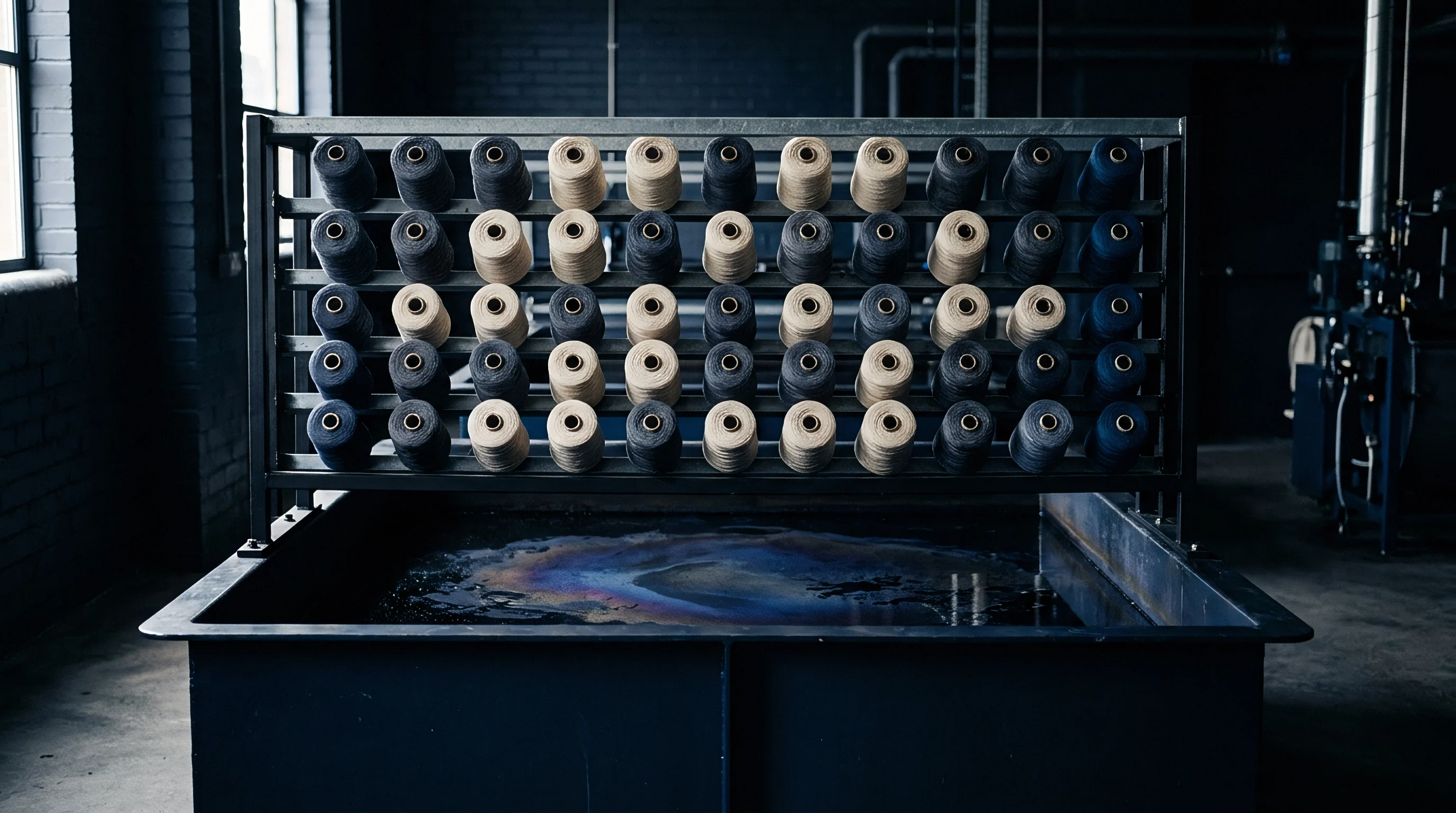
Dyehouse bath dockets capture the exact chemistry and physical parameters utilized during color execution. Logs document dyestuff lot numbers, auxiliary trade names, water hardness PPM levels, pH curves across the dyeing cycle, temperature ramp rates, and hold times. Crucially, the dyehouse docket must include raw digital spectral reflectance data files (QTX format) captured from both the approved master lab dip and the bulk batch.
Transmitting digital reflectance files allows downstream finishers and apparel factories to run mathematical metamerism audits before cutting fabric.

Data Architecture for Spectrophotometric Files
Digital spectrophotometric file management requires standardized naming conventions and cloud-accessible data architecture. QTX files encapsulate complete spectral curves from 360 to 700 nanometers along with instrument settings, illuminant setups, and color space metric calculations. Storing these digital records within a centralized supply chain repository enables real-time spectral compliance checks across geographic distances.
Technical managers compare the spectral signatures of rolls dyed at disparate facilities to detect emerging metamerism risks prior to garment assembly.
Advanced quality dockets link individual fabric roll serial numbers to specific dye vessel loads and stenter processing passes using barcode tracking. When a garment cutting plant discovers localized dimensional skew or shading across a single batch, historical docket queries isolate the exact processing window, machine number, operator shift, and chemical batch responsible for the defect. This targeted traceability isolates non-compliant roll ranges without halting entire production programs.
Traceability and Root Cause Diagnostics
Root cause diagnostic workflows use docket data to settle technical liability disputes between subcontracted entities. When finished fabric displays unacceptable wash spirality at quality audit, historical dockets reveal whether the failure originated from unbalanced yarn twist introduced at the greige mill or improper stenter overfeed execution at the finishing plant. Clear technical documentation prevents subcontract mills from shifting blame onto adjacent supply chain partners.
Contractual agreements must bind all subcontracted processing mills to mandatory docket compliance standards. Failing to upload verified physical test data and digital QTX files within twenty-four hours of process completion should trigger an automated hold on invoice settlements. Transparent technical data handovers force independent mill managers to maintain strict process control standards, protecting the primary buyer from latent physical and visual fabric defects.
Digital reflectance files uploaded to supply chain management platforms must remain unedited in raw QTX format to preserve original spectral data integrity.
- Greige Origin Logging mandates recording yarn lot numbers, twist factors, spinning method, machine gauge, and raw spirality percentages before shipping to wet processors.
- Chemical Bath Analytics requires capturing real-time pH profiles, electrolyte concentrations, bath temperature curves, and dyestuff lot identifiers for every bulk vessel run.
- Digital Color Exchange enforces uploading raw spectral reflectance QTX files for standard and batch runs across D65, F11, and Illuminant A light sources immediately post-dyeing.
- Finishing Setpoints Logging documents stenter pinning speeds, entry and exit moisture contents, applied overfeed percentages, and thermal fixing chamber residence times.
Missing technical data on handover dockets invariably indicates unmonitored processing variations that surface later as catastrophic garment failures on retail floor displays.

Route
Commercial decisions regarding multi-stage processing paths govern ultimate yield, scrap rates, freight additions, and overall landed unit costs. Selecting a highly fragmented subcontracting chain where fabric travels across multiple specialized independent mills increases logistics complexity and introduces margin stacking at every conversion node. Every independent mill adds its own scrap factor, energy surcharge, and profit margin onto the running bill of materials.
The financial viability of a fabric specification depends entirely on balancing specialized processing capabilities against cumulative route inefficiencies.
Scrap allocation models must account for cumulative fabric loss occurring at every subcontracted processing step. A greige mill allows a two percent structural loss for knitting or weaving defects. A specialized mercerizing facility requires an additional three percent width and length allowance to secure pin edges and trim selvedges.
The contract dyehouse calculates a four percent sampling and seam-loss factor, while the commission stenter finisher consumes two percent for bow and skew rectification trimming. In a four-stage subcontract chain, cumulative substrate loss frequently exceeds eleven percent of original greige weight, directly expanding the effective raw material cost per finished metre.

Commercial Allocation of Scrap and Width Reduction
Cuttable width reductions directly destroy garment yield logic. When high yarn torque forces a fabric to curl or shear, stenter operators trim wider selvedge margins to ensure the remaining fabric bed maintains uniform flat alignment across the pinning zone. A fabric specified at 180 centimeters cuttable width that loses five centimeters due to aggressive edge trimming drops garment marker efficiency by nearly three percent.
The primary buyer absorbs this loss either through higher fabric usage per garment or elevated scrap rates at the cutting facility.
Financial metrics associated with color correction and metamerism rectification impose severe economic penalties. When a subcontracted dyehouse delivers fabric exhibiting an unacceptable metamerism index relative to standard, the material must undergo strip-and-redye cycles or heavy topping additions. Stripping reactive dyes requires high-temperature alkali baths with chemical reducing agents, degrading cellulosic fiber molecular chains and reducing burst strength by fifteen to twenty-five percent.
The financial cost includes direct chemical charges, double dyehouse labor rates, machine downtime surcharges, and diminished fabric commercial value.

Financial Metrics of Rework versus Rejection
Rework cost models must compare the expense of secondary finishing interventions against total lot rejection and re-knitting options. Consider a 10,000-metre bulk lot of cotton-elastane interlock presenting eight percent latent spirality due to uncorrected greige torque. The financial calculus balances three distinct operational recovery routes:
Route One attempts mechanical rectification via a secondary stenter pass utilizing high overfeed and resin finishing. Resin application reduces fiber swelling and locks loop structure, successfully lowering spirality to three percent. Chemical finishing adds 0.35 USD per metre in chemistry and processing fees, while reducing fabric burst strength by eighteen percent and stiffening fabric hand.
Total additional cost equals 3,500 USD, preserving original delivery timelines.
Route Two subjects the fabric to open-width compaction and enzyme washing. Wet compaction neutralizes spirality down to two percent without resin chemistry, preserving natural hand. Processing charges equal 0.60 USD per metre, and mechanical handling generates a four percent length shrinkage loss equivalent to 400 metres of fabric valued at 1,800 USD.
Total financial impact equals 7,800 USD with a one-week delivery delay.

Landed Cost Calculus for Subcontracted Chains
Route Three enforces complete rejection of the bulk lot. The subcontracted dyehouse pays for greige replacement at 2.20 USD per metre, incurring a 22,000 USD charge, while losing its conversion fee. The primary buyer suffers a four-week delivery delay, incurring air freight penalties of 1.80 USD per finished garment to meet retail distribution deadlines.
Evaluating these options proves that implementing preventative technical quality controls across the subcontract route represents a fraction of the cost associated with post-production defect resolution.
| Route Strategy | Conversion Cost (USD/m) | Cumulative Scrap (%) | Cuttable Width (cm) | Final Spirality (%) | Metamerism Index (MI) |
|---|---|---|---|---|---|
| Vertical Single-Site Mill | 1.45 | 5.2 | 182 | 1.2 | 0.15 |
| Two-Stage Subcontract (Dye + Finish) | 1.85 | 8.5 | 178 | 2.8 | 0.45 |
| Four-Stage Subcontract (Merc + Dye + Print + Finish) | 2.60 | 12.8 | 172 | 4.2 | 1.35 |
Calculating the true landed cost per finished metre requires adding transport freight, intermediate insurance, quality audit fees, and scrap allowances onto base conversion quotes supplied by individual subcontracted mills. A low conversion quote from an unaccredited dyehouse quickly turns into the most expensive sourcing route when latent dimensional skew or metameric shade variations force bulk re-processing on the finishing floor.
The financial liability framework embedded within commercial supply contracts must explicitly dictate that any subcontracted mill altering specified dyestuff trichromies or bypassing stenter overfeed parameters absorbs all downstream scrap, re-processing, and freight charges incurred by the buyer.
Managing multi-stage subcontracted wet-processing chains requires continuous technical oversight at every physical handover node. Integrating greige yarn torque limits, spectral reflectance dye matching, standardized test protocols, precise stenter controls, and digital handover dockets creates a resilient manufacturing route capable of delivering dimensional stability and multi-illuminant color consistency across bulk global production runs.