Coupled Discrete Element Boundary Friction Modeling for Synthetic Staple Segregation Prevention
Calibrated boundary friction in chute walls suppresses synthetic staple percolation by equalizing velocity profiles across differing denier fractions.
Contact
Staple synthetic fibres traveling through pneumatic card-feeding ductwork collide at velocities exceeding twelve metres per second. These collisions occur thousands of times per second inside chutes feeding high-speed cards. Filament cross-sections deform under normal impact forces, dissipating kinetic energy while tangential forces induce surface slip.
When processors mix 1.3 dtex polyester with 3.3 dtex polyamide staple to form technical yarn lots, mass differentials between individual filaments create segregation pathways. The heavier coarse filaments carry higher momentum, whereas fine filaments decelerate rapidly upon colliding with incoming turbulence. Cohesion drops rapidly.
Without accurate boundary calibration, fine filaments migrate toward boundary layers while coarse fibres concentrate along the central stream. This separation destroys ratio uniformity before the carding cylinder opens the tufts.
Analytical representations of staple kinematics depend on accurate mechanical parameters defined across individual contact zones. Standard discrete element formulations model flexible fibres as bonded spheres or spherocylindrical segments. Each constituent element responds to mechanical deformation according to contact stiffness values derived from tensile modulus, transverse compressibility, and surface friction coefficients.
Normal contact interactions follow the Hertz-Mindlin contact formulation, while cohesive interactions between spin-finished synthetics require Johnson-Kendall-Roberts adhesion adjustments. The surface finish applied during staple manufacturing introduces microscopic liquid bridges. These capillary boundaries shift the restitution coefficient from 0.72 down to 0.41, increasing agglomeration tendencies among fine denier components.
| Fibre Type | Linear Density (dtex) | Cut Length (mm) | Normal Stiffness (N/m) | Fibre Friction Coefficient | Rolling Resistance Coefficient |
|---|---|---|---|---|---|
| Polyester (PET) Semi-Dull | 1.30 | 38.0 | 1420 | 0.24 | 0.12 |
| Polyester (PET) Bright | 3.30 | 51.0 | 2150 | 0.19 | 0.08 |
| Polyamide 6,6 (PA66) | 1.70 | 40.0 | 1680 | 0.31 | 0.16 |
| Polyamide 6 (PA6) High-Tenacity | 3.30 | 51.0 | 1920 | 0.28 | 0.11 |
| Polyacrylonitrile (PAN) | 2.20 | 44.0 | 1110 | 0.35 | 0.18 |
Staple Kinematics in Granular Assemblies
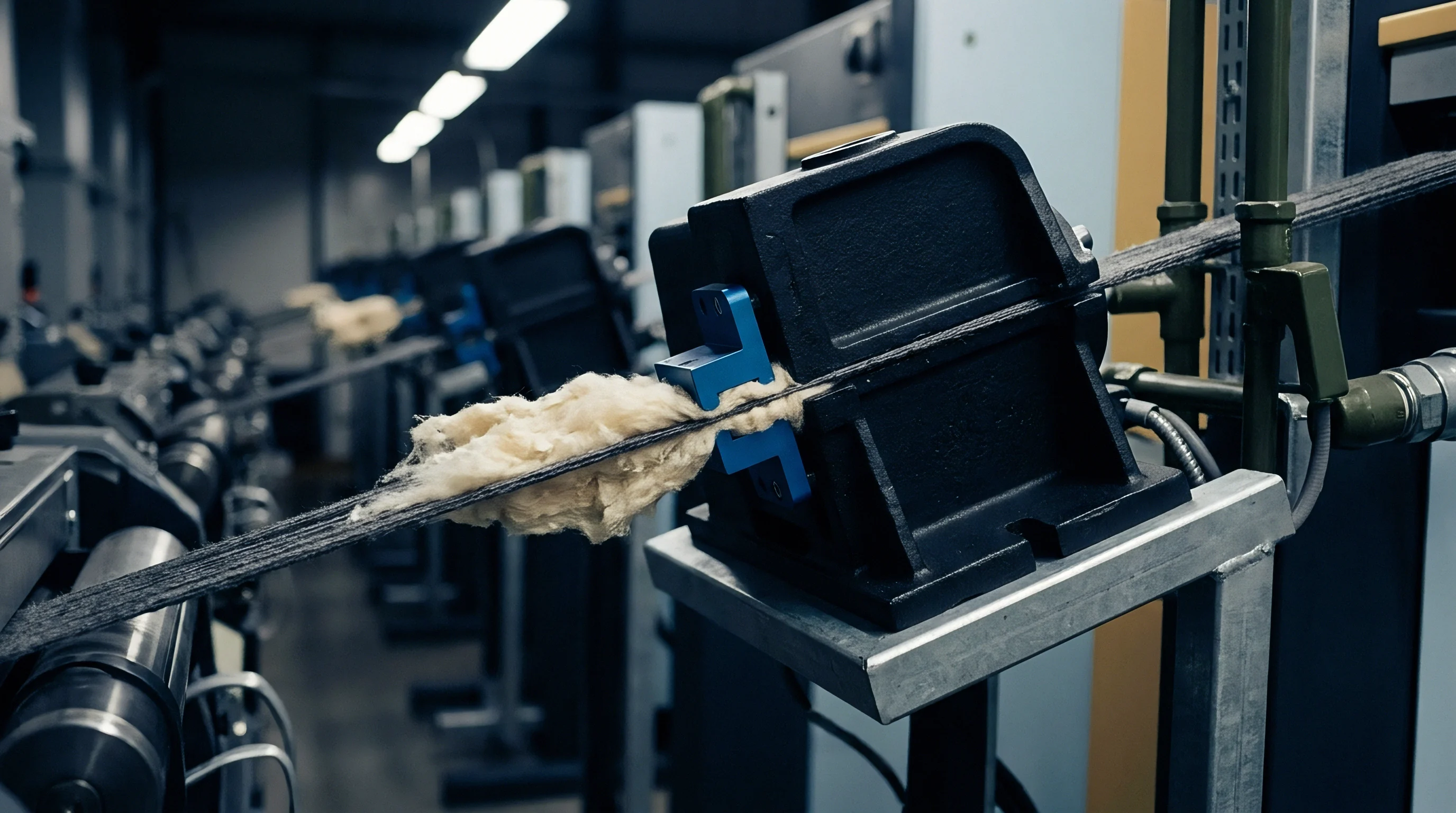
Discrete numerical schemes represent flexible polymeric filaments as chains of bonded spherical elements interacting through constitutive force-displacement equations. Bending stiffness scales with the fourth power of filament radius, creating an order-of-magnitude distinction in flexural rigidity between 1.3 dtex and 3.3 dtex stocks. When mechanical agitators or pneumatic drafts push the mixture through narrow conduit transitions, fine filaments flex readily around obstacles.
Coarse filaments resist bending, maintaining straight profiles that generate interlocking networks. Rolling friction limits particle rotation. As rotational resistance increases, the bulk porosity of the travelling tuft expands, enabling fine synthetic filaments to percolate downward through interstitial voids.
Laboratory validation of numerical contact parameters relies on raw fibre friction meters operating according to ASTM D3412. Testers draw parallel fibre assemblies across rotating cylinders under controlled normal loads of 50 millinewtons. Synthetic fibres treated with low-viscosity ester spin finishes display velocity-dependent friction curves.
Static friction values of 0.28 drop to kinetic values of 0.21 at drafting speeds. This lubrication discrepancy destabilizes numerical predictions if boundary models assume constant Coulomb friction. Dense packing inhibits sifting.
When discrete simulations neglect velocity-dependent boundary adhesion, the predicted segregation rate underestimates actual chute demixing by up to 28 percent. Spinning plant managers routinely dismiss raw sliver unevenness as normal spinning-line pneumatic variation while continuing to dispatch off-spec yarn packages.

Wall
Bulk chute ducting manufactured from cold-rolled 304 stainless steel exhibits distinct interface friction when interacting with synthetic polymers. Synthetic filaments sliding against ducting walls experience adhesive shear forces coupled with electrostatic attraction. Static charges accumulate along walls.
Polyamide fibres readily donate electrons, acquiring positive surface charges, while polyester accepts electrons to establish negative surface charges. This triboelectric polarity generates attractive forces toward grounded conductive steel conduits, altering the boundary velocity profile. Wall drag alters local packing.
As the boundary layer slows down, filaments adjacent to the steel sheet form a dense boundary zone that disrupts uniform pneumatic flow across the chute cross-section.
Boundary friction coefficients below 0.28 permit fine denier polyester accumulation along chute sidewalls at air velocities exceeding fourteen metres per second.
Wall roughness parameters alter sliding kinematics. Standard mill chute construction specifies 2B cold-rolled mill finishes with an average surface roughness between 0.3 and 0.5 micrometres. When processing abrasive titanium-dioxide-delustered polyester staple, this surface wears unevenly over eighteen months of continuous spinning operation.
Grooves formed along chute bends elevate the local boundary friction coefficient from 0.22 to 0.44. Polyurethane liners exhibit high adhesion. Installing specialized low-friction fluoropolymer or ceramic-coated plates alters the wall boundary reaction, changing how staple tufts slide along descending feed partitions.

Where Particle Segregation Alters Chute Velocity?
Dispersed filament bundles accelerate unevenly across cross-sectional air profiles within pneumatic ducting. Duct centerlines deliver air velocities of sixteen metres per second, whereas boundary air decelerates to zero along pipe perimeters. Because coarser 3.3 dtex filaments possess greater individual mass, they overcome aerodynamic drag and penetrate the high-velocity centerline.
Finer 1.3 dtex filaments stay trapped within slower peripheral boundary zones. Friction coefficients govern sliver mass. The resulting velocity differential causes coarse synthetic components to reach the card reserve box faster than fine components, creating periodic composition oscillations in downstream web production.
Fibre processors experience distinct mechanical failure modes along conduit boundaries during pneumatic feeding:
- Boundary Layer Stall occurs when wall friction coefficients exceed 0.45, forcing fine synthetic filaments to adhere permanently to sheet metal transitions until forming dense agglomerations.
- Sifting Percolation develops in low-friction vertical drop sections where coarse fibres bridge across the chute while fine fibres slip continuously through void networks.
- Static Clinging arises under relative humidity conditions below 45 percent, multiplying electrostatic image forces that hold charged polyamide tufts against grounded chute walls.
- Chute Choking results from local compaction waves where decelerated boundary layers narrow the effective pneumatic throat diameter below acceptable card feed thresholds.
Friction Calibration across Liner Surfaces
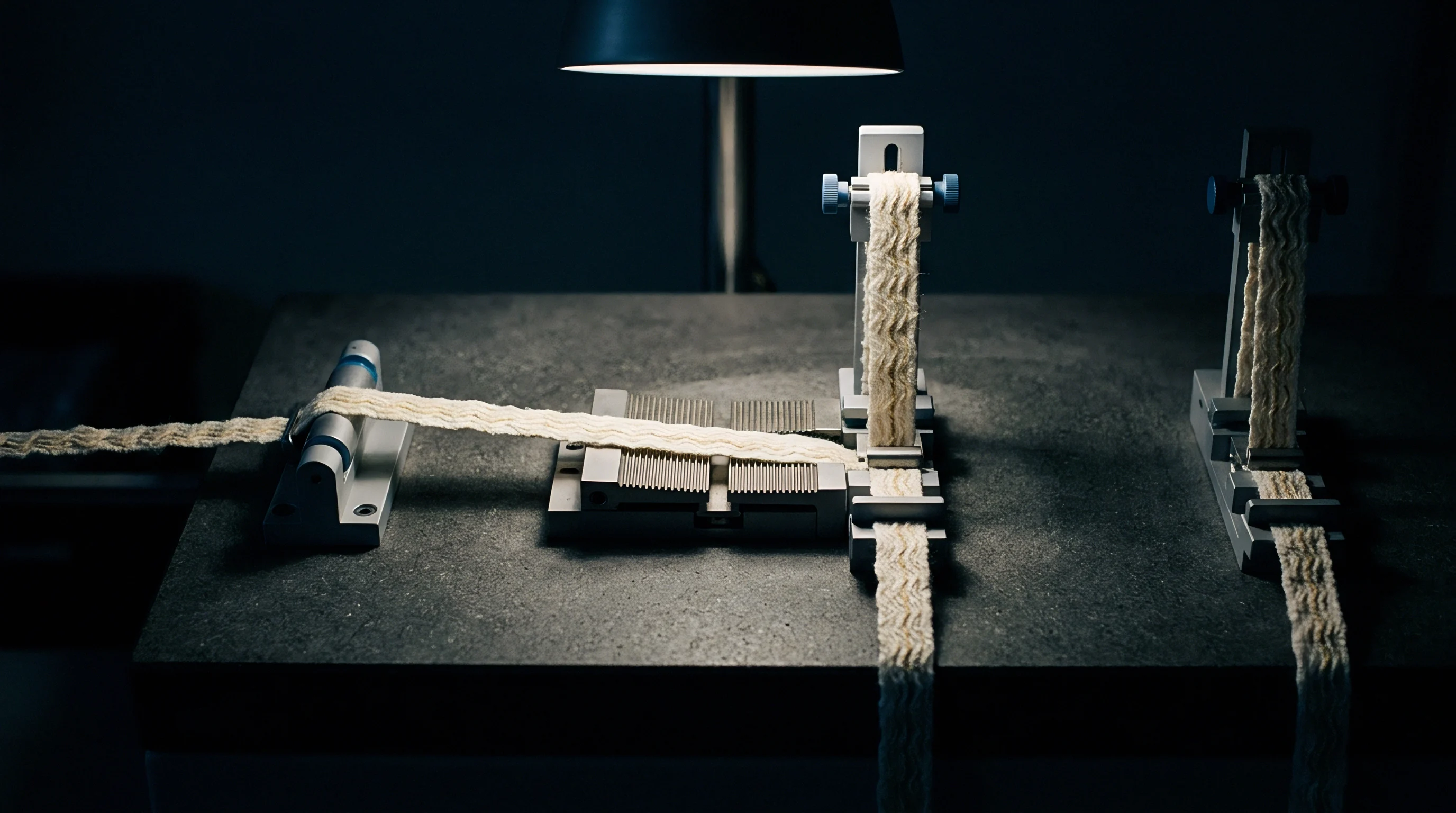
Direct measurement of metal-to-polymer sliding resistance utilizes rotational shear cells conforming to standard ASTM D6128 testing procedures. Technicians pack synthetic staple tufts into annular cells under normal consolidation pressures ranging from 0.5 to 5.0 kilopascals, representing typical pressures inside card feeding towers. The cell drives the fibre bed across candidate wall coupons to establish kinematic wall yield loci.
Adhesion parameters drop significantly when conduit temperature rises from 20 to 35 degrees Celsius, because softened spin finishes lubricate the contact plane. Conveying ductwork must maintain stable thermal control to prevent fluctuating boundary friction values during three-shift operations.
Coupled discrete element simulations require precise friction values assigned to wall boundary geometries. Boundary elements configured with rolling friction resistance replicate macroscopic chute behavior far more accurately than standard smooth-wall assumptions. When wall friction matches inter-fibre friction within five percent, filament tufts descend in uniform plug flow.
Coarse filaments migrate outward. Polished metal boundaries accelerate the descent of dense synthetic fractions while textured linings retain uniform mass flow across changing operating schedules.

Shear
Pneumatic transport streams generate steep lateral velocity gradients between the duct centerline and the boundary interface. Granular synthetic assemblies subjected to these shear planes undergo rapid internal restructuring. Dilatancy forces push larger, stiffer filaments toward regions of lower shear rate, driving them directly into the central flow core.
Fine, pliable filaments migrate along shear strain lines toward conduit perimeters. Boundary drag equalizes slip velocity. This trajectory divergence creates severe radial segregation within card distribution ducts, resulting in heterogeneous delivery into individual card feed reserves.
Higher boundary friction suppresses granular percolation by flattening the transverse velocity gradient across the transport channel.
Coupling computational fluid dynamics with discrete element representations resolves this transport mechanism. The fluid solver computes local air velocity, turbulence kinetic energy, and pressure fields via standard Reynolds-averaged Navier-Stokes equations. The discrete element solver tracks individual staple segments, calculating aerodynamic drag through modified Ergun or Wen-Yu drag correlations adapted for high-aspect-ratio cylinders.
Inter-phase momentum transfer couples the two systems. As high-speed air rushes past dense fibre clusters, the local pressure drop forces interstitial air outward, carrying detached individual filaments into the peripheral shear layer.
| Boundary Material | Wall Friction Coefficient | Superficial Air Velocity (m/s) | Percolation Velocity (mm/s) | Segregation Index (%) |
|---|---|---|---|---|
| Polished 304 Stainless Steel | 0.18 | 12.5 | 14.2 | 18.4 |
| Standard 2B Stainless Steel | 0.26 | 12.5 | 8.6 | 11.2 |
| PTFE-Coated Carbon Steel | 0.14 | 12.5 | 19.8 | 24.6 |
| Textured Polyurethane Liner | 0.38 | 12.5 | 3.1 | 4.8 |
| Ceramic Bead Blasted Steel | 0.44 | 12.5 | 1.9 | 2.3 |
Why Wall Boundary Friction Mitigates Sifting?
Elevated drag at conduit perimeters retards peripheral filament transport and forces continuous momentum transfer into the bulk core. The resulting back-pressure limits relative velocity differences between 1.3 dtex and 3.3 dtex staple fractions. When wall friction drops too low, as observed on fluoropolymer liners, boundary filaments accelerate unhindered.
This rapid wall slip expands internal void ratios throughout the core, creating open channels through which fine synthetic fibres fall under gravity. Percolation proceeds across chute bends. Increasing wall roughness counteracts this void expansion, maintaining dense packing that locks diverse denier components into fixed spatial orientations.
Simulating boundary friction adjustments requires systematic computational stages to guarantee convergence and material conservation:
- Domain Meshing establishes an unstructured hexahedral grid across the chute volume, refining cells adjacent to conduit walls to capture viscous sublayer velocity gradients.
- Constitutive Calibration maps experimental shear cell friction data directly to wall boundary face definitions, fixing static and kinetic coefficients across all computational boundaries.
- Lagrangian Injection introduces randomized multi-denier staple clumps into the fluid inlet, specifying initial ratio distributions matching blowroom mixing proportions.
- Convergence Tracking monitors local void fraction and species concentration across cross-sectional monitoring planes, continuing run cycles until mass variance stabilizes within two percent.

Coupled Fluid Mechanics and Particle Drag
Computational algorithms simultaneously resolve Navier-Stokes equations for pressurized convey air alongside Newtonian equations of motion for every individual fibre element. Aerodynamic drag coefficients for staple filaments deviate markedly from spherical particles. Longitudinal drag factors for aligned cylindrical segments average roughly half the magnitude of transverse cross-flow drag factors.
As fibres tumble through turbulent shear zones, dynamic orientation changes induce massive drag fluctuations. Drafting rolls amplify unevenness. These rapid force transitions overcome inter-fibre cohesive bonds, liberating individual fine filaments that sift into wall boundary layers.
Pneumatic conveying line geometry accelerates this physical separation. A standard 90-degree duct elbow induces centrifugal force fields exceeding twenty times gravitational acceleration. Coarser synthetic filaments, carrying greater mass, migrate toward the outer elbow curve, while finer filaments remain suspended in the inward secondary vortex.
Boundary walls lined with high-friction coatings slow down the outer filament layer, forcing rapid remixing as the stream enters the vertical card drop chute. Engineers continue to debate whether micro-scale surface texturing can permanently resist antistatic spin-finish contamination without requiring continuous mechanical scraping.

Bias
Chemical dissolution testing on finished card sliver exposes systematic composition errors caused by pneumatic demixing. Textile laboratories running standard ISO 1833-1 quantitative procedures routinely discover severe ratio discrepancies between initial blowroom laydowns and delivery slivers. When mills prepare a 50/50 mix of 1.3 dtex polyester and 3.3 dtex polyamide 6,6, chute segregation shifts delivered card sliver ratios to 44/56 at outer cards and 54/46 at central cards.
Discharged lots face rejection. This distribution variance undermines yarn strength, generates severe dye uptake variations in piece goods, and creates major commercial non-compliance risks during mill audits.
Commercial sliver exceeding the two percent composition tolerance defined in ISO 1833 triggers mandatory consignment retesting at the importer of record expense.
Solvent extraction protocols quantify these internal production shifts. Technicians dissolve polyamide fractions out of dried sliver specimens using 80 percent formic acid at 20 degrees Celsius, leaving insoluble polyester residues. Gravimetric analysis calculates component mass fractions within an accredited testing tolerance of plus or minus one percent.
Laboratory solvent tests expose differences. When test reports uncover sliver variations exceeding two percentage points across a single card room line, downstream ring spinning frames produce yarn packages with varying tensile properties and inconsistent boiling water shrinkage values.
| Line Position | Nominal Ratio (PET/PA66) | Actual Sliver Ratio (ISO 1833) | Sliver Mass CV (%) | Yarn Tenacity (cN/tex) | Tenacity CV (%) |
|---|---|---|---|---|---|
| Card 01 (Line Entry) | 50.0 / 50.0 | 54.2 / 45.8 | 4.8 | 38.2 | 9.4 |
| Card 04 (Mid-Line) | 50.0 / 50.0 | 50.8 / 49.2 | 3.1 | 41.5 | 6.2 |
| Card 08 (Line Terminal) | 50.0 / 50.0 | 45.1 / 54.9 | 5.4 | 36.8 | 10.8 |
| Combined Average | 50.0 / 50.0 | 50.0 / 50.0 | 4.4 | 38.8 | 8.8 |
| Data measured on 20 tex ring-spun yarns produced under standard mill conditions. Tolerances follow ISO 2060 and ISO 1833. | |||||
Chemical Separation in Slivers
Quantitative identification under ISO 1833-1 dissolves selective synthetic components to determine the exact gravimetric distribution of incoming lots. Testing houses extract clean three-gram sliver samples, drying specimens at 105 degrees Celsius to achieve constant dry mass before chemical immersion. For acrylic and polyester combinations, dimethylformamide at 95 degrees Celsius removes polyacrylonitrile components without attacking polyester backbones.
Tenacity losses follow segregation. If pneumatic chute systems allow acrylic components to sift away from polyester components, the delivered roving displays fluctuating mass-per-unit-length profiles that destabilize downstream draft gearings.
Verification protocols demand structured quality audits across carding preparation equipment to eliminate segregation sources:
- Chute Pressure Audits confirm that pneumatic static pressure drops along card feeding headers do not exceed 50 pascals between the first and last card stations.
- Boundary Liner Inspections examine conduit elbow interiors every 500 operating hours to detect abrasive wear, adhesive spin-finish buildup, or localized surface polishing.
- Sliver Cross-Sampling draws five-metre specimen slivers from every running card simultaneously, subjecting them to quantitative chemical separation within twenty-four hours.
- Drafting Zone Calibrations adjust break draft roll spacings to compensate for local fibre stiffness variations caused by fluctuating denier proportions.

Variance Propagation in Downstream Drafting
Uneven mass distribution entering the breaker drawframe multiplies unevenness across consecutive roller nips. Drawframes employ mechanical doubling to smooth out individual card sliver variations, but doubling fails to resolve long-term composition drift. When eight slivers entering a drawframe carry divergent polyester-to-polyamide ratios, their differing inter-fibre friction coefficients create erratic drafting forces.
Roll drafting rollers slip intermittently against low-friction polyester tufts while gripping polyamide tufts tightly. Drafting rollers amplify mass variation. The delivered drawframe sliver displays high-amplitude periodic mass variations that manifest as thick and thin places in final ring-spun yarn.
Knitters and weavers suffer severe losses when processing yarns with hidden composition variances. Piece-dyed knitted textiles made from segregated lots develop horizontal barre bands because polyamide absorbs acid dyes while polyester remains completely undyed without disperse dyestuffs. Importers pay higher assessment rates.
When batch testing reveals that barre defects stem from card room chute segregation, weavers issue immediate debit notes against yarn suppliers. Uncorrected sliver composition drift leads directly to uneven dye take across finished piece goods, widespread shade barré defects, and commercial lot cancellation.

Invoice
Customs authorities classify imported synthetic staple textiles strictly according to the constituent fibre predominating by weight under Harmonized System rules. Importers filing customs declarations under Chapter 55 must prove the precise gravimetric percentage of every synthetic polymer present in imported yarns or piece goods. When a customs laboratory tests an import entry declared as 52 percent polyester and 48 percent polyamide, any composition drift caused by card room segregation that pushes polyamide content to 51 percent changes the tariff heading.
The customs declaration fails. The shipment shifts from tariff subheading 5509.53 to 5509.59, exposing the importer to immediate duty recalculations, delayed clearance, and civil misdeclaration penalties.
Tariff classifications pivot on single percentage threshold crossings that transform standard duty rates into punitive anti-dumping liabilities.
Financial liability compounds when trade remedies target specific synthetic materials. Certain jurisdictions impose anti-dumping duties exceeding 35 percent on pure polyester staple yarns, while hybrid synthetic yarns containing over 50 percent polyamide enter at base tariff rates of 6.5 percent. A minor two percent chute segregation shift occurring inside the overseas spinning mill turns a compliant tariff declaration into an actionable customs offense.
Freight forwarders hold shipments pending security deposits. Retesting costs through accredited independent laboratories exceed 1200 dollars per sample container, while container demurrage charges accrue at hundreds of dollars daily during customs disputes.
Tariff Thresholds in Staple Shipments
Cross-border consignments face disparate duty schedules when composition margins cross specific classification lines. For example, consider a 40-tonne consignment of mixed synthetic yarn billed at 3.80 dollars per kilogram, yielding an initial commercial valuation of 152,000 dollars. If verified as predominantly polyester by weight, the baseline tariff rate might sit at 8.0 percent, generating a routine customs assessment of 12,160 dollars.
If internal segregation shifts the blend ratio so that polyamide predominates, the customs schedule may classify the consignment under an alternate tariff line carrying an 11.5 percent duty plus a 15 percent countervailing duty margin. The delivery contract lapses. The revised customs assessment immediately escalates to 40,280 dollars, destroying the purchasing margin and forcing renegotiation of the supply contract.
Landed cost calculations must incorporate composition tolerance buffers when purchasing multi-denier synthetic textiles. Product developers must establish binding technical contracts specifying maximum allowable ratio drift across delivered commercial packages. Procurement teams that omit boundary friction modeling specifications from chute equipment tenders expose their supply chains to ongoing compliance failures.
The tariff schedule penalizes drift. Customs clearance rules under Chapter 55 General Note 2 assign the full duty rate of the highest-taxed component whenever test results show equal weight percentages between competing synthetic polymers.

Landed Cost Arithmetic and Penalties
Commercial valuations collapse when a misdeclared customs entry triggers statutory audits and compound duty assessments. Customs authorities routinely audit imported textile shipments up to five years post-entry. If retrospective chemical testing shows systematic composition drift across historic shipments, customs agents issue demand notices covering back duties on every past consignment.
Interest charges accumulate from the original entry date. Financial penalties for negligent misdeclaration scale from two to twenty times the unpaid duty differential, transforming an uncorrected chute segregation problem into an enterprise-threatening financial balance sheet liability.
Mitigating this financial exposure requires embedding discrete element boundary calibration directly into plant engineering procurement standards. Machinery specifications must mandate CFD-DEM validated boundary coatings that hold sliver composition variations within plus or minus 0.5 percent across the entire carding line. Spinning mills that invest in proper wall boundary friction controls protect their product consistency, preserve dye lot integrity, and eliminate catastrophic tariff reclassification liabilities.
Importers purchasing synthetic staple yarns must demand documented ISO 1833 laboratory test certificates from both the lead card and trailing card of every manufacturing lot prior to authorizing commercial container dispatch.