Natural and Synthetic Fibres and What Each Does in a Fabric
Fibre composition dictates physical durability, moisture regain, dye chemistry, and customs classification before spinning machinery turns.

Mechanism
A yarn’s moisture retention, stretch under load, and surface fibril shedding during abrasion trace back to polymer morphology. Natural fibers such as cotton, wool, and silk inherit their behavior directly from biological synthesis, built up as semi-crystalline matrices of cellulose, keratin, or fibroin. In these biological polymers, molecular weight distributions and microfibrillar orientation vary widely.
Synthetic polymers like polyethyleneterephthalate, polyamide six-six, and polyacrylonitrile, on the other hand, come out of industrial polymerization reactors, where melt extrusion or solvent spinning draws the macromolecules into continuous, uniform profiles to tight mechanical tolerances.
Cellulose consists of repeating beta-D-glucose units joined by beta-one-four-glycosidic bonds. This linear chain packs into crystalline domains separated by disordered amorphous zones. Because each anhydroglucose ring carries three hydroxyl groups, cellulose develops an extensive network of intra- and intermolecular hydrogen bonds.
These same hydroxyl sites pull ambient water into the amorphous zones, swelling the cell walls while preserving thermal resistance up to two hundred degrees Celsius.
Keratin in sheep wool forms a helical protein structure stabilized by covalent disulfide bonds, ionic salt bridges, and hydrogen bonds. Because wool is amphoteric, it takes up both acidic and basic compounds, yet its fatty-acid epicuticle remains hydrophobic, unlike polyester, which resists water completely.

Crystalline Alignment and Tensile Tenacity
During high-speed melt spinning, monomer chains in filaments like polyethyleneterephthalate align into oriented zones. Downstream mechanical drawing pulls the remaining disordered segments parallel to the fiber axis, so increasing the draw ratio drives up crystalline density and tensile yield at the expense of elongation. Filament polyester reaches tenacity values between forty-five and seventy-five centinewtons per tex, whereas carded upland cotton yields only twenty-two to thirty-two centinewtons per tex.
The higher crystalline alignment simply limits chain mobility under stress, passing tensile loads straight down the covalent backbone.
Fully synthetic polyamides place repeating amide linkages along aliphatic carbon chains. Hydrogen bonding between carbonyl oxygens and amine hydrogens gives the material its characteristic resilience, flex life, and toughness. Under tensile load, the amorphous zones deform elastically before any crystalline slip occurs.
That elastic recovery prevents permanent deformation, which is why knits containing polyamide six snap back to their original dimensions even after heavy strain.

Hydrophilic Regain and Polymer Hydrogen Bonding
Cellulosic and protein fibers carry accessible hydroxyl and amino groups that draw ambient moisture straight into the amorphous cell wall. Water molecules latch onto these sites through hydrogen bonds, building a bound layer that transitions into secondary capillary condensation. Under standard conditions ~ twenty degrees Celsius and sixty-five percent relative humidity ~ upland cotton carries a moisture regain of eight point five percent, while polyester registers just zero point four percent.
Absorbed water changes mechanical behavior in fundamentally different ways across fiber types. Cotton actually gets stronger when wet: water relieves internal strain points in the amorphous regions, letting microfibrils align more uniformly as load comes on. Synthetics show no such response, maintaining identical tenacity profiles wet or dry.
Regenerated cellulosics, on the other hand, lack the crystalline fraction of raw cotton; once saturated, standard viscose loses fifty percent of its tenacity.
Filament Continuity versus Staple Discontinuity
Synthetic filaments enter yarn spinning as endless strands, while natural fibers arrive in discrete lengths set by plant genetics or shearing schedules. Because filament bundles run unbroken along their entire length, they need very little twist to stay together. They yield smooth, lustrous yarn surfaces that will not pill, provided the filaments are not snagged and broken by mechanical contact.
Staple fibers rely on mechanical drafting and twist to create frictional hold between neighboring strands. Shorter staple stock inevitably leaves loose ends protruding from the yarn core, creating a fuzzy perimeter. Under surface abrasion, these exposed fiber ends knot together into pills.
Standard atmospheric testing at twenty degrees Celsius and sixty-five percent relative humidity assigns sheep wool a moisture regain of fifteen point seven percent.
| Fibre Classification | Monomer Base | Tenacity (cN/tex) | Moisture Regain (%) | Glass Transition (°C) | Elongation at Break (%) |
|---|---|---|---|---|---|
| Upland Cotton | Beta-D-Glucose | 26.5 | 8.5 | 225 | 7.0 |
| Merino Wool | Amino Acid Keratin | 14.0 | 15.7 | 170 | 35.0 |
| Filament Polyester | Polyethyleneterephthalate | 58.0 | 0.4 | 75 | 18.0 |
| Polyamide 6,6 | Hexamethylenediamine | 62.0 | 4.5 | 50 | 22.0 |
| Standard Viscose | Regenerated Cellulose | 20.0 | 12.5 | 190 | 20.0 |
Synthetic extrusion allows precise control over cross-sectional profile and linear mass distribution. Hollow filaments trap core air for insulation without adding weight, while trilobal shapes bounce light to hide surface soil and introduce a directional sheen. Natural fibers, by comparison, are locked into whatever geometry biological growth produced: cotton matures into a flattened, twisted ribbon wrapping an empty lumen, and wool grows as a round-to-oval shaft covered in shingled cuticle scales that cause felting whenever moisture, heat, and friction coincide.
Blending natural and synthetic staples into one yarn pairs their mechanical traits by design. Polyester brings tensile strength and dimensional stability; cotton provides moisture uptake and thermal insulation. Getting the balance right, however, requires tight control over staple length distributions and linear densities in both fiber feeds.
Whether melt-spun bio-based polyester can match the moisture transport rates of untreated, combed ring-spun long-staple cotton remains unproven at production scale.
Swell
Water uptake changes yarn diameter, yarn length, and the overall stability of the fabric. As water penetrates amorphous domains, hydrophilic fibers swell radially rather than longitudinally. This increase in diameter forces interlacing warp and weft yarns to bend further around each other, causing relaxation shrinkage across both axes.
Unaffected by moisture, synthetic fibers hold their dimensions and act as internal anchors within blended structures.
When a fifty-fifty cotton-polyester blend is saturated, the cotton swells radially while the polyester fibers stay rigid. That mismatch creates localized shear stress through the yarn core, causing exposed cotton fiber tails to untwist and curl outward.

Cellulosic Hygral Expansion Mechanics
Fully saturated cotton swells up to fourteen percent in diameter, but lengthens by less than two percent. As water molecules interrupt secondary hydrogen bonds in the amorphous regions, microfibrils spread apart. This radial thickening steepens the yarn’s helix angle, pulling its ends inward.
In unfinished cotton goods, this geometric shift combines with the release of spinning and weaving tensions to cause heavy relaxation shrinkage on the first wash.
Because they have a lower crystalline fraction than raw cotton, regenerated cellulosics take up significantly more water. Viscose expands up to twenty-five percent in cross-sectional area when immersed. The fiber softens sharply and loses modulus, leaving wet yarns vulnerable to permanent stretching under low tension unless handled gently in wet finishing.
Hydrophobic Synthetic Resistance
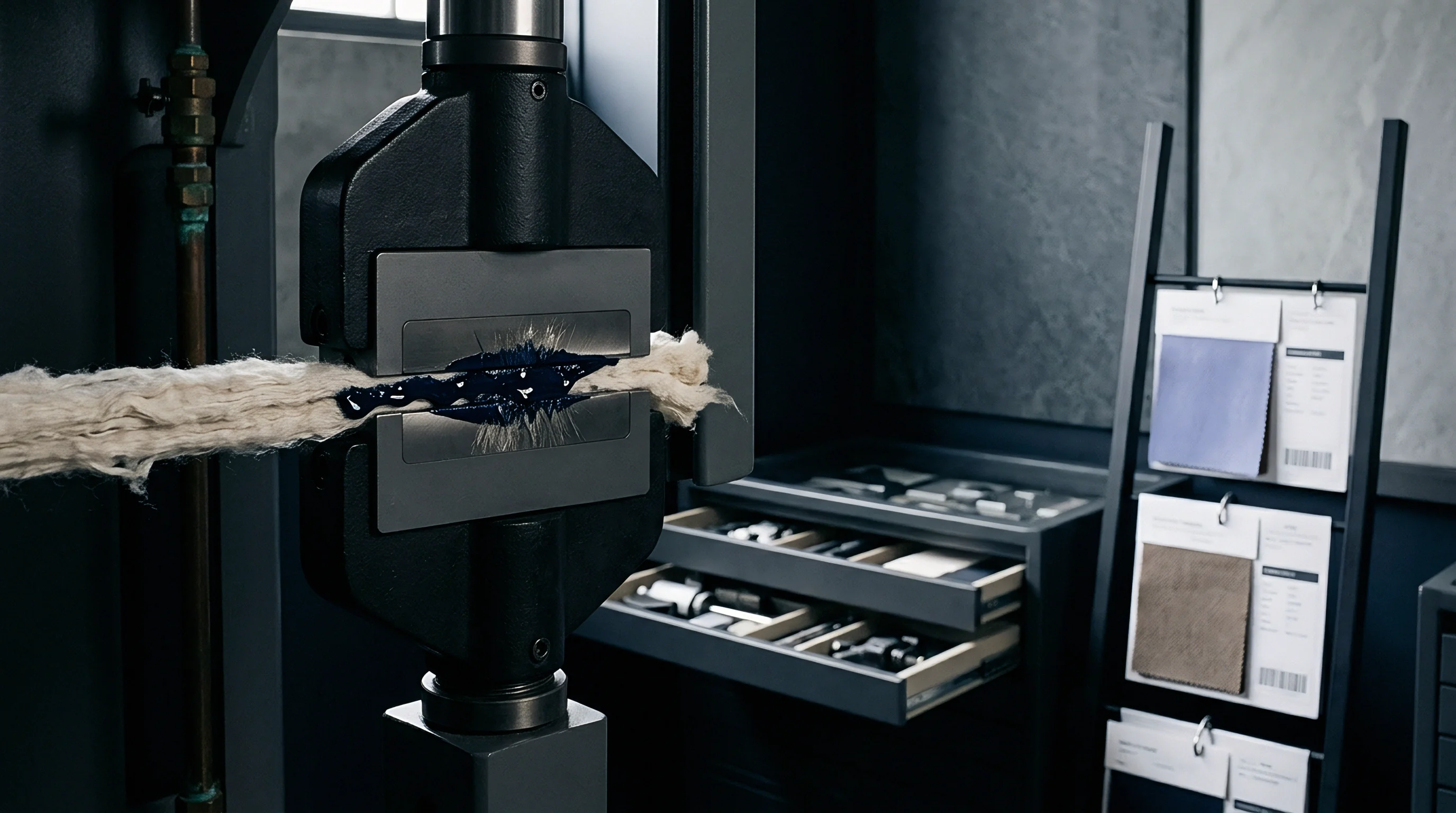
Polyester and polyamide filaments show virtually no cell-wall swelling in water, shielded by their non-polar aliphatic and aromatic structures. In polyethyleneterephthalate, water cannot penetrate the tightly packed crystalline lattice; any water held by a synthetic yarn sits in the capillary spaces between filament surfaces.
With almost no water absorption, synthetic filaments cannot bleed off frictional electrical charges into ambient air. In dry environments, hydrophobic fabrics can build up static charges above five thousand volts, drawing dust out of the air and causing lightweight garments to cling to skin.
- Differential Hygral Shrinkage creates severe surface warping across piece-dyed mixed materials when natural and synthetic components shrink at unequal rates during laundering.
- Moisture-Induced Seam Puckering occurs when wet hydrophilic sewing threads expand and contract within seam lines joined to dimensionally stable synthetic substrate panels.
- Pilling Acceleration Under Wet Friction develops as saturated natural fibers lose modulus, break off from the yarn bundle, and tangle around high-tenacity synthetic anchor filaments.
- Variable Dye Pick-Up results when uneven swelling alters dyestuff diffusion rates across mixed fiber lots during continuous liquor immersion.
- Latent Skewing in Finished Goods emerges when asymmetric twist liveliness in wet ring-spun yarns rotates knitted courses out of perpendicular alignment.
Stabilizing fabric against water swell requires targeted mechanical and chemical finishing. Mercerizing cotton with concentrated sodium hydroxide permanently swells the cell walls, rounds out the kidney-bean cross-section, and locks microfibrils into a stable, highly crystalline state. For synthetic components, heat setting above the glass transition point relieves frozen-in polymer stress, keeping the structure from shrinking during downstream washing and tumble drying.
Introducing polyester staple into a cotton blend caps total fabric swell. The hydrophobic fibers interrupt water capillary paths across the yarn bundle, preserving the cloth’s dimensional stability even during prolonged boils.
Yarns containing hydrophilic staples contract in length as individual fiber diameters widen within the twisted bundle.
Balancing hydrophilic moisture capacity against hydrophobic dimensional stability avoids wet-processing distortion across multi-component material orders.

Spindle
Ring, open-end rotor, and air-jet systems turn staple fiber into yarn through fundamentally different draft and twist mechanisms. The spinning frame configuration determines where individual natural and synthetic fibers settle across the yarn cross-section, while staple length distribution, micronaire, crimp, and surface friction govern draft zone stability at high throughput.
Raw cotton staples range from twenty-two to thirty-eight millimeters with irregular crimp and plant residue, whereas synthetic polyester is precision-cut to fixed lengths such as thirty-eight millimeters with mechanical crimp engineered for draft friction, allowing ring spinning to add strength to the blended assembly.
Staple Length Distribution and Pilling Kinetics
During ring drafting, short fibers under twelve millimeters migrate toward the yarn perimeter, creating a loose surface fuzz. Friction eventually tangles these exposed tips into tight pills. When high-tenacity synthetics are present, they act as permanent anchors that hold pills on the cloth face; weaker natural fibers tend to break under mechanical stress, allowing pills to shed naturally over time.
Low-pill polyester staple relies on a reduced polymer intrinsic viscosity. Bringing molecular weight down drops filament tenacity from fifty-five to thirty-five centinewtons per tex. When pills develop on fabrics spun from these modified synthetics, normal surface abrasion snaps the anchor fibers, shedding the pills before they ruin the fabric face.
Air-Jet versus Ring Drafting Dynamics
In air-jet spinning, vortex nozzles twist surface fibers around an untwisted parallel core, tucking loose ends inward. This architecture yields a crisp, clear yarn face with minimal hairiness, offering far better pilling resistance than ring-spun yarn. The trade-off is tensile strength: because load transfer depends entirely on the outer wrapping fibers, air-jet yarns break earlier under tension.
Ring spinning twists the entire cross-section evenly, binding staples tightly together to maximize inter-fiber friction. The resulting yarns deliver high tensile strength and a soft hand, but leave significant fuzz on the yarn perimeter. Open-end rotor yarns sit in the middle: intermediate tensile strength, but bulkier and rougher, making them well suited to heavy workwear.
Fibre Combination Performance under ISO Tensile Testing
Benchmarking these yarn constructions under ISO 13934-1 highlights structural trade-offs. In a sixty percent combed cotton, forty percent polyester blend at twenty tex, ring spinning outperforms air-jet spinning in pure tensile strength, though short fibers still cause pilling on the yarn face. The ring-spun yarn records a breaking force of three hundred twenty newtons at nine point five percent elongation, compared to two hundred seventy newtons and seven point two percent elongation for the air-jet equivalent.
Martindale pilling evaluations under ISO 12945-2 demonstrate contrasting performance profiles. After two thousand cycles, the air-jet yarn maintains a pilling grade of four to five, whereas the ring-spun sample drops to grade two to three under identical friction conditions because of its higher surface fuzz density.
Which Fiber Ratio Prevents Pilling in Fine Knits?
Keeping circular knits free of pilling requires either capping the synthetic share or switching to long-staple combed cotton. A blend of thirty percent low-pill polyester and seventy percent long-staple combed cotton generally holds pilling performance above grade four while maintaining dimensional stability and abrasion resistance. Pushing synthetic content up to sixty percent with standard-tenacity staple almost invariably triggers rapid pilling failures in consumer wear.
- Draw twenty random yarn samples across ten separate packages within the delivered spinning lot.
- Condition the samples for twenty-four hours at standard laboratory climate prior to testing.
- Mount each yarn segment into the pneumatic clamps of an automated tensile tester set to a gauge length of five hundred millimeters.
- Record the breaking load in centinewtons and strain percentage at peak force under constant rate of extension.
- Calculate the yarn tenacity by dividing mean breaking load by declared linear density in tex units.
ISO 12945 testing standards require pilling assessments to run under controlled abrasive friction for two thousand cycles before grading on a five-point visual scale.
The plant paid an eighteen thousand dollar remanufacturing charge when a high-twist open-end yarn lot sheared cutting needles during high-speed garment production.
Dyeing
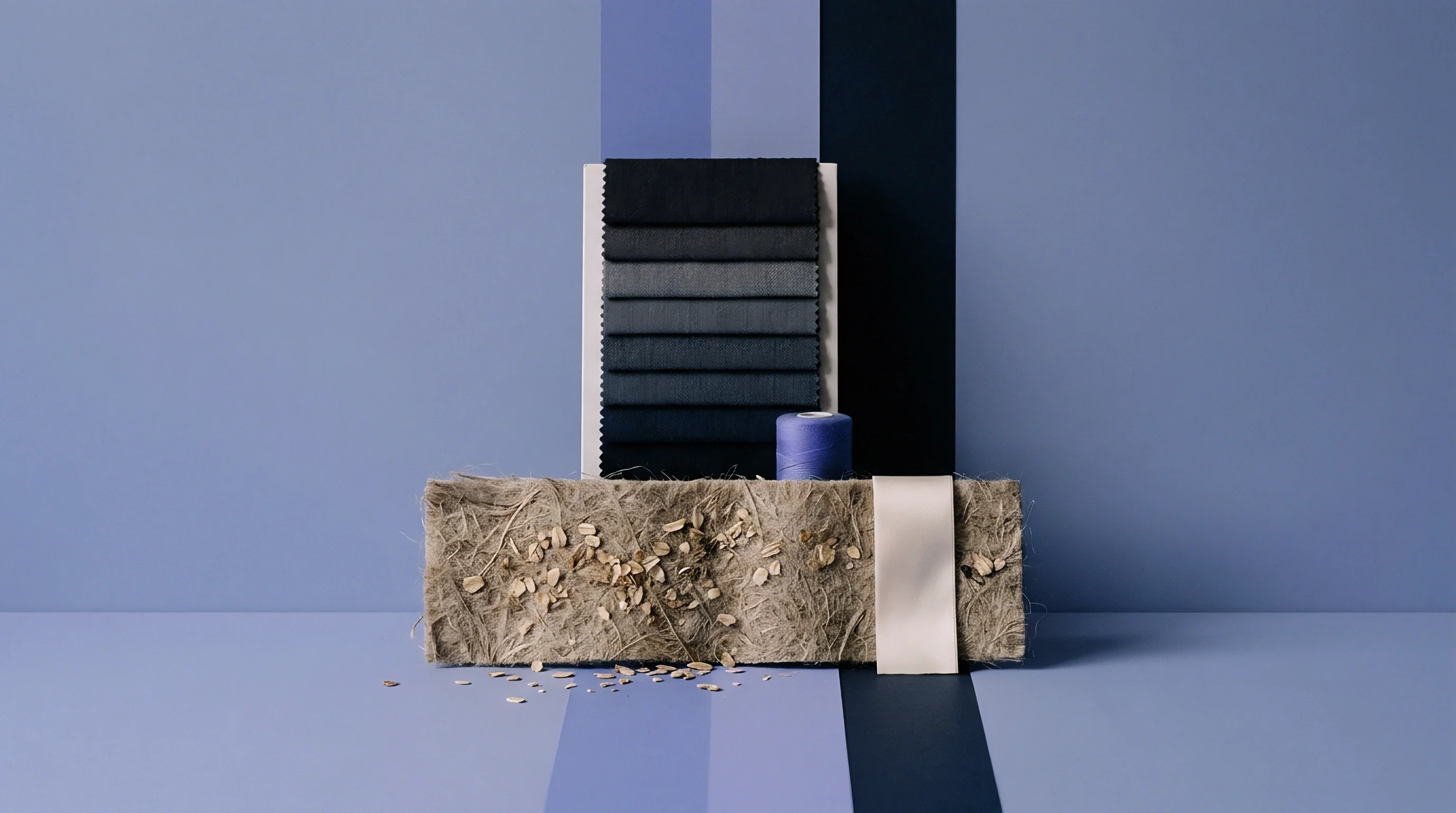
Dyeing blended textiles requires distinct bath chemistries and disciplined thermal profiling. Because natural and synthetic fibers share few chemical affinities, each component demands its own dyestuff class, auxiliaries, and temperature curve. Running single-bath cycles without proven compatibility yields cross-staining, poor color fastness, and patchy shades.
Cotton relies on water-soluble reactive dyes that form covalent bonds with cellulose hydroxyl groups under alkaline conditions. Polyester, by contrast, takes water-insoluble disperse dyes that diffuse into its non-polar matrix under high heat.
Disperse and Reactive Dual-Bath Protocols
Dyeing the polyester fraction requires pressurized jet vessels running at one hundred thirty degrees Celsius. Sparingly soluble disperse dyes move through the aqueous liquor and migrate into the heat-expanded polymer chains. Once the disperse cycle exhausts, the liquor cools to eighty degrees Celsius before beginning cellulosic coloration.
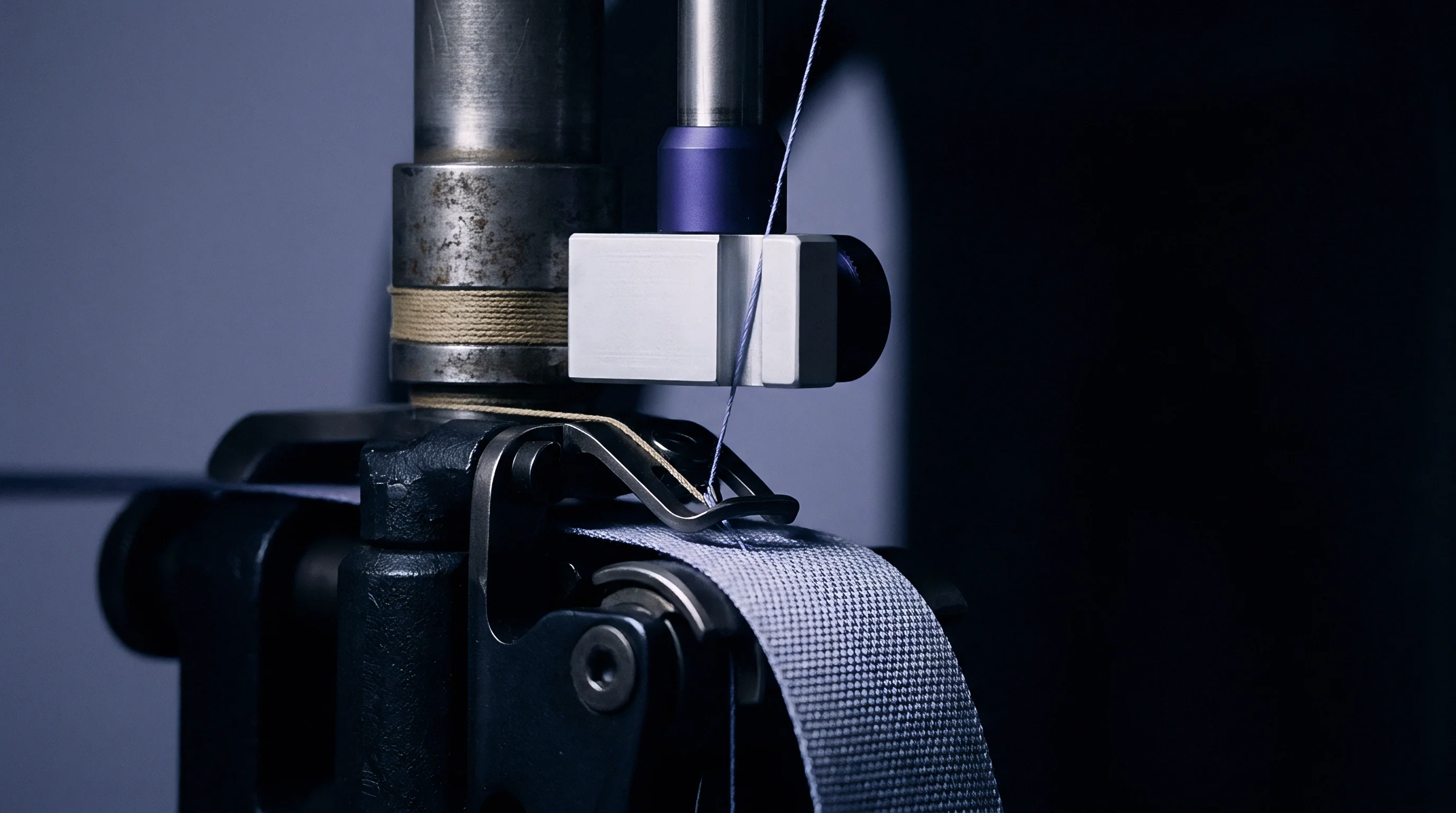
Adding an alkali like sodium carbonate lifts bath pH to eleven, driving the covalent reaction between reactive dyes and cotton hydroxyl groups. Temperature control during fixation must remain tight; allowing the bath to overheat hydrolyzes the reactive molecules, dulling shades and dropping wash fastness.
Cross-Staining Hazards and Chemical Fastness
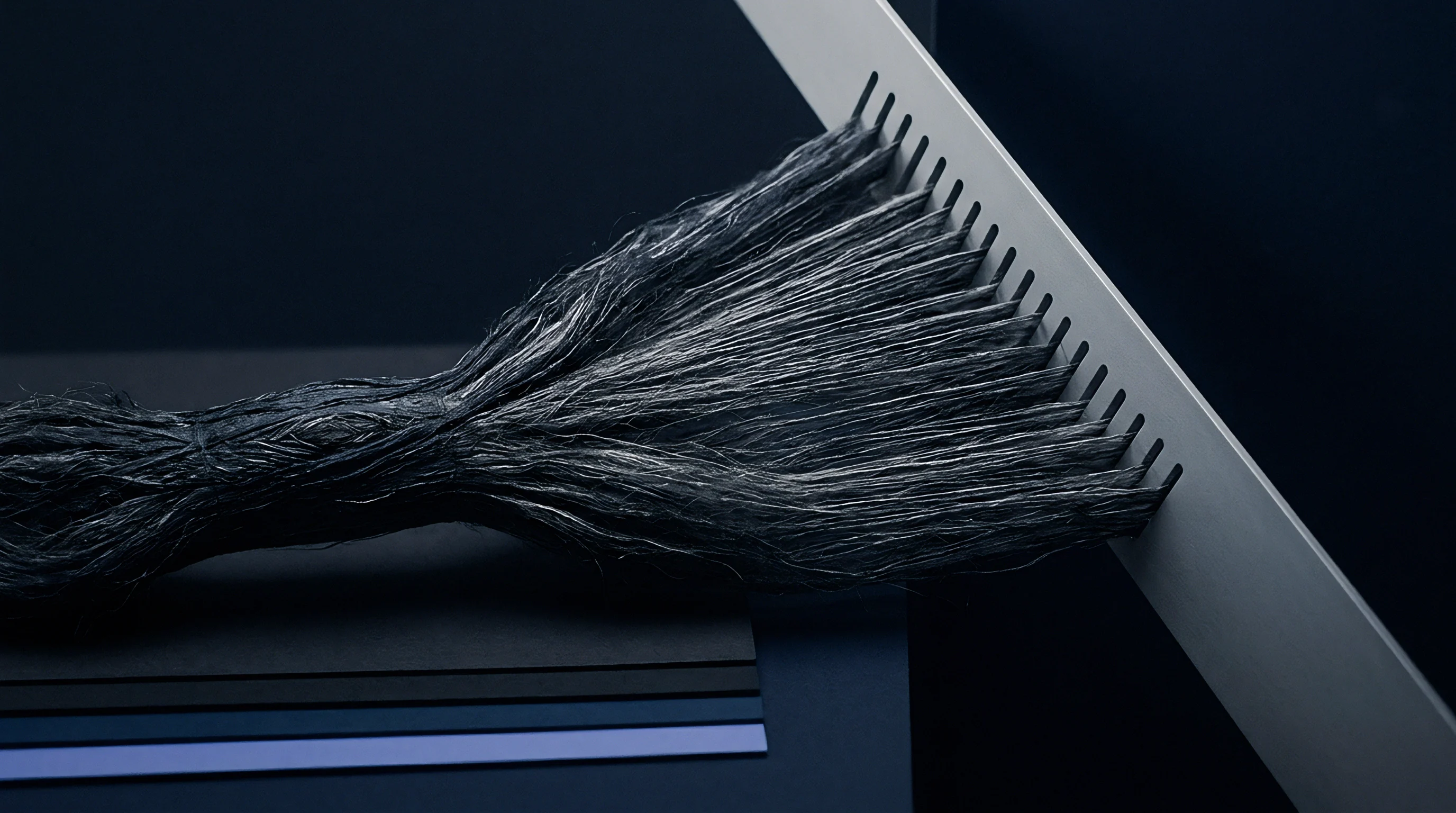
During high-temperature exhaust cycles, loose disperse dye frequently migrates onto adjacent cotton fibers. Because disperse dyes form no chemical bond with cellulose, this surface staining yields poor crocking values and bleeds heavily during washing. Clearing the stain requires an alkaline reduction clear at seventy degrees Celsius using sodium hydrosulfite and caustic soda.
Polyamide and wool blends call for acid or pre-metallized dyes applied at a pH between four and five. These dyes link electrostatically to terminal amino groups along the protein or nylon backbones. Rinsing must remove all unfixed acid dye, or adjacent light fabrics will pick up heavy staining during home laundering.
| Fibre Class | Dye System | Fixation Temp (°C) | ISO 105-C06 Washing Fastness | ISO 105-X12 Rubbing Fastness |
|---|---|---|---|---|
| Upland Cotton | Reactive / Direct | 60 – 80 | Grade 4 – 5 | Grade 4 (Dry) / Grade 3 (Wet) |
| Merino Wool | Acid / Pre-metallized | 98 – 100 | Grade 4 | Grade 4 (Dry) / Grade 3-4 (Wet) |
| Filament Polyester | Disperse High-Temp | 130 | Grade 4 – 5 | Grade 4-5 (Dry) / Grade 4-5 (Wet) |
| Polyamide 6,6 | Acid / Disperse | 98 – 115 | Grade 3 – 4 | Grade 4 (Dry) / Grade 3-4 (Wet) |
| Standard Viscose | Reactive / Vat | 60 – 80 | Grade 4 | Grade 3-4 (Dry) / Grade 2-3 (Wet) |
Thermosol ranges apply disperse dyes continuously across wide-width poly-cotton sheetings. The fabric travels through an infrared pre-dryer before entering a thermosol zone heated to two hundred twenty degrees Celsius for forty-five seconds. The extreme heat opens the polyester structure, letting vaporized dye sublimate straight into the filaments without liquid carriers.
Color fastness testing under ISO 105 protocols verifies shade stability under washing, light exposure, and crocking friction. In blended materials, both fiber types have to meet the threshold independently to avoid shade shifts and staining in end use.
Dark shade staining on the cotton component may trace to normal disperse dye carrier volatilization rather than inadequate reduction clearing.

Duty
Border authorities examine raw material declarations to enforce tariff schedules, trade agreements, and import quotas. Custom classification of mixed fiber textiles depends on identifying the single fiber component that predominates by weight under international Harmonized System regulations. Misdeclaring a composition percentage shifts the applicable duty rate substantially, exposing importers to financial penalties and seizure of goods.
Chapter fifty-two covers cotton goods, which face lower baseline tariffs across most jurisdictions, while Chapter fifty-five covers synthetic staples carrying higher protective rates that prompt customs inspectors to reclassify border shipments.
Chief Weight Classification under Harmonized System Rules
Tariff classification follows chief weight: the fiber with the largest single percentage by mass determines chapter assignment. A twill containing fifty-one percent cotton and forty-nine percent polyester enters under Chapter fifty-two as cotton cloth; if mill variance flips that lot to forty-nine percent cotton and fifty-one percent polyester, customs enters the shipment under Chapter fifty-five as a synthetic fabric.
Chief weight determination demands precise lab testing because chemical moisture regain adjustments alter dry mass figures. A weight distribution measured in an unconditioned state can invert once standard commercial regain allowances apply.

Quantitative Chemical Analysis via ISO 1833
Laboratory technicians selectively dissolve synthetic components in concentrated reagent baths to measure remnant natural material dry mass. ISO 1833 part three utilizes seventy-five percent sulfuric acid to dissolve viscose, leaving cotton fibers intact. ISO 1833 part eleven utilizes boiling dichloromethane or concentrated reagent solutions to dissolve polyester out of cotton and polyester mixtures.
Because lab reports govern final customs entry, chemical separation methods account for analytical tolerances, typically plus or minus two percent absolute composition margin. When testing a declared fifty-fifty material, a laboratory return of forty-eight point five percent cotton falls within legal standard tolerance, preventing misdeclaration penalties.
- Certified Test Certificate issued by an accredited laboratory documenting quantitative chemical separation according to ISO 1833 protocols.
- Commercial Mass Calculation Sheet detailing oven-dry weights, clean scoured yields, and applied commercial regain percentages.
- Spinning Mill Origin Dossier confirming fiber supply chain origin, raw staple purchase invoices, and production batch lot records.
- Quantitative Separation Record recording individual reagent solubility residues, ash content adjustments, and corrected component percentages.
Rules of origin under preferential trade agreements mandate specific processing thresholds within signatory nations. Qualifying for duty-free status often requires a yarn-forward rule, stipulating that spinning, knitting, or weaving must occur within designated partner countries. Blending non-originating synthetic staples into native natural fiber lots disqualifies the final cloth if non-originating mass exceeds regional allowance thresholds.
Customs enforcement agencies deploy infrared spectroscopy and microscopic cross-section scanning alongside chemical dissolution to catch fraudulent declarations. Maintaining full laboratory documentation prior to shipment entry avoids costly customs holds at point of discharge.
Customs laboratories calculate chief weight using oven-dry fiber mass adjusted for official commercial moisture regain allowances.
Writing ISO 1833 chemical separation tolerances directly into commercial purchase agreements shifts financial liability for customs reclassification back to the spinning mill.
Margin
Financial yield on finished goods depends on raw material pricing, process waste rates, and landed transport fees. Natural staple prices fluctuate based on agricultural crop yields, weather patterns, and global commodity exchange trading. Synthetic filament and staple prices track petrochemical feedstocks like purified terephthalic acid and ethylene glycol, offering greater price predictability over long production cycles.
Fiber invoices bill on weight in kilograms, while fabric sells by the linear meter. Converting raw staple mass into finished cloth meters requires accounting for spinning comb waste, weaving scrap, processing shrinkage, and commercial moisture allowances.
Raw Fiber Cost Vectors and Waste Allowances
Carded spinning lines remove trash but generate up to six percent comb waste, increasing net clean material cost per kilogram. Combing high-grade long-staple cotton removes up to eighteen percent short fibers, elevating raw material cost significantly while improving yarn evenness and strength.
Synthetic staple processing generates low waste, typically under two percent across modern opening and carding lines. Synthetic staples carry zero agricultural trash or leaf particles, eliminating raw material cleaning steps and minimizing processing yield loss.
Commercial Moisture Regain Invoicing Mechanics
Sellers adjust gross shipment weight to official commercial mass using standardized regain percentages under international trade rules. ISO 6741 defines commercial mass as the oven-dry mass of the lot plus the official commercial moisture regain allowance. Invoicing raw cotton at eight point five percent regain means paying for eight point five kilograms of water for every one hundred kilograms of dry fiber mass.
Purchasing raw wool clip involves paying on a clean scoured yield basis. Raw greasy wool contains lanolin, dirt, and suint, which can account for up to fifty percent of raw fleece weight. Scouring cleans the clip, leaving pure keratin fibers calculated against standard commercial regain limits of seventeen percent.
| Raw Fibre Type | Spot Price (USD/kg) | Process Scrap Loss (%) | Commercial Regain (%) | Landed Yarns Cost (USD/kg) |
|---|---|---|---|---|
| Combed Upland Cotton | 2.20 | 15.0 | 8.5 | 3.10 |
| Fine Merino Wool | 12.50 | 8.0 | 18.25 | 15.80 |
| Staple Polyester (Low-Pill) | 1.35 | 1.5 | 0.4 | 1.62 |
| Filament Nylon 6,6 | 3.10 | 1.0 | 4.5 | 3.65 |
| Standard Viscose Staple | 1.95 | 3.0 | 13.0 | 2.55 |
Calculating the landed cost per meter of a sixty-forty cotton-polyester woven twill requires combining raw yarn input prices, warp sizing fees, weaving conversion costs, dyeing charges, and import duties. A finished woven fabric weighing two hundred grams per square meter at one point five meters width contains three hundred grams of yarn per linear meter. At an average yarn cost of two point five zero dollars per kilogram, raw material costs seventy-five cents per linear meter.
Adding weaving conversion at sixty cents, commission dyeing at forty cents, finishing at twenty cents, and freight with duty at twenty-five cents brings total landed cost to two dollars and twenty cents per linear meter. Optimizing fiber composition ratios balances physical performance, visual drape, fastness properties, and customs classification against landed financial margin.