Woven and Knitted Fabric Structural Construction Specifications
Fabric specifications mandate exact finished thread densities, stitch lengths, and test conditions to enforce supplier compliance and control landed costs.


Geometry
Inside the loom shed, mechanical tension converts linear yarn into a planar grid. Construction specifications define these dimensions through thread density, yarn linear density, and the crimp differential between warp and weft systems. Thread density ~ ends per centimeter in the warp and picks per centimeter in the weft ~ anchors the physical structure.
Because yarn shrinks during wet processing, warp threads take up crimp bending over the weft, and weft threads contract when reed tension drops, raw loom settings rarely align with finished measurements. Specification sheets need to clarify whether thread counts refer to the off-loom greige state or the fully relaxed finished state.
Yarn count dictates overall mass and thickness. Linear density is specified in Tex (grams per thousand meters) or indirect systems such as English Cotton Count, which requires conversion to Tex when normalizing calculations across fiber blends. Yarn count also sets a boundary on maximum thread density before yarn jamming occurs ~ where adjacent threads touch and resist compression.
Calculating warp cover factor relies on yarn diameter derived from yarn count and packing fraction. Equations model the percentage of surface covered by yarn; fractional warp cover is the ratio of warp ends per centimeter to the square root of warp Tex. The sum of warp and weft cover factors minus their product yields total fabric cover.
Weave geometry directly alters fabric hand by changing thread mobility. Plain interlacing creates the maximum number of intersections per unit area, restricting thread movement and increasing initial rigidity. Twill configurations lower intersection frequency by floating warp threads over multiple picks, improving diagonal flexibility and tear strength.
Satin weaves isolate intersections further, maximizing thread density and surface smoothness while leaving long floats vulnerable to abrasion. Crimp balance determines whether warp or weft threads take tensile loads first. When warp crimp exceeds weft crimp, the fabric exhibits high warp elongation under low initial loads because the warp threads must straighten before carrying direct axial stress.
A ten percent increase in warp crimp during wet processing elevates finished mass by twenty-two grams per square metre when warp sett remains constrained on the stenter.
Mass calculations must account for crimp amplitude and take-up factor ~ the yarn length needed to weave one meter of cloth. Accounting for wet-processing contraction in calculation models connects yarn count, finished sett, and finished mass, preventing off-spec weight deliveries that trigger commercial penalties.
| Interlacing Pattern | Warp Sett (ends/cm) | Weft Sett (picks/cm) | Warp Yarn Count (Tex) | Weft Yarn Count (Tex) | Warp Crimp (%) | Finished Mass (g/m²) |
|---|---|---|---|---|---|---|
| 1/1 Plain Interlace | 44.0 | 28.0 | 15.0 | 15.0 | 11.5 | 122.5 |
| 2/2 Right Twill | 52.0 | 32.0 | 18.0 | 18.0 | 8.0 | 168.0 |
| 4/1 Warp Satin | 68.0 | 38.0 | 12.0 | 12.0 | 5.5 | 142.0 |
| 3/1 Broken Twill | 48.0 | 30.0 | 20.0 | 20.0 | 7.2 | 172.5 |
While yarn count dictates weight and crimp differential alters drape, specifying woven fabric requires explicit test conditions for width and weight under ISO 3801. Mass per unit area shifts during finishing: washing, bleaching, and dyeing strip natural oils or synthetic sizes, cutting greige weight by two to eight percent before finishing chemicals or resins add mass back. Specifications should state target thread counts on finished goods, supported by tolerances of plus or minus two percent for warp ends and plus or minus three percent for weft picks.
Loom setup parameters must incorporate this finishing shrinkage to hit target finished dimensions consistently.
A spec sheet lacking defined finished crimp limits allows mills to deliver unstable fabrics that distort during garment pressing. High warp crimp paired with low weft crimp causes asymmetrical shrinkage during domestic washing under ISO 6330. Controlling warp tension through sizing, weaving, and stenter drying keeps crimp balanced.
Pulling tight warp tension during weaving flattens the warp path and transfers crimp into the weft, forcing weft threads to bend sharply over straight warp ends. This creates high weft stretch and leaves the cloth vulnerable to transverse shrinkage. Adjusting loom shed timing realigns crimp distribution across both systems before wet finishing.
Warp thread density limits must reflect reed capacity and yarn strength. Dense warp counts build friction inside the reed, risking filament breakage in synthetics or fiber shedding in staple yarns. Weft insertion rates also drop when weaving heavy counts or high pick densities due to the larger shed clearance required.
Balancing yarn count against thread density protects loom output while meeting physical requirements. Technical specifications therefore state raw loom parameters alongside finished targets to anchor processing limits.
Tight setts resist surface abrasion, while thread density dictates air permeability under ISO 9237. Pushing total cover factor above eighty-five percent restricts airflow, creating wind-resistant structures at the expense of breathability. Lower cover factors produce loose, breathable fabrics suited for linings or warm-weather garments.
Designing fabric structure requires balancing air permeability against tensile and tear performance; yarn count, thread density, and interlace pattern operate as an integrated system where shifting one variable alters every performance metric.
A loose weave relaxes more during scouring than a dense weave made from identical yarns.

Loop
Circular and flatbed needles form intermeshed loops that govern mechanical stretch and recovery. Knitted structural specs rely on dimensional variables distinct from wovens: wales per centimeter define vertical needle column density, while courses per centimeter measure horizontal stitch row density. Machine gauge, expressed as needles per inch along the needle bed, establishes the frame’s fundamental capacity.
Yarn linear density must match machine gauge to prevent defects; heavy yarn causes needle breakage and drop stitches, while lightweight yarn produces loose, unstable loop arrays prone to distortion.
Stitch length is the primary parameter governing knitted fabric performance. Measured as the linear length of yarn consumed in a single knit loop, it determines mass per unit area, dimensional stability, and hand. Expressed in millimeters per loop, this value is measured by unraveling a set number of wales under standardized tension per ISO 5084.
Tightness factor ~ the square root of yarn Tex divided by stitch length in centimeters ~ quantifies structural compactness. Values range from 1.1 for loose, high-stretch knits to 1.5 for dense jersey structures. This loop geometry governs recovery after extension.
Single jersey structures use one needle bed, producing distinct face and back surfaces ~ face loops present vertical V-shaped wales, while back loops present horizontal course arcs. Cut edges of single jersey curl due to internal loop torque. Unbalanced single-yarn torque also causes spirality, where vertical wales skew relative to the perpendicular axis.
Machine setups incorporate alternating S-twist and Z-twist yarns or torque-balanced plied yarns to eliminate skew. Rib structures use two needle beds with alternating front and back needles, creating balanced lateral extension without edge curling. Interlock knits combine two 1×1 rib structures back-to-back, giving smooth, identical surfaces on both sides alongside high dimensional stability and opacity.
Because stitch length determines density and spirality skews garment alignment, knit specifications must define loop geometry alongside machine settings to maintain consistency across manufacturing sites.
- Spirality imbalance occurs when single-feed Z-twist yarns destabilize loop geometry, forcing vertical wale rows to lean laterally after wet processing relaxation.
- Barre banding arises from irregular yarn tension during loop formation, creating visible horizontal striping across successive courses down the fabric roll.
- Course drop occurs when needle latch mechanisms miss yarn under excess tension, producing vertical runs and structural holes in the knitted matrix.
- Wale distortion develops when a tension differential across stenter chains forces vertical loop rows out of alignment, causing garment panels to twist after cutting.
Knitted fabric mass varies directly with stitch length and yarn count. Calculating theoretical knit mass per square meter involves multiplying course density, wale density, stitch length, and yarn linear density in Tex, adjusted for unit conversions. Lowering stitch length increases course and wale density while elevating mass per unit area.
Tight loop structures reduce elongation but improve resistance to pilling and bursting pressure. Specification sheets mandate exact stitch length targets within a tolerance of plus or minus one point five percent to maintain lot-to-lot weight consistency.
| Structure Type | Machine Gauge (E) | Yarn Count (Tex) | Stitch Length (mm) | Tightness Factor | Finished Wales (w/cm) | Finished Mass (g/m²) |
|---|---|---|---|---|---|---|
| Single Jersey | 28 | 18.0 | 2.70 | 1.57 | 16.0 | 145.0 |
| 1×1 Rib | 18 | 30.0 | 3.10 | 1.77 | 11.0 | 210.0 |
| Interlock | 24 | 20.0 | 2.50 | 1.79 | 14.0 | 230.0 |
| French Terry | 20 | 36.0 (Ground) | 3.40 | 1.76 | 10.0 | 280.0 |
Loop shape factor defines the ratio of courses per centimeter to wales per centimeter. In fully relaxed cotton knits, this ratio stabilizes near 1.3 for single jersey and 1.0 for interlock. Wet processing forces loop relaxation, contracting fabric length while expanding width ~ or vice versa, depending on mechanical tension during dyeing and drying.
Unprocessed greige knits carry internal stresses from high-speed circular knitting, making preshrinkage through compacting or wet relaxation essential before garment cutting.
Warp knits, including tricot and raschel configurations, interlock loops vertically along the fabric length using guide bars. These combine the dimensional stability of wovens with the stretch of weft knits. Tricot fabrics use fine yarns formed into smooth, run-resistant structures for lingerie and activewear; raschel machines run heavier spun or filament yarns into openwork, mesh, or pile structures.
Warp knit specifications detail guide bar movement patterns, chain link notations, and rack length consumption per rack of 480 courses. Controlling warp let-off tension on tricot beam sets regulates stitch density and fabric mass per unit area.
Introducing elastomeric yarns alters mechanical stretch and recovery limits. Core-spun yarns or bare elastane plated into every course increase elastic recovery while limiting permanent deformation. An elastane content as low as two percent shifts loop geometry by pulling courses and wales closer together, increasing mass per unit area by up to thirty percent compared to non-elastomeric structures of identical stitch length.
Heat setting synthetic elastomeric knits on a stenter between 185 and 195 degrees Celsius fixes dimensions, preventing thermal shrinkage during subsequent garment dyeing or laundering.
Spirality defects frequently originate when single yarns carry excessive torque outside standard twist multiplier limits.
Frame
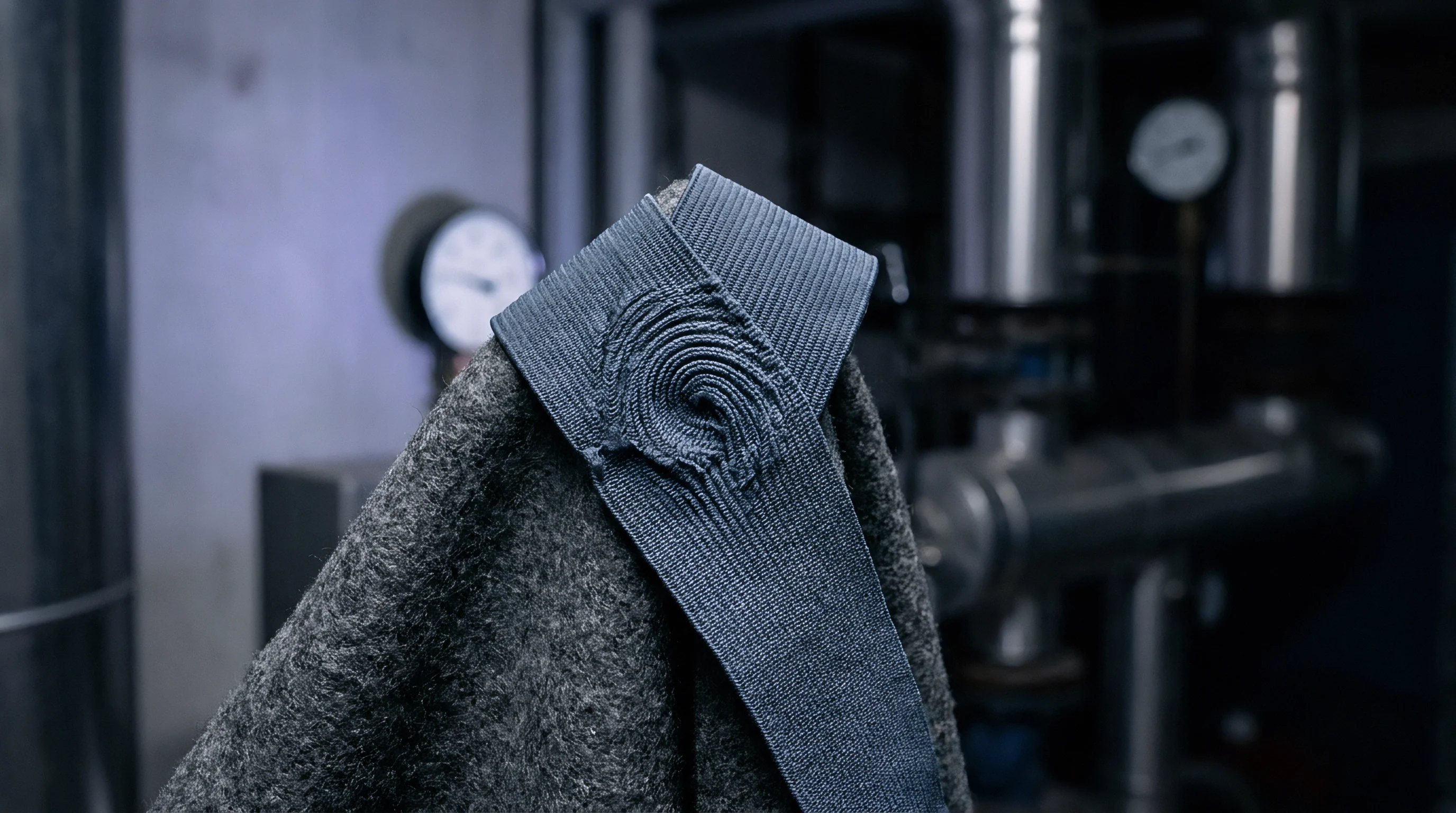
Finishing ranges reshape greige textiles through controlled heat, moisture, tension, and chemical application. Wet processing drives structural transformation across both wovens and knits. Scouring removes yarn lubricants, sizing agents, and natural waxes, allowing fibers to swell and relax into low-stress configurations; bleaching and dyeing further alter yarn friction and surface properties.
Stenter frames establish finished width, density, and skew alignment. Overfeed mechanisms feed fabric onto tenter pins faster than chain transport speeds, allowing lengthwise relaxation while heat setting or drying fixes transverse dimensions.
Overfeed settings directly dictate residual dimensional stability. Feeding fabric onto stenter pins with ten to twenty percent overfeed forces course or pick compaction along the length axis, counteracting length shrinkage during domestic laundering per ISO 5077. Insufficient overfeed leaves lengthwise tension trapped in the yarn matrix, which releases during wet laundering to cause severe length contraction.
Comparing stenter feed speeds against exit speeds reveals the mechanical relaxation imparted to the structure.
While heat setting locks synthetic loop dimensions and overfeed prevents washing shrinkage, stenter temperature, dwell time, and chain width must calibrate to the thermal properties of specific synthetic fibers. Polyester requires heat setting between 190 and 210 degrees Celsius for 30 to 45 seconds to crystallize polymer chains and stabilize dimensions, whereas Nylon 6,6 requires temperatures between 180 and 200 degrees Celsius. Inadequate heat setting leads to thermal shrinkage when end-use products encounter elevated temperatures during tumble drying or steam pressing.
- Cut three full-width 500 millimeter swatches from the lead end of the finished bulk roll.
- Condition all swatches at standard atmosphere of 20 degrees Celsius and 65 percent relative humidity for 24 hours per ISO 139.
- Mark a 350 millimeter benchmark square on each swatch using indelible fine-line ink and template frames.
- Subject the marked swatches to five consecutive washing cycles per ISO 6330 Procedure 4N at 40 degrees Celsius followed by flat drying.
- Measure dimensional deviation along three warp and three weft axes to calculate mean relaxation percentage.
Bow and skew distortion arise from unaligned tension across the stenter chain or dye vessel rollers. Bowing presents as parabolic curvature of weft picks or knit courses across the fabric width, while skewing appears as angular misalignment where weft threads or knit courses meet selvedges at angles deviating from ninety degrees. ISO 13015 defines measurement procedures for bow and skew.
Maximum allowable skew must remain under two percent of fabric width for woven goods and under three percent for knitted goods to prevent garment panel twisting and seam displacement.
Standard purchase agreements that omit explicit dimensional tolerance limits default to international standard limits that allow up to four percent relaxation shrinkage.
Chemical and mechanical finishes alter structural mass and physical properties. Resin finishing of cellulosic fabrics using dimethyloldihydroxyethyleneurea (DMDHEU) cross-links cotton cellulose chains to achieve crease recovery and dimensional stability. However, chemical cross-linking weakens cellulosic fibers, cutting tensile and tearing strength by twenty to thirty-five percent ~ so finishing specs must state minimum residual tearing strength limits following resin application.
Mechanical finishing processes, such as calendering, compressive shrinking (sanforizing), and napping, alter surface topography and fabric thickness without adding chemical mass.
Compressive shrinking passes wet woven fabric around a thick rubber belt under tension over a heated curved shoe; releasing belt tension compresses warp yarns along their horizontal axis, forcing immediate mechanical shrinkage. Sanforizing reduces residual warp shrinkage in woven cotton to under one percent per ISO 6330. Napping and sueding use abrasive rolls or wire-covered drums to raise surface fibers and create velvet textures.
Raising surface fibers weakens yarn cores, reducing bursting and tensile strength while increasing fabric thickness and thermal insulation. Specifications must therefore balance surface aesthetic against minimum load-bearing requirements.
Inadequate heat-setting on the stenter chain leaves residual thermal strain in synthetic fibers, triggering unrecoverable distortion during garment wet processing.

Stress
Mechanical loads applied to finished textiles reveal the structural efficiency of yarn arrangements, with specifications defining minimum physical strength thresholds based on standardized testing protocols. Tensile strength evaluation per ISO 13934-1 utilizes the strip method, clamping a 50 millimeter wide specimen and applying axial force until structural failure. Breaking force, measured in Newtons, and elongation at break, expressed as a percentage, reflect yarn strength, thread count, and weave pattern.
Plain structures distribute tensile loads across numerous yarn intersection points, producing high tensile resistance relative to yarn count. Twill structures allow more yarn movement under tension, yielding lower initial modulus but higher ultimate tearing resistance.
Tear propagation strength measures the force required to extend an existing cut within a fabric matrix. ISO 13937-2 defines the single tear wing test, while ISO 13937-1 covers the Elmendorf falling pendulum method. Tearing strength depends heavily on yarn mobility within the weave geometry, as adjacent yarns must group together to resist tearing forces.
Dense weaves with high cover factors lock yarns into fixed positions, preventing grouping and resulting in low tear resistance. Loose weaves or long-float patterns allow yarns to slide together, sharing the localized load across multiple threads and raising tear resistance. Finishes that increase yarn-to-yarn friction, such as fluorocarbon coatings or heavy resin applications, depress tear strength by restricting mobility.
Because tear strength relies so heavily on yarn mobility, liquidation of bulk lots often follows strength test failures caused by resin over-application.
Which Structural Adjustments Prevent Pilling on Fine Knits?
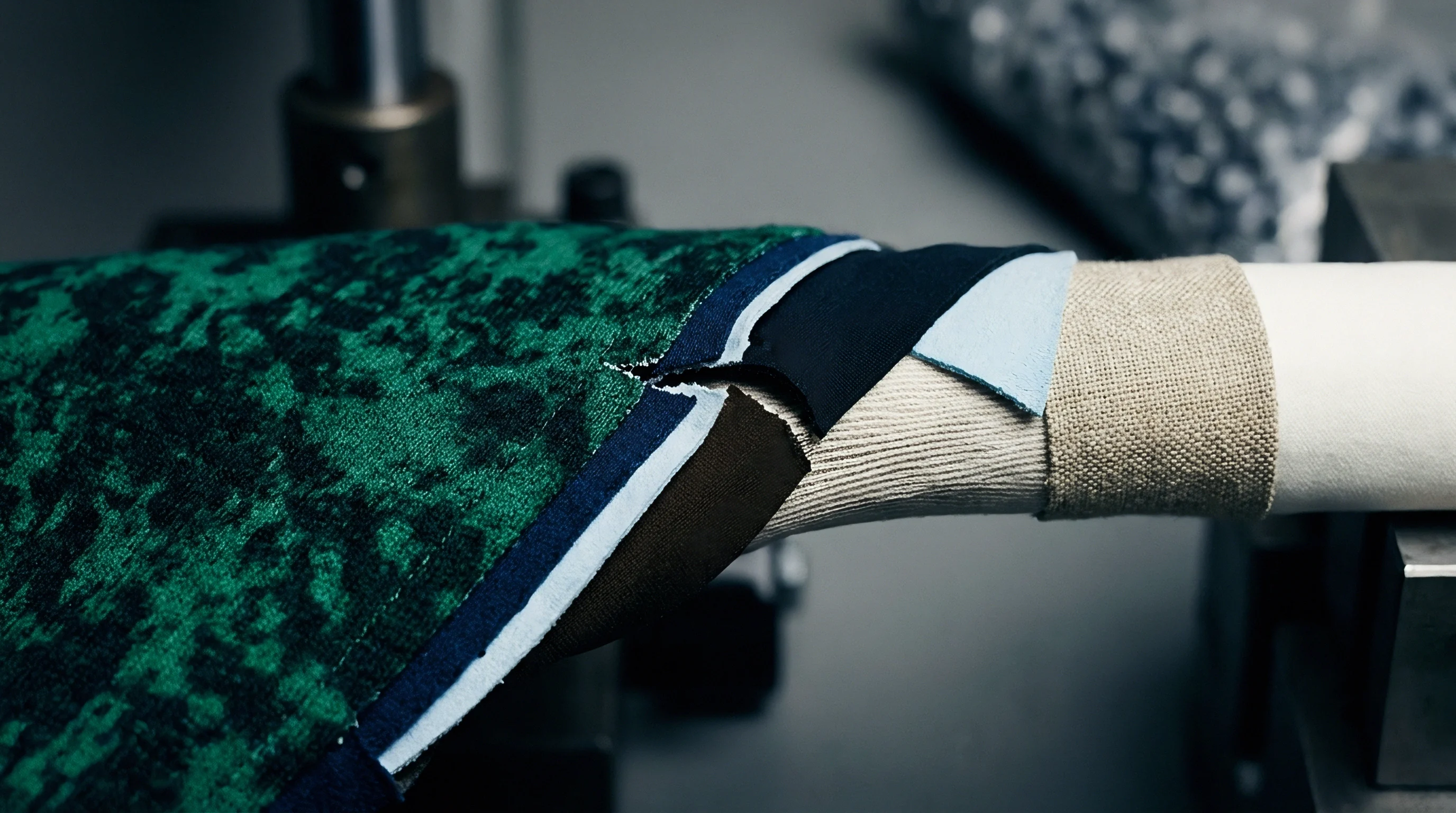
Pilling resistance measures a fabric’s susceptibility to surface fiber entanglements forming pills during wear. ISO 12945-2 details the Martindale pill testing method, which subjects specimens to rotational rubbing against a standard wool abradant and rates performance from Grade 1 (severe surface pilling) to Grade 5 (no surface change). Fiber staple length, yarn twist level, knit tightness factor, and surface finishing all alter pilling performance.
Short staple cotton or acrylic fibers easily slip out of yarn structures under friction and entangle on the surface. Elevating the yarn twist multiplier locks fibers within the yarn core, reducing fuzz formation, while higher tightness factors in knitted loop arrays restrict loose fibers from migrating to the surface during rubbing.
- Strip tensile loading measures maximum breaking force and elongation at break along primary yarn axes using constant-rate-of-extension testing frames.
- Tear propagation force assesses the energy needed to continue a slit cut into fabric specimens using falling pendulum or trapezoidal mechanical methods.
- Hydraulic diaphragm pressure measures multi-directional bursting resistance of knitted fabrics expanded to rupture point within circular specimen clamps.
- Martindale rub cycles evaluate surface fiber detachment and pilling formation under controlled multi-directional abrasive contact against reference abradants.
Bursting strength testing per ISO 13938-1 evaluates knitted fabrics subjected to multi-directional stress. Hydraulic fluid forces a flexible elastic diaphragm upward against a circular clamped specimen until the loop structure ruptures. Measured in kilopascals, bursting strength reflects yarn tensile strength, stitch length, and tightness factor.
Dense interlock structures deliver higher bursting resistance than loose single jersey fabrics knitted from identical yarns, while yarn degradation during wet processing ~ from excessive bleaching temperatures or acid enzyme washing ~ manifests immediately as dropped bursting strength values.
| Test Parameter | Standard Method | Cotton Plain Weave | Polyester/Cotton Twill | Cotton Interlock Knit | Nylon Ripstop Woven |
|---|---|---|---|---|---|
| Tensile Strength (Warp/Weft) | ISO 13934-1 | 450 N / 380 N | 850 N / 620 N | N/A | 1100 N / 950 N |
| Tearing Strength (Warp/Weft) | ISO 13937-2 | 18 N / 14 N | 35 N / 28 N | N/A | 65 N / 55 N |
| Bursting Strength | ISO 13938-1 | N/A | N/A | 420 kPa | N/A |
| Abrasion Resistance | ISO 12947-2 | 20,000 rubs | 45,000 rubs | 15,000 rubs | 75,000 rubs |
| Pilling Resistance | ISO 12945-2 | Grade 3-4 | Grade 4 | Grade 3 | Grade 4-5 |
Abrasion resistance testing per ISO 12947-2 measures fabric endurance against surface wear using the Martindale apparatus. Specimen failure occurs when two individual yarns break in woven fabrics, when one yarn breaks in knitted fabrics, or when total mass loss reaches a specified threshold. Synthetic filament yarns deliver superior abrasion endurance compared to natural staple yarns.
High pick density elevates abrasion resistance up to the point where yarn crowding induces yarn jamming and localized stress concentration.
Higher pick density enhances abrasion resistance up to the point where yarn jamming reduces tear strength.
Standard testing schedules based on ISO 13934-1 specify specimen conditioning at twenty degrees Celsius and sixty-five percent relative humidity, which invalidates any mill test report generated under ambient unconditioned air.

Route
Factory allocation decisions dictate landed cost per linear meter and determine total manufacturing lead times. Sourcing fabric requires mapping the entire manufacturing route across spinning mills, weaving or knitting facilities, wet processing dyehouses, and finishing plants. Each conversion step adds transport delays, minimum order quantity thresholds, and processing waste allowances.
Converters frequently aggregate greige orders across multiple buyers to meet loom setup minimums, introducing potential lot-to-lot yarn variations. Managing this chain of mills requires auditing individual facility capabilities rather than relying on trading house representations.
Minimum Color Quantities (MCQ) and Minimum Order Quantities (MOQ) originate from dyehouse equipment capacities. Atmospheric jet dyeing vessels process fabric in continuous ropes within closed tube circuits, with vessel capacities running in fixed increments such as 250 kilograms, 500 kilograms, or 1000 kilograms per chamber. Dyeing a batch below minimum chamber capacity causes uneven liquor circulation, shade banding, and excessive liquor-to-fabric ratios that waste water, dyestuffs, and energy.
Converter quotations are evaluated by breaking down yarn procurement, knitting or weaving rates, and finishing surcharges.
Because liquor ratio drives chemical consumption and dye lot size dictates cost, processing small colorways below minimum jet capacity incurs shade surcharges or requires sample jet vessels, elevating unit costs by twenty to fifty percent. Continuous pad-steam or pad-thermosol dyeing lines demand minimum run lengths of 3,000 to 5,000 meters per shade to establish shade equilibrium across the dye padder; small dye lots processed on continuous ranges generate high scrap rates during shade adjustments at startup.
- Vessel capacity matching aligns bulk dye batch sizes with ordered dye lots to optimize liquor ratios and prevent shade variation.
- Stenter width capability ensures incoming greige width accommodates expected wet relaxation without exceeding mechanical frame boundaries.
- In-house lab dip matching verifies dyehouse spectrophotometer calibration and standardized light box illuminant availability per ISO 105-J01.
- Minimum order thresholding prevents unit price surcharges on small colorways by consolidating sub-lots into standard vessel charges.
Lead time calculations must account for sequential production steps, transportation windows, and quality verification pauses. Greige spinning and weaving consume four to six weeks, while wet processing, shade matching, and chemical finishing demand another three to four weeks. Physical testing, laboratory verification, and final inspection add one additional week, putting total procurement timelines at eight to twelve weeks from initial purchase order issuance to warehouse delivery.
A disruption at a single dyehouse can stall the entire garment assembly schedule, triggering factory airfreight costs to meet retail delivery windows.
Converters frequently aggregate greige orders across multiple apparel buyers to meet loom minimums, introducing lot-to-lot yarn variations.
Cost-per-finished-meter models aggregate raw material expenses, conversion surcharges, and processing shrinkage losses. A worked commercial calculation illustrates landed cost structures for a 100 percent cotton twill build:
Raw cotton fiber yarn procurement costs $3.20 per kilogram. Weaving conversion fees add $1.10 per linear meter at 160 centimeters greige width. Greige fabric mass measures 200 grams per square meter, yielding 320 grams of yarn per linear meter ~ making raw yarn cost equal to $1.02 per linear meter and bringing combined greige manufacturing cost to $2.12 per linear meter.
Wet processing, dyeing, and sanforizing add another $1.45 per linear meter. Finishing shrinkage contracts fabric length by five percent and width to 150 centimeters finished width, which increases the effective unit cost by five point two percent. Adding $0.35 per linear meter for freight, tariff duties, and laboratory inspection fees brings the final landed cost to $4.02 per finished linear meter.
| Fabric Build | Minimum Dye Lot (m) | Greige-to-Finish Shrink (%) | Processing Time (Weeks) | Waste Factor (%) | Landed Cost Surcharge (%) |
|---|---|---|---|---|---|
| Cotton Plain Weave 120 g/m² | 3,000 | 6.5 | 8 | 3.0 | +8.5 |
| Poly/Cotton Twill 240 g/m² | 1,500 | 4.0 | 7 | 2.5 | +6.0 |
| Cotton Jersey Knit 160 g/m² | 500 (kg) | 12.0 | 6 | 5.0 | +14.0 |
| Nylon Ripstop 80 g/m² | 5,000 | 3.0 | 10 | 2.0 | +11.0 |
Yield calculations must bridge the gap between length-based commercial purchasing and mass-based structural specifications. Buying fabric strictly by the linear meter leaves buyers vulnerable to mass fluctuations, as mills running yarn counts on the light side of tolerance can deliver lighter fabrics that meet length targets while failing structural performance requirements. Purchasing specifications should establish a target linear yield ~ defined as meters per kilogram ~ derived directly from finished width and finished mass per square meter.
Whether regional dyehouses can maintain shade consistency while reducing liquor ratios below five to one remains an open technical challenge for wet processors.

Docket
Technical spec sheets transform physical targets into binding legal standards for global textile supply chains. A complete construction specification docket eliminates vague language in favor of explicit numerical targets, approved test standards, and mandatory tolerance bands. These sourcing dockets anchor dispute resolutions whenever bulk shipments deviate from approved development swatches.
Every structural parameter must list its governing standard, sampling frequency, and pass/fail thresholds. Finished mass tolerances are specified as a symmetric percentage around target weight to prevent weight shedding.
Finished width specifications state minimum usable width inside selvedges per ISO 22198. Pin holes from stenter chains, selvedge print lines, and un-dyed selvedge borders must all sit outside declared usable width. Standard width tolerances allow plus two centimeters and minus zero centimeters; delivering fabric below specified usable width reduces garment marker efficiency and generates high cutting waste across assembly plants.
Mass per unit area specifications state nominal target values with an allowable tolerance of plus or minus five percent per ISO 3801.
Thread density and knit course/wale counts require precise tolerance setting. Woven specifications typically allow plus or minus two percent for warp ends and plus or minus three percent for weft picks, whereas knitted specifications allow plus or minus five percent for both course and wale densities to reflect the higher inherent elastic variance of looped arrays. Stitch length in knitted goods demands a tight tolerance of plus or minus one point five percent, as deviations exceeding these thresholds alter fabric drape, hand, and mechanical strength performance.
Dimensional stability specifications define maximum allowable shrinkage and growth across laundering cycles per ISO 5077 and ISO 6330. Standard commercial limits allow a maximum of three percent length and width shrinkage for woven goods, and five percent for knitted goods. High-performance activewear specifications tighten knit shrinkage limits to three percent by requiring mechanical compacting or continuous heat setting during wet processing.
In single jersey knits, spirality tolerances must mandate a maximum wale skew under three percent following five washing cycles.
Colorfastness specs form an integral part of the technical docket, referencing the ISO 105 series. Fastness to washing (ISO 105-C06), rubbing/crocking (ISO 105-X12), and light (ISO 105-B02) require minimum numerical ratings based on grey scale assessments from Grade 1 (severe change/staining) to Grade 5 (no change/staining). Standard commercial specifications mandate a minimum Grade 4 for dry rubbing, Grade 3-4 for wet rubbing, and Grade 4 for color change under home laundering.
Technical apparel exposed to outdoor conditions requires lightfastness ratings of Grade 4-5 after 100 hours of continuous xenon arc exposure.
Because tolerances protect bulk shipments and off-spec mass triggers chargebacks, incoming inspection protocols must reference ISO 2859-1 single sampling plans for normal inspection. Roll-by-roll inspection utilizes the four-point system per ASTM D5430 to quantify visual surface defects. Defect points are assigned based on flaw size, and shipments exceeding forty points per one hundred square meters trigger lot rejection.
Combining four-point visual scoring with mandatory laboratory strength testing ensures comprehensive quality control before fabric rolls move to the cutting room floor.
Clear specification definitions align mill output with buyer expectations, ensuring batch-to-batch consistency across global manufacturing runs without requiring constant emergency interventions.