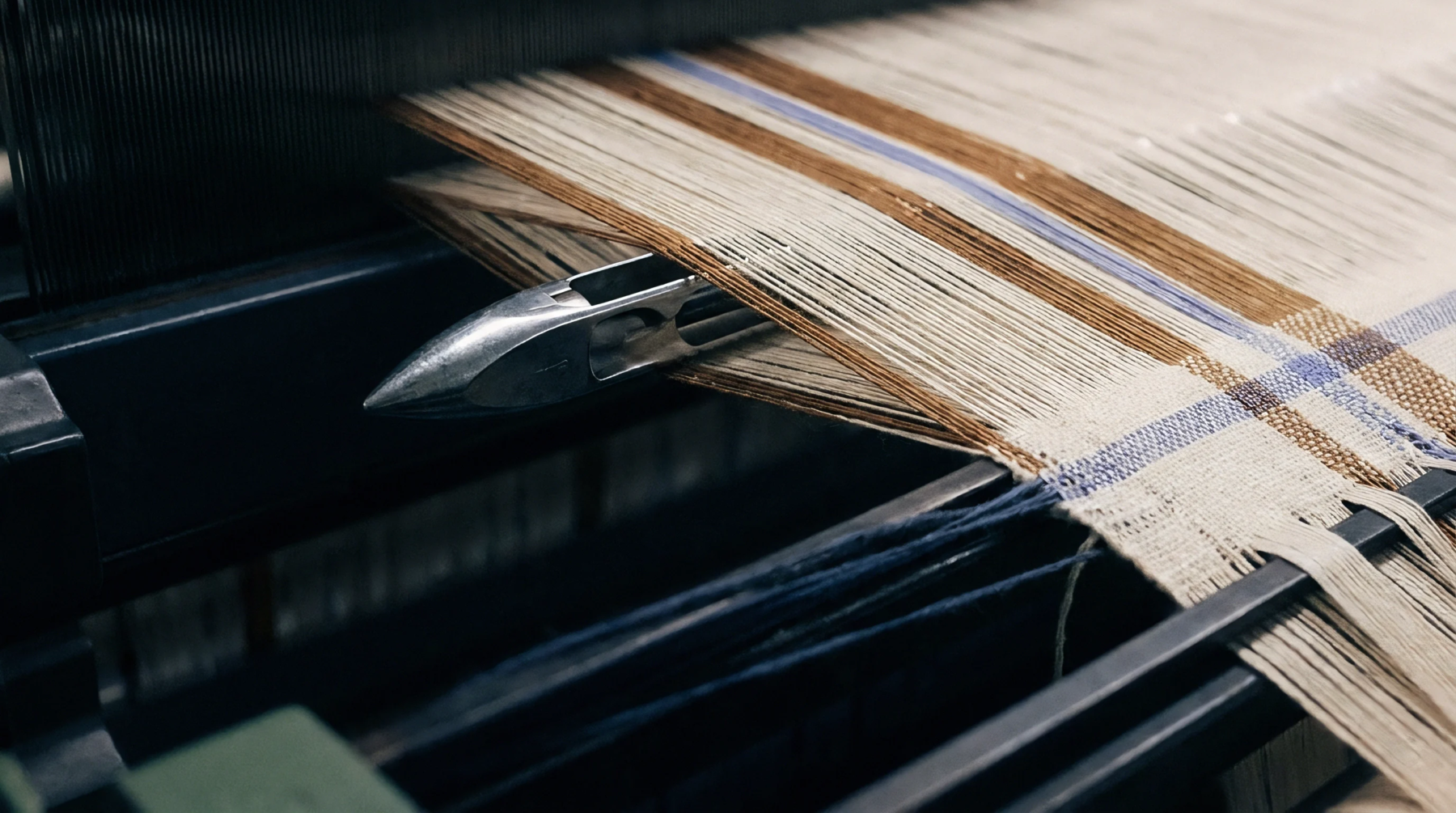
Loom Geometry
Mathematical estimation of the required spacing of warp threads on the loom reed ensures that the fabric reaches the specified width after relaxation and finishing. This process is the reed width derivation, which accounts for the shrinkage and crimp that occur when the yarn is taken off the loom.
Calculation Steps
Weavers calculate this dimension by adding the desired finished fabric width to the shrinkage allowances for both wet processing and warp crimp. Through reed width derivation, the designer determines the exact width of the reed needed to accommodate the warp. The formula incorporates the yarn type, the weave structure, and the pick density, as tighter weaves shrink more when the tension is released.
If the reed width is calculated incorrectly, the woven fabric will either be too narrow to meet customer specifications or too wide, requiring wasteful trimming.
Sizing Influence
Sizing agents applied to the warp yarn during preparation affect the elasticity and the subsequent shrinkage behavior of the fabric. Including these factor variations in the reed width derivation ensures that the loom settings are optimized for the specific chemical finish of the yarn.
Machine Selection
Production planners use the calculated width to select the correct loom size and to arrange the warp yarn on the beam. Correct width planning avoids machinery bottlenecks and ensures that the warp is evenly tensioned.