Feed Proportion
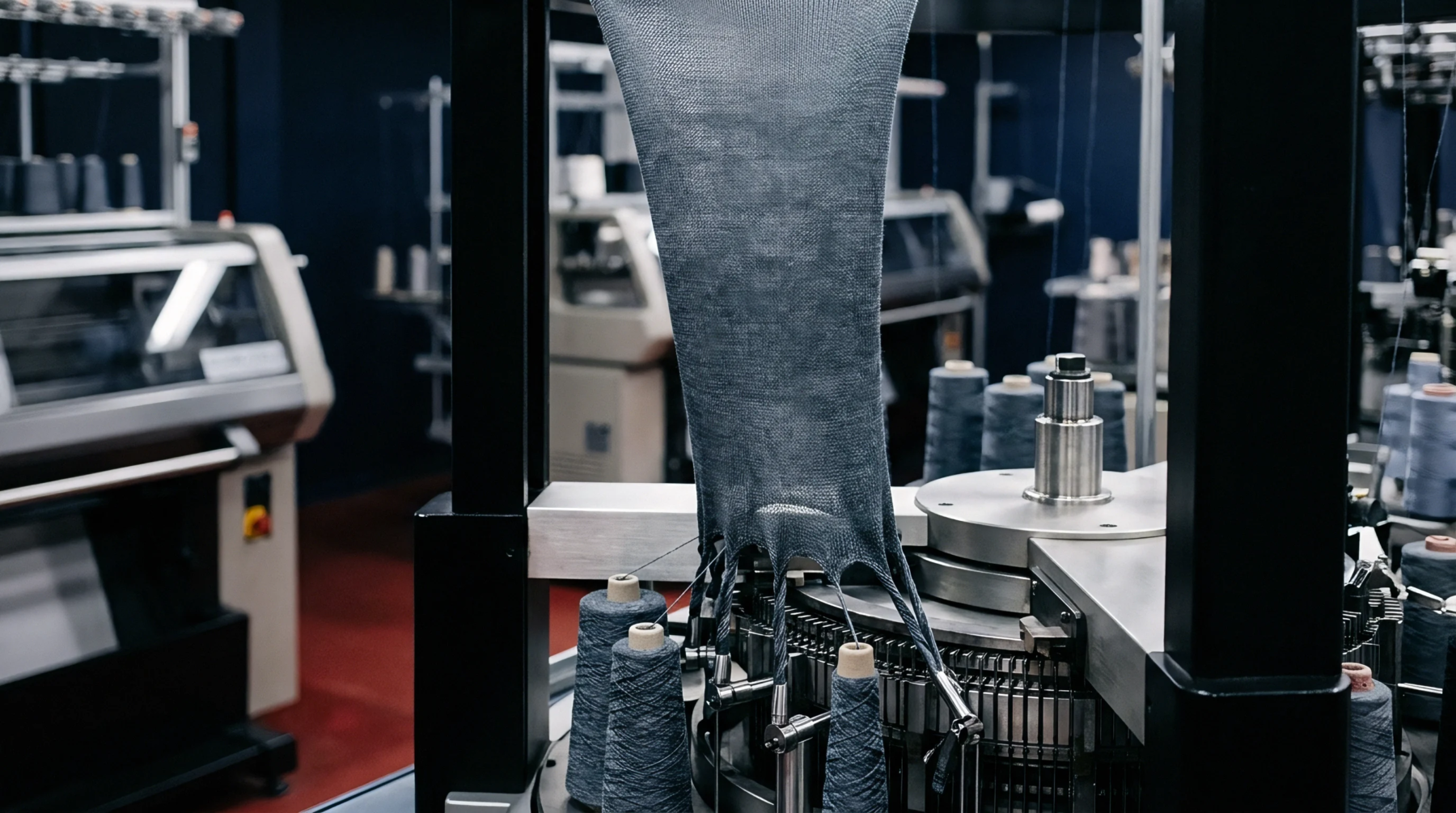
Measured length ratio of individual warp sheets consumed during the formation of a fixed unit length of warp-knitted fabric governs the structural balance and elasticity of the resulting textile. This calculated balance, known as the run-in ratio, expresses the millimeter consumption of the front guide bar relative to the middle and back guide bars over one rack, which equals four hundred and eighty machine revolutions. Because each guide bar traces distinct lapping movements, differing yarn lengths are required to form overlapping underlaps and needle loops.
Setting this ratio establishes stitch stability, fabric weight, and elongation recovery.
Yarn Displacement
Changing the underlap length of a guide bar directly affects its yarn consumption per rack. A front guide bar performing a 1-0/1-2 closed lap consumes significantly less yarn than a back bar executing a 1-0/3-4 lay-in stitch across four needle spaces. Modern machines use electronic warp let-off systems driven by servomotors to supply the precise millimeter allocation demanded by each bar.
If the assigned ratio drifts during high-speed operation, the fabric structure tightens or loosens unexpectedly, altering the nominal yield and breaking strength of the commercial batch.
Operational Adjustment
Technicians calibrate run-in values using mechanical rack-counters and marked yarn techniques or digital encoder readouts displayed on the machine console. Typical locknit constructions require run-in configurations near three to four, where the front bar feeds three millimeters of yarn for every four millimeters drawn by the back bar. Incorrect balance leads to looping distortions, selvage curl, and needle bending.
The resulting fabric exhibits skewed warp ribs and variable modulus when subjected to multidirectional stretch testing.
Quality Verification
Receiving warehouses verify the delivery ratio by de-knitting measured fabric swatches according to standardized test protocols. Lab analysts extract yarn lengths from identical course counts, measure their uncurled extended length under standard preload tensions, and calculate the exact consumption ratio. Batches falling outside a two percent tolerance band are flagged for non-conformance, as variations lead to dimensional instability during garment laundering.
Production plants run continuous monitoring of let-off motors to ensure ratio stability across thousands of linear meters.