Cold Pad Batch Dosing Ratio Calibration for Reactive Dyeing Systems
Calibrating cold pad batch dosing ratios requires synchronized dye-to-alkali volumetric displacement to prevent reactive dye hydrolysis and batch shade tailing.

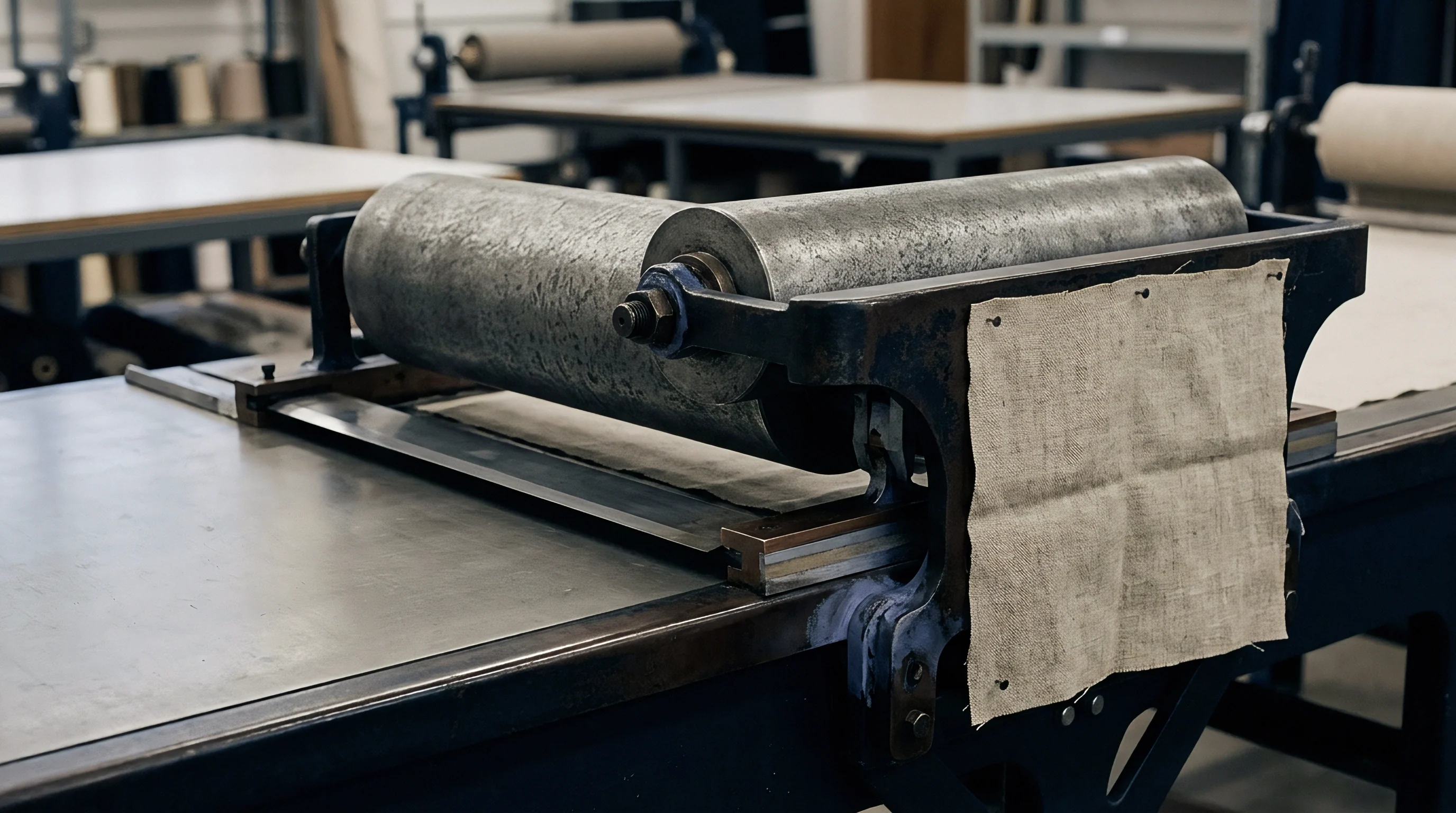
Trough
Continuous liquor delivery in cold pad batch reactive dyeing relies on precise volumetric separation between reactive dye concentrates and active alkaline fixatives until seconds before fabric immersion. Mixing reactive dyes with sodium hydroxide or sodium silicate initiates nucleophilic cellulosate substitution alongside competing aqueous hydrolysis. Premature bath contact converts reactive vinyl sulfone or halotriazine groups into unreactive hydroxyl derivatives, destroying fixation yield and colour yield across bulk production runs.
Fabric dyers prevent this premature reaction through split-stream dosing units delivering dyestuff solutions and alkali streams directly into a low-capacity padder trough.
Padder troughs for cold pad batch processing operate with working volumes between ten and twenty litres. Minimizing trough volume guarantees rapid liquor turnover at standard production speeds of thirty to eighty metres per minute. Rapid turnover maintains an average chemical dwell time in the trough of less than five minutes.
Dwell times below three hundred seconds prevent measurable dye hydrolysis before the liquor penetrates the fibrous core of the textile substrate.
Low trough volumes restrict reactive dye liquor residence time below the threshold of uncatalyzed hydrolysis.
Dosing pumps supply dye and alkali in predetermined volumetric ratios, predominantly four parts dye solution to one part alkali solution, or one part dye to one part alkali in specialized high-carbonate systems. The combined liquor feeds a submerged distributor pipe running parallel to the padder bowls. The distributor pipe deposits the freshly blended liquor uniformly across the full width of the trough to prevent localized concentration gradients.
| Fabric Construction | Dry Weight (g/m²) | Running Speed (m/min) | Target Pick-Up (%) | Liquor Consumption (L/min) | Trough Volume (L) | Turnover Time (min) |
|---|---|---|---|---|---|---|
| Cotton Poplin 40s×40s / 133×72 | 110 | 60 | 65 | 4.29 | 12 | 2.80 |
| Cotton Twill 20s×16s / 128×60 | 240 | 45 | 70 | 7.56 | 12 | 1.59 |
| Cotton Heavy Drill 16s×12s / 108×56 | 310 | 35 | 75 | 8.14 | 15 | 1.84 |
| Viscose Plain Weave 30s×30s / 68×68 | 135 | 50 | 85 | 5.74 | 12 | 2.09 |
| Single Jersey 30s Combed Cotton | 160 | 40 | 90 | 5.76 | 15 | 2.60 |
Liquor consumption per minute governs the actual residence time inside the impregnation box. When running line speeds drop during batch changes or mechanical slow-downs, bath dwell times expand. Any dwell time exceeding ten minutes causes progressive hydrolysis of vinyl sulfone dyes at twenty-five degrees Celsius.
Hydrolysis reduces the active dye concentration available for fixation, causing tailing across the first three hundred metres of cloth.
Inaccurate replenishment rates destabilize the liquid level inside the padder. Dropping levels alter the contact arc between the textile web and the padder roller, modifying dynamic liquor pick-up and creating tailing from roll head to tail.
Piston
Mechanized metering units use positive displacement positive-drive pumps to control the flow rate of each chemical component. Dual-piston systems mechanically link the dye dosing stroke to the alkali dosing stroke through an adjustable eccentric cam or electronic servo drives. Setting the ratio to 4:1 requires the dye piston to displace exactly four hundred millilitres per stroke cycle while the alkali piston delivers precisely one hundred millilitres.

Which Process Variables Dictate Dosing Pump Adjustment?
Specific gravity variations alter the actual mass of chemical delivered per piston stroke. Concentrated reactive dye solutions possess specific gravities ranging from 1.02 to 1.08 grams per cubic centimetre. Liquid alkali mixtures containing commercial sodium silicate at 38 to 40 degrees Baumé combined with 50 percent caustic soda reach specific gravities between 1.35 and 1.42 grams per cubic centimetre.
Positive displacement piston chambers fill and discharge by volume, requiring mass-balance corrections when formulation sheets state chemical targets in grams per kilogram rather than millilitres per litre.
A volumetric delivery error of two percent shifts the dye-alkali equilibrium past the operational pH tolerance of vinyl sulfone dyes at twenty-five degrees Celsius.
Viscosity differentials between cold silicate solutions and hot-dissolved dye stocks create dynamic backpressure inside dosing manifolds. High viscosity in the alkali channel creates cavitation in unpressurized intake lines. The following mechanical failure modes disrupt proportional displacement during continuous pad batch runs:
- Piston seal degradation allows high-density caustic solutions to slip past the cylinder wall, eroding the alkaline delivery volume.
- Check valve seat encrustation prevents full closure during discharge strokes, letting dye liquor reflux into the feed hopper.
- Intake manifold cavitation generates air pockets that compress under pressure, delivering erratic liquid volumes to the mixing chamber.
- Drive shaft timing backlash introduces mechanical lag during acceleration phases, shifting the instantaneous mixing ratio toward alkaline excess.
Technicians calibrate dosing pumps by collecting independent discharge volumes from both lines into calibrated graduated cylinders over a timed interval of two minutes. Measuring volumetric delivery across three replicate cycles confirms stroke accuracy. Piston stroke length is adjusted mechanically or through digital drive interfaces until three consecutive checks yield identical volumetric splits within a tolerance of plus or minus one percent.
Calibration remains stable only while suction lines stay clear of crystallized solids.
Alkali
Fixation efficiency in cold pad batch systems depends on achieving a precise target pH inside the wet fabric bundle throughout the batching duration. Reactive dye anchors display distinct chemical activation energies and hydrolysis rates. Vinyl sulfone groups require an alkaline pH range between 10.8 and 11.2 for optimum conversion to the reactive vinyl form followed by ether linkage formation with cellulose.
Dichlorotriazine, monochlorotriazine, and heterobifunctional dye molecules require specific pH plateaus between 11.5 and 12.5 to activate covalent fixation.
Alkali System Selection and Buffer Capacity
Standard cold pad batch dyeing utilizes two distinct alkali systems. The silicate system blends sodium silicate with concentrated sodium hydroxide. Sodium silicate acts as a high-capacity chemical buffer, stabilizing the bath against atmospheric carbon dioxide absorption during the sixteen to twenty-four hour batching period.
The silicate-free system combines sodium carbonate with sodium hydroxide or potassium carbonate, eliminating silicate washing issues at the cost of narrower buffering margins.
| Dye Anchor Chemistry | Dye Concentration (g/L) | NaOH 50° Bé (mL/L in mixed bath) | Sodium Silicate 38° Bé (mL/L in mixed bath) | Soda Ash (g/L in mixed bath) | Target Fixation pH |
|---|---|---|---|---|---|
| Vinyl Sulfone | Under 20 | 2.5 | 50 | 0 | 10.8 to 11.0 |
| Vinyl Sulfone | 20 to 50 | 4.0 | 50 | 0 | 11.0 to 11.2 |
| Vinyl Sulfone | Over 50 | 6.5 | 50 | 0 | 11.2 to 11.4 |
| Bi-Reactive (VS / MCT) | Under 30 | 5.0 | 50 | 0 | 11.2 to 11.5 |
| Bi-Reactive (VS / MCT) | Over 30 | 8.0 | 50 | 0 | 11.5 to 11.8 |
| Silicate-Free Vinyl Sulfone | Under 40 | 3.0 | 0 | 25 | 10.8 to 11.1 |
| Silicate-Free Bi-Reactive | All Depths | 5.5 | 0 | 30 | 11.4 to 11.7 |
| Quantities represent final mixed concentrations in pad trough after 4:1 dosing dilution. | |||||
Alkali stock solutions are formulated at five times their target mixed-bath concentration when operating on a 4:1 dosing system. Preparing a 4:1 alkali tank to supply fifty millilitres per litre of sodium silicate and four millilitres per litre of caustic soda requires dissolving two hundred and fifty millilitres of silicate and twenty millilitres of caustic soda per litre of stock solution. Any evaporation or incorrect tank dilution distorts the final chemical balance.
Purchase contracts specifying ISO 105-C06 wash fastness ratings above grade four require documented titration records for every dyehouse batching roll.
Dosing ratios must adjust dynamically when reactive dye formulations change from pale tints to heavy depths. Concentrated reactive dyes contain weakly acidic stabilizing agents and release sulfuric acid esters or hydrochloric acid during cellulosate covalent bonding. Heavy depths consume active hydroxide ions rapidly.
Failing to scale alkali dosing alongside dyestuff concentration causes terminal pH collapse inside the rolled batch, yielding unreacted dye that washes off during wet clearing.
The exact quantitative boundary where silicate-free buffering systems fail to resist carbon dioxide acidification across twenty-four-hour rotating batch rolls under high ambient relative humidity remains subject to active industrial debate.


Substrate
Cellulose fabric structure directly governs wet pick-up capacity, liquor exchange kinetics, and physical liquor displacement at the padder nip. Woven fabrics constructed from tightly twisted ring-spun yarns resist rapid liquor penetration. Loose circular knits absorb chemistry instantly while retaining high capillary water volumes.
The cold pad batch dosing system must deliver chemical mass matching the physical retention characteristics of each specific construction.
Woven and Knitted Construction Variables
A 240 g/m² 3/1 cotton twill woven with 20s warp and 16s weft yarns presents high internal yarn density. Under a padder nip pressure of 0.4 megapascals, this twill achieves a calibrated wet pick-up of 68 percent. A 160 g/m² single jersey knit dyed on the same line achieves 90 percent pick-up at 0.2 megapascals to prevent fabric elongation.
The absolute chemical mass deposited per linear metre of fabric shifts according to this pick-up differential.
Pick-up calibration requires calculating the exact liquor volume deposited per kilogram of dry substrate. The dyer calculates the required dye concentration in the feed stock tank using the formula:
Feed Concentration (g/L) = (Target Recipe g/kg × 1000) / (Pick-Up % × 0.8)
The 0.8 multiplier accounts for the 4:1 volumetric dosing dilution where four parts dye stock combine with one part alkali stock. A target recipe of thirty grams per kilogram on a fabric with 75 percent pick-up demands a dye feed tank concentration of fifty grams per litre.
Dense twill weaves demand higher padder nip pressure than loose single knits to achieve identical liquor displacement.
Fabric preparation quality dictates wetting consistency across the width of the piece. Incomplete desizing or uneven scouring leaves residual fats, waxes, and synthetic size polymers that retard capillary absorption. The following substrate specifications govern dosing stability:
- Capillary drop absorption time measured by AATCC 79 must record values below two seconds across both selvages and the fabric centre.
- Barium activity number determined under ISO 11507 must exceed 140 for mercerized cotton to confirm uniform cellulose lattice expansion.
- Residual moisture content measured before impregnation must sit within a narrow window of four to six percent to prevent differential dilution.
- Fabric surface core pH tested according to ISO 3071 must remain neutral between 6.5 and 7.2 to avoid neutralizing the alkali dosing stream.
Converters frequently claim that sudden shade tailing across a five-thousand-metre dye run was caused by unannounced variations in yarn sizing wax rather than dosing pump drift.

Ledger
Shade divergence from uncalibrated dosing units represents a severe commercial risk in cold pad batch manufacturing. Because fabric remains wrapped in polyethylene film on batching A-frames for sixteen to twenty-four hours before wash-off, shade errors are detected only after an entire production lot has completed chemical fixation. Stripping and re-dyeing hydrolyzed or off-shade reactive dyeings weakens cotton yarn tensile strength by fifteen to twenty-five percent under ISO 13934 testing and adds substantial processing expense.
A typical bulk dye run of ten thousand metres of 200 g/m² cotton bottom-weight fabric illustrates the financial stakes. The total dry fabric weight equals two thousand kilograms. At a nominal fabric cost of 3.20 USD per finished metre, the raw batch value equals 32,000 USD.
Reactive dyestuff and auxiliary chemicals contribute 0.45 USD per metre, representing an additional 4,500 USD in applied chemistry. An undetected 5 percent volumetric dosing error on the alkali pump that triggers partial dye hydrolysis renders the entire lot uncorrectable to first-quality standard.
Scrapping a ten-thousand-metre order triggers direct financial losses:
- Raw material write-off equals 32,000 USD for the compromised greige substrate.
- Applied chemical loss totals 4,500 USD for wasted reactive dyestuff and alkali.
- Effluent processing costs consume 600 USD to neutralize and treat the stripped wash-off liquors.
- Air freight surcharges reach 12,000 USD to transport replacement yardage to meet garment factory cut dates.
Dosing unit calibration logs, automated inline mass-flow meter records, and hourly titration check sheets constitute mandatory technical documentation for quality audits. Standard commercial purchase agreements stipulate that bulk lots displaying colour variance exceeding a Delta E CMC (2:1) value of 0.8 against the approved master lab standard under D65 illumination result in total lot rejection and supplier liability for downstream garment production delays.