Quantitation of Residual Solvents in Industrial Polyurethane Coated Fabrics
Gas chromatography mass spectrometry quantitation of residual solvents in polyurethane fabrics demands liquid extraction to prevent border detentions.
Temperature distribution across the width of a running fabric web during continuous heat setting operations governs residual shrinkage behavior in finished synthetic textiles. Heat transfer mechanics rely on forced convection from heated nozzles positioned above and below the moving material. Air velocity variations across nozzle orifices create localized drying rate discrepancies between center zones and selvedges.
Residual moisture evaporation removes latent heat differentially across the web span. Uneven thermal energy input causes differential polymer chain relaxation during the second phase of finishing. Stenter drying profile variations produce widthwise dimensional instability during subsequent garment laundering cycles.
Excessive edge temperatures induce polymer degradation and yellowing in sensitive polyester blends. Temperature sensors mounted within the housing monitor surface radiation continuously to prevent localized scorching during high speed processing.
Momentum transfer from high pressure exhaust nozzles controls boundary layer removal rates across the textile substrate. Blower fan frequency modulation dictates the kinetic energy delivered to wet fabric entering the high temperature chamber. Laminar boundary layers restrict moisture migration until turbulent jet impingement strips the vapor barrier from the material surface.
Static pressure imbalances between upper and lower plenums displace the fabric centerline vertically. Vertical displacement alters nozzle distance parameters and generates non uniform drying coefficients across the web width. Excessive airflow turbulence causes edge flutter and physical distortion of lightweight knitted constructions.
Air distribution dampers require manual calibration during style changeovers to maintain consistent mass transfer rates.
Water content distribution within the cellulose or synthetic substrate dictates heat capacity fluctuations during continuous evaporation phases. Capillary action draws moisture toward external surfaces as internal vapor pressure rises under thermal load. Drying rates transition from a constant rate period to a falling rate period once critical moisture thresholds are breached.
Residual solvent concentrations from prior dyeing stages alter drying kinetics and local evaporation rates. High initial moisture levels suppress fabric temperature through sustained latent heat absorption until dryout occurs near the chamber exit. Uneven moisture extraction causes differential dye sublimation in dispersed color formulations applied to polyester substrates.
Laboratory moisture meters verify final conditioning targets before the material reaches the windup batcher.
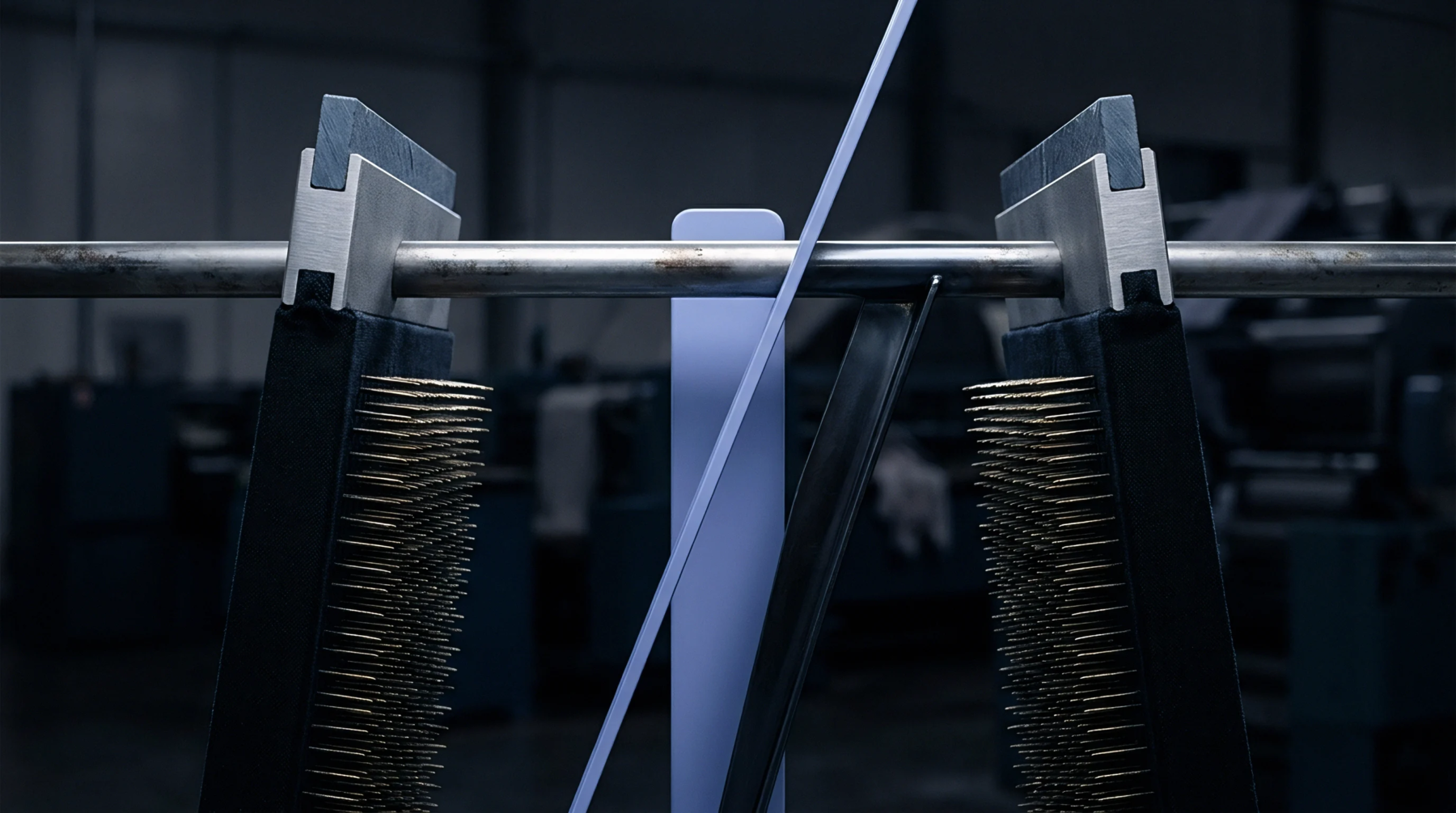
Widthwise tension control regulates mechanical recovery limits following thermal exposure in the finishing zone. Overfeeding mechanisms push excess material longitudinally into the pin chain to compensate for lateral shrinkage forces. Pinhole tear resistance degrades when mechanical overfeed values exceed structural warp density thresholds.
Pin slip occurrences during high speed processing generate permanent distortions in plaid and stripe alignments. Finished goods undergo standard wash testing in commercial laundry equipment to quantify residual area shrinkage against buyer specifications. Final inspection protocols measure width uniformity at regular intervals along the entire roll length.
Gas chromatography mass spectrometry quantitation of residual solvents in polyurethane fabrics demands liquid extraction to prevent border detentions.
Expertise is a utility, not a secret. sentiention™ publishes its working knowledge as open reference: intelligence layer covering the materials it sources, the markets it enters, and the reference that serves both.