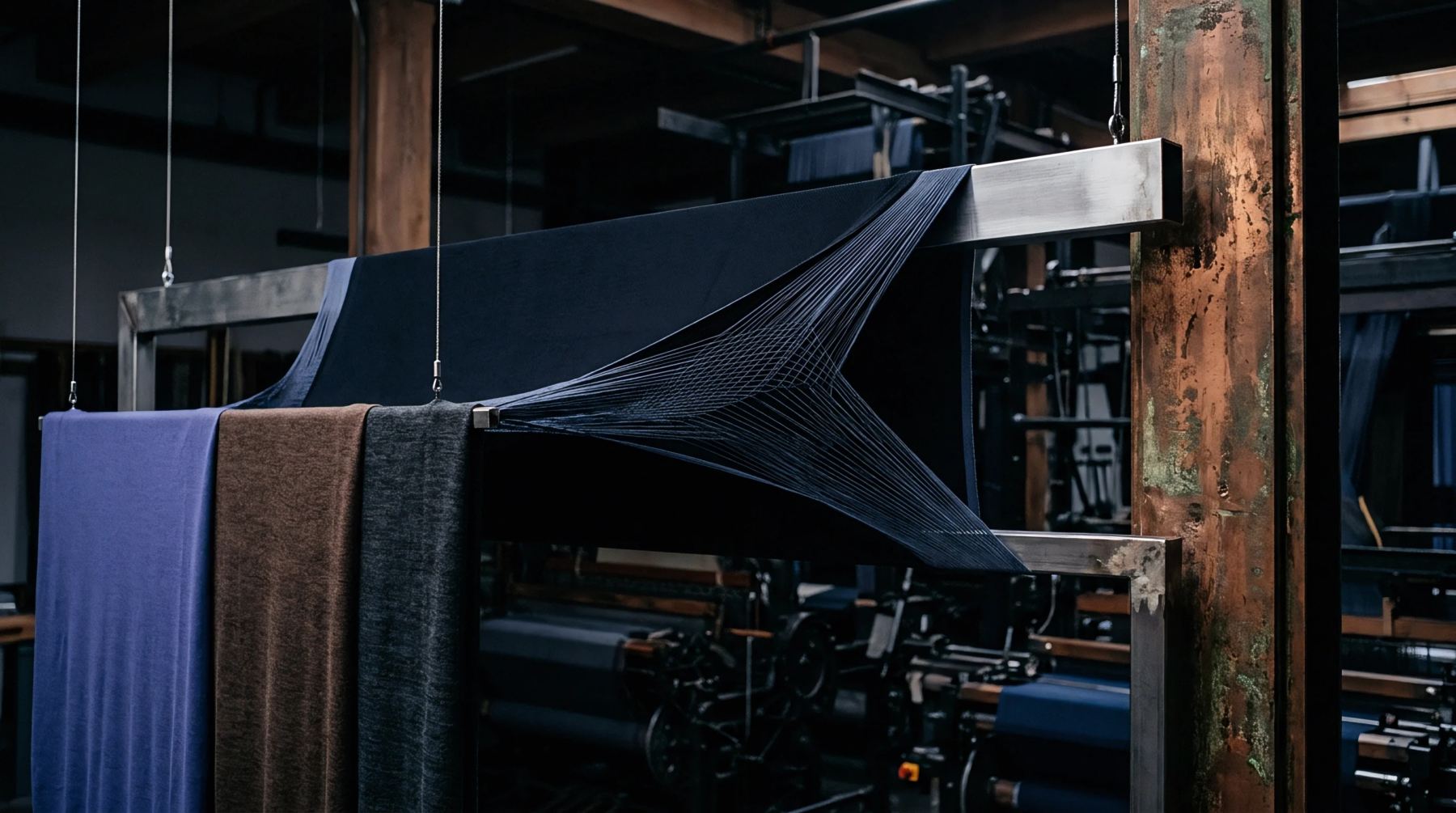
Calculating Loom Reed Width from Warp Crimp and Fabric Sett
Calculating correct loom reed width requires combining off-loom grey contraction, finished warp sett, and weft crimp percentage into one unified formula.
Geometric waviness or curvature present in high-quality wool fibers that have been aligned through combing to provide elasticity and bulk to the resulting spun thread. Worsted yarn crimp is a natural characteristic of wool that is preserved and enhanced during the worsted spinning process. Unlike woollen yarns, which are carded to create a fuzzy, disorganized structure, worsted yarns are combed to remove short fibers and align the long ones in a parallel fashion.
This alignment allows the natural crimp of the individual fibers to work together, creating a yarn that is smooth, dense and resilient. The amount of crimp is a key indicator of the quality of the wool, with finer fibers typically having more crimp than coarser ones.
Ability of the yarn to stretch and then return to its original length is a direct result of the wavy structure of the individual wool fibers. Worsted yarn crimp acts as a built-in spring that provides excellent shape retention and wrinkle resistance to the finished fabric. This is why worsted wool is the preferred material for high-end suits and formal wear.
When the yarn is pulled, the crimp straightens out, and when the tension is released, it pulls back into its original shape. This elasticity makes the fabric comfortable to wear and helps it to maintain a sharp, clean appearance even after long hours of use. Manufacturers test the crimp recovery to ensure that the yarn meets the required standards for performance.
Volume and insulation of the yarn are influenced by the amount of air that is trapped within the crimped structure of the fibers. Worsted yarn crimp provides a level of bulk and warmth that is disproportionate to its weight. Even though the yarn is smooth and compact, the internal waves create small pockets of air that act as a thermal barrier.
This makes worsted wool suitable for a wide range of climates, from cool autumn days to cold winter months. The degree of bulk can be adjusted by changing the amount of twist applied to the yarn during spinning. A lower twist allows the crimp to expand, while a higher twist pulls the fibers closer together and reduces the bulk.
Assessment of the wool fibers based on their crimp frequency and uniformity is a standard part of the raw material selection process. Worsted yarn crimp is measured as the number of waves per inch or centimeter. High-quality Merino wool, for example, is known for its exceptionally fine and regular crimp.
This regularity ensures that the yarn is uniform in both strength and appearance. During the combing and spinning processes, the fibers must be handled carefully to avoid damaging the crimp. Excessive heat or tension can permanently straighten the fibers and reduce the quality of the yarn.
Quality control labs use microscopic analysis to verify the crimp characteristics of every batch of wool before it is processed into worsted yarn. This ensures that the final product will have the desired level of softness, strength and resilience.
Calculating correct loom reed width requires combining off-loom grey contraction, finished warp sett, and weft crimp percentage into one unified formula.
Expertise is a utility, not a secret. sentiention™ publishes its working knowledge as open reference: intelligence layer covering the materials it sources, the markets it enters, and the reference that serves both.