Predicting Structural Jamming Limits in Fine Yarn Broadcloth Weaving and Wet Processing Shrinkage
Predicting plain weave jamming limits prevents fabric distortion and secures dimensional stability across caustic mercerizing, dyeing, and wash finishing.

Geometry
Analytical prediction of structural boundaries in fine cotton plain weaves rests on the mathematical relationship between thread diameter, spatial packing, and inter-thread spacing. Weaving density dictates ultimate shrinkage. In high-count poplin and broadcloth constructions utilizing single combed cotton yarns from Ne 80/1 to Ne 120/2, yarn diameter determines inter-thread spacing.
Circular geometry oversimplifies real yarn behavior. When yarn density increases toward theoretical maximums, thread cross-sections deform from circular profiles into race-track or elliptical geometries under mechanical pressure at beat-up.
The classical Peirce plain weave model defines structural jamming as the point where adjacent threads touch while warp and weft crimp angles reach their maximum geometric packing state. In customary indirect cotton count systems, nominal yarn diameter in inches equals one divided by twenty-eight times the square root of the yarn count. Metric thread diameter calculation relies on yarn linear density in tex and fiber density.
Fractional cover factor measures the ratio of yarn diameter to thread spacing. Summing warp cover factor and weft cover factor yields total structural cover factor.
Theoretical circular yarn jamming occurs when the sum of warp fractional cover and weft fractional cover reaches approximately 1.0 in dimensionless cover units, or 28 in traditional fractional system counts. Beyond this threshold, threads cannot occupy the same plane without cross-sectional compression. Fine-count broadcloth specifications targeting high thread counts force yarns to flatten along their contact planes.
Flattening increases the contact surface area between warp and weft yarns, altering the crimp geometry and elevating beat-up resistance during fabric formation.
The classical Peirce equation predicts structural jamming when the combined fractional cover factor of warp and weft reaches 0.905 in unflattened circular yarn models.

Peirce Models for Packing Calculations
Mathematical calculations for broadcloth density establish boundaries for loom shed opening and subsequent wet contraction. In a balanced square plain weave constructed from Ne 100/2 combed cotton with a nominal yarn diameter of 0.082 millimeters, spacing between adjacent warp ends equals yarn diameter when end density reaches 122 ends per inch. Increasing density beyond 122 ends per inch forces weft yarns to bend sharply around warp ends, transferring crimp entirely into the fill direction unless loom warp tension forces crimp redistribution.
When warp density reaches 140 ends per inch in an Ne 100/2 construction, warp cover factor reaches 0.61. To avoid exceeding the jammed boundary of 0.92 combined cover factor, weft pick density cannot exceed 70 picks per inch while yarns maintain circular cross-sections. Commercial fine broadcloths frequently demand 110 picks per inch on a 140 ends per inch warp set.
Loom beat-up forces accomplish this high density by flattening the yarn profile by 15 percent to 25 percent along the vertical axis, creating an elliptical cross-section that reduces effective diameter along the axis of interlacings.
Yarn Deformation Mechanics
Mechanical compression during beat-up transforms yarn cross-sections from circular shapes to flattened ellipses with major axis horizontal to the fabric plane. Flattening alters the effective jamming boundary by reducing vertical thread height while increasing horizontal yarn width. Yarn cross-sectional flattening factor equals major axis width divided by minor axis height.
A higher compression factor permits greater end and pick counts, but locks the spatial positioning of yarns, reducing thread mobility.
Unflattened yarn assumptions cause systematic errors when predicting fabric weight and grey construction limits. Incorporating a flattening ratio of 1.25 into Peirce calculations raises the allowable combined cover factor limit from 0.905 to 1.08. Higher compression limits permit high-density broadcloth constructions, but create residual mechanical stress within the greige state.
Stored elastic energy inside compressed yarns releases during aqueous wet processing, triggering major dimensional re-alignment.
| Yarn Count (Ne) | Greige Set (EPI x PPI) | Warp Cover Factor | Weft Cover Factor | Combined Cover Factor | Jamming Status |
|---|---|---|---|---|---|
| 80/1 combed | 130 x 70 | 0.576 | 0.310 | 0.886 | Unjammed circular |
| 80/1 combed | 140 x 90 | 0.620 | 0.399 | 1.019 | Deformed elliptical |
| 100/2 combed | 144 x 76 | 0.573 | 0.302 | 0.875 | Unjammed circular |
| 100/2 combed | 150 x 110 | 0.597 | 0.438 | 1.035 | Severely jammed |
| 120/2 combed | 160 x 120 | 0.584 | 0.438 | 1.022 | Severely jammed |
Calculating jamming limits based purely on circular yarn geometry leads to incorrect loom setting parameters when specifying high-density poplins.
Loom
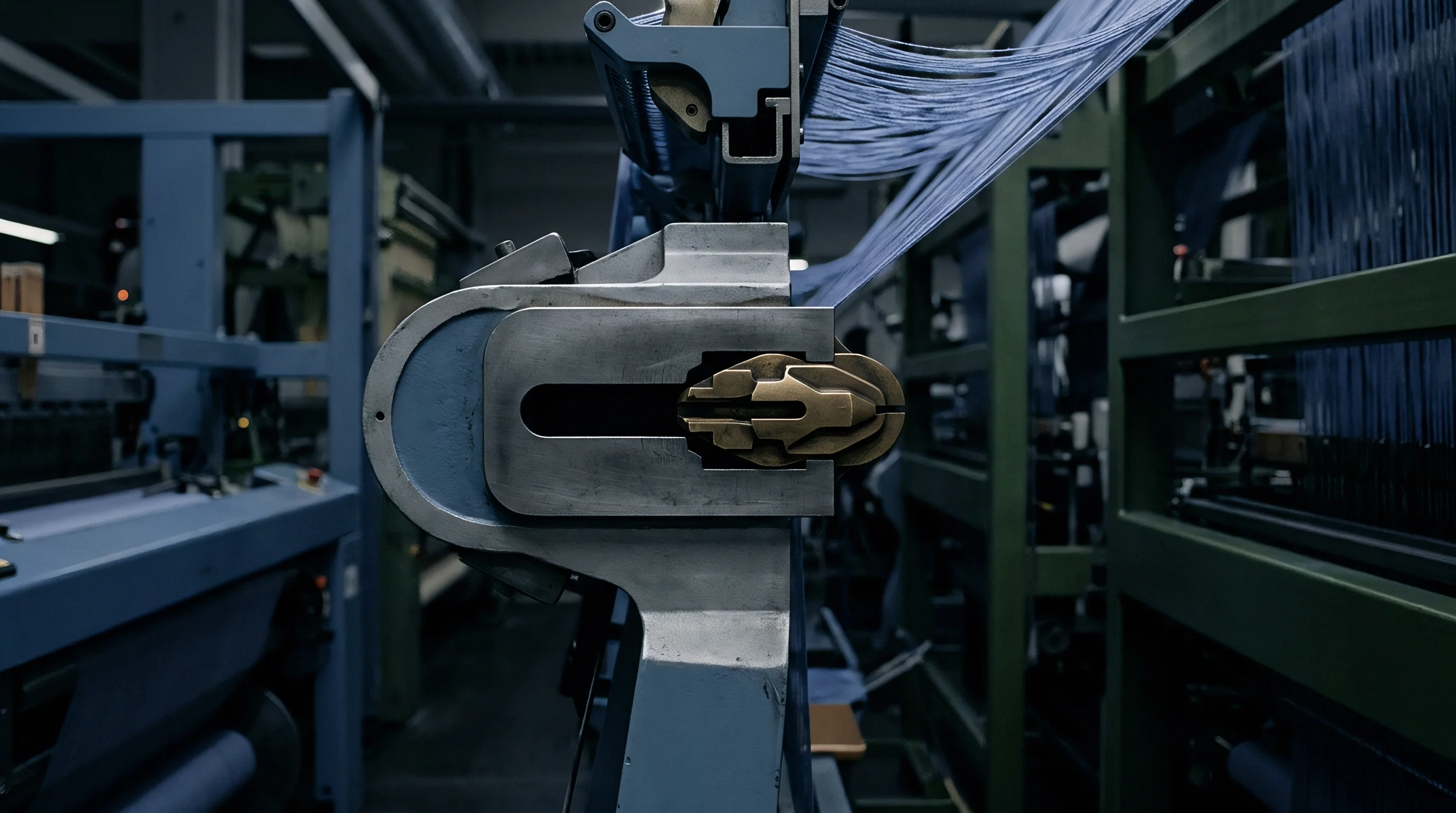
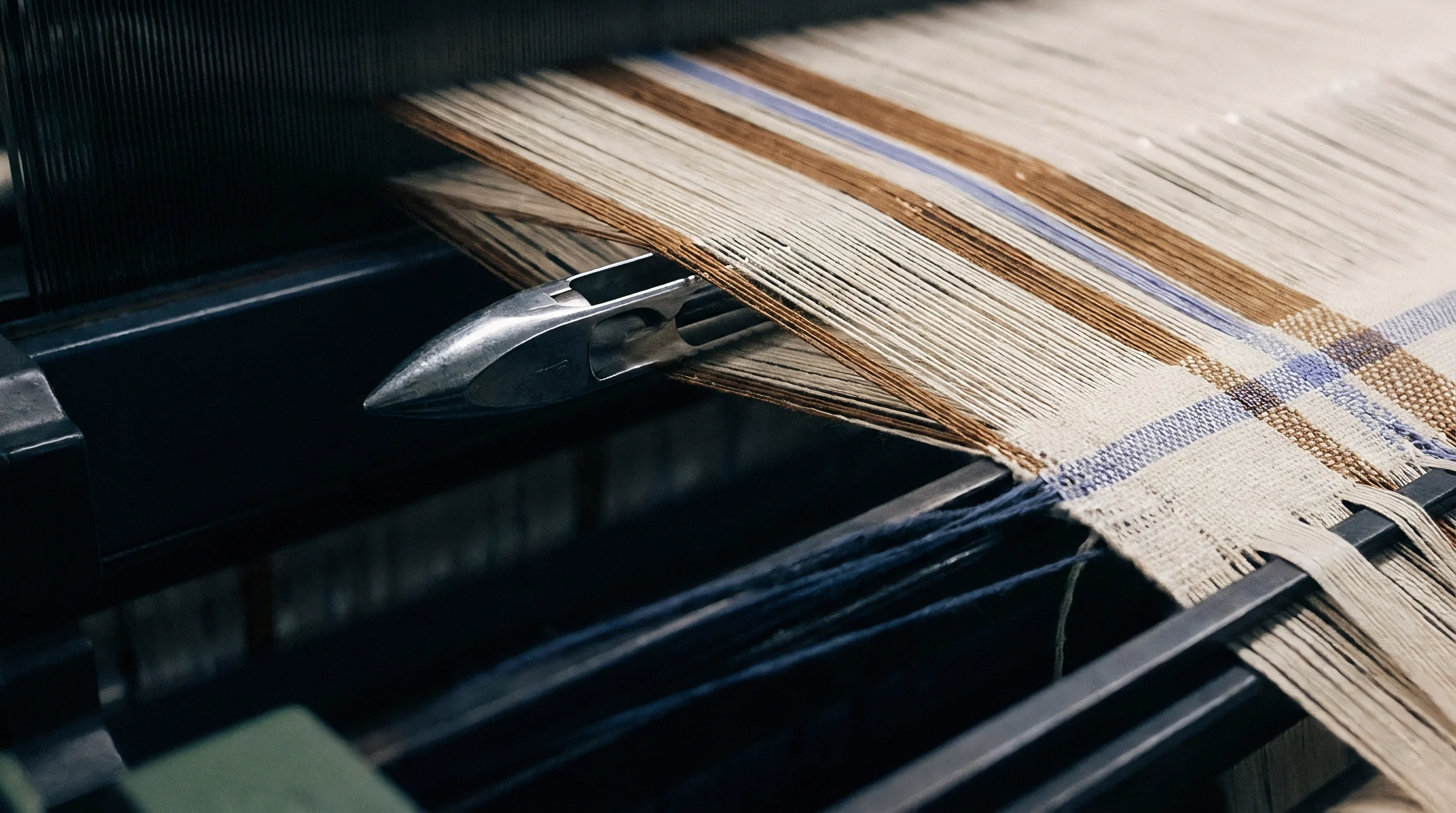
Warp tension adjustments on high-speed air-jet and rapier weaving machines directly alter grey fabric crimp balance and jam density. Beat-up force crushes fine yarns. Tension spikes break warp threads.
When weaving fine broadcloth near the theoretical jamming limit, the beat-up motion of the reed must drive filling threads into an extremely tight shed against high structural resistance. High beat-up resistance creates reed marks, filling stops, and uneven pick spacing across the cloth width.
Positioning the backrest roller above the level plane creates asymmetric shed tension during weaving. Higher tension on the closed shed line forces warp crimp to transfer into the filling yarn during beat-up. Crimp differential between warp and filling yarns determines how much the grey cloth will contract when removed from loom tension.
Fabrics woven with elevated warp tension exhibit low warp crimp off the loom, leaving high latent energy for warp-way shrinkage during subsequent wet processing operations.
Beat up Resistance and Shedding Stress
Exceeding 95 percent of theoretical jammed density dramatically increases mechanical load on reed wires and warp yarns. Air-jet weaving machines operating at 800 picks per minute require precise shed timing to prevent pick bounce when inserting fine filling yarns into jammed constructions. Off-loom contraction immediately reduces cloth length while increasing pick density per inch relative to reed density calculation.
Warp thread breakage rates rise exponentially when beat-up resistance forces yarn displacement against tight shed openings. As filling yarn density approaches the structural packing limit, reed wire deflection increases, causing uneven striping along the warp direction. Optimizing dwell time and adjusting heddle frame stagger allows filling picks to settle into the interlacing points before maximum reed pressure applies, mitigating mechanical damage to fine combed yarns.
- Backrest Height Elevation elevates upper shed tension to open inter-yarn gaps for filling insertion.
- Heddle Stagger Adjustment separates warp sheet arrival times at the fell, reducing instantaneous peak beat-up force.
- Asymmetric Warp Shedding increases filling crimp uptake while holding warp threads under flat linear extension.
- Reed Air Pressure Calibration prevents filling pick rebound when driving fine yarns into jammed fell boundaries.
Incorrect estimation of loom beat-up capacity on jammed broadcloth constructions results in widespread reed mark defects, uneven pick densities across the cut, and catastrophic warp end breakage rates that reduce weaving shed efficiency below 75 percent.

Swell
Water forces cotton fibers outwards. Swelling alters yarn spatial occupancy. Immersing greige cotton broadcloth into aqueous baths causes immediate transverse fiber swelling without significant longitudinal length changes.
Cellulosic fibers absorb liquid, expanding their cross-sectional area by 14 percent to 22 percent during standard scouring and bleaching. Fiber transverse expansion increases yarn diameter, reducing space between adjacent threads inside the woven matrix.
In a broadcloth construction woven near its greige jamming limit, yarn expansion forces adjacent threads into hard lateral contact inside the aqueous liquor. Inter-thread space disappears completely. Because cotton fibers expand outward, yarn diameter increases by 8 percent to 12 percent during aqueous processing.
Expanded yarn diameters force the interlacing threads to take longer, more circuitous paths around each other, driving dramatic increase in fabric crimp.

Caustic Mercerization and Hydrophilic Expansion
Mercerization using sodium hydroxide solutions between 26 and 30 degrees Baumé (220 to 260 grams per liter NaOH) at 15 to 20 degrees Celsius transforms cotton fiber morphology from kidney-bean profiles to circular cross-sections. Transverse fiber area expansion reaches 40 percent to 50 percent during full caustic swelling. Circular fiber profiles pack more densely inside the yarn structure, but total yarn diameter increases substantially under tensionless state.
Chainless and chain mercerizing ranges exert high directional tension to control dimensional changes during caustic exposure. Chain mercerizers hold fabric width via clip chains while applying longitudinal draft, counteracting swelling-induced crimp increase. Chainless mercerizers rely on curved expanding rollers and surface contact drums, allowing partial transverse relaxation while holding longitudinal control.
Inadequate tension control during caustic swelling locks high crimp levels into the fabric structure permanently.
| Processing Stage | Caustic Concentration (g/L NaOH) | Fiber Area Increase (%) | Yarn Diameter Increase (%) | Crimp Shift Differential (%) |
|---|---|---|---|---|
| Aqueous Scour | 0 | 16.5 | 8.2 | +2.1 |
| Mild Mercerization | 180 | 28.0 | 11.4 | +4.5 |
| Full Mercerization | 240 | 42.5 | 15.1 | +7.8 |
| Caustic Neutralization | 0 (Rinse) | 31.0 | 12.8 | +6.2 |
Caustic mercerization expands yarn diameters beyond greige spatial limits, causing severe structural buckling when broadcloth grey construction lacks adequate inter-thread clearance.
- Buckling Creases appear as permanent longitudinal rope marks when broadcloth expands laterally beyond physical flat packing limits during rope-form scouring.
- Selvedge Curling occurs when higher warp crimp at fabric edges drives differential transverse swelling rates relative to the central cloth body.
- Density Banding arises from uneven caustic penetration across jammed thread intersections, creating localized variations in yarn cross-sectional expansion.
- Pin Tear Defects develop at stenter enter chains when wet broadcloth contracts under high force against mechanical holding pins.
Aqueous processing of cotton broadcloth increases yarn diameter by up to fifteen percent, converting spatial clearance into structural crimp strain.
Finishing suppliers frequently attribute post-mercerization edge bowing to loom skew rather than acknowledging that grey thread density exceeded transverse swelling limits in the caustic bath.
Contraction
Crimp must migrate during washing. Excessive tension locks crimp movement. Wet processing dimensional changes result directly from the release of stored weaving strains and the migration of yarn crimp under swelling pressures.
Continuous bleaching, washing, and dyeing ranges subject broadcloth to longitudinal machine tension. Machine tension pulls warp yarns straight, stretching warp length while forcing filling yarns to bend more sharply around warp threads, a phenomenon known as crimp exchange.
Crimp exchange transfers dimensional relaxation from one thread direction to the other. Pushing warp crimp down from 8 percent to 4 percent under stenter machine tension forces filling crimp up from 6 percent to 12 percent, reducing fabric width. If broadcloth is dried under continuous longitudinal tension without mechanical overfeed, latent warp contraction remains trapped inside the fabric structure.
Subsequent domestic laundering under ISO 5077 releases this trapped strain, resulting in severe residual warp shrinkage.

When Does Crimp Exchange Exceed Washing Allowance?
Crimp exchange exceeds standard washing allowance when greige warp cover factor exceeds 0.60 and wet finishing tension pulls warp crimp below its natural geometric equilibrium state. Under ISO 6330 laundering procedure 4M at 40 degrees Celsius with tumble drying, broadcloth attempting to re-establish spatial equilibrium contracts until warp and weft crimp reach thermodynamic stability. If finished warp crimp was artificially suppressed during stenter drying, residual warp shrinkage exceeds 5 percent.
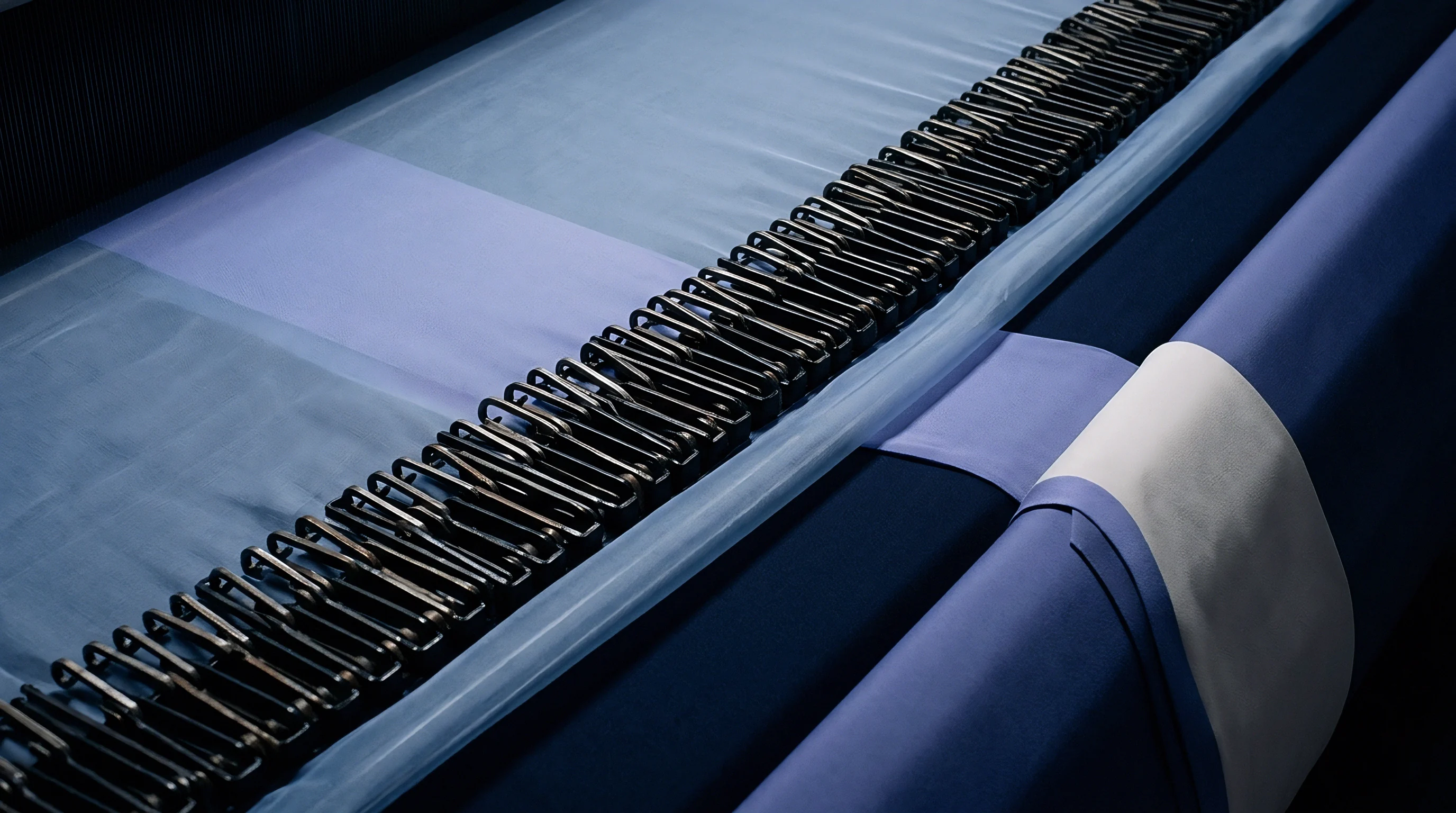
Mechanical Sanforizing or rubber-belt compacting forces warp contraction prior to garment cutting. Compacting machine operators feed wet fabric onto an expanded rubber belt that contracts upon relaxing, mechanically driving warp yarns into a higher crimp state. Maximum compaction capacity for fine combed broadcloth ranges between 6 percent and 10 percent.
When combined greige density and swelling-induced crimp demand exceed 10 percent compression, compacting machines induce surface ripples and diagonal distortion rather than smooth contraction.
- Immerse sample in standardized surfactant solution at 20 degrees Celsius for 30 minutes to eliminate wet processing tension memory.
- Extract excess water via low-g centrifuging without mechanical twisting or wringing.
- Dry fabric flat on vacuum tables under zero-tension conditions to establish baseline geometric equilibrium state.
- Measure warp and filling bench mark distances under standard atmosphere conditions per ISO 139.
- Calculate absolute spatial crimp equilibrium percentage for warp and filling thread systems.
ISO 5077 testing demonstrates that finished broadcloth dried under excessive warp tension re-absorbs moisture and shrinks until natural crimp equilibrium restores.
Whether stenter mechanical overfeed can compensate for structural jamming without inducing diagonal fabric spirality remains contested between weavers and wet processors.

Tolerance
Calculating grey-to-finished specifications requires accurate prediction of total dimensional change across all mill processing stages. Calculated setts prevent loom jamming. Shrinkage tolerances govern bulk approvals.
Target finished specifications dictate required thread counts, weight per unit area, and tensile performance. Reversing finishing contraction figures allows engineers to establish target grey construction parameters on the loom spec sheet.
Target finished broadcloth specifying 136 ends per inch and 72 picks per inch at 115 grams per square meter finished width of 147 centimeters requires precise allowance for finishing warp shrinkage and weft takeoff. Assuming 8 percent warp-way finishing contraction and 6 percent width contraction from reed width, grey construction calculation proceeds systematically through density and weight steps.
Worked Mathematical Matrix for Greige Calculation
A target finished broadcloth requires 136 ends per inch (53.5 ends/cm) and 72 picks per inch (28.3 picks/cm) using Ne 80/1 combed cotton in both warp and filling systems. Standard continuous wet processing (scour, bleach, mercerize, jet dye, and compact) yields an average 7.5 percent warp length contraction and 5.0 percent width contraction from grey off-loom dimensions.
Calculating off-loom warp density: 136 ends/in times (1 – 0.050 width contraction factor) equals 129.2 ends per inch off-loom. Rounding to standard reed availability gives 128 ends per inch on loom. Calculating off-loom pick density: 72 picks/in times (1 – 0.075 warp contraction factor) equals 66.6 picks per inch off-loom.
Rounding gives 66 picks per inch on loom.
Verifying jammed cover factors for proposed grey construction (128 x 66, Ne 80/1): Warp cover factor equals 128 divided by 28 times square root of 80 (8.944), yielding 128 / 250.4 = 0.511. Weft cover factor equals 66 divided by 250.4 = 0.263. Combined cover factor equals 0.774.
This grey construction resides safely below the theoretical circular yarn jamming limit of 0.905, ensuring clean weaving shedding and providing spatial volume for 15 percent yarn swelling during mercerization without buckling.
| Finishing Route | Greige Set (EPI x PPI) | Target Finished Set (EPI x PPI) | Warp Shrinkage Range (%) | Weft Shrinkage Range (%) |
|---|---|---|---|---|
| Route A (Continuous Bleach + Pad-Steam + Sanforize) | 128 x 66 | 136 x 72 | 6.5 to 8.0 | 4.5 to 5.5 |
| Route B (Jet Dyeing + Stenter + Rubber Belt Compact) | 128 x 66 | 138 x 74 | 8.5 to 10.5 | 6.0 to 7.5 |
| Route C (Low-Tension Jig Dyeing + Flat Dryer) | 128 x 66 | 132 x 70 | 3.5 to 5.0 | 3.0 to 4.0 |
| Test methods conform to ISO 5077 washing cycles at 40 degrees Celsius with stenter compaction settings adjusted for relaxed state. | ||||
- Greige Thread Count Verification confirms loom density before authorizing volume yarn spinning commitments.
- Finishing Route Alignment matches mill mechanical equipment capabilities to theoretical crimp exchange demands.
- Dimensional Stability Validation verifies residual shrinkage under ISO 5077 after three standard washing cycles.
- Weight Tolerances Specification bounds acceptable mass variance within plus or minus 3 percent of target grams per square meter.
Standard commercial contracts enforce a maximum three percent residual dimensional change allowance under ISO 5077 testing for fine broadcloth shipments.
Contracts specifying ASTM D3775 thread density tolerances without citing finishing route dimensional change factors fail to hold converters liable for off-spec broadcloth width drops.

Contract
Finished width dictates cutting yield. Uncontrolled shrinkage destroys garment fit. Translating structural broadcloth jamming limits into commercial supply contracts demands precise integration of grey construction metrics and finished dimensional stability guarantees.
Sourcing specifications must define technical parameters for both greige weaving mills and wet processing converters, establishing clear liability boundaries for off-spec fabric performance.
Master supply agreements require detailed annexes governing physical performance metrics. Dimensional stability under ISO 5077 laundering represents the central compliance metric for fine broadcloth. When grey fabric construction is woven too close to its theoretical jamming limit, wet finishing ranges cannot achieve required dimensional stability without severely over-stretching warp threads, storing latent strain that triggers customer chargebacks.

Commercial Specification and Penalty Triggers
Technical broadcloth purchase orders must stipulate maximum allowable residual shrinkage, typically set at 2.0 percent warp and 2.0 percent weft for premium shirting applications. Achieving these figures on jammed greige constructions requires wet processing mills to execute aggressive compacting passes. If greige cover factor exceeds 0.95, compacting machines create horizontal surface ripples known as compaction waves, rendering the fabric commercially unuseable.
Contracts must explicitly link greige fractional cover factor limits to finishing plant performance guarantees. When buyers supply greige broadcloth with combined cover factors exceeding 0.98, wet processing facilities should be contractually indemnified against failure to achieve 2.0 percent dimensional stability. Responsibility for width loss and surface distortion shifts to the greige construction designer when loom densities exceed physical jamming boundaries.
Dyehouse chargeback clauses activate when bulk lots exhibit dimensional variation exceeding published specification limits. Standard agreement terms mandate that fabric failing ISO 5077 stability checks undergoes re-compacting at the dyehouse expense. If re-compacting reduces usable cut width below the master purchase order minimum, the wet processor pays indemnity fees calculated directly from lost garment cutting efficiency.
Establishing audit protocols across independent weaving and finishing mills secures technical compliance before bulk cutting operations begin. Sourcing practices audit greige thread counts, inspect off-loom crimp differentials, and track caustic mercerization tension parameters across every production lot. Rigorous technical oversight ensures fine combed broadcloth delivers target weight, soft hand, and stable dimensions across commercial laundering cycles.