Dynamic Fluid Penetration Kinetics in Finishing Induced Pore Geometry Shift Models
Calendering and resin crosslinking shrink effective capillary radii by forty percent, requiring adjusted dynamic wetting models for hydrophobic barrier fabrics.

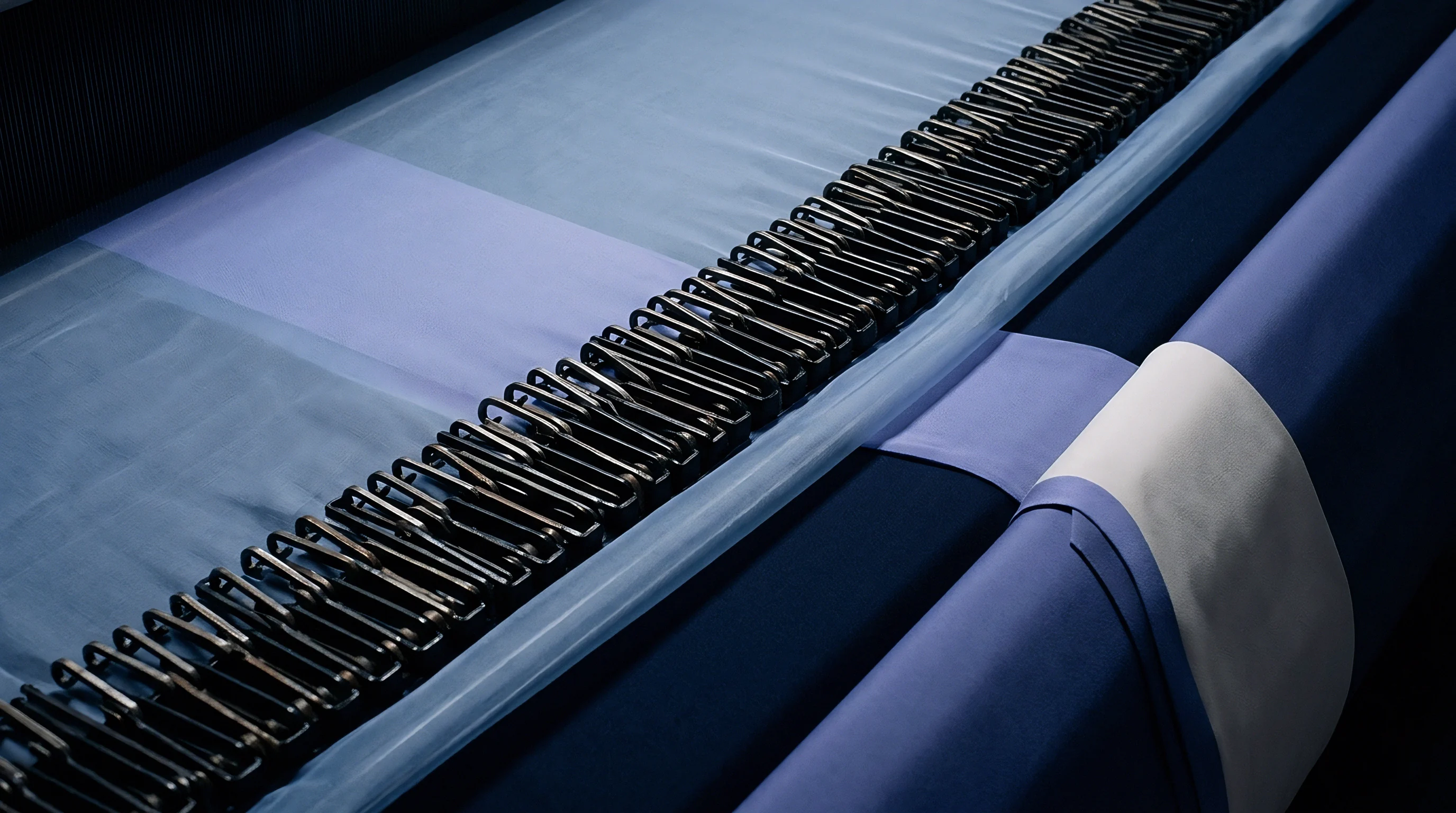
Aperture
Woven and knitted fabrics contain two distinct capillary networks: inter-yarn voids between crossing threads and intra-yarn gaps between individual filaments. In the raw greige state, this porosity follows a bimodal distribution. Inter-yarn macropores span 10 to 100 micrometres depending on warp and weft density, thread count, and weave pattern, while micropores within fibre bundles measure between 0.5 and 8 micrometres across.
Fluid absorption, wicking rates, and hydrostatic resistance all depend on how liquid moves through these dual pathways.

Inter-Yarn and Intra-Yarn Structural Duality
Large channels separate crossing yarn systems in greige goods, running alongside tight micro-gaps within filament bundles. Standard cover factor calculations based only on yarn diameters and end counts give an incomplete picture of total pore volume. Unfinished textiles offer minimal hydraulic resistance through their macropores, allowing rapid bulk flow, while capillary draw pulls liquid into the narrower inter-filament spaces where viscous drag governs transport.
Wet processing disrupts this layout through mechanical tension, thermal shrinkage, and chemical swelling. Mercerizing cotton or caustic weight-reducing polyester alters the yarn cross-section, while stenter heat setting fixes yarn paths and sets filament packing density. Together, these steps shift pore dimensions across the fabric, constricting macropores and either compressing or opening voids inside the yarn bundles.
Mechanical compaction flattens inter-yarn macropores while driving filament consolidation within intra-yarn capillaries.
Deformation Modes in Finishing
Compaction machinery reshapes yarn geometry by applying targeted heat and pressure across the moving web. High-pressure calendering presses round yarn bundles into elliptical profiles, thinning the fabric and reducing macropore height. Resin treatments deposit crosslinked polymers within intra-yarn channels, partially occluding gaps between filaments.
Fluorocarbon repellents coat fibre surfaces with a thin layer, altering wall contact angles without filling pore volumes entirely.
- Calender Flattening Compresses yarn cross-sections under linear mechanical pressure, reducing inter-yarn void volume while increasing path tortuosity across the fabric plane.
- Chemical Resin Deposition Deposits crosslinked polymer networks within intra-yarn spaces, reducing effective capillary radii and altering local surface free energy.
- Thermal Stenter Compaction Adjusts warp and weft crimp distribution through controlled longitudinal overfeed, narrowing inter-yarn pore openings while increasing mass per unit area.
- Fibre Swelling Finish Introduces chemical agents that expand individual fibre diameters upon fluid exposure, dynamically contracting surrounding pore channels during liquid absorption.
These structural shifts dictate how liquids move through the fabric under static and dynamic heads. A smaller mean hydraulic radius raises the capillary entry pressure needed for fluid to penetrate, while lowering steady-state volumetric flux. Mapping these geometric changes is essential for predicting penetration kinetics in technical textiles.
Whether transient swelling during aqueous contact permanently alters intra-yarn filament spacing remains an open question among textile rheologists.
Transport
Capillary flow in finished textiles moves through irregular channels under shifting pressure gradients. The classical Lucas-Washburn equation models absorption by assuming straight, smooth cylinders with constant radii, but finished fabrics depart from that ideal. Real channels vary in cross-section, have rough surfaces, and show localized constrictions left by wet processing.
Lucas-Washburn Boundary Conditions
Absorption kinetics depend on the balance between capillary driving pressure and viscous drag. The Washburn relation defines penetration distance through time, viscosity, surface tension, effective pore radius, and contact angle. In calendered or resin-treated fabrics, however, the hydraulic radius shifts along the flow path, creating local pressure gradients and velocity changes that static models miss.
As a fluid front moves from open macropores into compressed intra-yarn micropores, the sudden drop in radius increases capillary pressure while sharply raising viscous drag. Compaction also lengthens flow paths, requiring a higher tortuosity factor to capture the three-dimensional route through the yarn. At the same time, patchy chemical finishing along filament walls produces local surface energy variations that disturb steady meniscus advance.
The modified penetration velocity accounts for variable pore radii and dynamic tortuosity across the fabric cross-section:
| Fabric Processing Stage | Mean Pore Radius (µm) | Pore Tortuosity Factor | Total Porosity (%) | Saturated Permeability (m²) |
|---|---|---|---|---|
| Unfinished Greige Goods | 14.2 | 1.18 | 68.5 | 4.2 × 10⁻¹¹ |
| Scoured and Heat-Set | 11.6 | 1.25 | 62.1 | 2.8 × 10⁻¹¹ |
| Hot Calendered (40 N/mm) | 4.8 | 1.54 | 44.3 | 5.1 × 10⁻¹² |
| DWR and Resin Finished | 3.9 | 1.68 | 39.8 | 1.9 × 10⁻¹² |
| Data measured on 100% nylon 6,6 high-tenacity 110 g/m² plain weave under ISO 15901-1 capillary flow porometry and ISO 9237 test conditions. | ||||
Dynamic Contact Angle and Fluid Velocity Decay
Initial wetting depends on the instantaneous interfacial energy at the capillary wall. Static contact angles measured on flat films give misleading inputs for kinetic penetration models; as liquid enters compressed fabric, the dynamic contact angle rises with front velocity following the Hoffman-Voinov-Tanner relationship. These high initial velocities steepen the dynamic contact angle, temporarily curbing net capillary driving force.
Hot calendering at 40 N/mm nip pressure reduces mean pore radius from 14.2 micrometres down to 4.8 micrometres in 100 percent nylon high-tenacity filament weaves.
Fibre swelling constricts channels progressively during aqueous penetration. When polar liquids reach hydrophilic synthetic or cellulosic fibres, polymer relaxation causes filaments to expand into adjacent voids, narrowing the effective hydraulic radius while wetting is underway. Penetration velocity therefore decays faster than the square-root-of-time relationship predicted by classical Washburn theory.
Applying static Washburn equations to finished barrier fabrics overestimates penetration rates by up to three hundred percent, skewing performance projections ahead of field qualification.

Nip
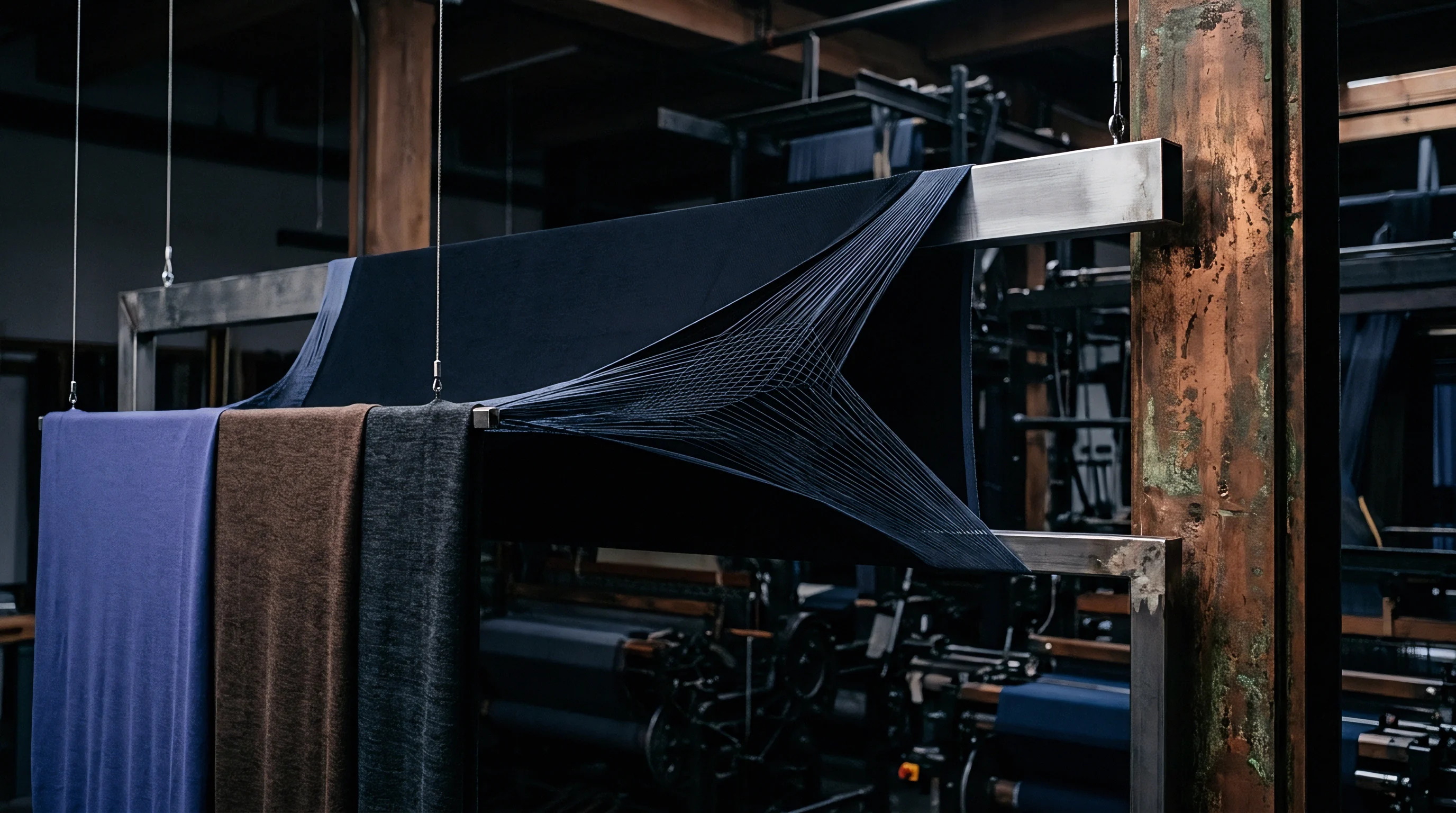
Calendering rolls apply compressive loads of twenty to eighty Newtons per millimetre across the moving web, flattening yarn cross-sections and packing filaments tighter inside the contact zone. Line speed, bowl surface temperature, and hydraulic roll pressure dictate the resulting pore geometry.
Thermal Compaction and Crimp Redistribution
Calender bowls operating above the polymer glass transition temperature permanently alter filament packing. Thermo-mechanical pressure flattens raised crown points, forcing warp and weft yarns into closer physical contact. This compresses the vertical clearance of inter-yarn macropores and smooths the fabric face, while stenter overfeed allows controlled relaxation that shifts crimp between yarn systems to dial in target density.
Applying crosslinking resins prior to calendering sets the flattened yarn geometry. Thermosetting dimethyloldihydroxyethyleneurea or melamine resins bond adjacent filaments, preventing relaxation during later laundering. The resulting capillary paths run through rigid, narrow channels with minimal wall elasticity.
Failure to meet ISO 9237 air permeability limits under a 100 Pascal test pressure voids the hydrophobic performance guarantee under commercial supply agreements.
What Shift Occurs in Capillary Force under High Wash Cycles?
Repeated laundering relieves internal yarn stresses, allowing compressed filaments to drift back toward their original positions. Mechanical action washes away weakly bound surface agents and opens partially blocked intra-yarn gaps, while surface abrasion disrupts fluorocarbon alignment on fibre walls. The resulting rise in surface energy and widening of pore radii steadily lower penetration resistance over successive wash cycles.
- Impregnate greige cloth in a pad bath containing crosslinking resin and fluorocarbon repellent chemistry at sixty percent wet pick-up.
- Pass the wet web through a multi-zone stenter frame at 160°C to achieve full water evaporation and preliminary polymer fixation.
- Feed the conditioned fabric into a steel-on-composite calender nip under forty-five Newtons per millimetre linear pressure at 175°C.
- Cure the compressed fabric in an indirect gas-fired oven at 180°C for forty-five seconds to lock crosslinked resin architecture.
- Condition finished rolls for twenty-four hours at twenty degrees Celsius and sixty-five percent relative humidity prior to quality testing.
Unexpected fluid barrier leakage often stems from uneven nip pressure across the roll width rather than raw yarn denier variance.

Wick
Capillary flow porometry tracks effective flow diameters before and after wet processing by measuring liquid displacement pressures across saturated fabric swatches. Combining porometry data with dynamic liquid absorption measurements allows fluid penetration rates to be calculated under controlled pressure differentials, while hydrostatic testing establishes baseline burst resistance.
Worked Penetration Kinetics Calculation
Evaluating a 110 g/m² nylon 6,6 plain weave calendered at 40 N/mm and 170°C illustrates the shift in intake kinetics. Taking a fluid surface tension of 0.072 Newtons per metre, dynamic viscosity of 0.001 Pascal-seconds, and an initial contact angle of sixty degrees, the uncalendered cloth presents an effective pore radius of 14.2 micrometres with a tortuosity factor of 1.18. Following hot calendering, the radius falls to 4.8 micrometres while tortuosity climbs to 1.54.
Applying the tortuosity-corrected Lucas-Washburn equation at a penetration depth of 100 micrometres highlights the operational trade-offs. In the greige material, capillary pressure reaches 3.04 kilopascals, producing an initial penetration velocity of 0.38 metres per second. In the hot calendered weave, the narrower radius drives capillary pressure to 9.00 kilopascals, but steeper viscous resistance and longer flow paths hold the net velocity down to 0.16 metres per second.
Dynamic fluid penetration velocity decays faster in micro-porous finished structures than in untreated greige fabrics due to progressive capillary radius constriction.
Capillary Porometry and Wetting Verification
Bubble point testing under ISO 15901-1 determines the pressure needed to clear wetting liquid from the largest through-pore, with higher values confirming macropore reduction after calendering or coating. Liquid Moisture Management testing under AATCC 195 measures directional absorption rates, tracking face and back wicking speeds alongside overall moisture management capacity.
| Finish Specification | Bubble Point Pressure (kPa) | Hydrostatic Head ISO 811 (mbar) | AATCC 195 Wicking Speed (mm/s) | Dynamic Penetration Time (s) |
|---|---|---|---|---|
| Untreated Plain Weave | 4.2 | 28 | 18.5 | 0.42 |
| Cured Fluorocarbon Finish | 8.6 | 145 | 2.1 | 4.80 |
| Calendered + Fluorocarbon | 22.4 | 380 | 0.3 | 18.50 |
| Calendered + PU Membrane | 85.0+ | 1500+ | 0.0 | 300.00+ |
Pairing hydrostatic head tests under ISO 811 with dynamic drop absorbency measurements under BS 4554 isolates pore size shifts from chemical surface effects. These verification protocols confirm that finished fabrics meet barrier thresholds without choking off specified air permeability.
- ISO 15901-1 Porometry Determines maximum and mean flow pore sizes by measuring gas displacement pressure through liquid-saturated test specimens.
- ISO 811 Hydrostatic Head Evaluates fluid barrier resistance by applying increasing distilled water pressure at sixty millibars per minute until breakthrough occurs.
- AATCC 195 Liquid Management Records electrical resistance shifts across concentric sensor rings to calculate dynamic liquid absorption and transport vectors.
- BS 4554 Drop Absorbency Measures time duration required for complete surface absorption of standardized liquid droplets under ambient laboratory conditions.
Specifying ISO 811 hydrostatic testing at a minimum rate of fifty millibars per minute alongside ASTM F316 pore size limits protects against low-pressure leakage in high-density outerwear fabrics.

Dossier
Commercial fabric contracts tie mechanical finishing parameters directly to fluid barrier tolerances. Procurement specifications require explicit operating windows for calender bowl temperatures, nip pressures, and stenter line speeds to preserve pore geometry across production runs. Looser controls introduce lot-to-lot variance in penetration rates, risking cutting-room rejections and field failures.

Technical Procurement Specifications
Supply contracts define acceptable air permeability ranges under ISO 9237 alongside minimum hydrostatic head limits under ISO 811. Strict tolerance windows keep converters from easing calender pressure or thinning chemical baths, while routine roll-to-roll testing catches pore drift before yardage accumulates.
Quality dossiers document chemical identities, wet pick-up rates, thermal curing profiles, and nip pressures. Binding these metrics to the purchase order establishes liability if bulk yardage fails dynamic barrier benchmarks, while on-floor finishing audits verify compliance prior to shipment.
- Finishing Process Envelope Mandates exact speed, temperature, and nip pressure boundaries to guarantee uniform pore size distributions across bulk mill runs.
- Physical Barrier Tolerances Establishes mandatory upper and lower limits for air permeability, bubble point pressure, and dynamic hydrostatic head performance.
- Chemical Pick-up Verification Requires bath concentration logs and pick-up percentage recordings for every production roll to verify surface energy uniformity.
- Wash Fastness Guarantees Specifies minimum acceptable fluid barrier performance levels after twenty-five standard domestic laundry cycles under ISO 6330 protocols.
Tight mechanical control at the calender bowl yields more consistent barrier performance than compensating with heavier fluorocarbon add-ons downstream.