Alkali Penetration Kinetics in Viscose Crepe Yarn Wet Processing
Caustic penetration kinetics govern torque release in high-twist viscose crepe yarns, where incomplete core swelling produces ring dyeing and dimensional instability.
Twist
Crepe yarns constructed from regenerated cellulose depend on torsional energy stored during high-twist spinning, where continuous-filament viscose or staple singles receive between 1,200 and 2,400 turns per metre. This severe rotation packs individual filaments into dense, helical geometries that resist chemical wetting. Filament alignment shifts from an axial orientation to angles exceeding thirty-five degrees relative to the yarn axis.
As twist multiplier values cross five, inter-filament void space drops below fifteen percent of the total cross-sectional area. The peripheral envelope of the yarn forms a compacted boundary layer while the interior retains dry, unswollen cellulose chains held under mechanical tension.
Water alone initiates slow partial recovery of torsional strain, but concentrated sodium hydroxide liquor accelerates radial swelling to trigger controlled untwisting and structural contraction. Industrial processing balances this mechanical discharge against chemical degradation. Viscose rayon dissolves in aqueous sodium hydroxide at concentrations between eight and ten percent by weight at ambient temperature.
Stable processing runs either below five percent sodium hydroxide or within mercerization windows exceeding sixteen percent where sodium cellulosate forms without complete molecular cleavage. The yarn cross-section presents an extreme packing density that delays alkali ingress toward the core.
| Yarn Count (dtex) | Twist Level (TPM) | Helix Angle (deg) | Packing Fraction | Specific Volume (cm³/g) |
|---|---|---|---|---|
| 83/24 | 2,200 | 38.2 | 0.81 | 1.08 |
| 110/30 | 1,850 | 34.6 | 0.78 | 1.12 |
| 167/40 | 1,450 | 31.1 | 0.74 | 1.18 |
| 330/60 | 1,150 | 28.5 | 0.69 | 1.25 |
Dry yarns introduced into open-width continuous washers or tensionless scouring vats encounter immediate resistance to chemical wetting. Entrapped air within the helical core cannot escape through the tightly wrapped outer filaments. Surfactants lower interfacial surface tension from 72 millinewtons per metre to below 30 millinewtons per metre to displace this air.
Wetting agents formulated with ethoxylated alcohols and sulfated fatty acids accelerate fluid displacement within the primary capillaries. When wetting chemistry fails to eliminate trapped micro-bubbles, the rate of alkali penetration drops by half. Tight yarn packages amplify this delay.
Low-tension transport conditions maintain yarn stability during rapid hydration steps.
Tension variations across the warp sheet during wet processing modify local packing geometry. Higher warp tension suppresses lateral swelling, locking the helical structure into an elongated state. Lower warp tension permits spontaneous axial shrinkage, widening inter-filament channels and accelerating fluid uptake.
Mills running viscose crepe woven fabrics on jig dyeing machines face severe edge-to-centre shade variation because selvages experience lower longitudinal strain than the fabric body. Uniform torque release demands identical mechanical boundary conditions across every linear metre of fabric.
Loose yarns swell freely while restricted yarns build internal hydraulic resistance.
Front
Alkaline transport into compacted viscose bundles follows anomalous non-Fickian kinetics governed by concurrent chemical reaction and swelling stress relaxation. The diffusion coefficient of the hydroxide anion in water measures roughly 5.27 × 10⁻⁹ square metres per second at 25 degrees Celsius. Within the regenerating cellulose gel, steric hindrance and chemical interaction reduce this figure by two orders of magnitude.
Hydroxide ions break interchain hydrogen bonds, converting native cellulose II into swollen alkali-cellulose complexes. This chemical transformation produces a sharp visual boundary between swollen outer filaments and the glassy yarn core.
Planar diffusion equations fail to describe the moving boundary inside highly twisted geometries. Penetration kinetics follow a Case II sorption model where the rate-limiting step shifts from solvent diffusion to macromolecular chain relaxation. The advancing chemical boundary moves at a constant velocity until the inward-propagating stress field reaches the yarn centre.
The reaction velocity depends on liquor temperature, caustic concentration, and instantaneous yarn diameter.
| NaOH Conc. (g/L) | Penetration Rate (µm/s) | Core Saturation Time (s) | Apparent Diffusivity (m²/s) | Sorption Exponent (n) |
|---|---|---|---|---|
| 25 | 1.45 | 48 | 1.8 × 10⁻¹¹ | 0.58 |
| 45 | 3.10 | 22 | 4.2 × 10⁻¹¹ | 0.72 |
| 75 | 0.85 | 82 | 0.9 × 10⁻¹¹ | 0.91 |
| 120 | 4.60 | 15 | 6.8 × 10⁻¹¹ | 0.84 |
| 180 | 6.25 | 11 | 9.1 × 10⁻¹¹ | 0.79 |
Temperature alters the diffusion rate through liquor viscosity changes and thermodynamic swelling equilibria. Lower bath temperatures enhance cellulose swelling power while reducing the kinetic energy of the hydroxide ions. Running an alkaline bath at 12 degrees Celsius produces extreme gelatinization of the filament skin, forming a dense barrier that chokes further liquor transport.
Raising bath temperatures to 40 degrees Celsius decreases swelling capacity, accelerating chemical transit toward the core without creating a gelatinous boundary. Dyehouse operations balance swelling magnitude against transit speed by stabilizing bath temperatures within a tight operational band of 20 to 24 degrees Celsius.
Electrolytes present in the processing bath alter the thermodynamic activity of water and sodium hydroxide. Dissolved salts compete for water molecules, modulating the hydration radius of the sodium cation. Industrial rinse baths carry residual sodium sulfate from acid neutralization steps, dampening alkali penetration velocity by raising liquor ionic strength.
Uncontrolled salt carryover from previous batch tanks alters core penetration times by up to thirty percent across identical production shifts.
The exact threshold where macromolecular chain disentanglement outpaces hydroxide transport under fluctuating liquor ratios remains open to empirical debate.

Pebble

Why Do Caustic Concentrations Invert Crepe Contraction?
Pebble formation represents the primary aesthetic objective in wet processing viscose crepe fabrics, occurring when yarn untwisting torque overcomes fabric weave friction to cause localized buckling. The physical topography of the finished surface directly reflects the depth and uniformity of alkali penetration during continuous boil-off. Incomplete core penetration leaves a stiff, untwisted structural skeleton that restrains fabric contraction, producing a flat, untextured pebble.
Symmetrical, complete chemical permeation allows unrestrained yarn uncoiling, yielding dense, three-dimensional surface nodes with high pebble height.
Caustic concentrations create an unexpected inversion in contraction behaviour due to cellulose dissolution dynamics. Between 60 and 90 grams per litre of sodium hydroxide, viscose filaments undergo maximum swelling and surface dissolution. Viscose loses structural tenacity in this dissolution window, dropping from 2.2 centinewtons per dtex down to 0.4 centinewtons per dtex.
The filament gel loses torsional stiffness, preventing the yarn from generating the elastic recovery force needed to buckle the woven structure. Contraction capacity collapses.
A twelve percent concentration of sodium hydroxide reduces yarn recovery torque below the mechanical threshold needed to buckle warp yarns.
Processing below 40 grams per litre or above 140 grams per litre preserves filament core integrity. At 35 grams per litre, the outer filaments swell moderately while the core maintains sufficient tensile modulus to transmit torque. The yarn discharges its stored twist against neighbouring warp and weft intersections, driving predictable pebble formation.
Above 140 grams per litre, true mercerization stabilizes the inner polymer chains into alkali-cellulose lattices without surface dissolution, preserving high recovery forces. The fabric shrinks rapidly in width and length, generating coarse, pronounced pebble grains.
Chemical relaxation lines follow strict mechanical requirements to translate yarn shrinkage into surface relief:
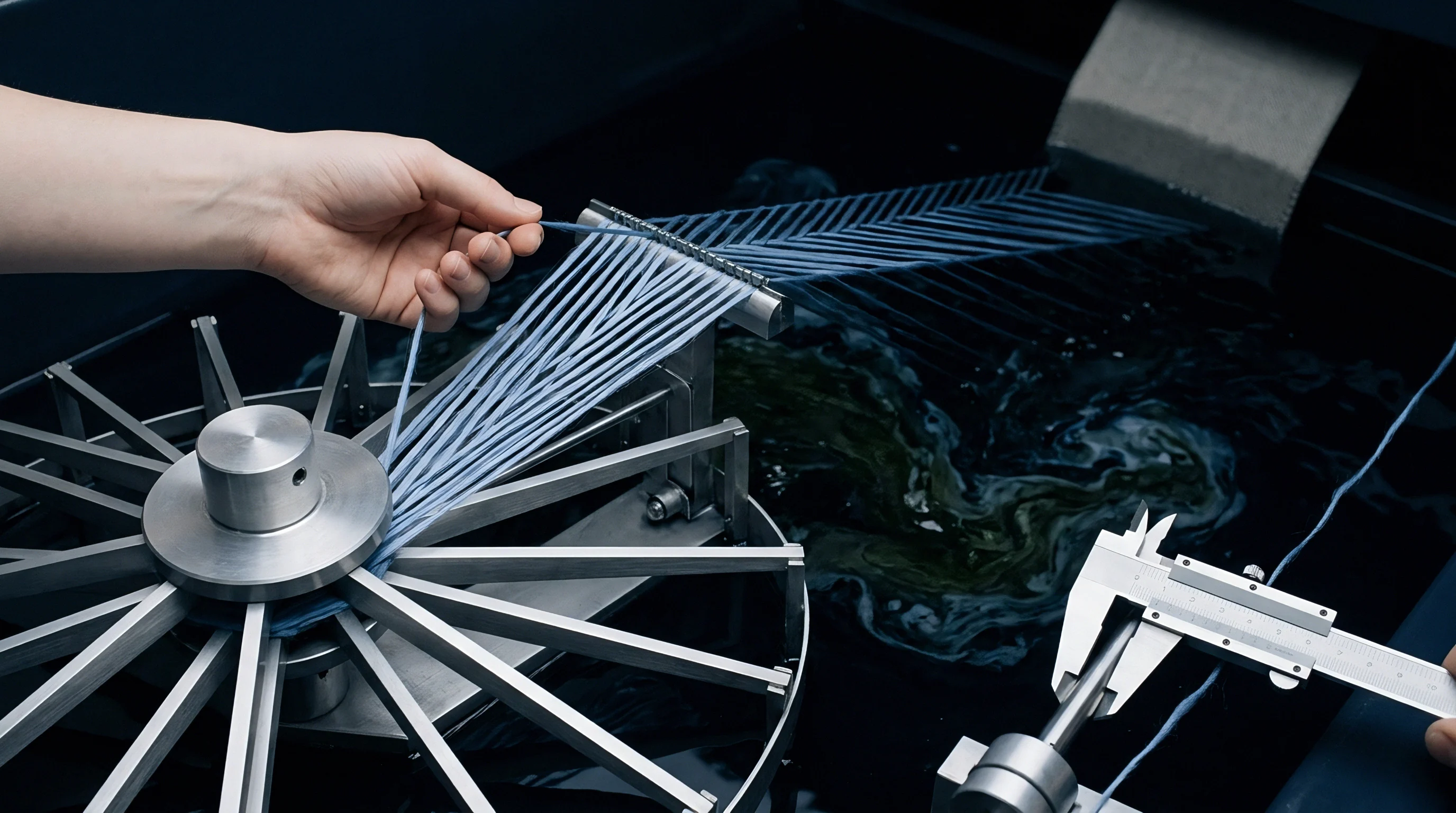
- Tensionless Fabric Delivery prevents premature warp extension before chemical wetting initiates relaxation.
- Counter-Current Spray Impregnation forces alkaline liquor through both faces of the open-width fabric simultaneously.
- Loop Conveyor Dwell Zones provide forty to sixty seconds of mechanical freedom while yarns undergo contraction.
- Cascade Washing Extraction removes residual alkali before fabric enters high-tension squeeze nips.
When fabric tension exceeds twenty newtons per metre during chemical contact, yarn uncoiling ceases and the textured grain disappears permanently.
Defect
Non-uniform chemical diffusion across the yarn cross-section generates severe structural defects that appear during subsequent dyeing and garment wear. Ring dyeing occurs when the core remains unmercerized while the sheath converts completely into alkali-cellulose. During reactive dyeing under standard conditions, unmercerized cellulose exhibits lower dye affinity and slower fixation rates than mercerized outer layers.
When yarns experience abrasion during garment washing or Martindale testing under ISO 12947-2, peripheral filaments abrade to reveal the pale, undyed core, creating frosted patches and premature rejection.
Differential shrinkage within single yarn bundles produces latent torque imbalance. Incomplete penetration leaves one-half of the filament count twisted and tensioned while outer filaments untwist and shorten. The resulting yarn structure contains internal shear stresses that cause edge curling and severe fabric skew after slit opening.
Woven twill crepes skew by ten to fifteen percent across the cutting table if alkali dwell time drops below twenty seconds on open-width washers.
Dyehouses encounter distinct physical manifestations of chemical diffusion failure across bulk production:
- Moire Striations originate from uneven nip pressure during pad-batch alkaline impregnation, causing localized variations in core swelling depth.
- Selvage Pinning Marks develop when edge guiders hold fabric under high tension, suppressing local untwisting while the centre contracts freely.
- Crank Barré Bands result from continuous washer stoppages where stationary fabric dwell exceeds nominal contact time by thirty seconds.
- Surface Fuzzing emerges after outer filament dissolution reduces fiber abrasion resistance below fifteen thousand Martindale cycles.
Under ISO 105-C06 wash fastness testing, unmercerized viscose cores release trapped reactive dyes, causing staining ratings to drop below grade three.
Batch-to-batch variation often tracks back to raw yarn twist consistency. Crepe yarn spinners operate within standard commercial tolerances of plus or minus five percent twist per metre. In a nominal 1,800 TPM yarn, this variance represents a spread of 180 turns per metre between yarn lots.
Higher-twist yarn packages resist alkali penetration five to eight seconds longer than lower-twist packages, resulting in optical barré across weft repeats that cannot be leveled by auxiliary chemicals during dyeing.
The processing mill claims that natural filament density fluctuations from spinneret wear account for all visible surface shading.
Margin
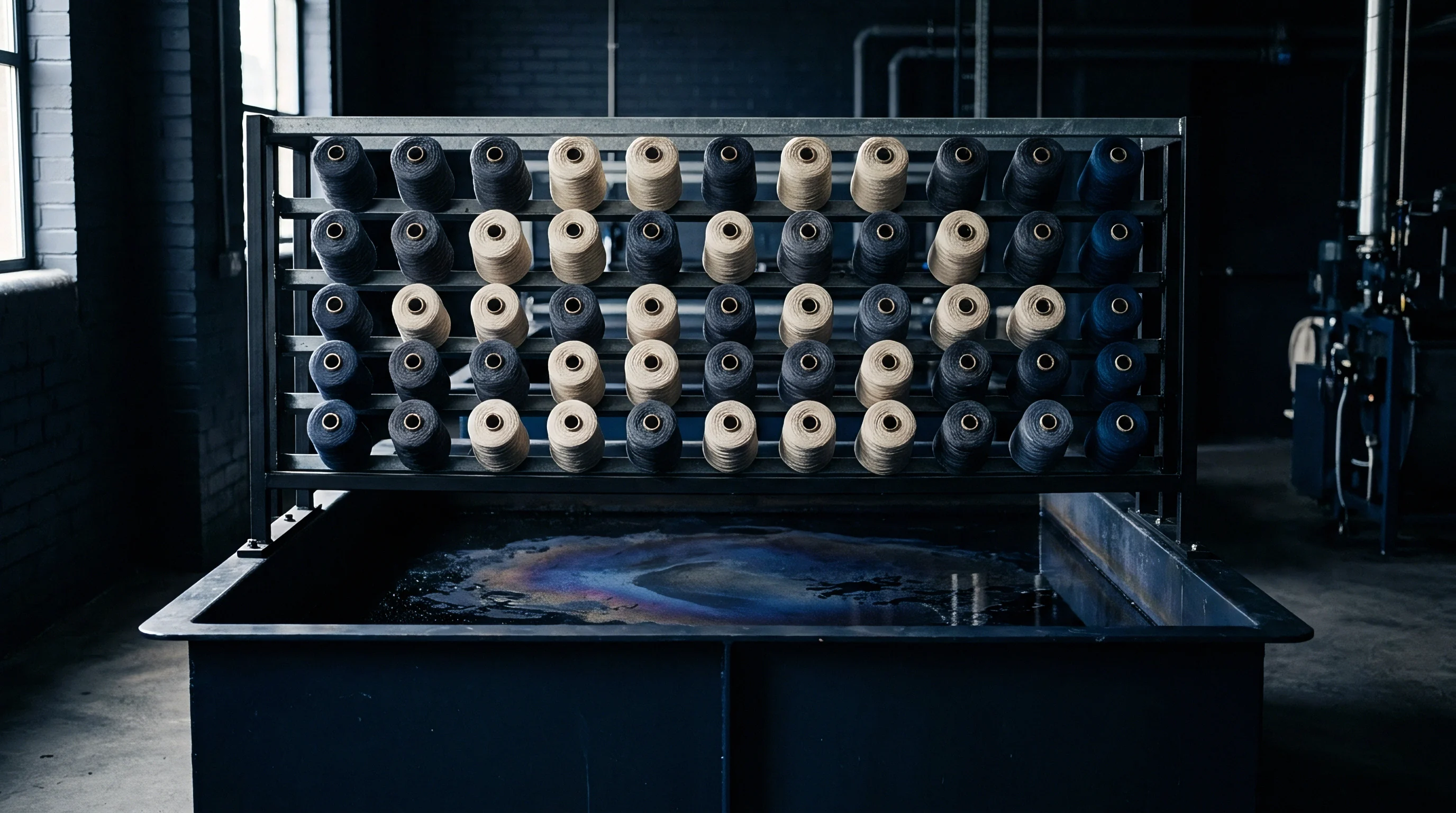
Commercial viability in viscose crepe wet processing depends on managing liquor consumption, dwell times, and chemical waste treatment costs. Sodium hydroxide represents fifteen to twenty percent of total chemical expenditure in a continuous preparation plant. Operating open-width relaxers at low liquor ratios reduces steam consumption but concentrates dissolved hemicelluloses and organic residues within the processing bath.
As bath viscosity climbs, liquor drag-out increases, raising caustic loss from 45 grams per kilogram of fabric to over 85 grams per kilogram.
Effluent treatment plants charge steep surcharges for high chemical oxygen demand and total dissolved solids. Neutralizing spent alkaline wash water requires roughly 1.25 kilograms of ninety-eight percent sulfuric acid for every kilogram of sodium hydroxide discharged. Facilities without caustic recovery systems pay between 0.12 and 0.18 USD per finished metre simply to neutralize and discharge preparation liquors.
Automated recovery systems utilizing multi-effect evaporators reclaim up to eighty-five percent of caustic streams, lowering chemical processing overhead by 0.09 USD per metre.
| Route Configuration | Speed (m/min) | Water Use (L/kg) | Chemical Cost ($/m) | Defect Rate (%) | Lead Time (Days) |
|---|---|---|---|---|---|
| Winch Beck Relax + Jet Dye | 18 | 45 | 0.38 | 4.5 | 12 |
| Continuous Relax + Cold Pad-Batch | 40 | 18 | 0.22 | 1.8 | 6 |
| Continuous Relax + Jet Dye | 35 | 28 | 0.29 | 2.4 | 8 |
| Jig Desize + Jig Mercerize | 22 | 22 | 0.31 | 6.2 | 14 |
Continuous open-width relaxation combined with cold pad-batch dyeing delivers optimal economic efficiency for bulk crepe production. Production speeds reach forty metres per minute while water consumption drops below twenty litres per kilogram of finished fabric. Cold pad-batch dyeing avoids the mechanical abrasion and filament fuzzing common to hydraulic jet dyeing machines.
Fabric runs flat without rope creasing, maintaining consistent pebble relief across thousand-metre production batches.
Audit standards on finished viscose crepe demand rigid dimensional stability parameters. Standard fabric specifications state shrinkage limits of three percent in both directions after three commercial laundry cycles under ISO 6330 method 4N. Achieving this stability requires complete alkali core penetration during preparation to exhaust latent yarn shrinkage prior to stenter heat setting.
Incomplete penetration leaves residual shrinkage exceeding eight percent, forcing converters to apply toxic cross-linking resins that reduce fabric tearing strength below fifteen newtons under ISO 13937-2 testing.
Procurement teams evaluate fabric weight and construction figures on finished goods conditioned under ISO 139 standard atmosphere. Unrelaxed greige fabric measuring 110 grams per square metre with 36 ends and 28 picks per centimetre contracts into a finished build of 155 grams per square metre with 48 ends and 38 picks per centimetre. Sourcing contracts specifying greige sett rather than finished construction allow mills to under-process goods, delivering insufficient pebble relief and latent dimensional instability that surfaces only in cut-and-sew assembly.