Continuous Pad Dyeing Shade Drift Control across Variable Humidity Wet Processing Routes
Dynamic control of ambient regain, pad bowl deflection, wet-bulb drying temperatures, and steam saturation halts continuous shade drift across variable weather.
Psychrometrics
Ambient air inside a continuous dyehouse acts on dry fabric well before the web reaches the liquor trough. Cellulosic and blended synthetic webs absorb atmospheric moisture until internal regain balances with hall conditions. A mill running cotton poplin at forty-five percent relative humidity feeds fabric holding roughly five point five percent moisture into the trough.
If that same mill operates during a summer monsoon at eighty-five percent relative humidity, greige rolls enter the pad nip at upwards of ten point five percent moisture. That unseen five percent jump in initial fabric moisture alters hydraulic pick-up mechanics at the souse roll, dilutes the liquor boundary layer, and can shift bulk color density by up to two units of shade depth before chemical fixation even starts.
Cellulosic fibers follow a hysteresis curve in which desorption and adsorption paths diverge. A roll stored in a humid staging bay pulls ambient water vapor into the amorphous regions of the fiber structure. When this damp fabric enters the dye bath, unbound water already occupies the capillary pore volume inside the cotton lumen.
Assuming a fixed liquor pick-up percentage based on dry weight no longer works. Dry fiber pulls dye liquor into its core by rapid capillary action; damp fiber must rely on slower liquid-liquid diffusion. As a result, more dye stays trapped in the surface film, vulnerable to migration during early thermal drying.
Seasonal shifts between dry winter months and humid summers drive pad-dry-thermosol and pad-steam lines into shade drift unless intake air is monitored continuously. Temperature swings alter both air density and moisture-carrying capacity in the air pulled into hot-flue pre-dryers and thermosol chambers. As the wet-bulb temperature in the hall rises, water evaporates more slowly from the moving web.
This delay keeps the fabric surface wet across a longer stretch of transport rollers, expanding the zone where particulate dye migration can occur.
| Fiber Type | Ambient RH (%) | Equilibrium Regain (%) | Target Wet Pick-Up (%) | Actual Wet Pick-Up (%) | Shade Drift (Delta E CMC) |
|---|---|---|---|---|---|
| 100% Combed Cotton Poplin (120 gsm) | 45 | 5.8 | 65.0 | 65.2 | 0.15 (Baseline) |
| 100% Combed Cotton Poplin (120 gsm) | 65 | 7.5 | 65.0 | 62.8 | 0.68 (Lighter) |
| 100% Combed Cotton Poplin (120 gsm) | 85 | 10.8 | 65.0 | 59.4 | 1.42 (Lighter/Tail) |
| 65/35 Poly/Cotton Twill (210 gsm) | 45 | 3.2 | 55.0 | 55.1 | 0.10 (Baseline) |
| 65/35 Poly/Cotton Twill (210 gsm) | 85 | 6.4 | 55.0 | 51.3 | 0.95 (Lighter) |
| 100% Viscose Rayon (140 gsm) | 45 | 11.2 | 75.0 | 74.8 | 0.22 (Baseline) |
| 100% Viscose Rayon (140 gsm) | 85 | 16.5 | 75.0 | 67.1 | 1.85 (Lighter/Streak) |
Maintaining stable bath concentration depends on a constant mass ratio between dry fiber and chemical volume. When damp fabric hits the trough, water inside the cell walls dilutes the dye bath right at the fiber boundary layer. Running wet fabric through an unadjusted bath yields an effective pick-up that looks lower on paper because weight gain is measured from a wet baseline rather than dry mass.
Actual dyestuff mass transferred per meter drops as greige moisture rises. Operators often try to offset this lightening by cranking up pad bowl squeeze pressure, compressing the yarn matrix and blocking core penetration without fixing the concentration drop.
Conditioning greige rolls in controlled staging areas is the primary defense against atmospheric drift. Moving heavy batching rolls directly from cold delivery trucks into an eighty-degree hall causes condensation across outer fabric layers. The outer fifty meters absorb excess moisture while the core stays dry, setting up head-to-tail shade drift before the batch even enters the trough.
Storing grey cloth in staging corridors held at sixty-five percent relative humidity and twenty degrees Celsius allows regain equilibrium to settle evenly throughout the roll.
Enclosed pad troughs with steam tracing stabilize dye temperature against plant floor drafts. Drafts across an open trough cause surface evaporation, cooling liquor locally and spiking concentration. A three-degree drop in bath temperature alters viscosity, increasing drag on the fabric face and changing film thickness pulled through the nip rolls.
Trough covers paired with micro-troughs holding under ten liters force rapid turnover, making sure fresh, thermally stable bath hits the web every few seconds.
Engineers often blame head-to-tail shade shifts on dyestuff hydrolysis or batching errors when the actual cause is an unmonitored drift in hall humidity over an eighteen-hour run.
Impregnation
Liquor transfer in the pad trough depends on dye solution instantly displacing air trapped within the yarn matrix. Entering the dip pan at speeds between forty and ninety meters per minute, the dry web drags a boundary layer of air along its surface. Dynamic wetting agents must break this air layer across an immersion distance often shorter than thirty centimeters.
Formulations typically rely on low-foaming anionic sulfosuccinate derivatives or non-ionic ethoxylated alcohols designed to bring surface tension below thirty dynes per centimeter in milliseconds.
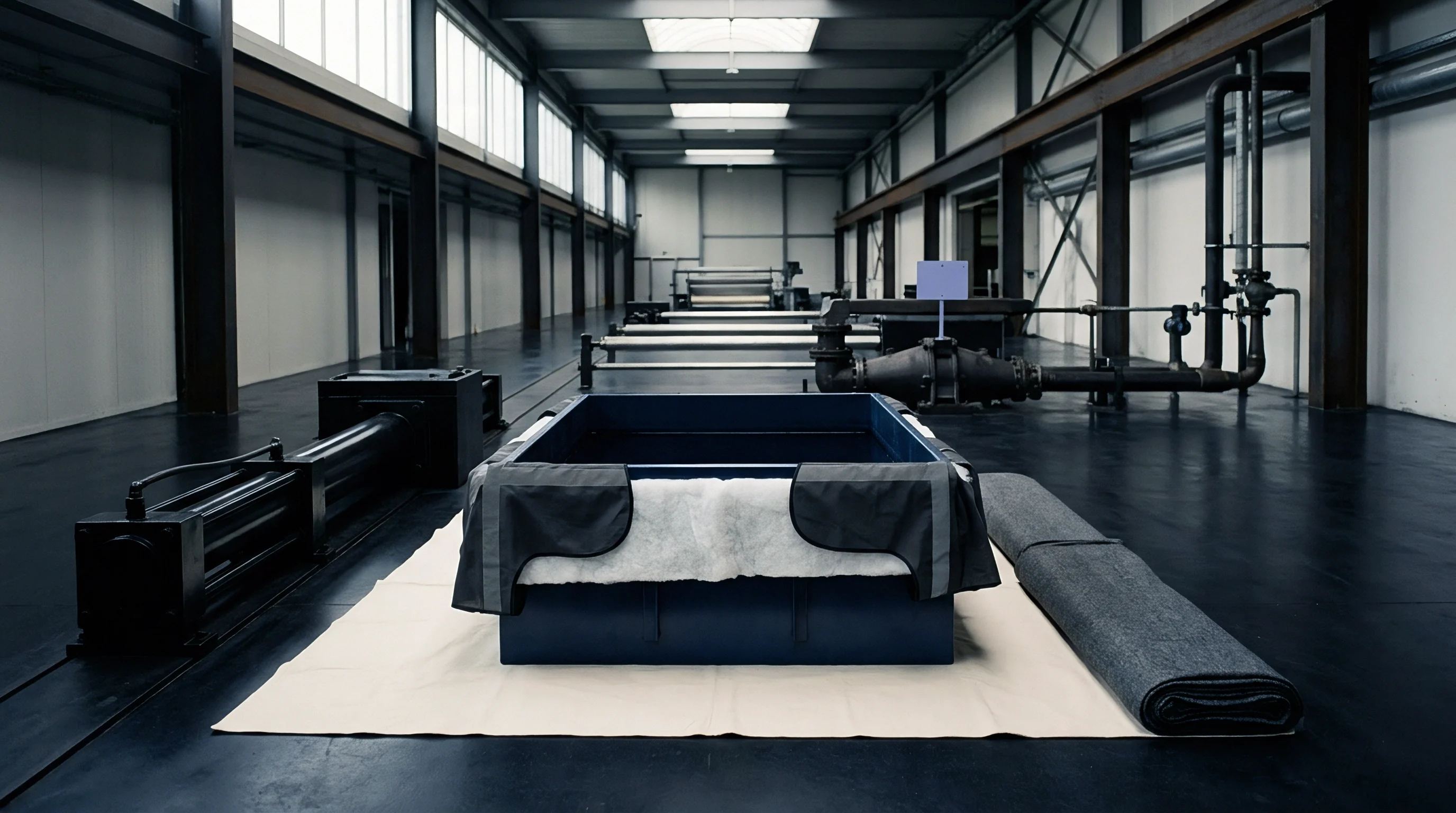
Squeeze rolls apply pressure to force chemical into yarn bundles while shedding excess liquid back into the trough. Bowl hardness, measured in Shore A, dictates the width of the nip contact zone under load. Soft bowls at sixty-five Shore A deform under pressure, creating a wide nip that increases dwell time but lowers peak stress.
Harder bowls at eighty Shore A concentrate force across a narrow strip, maximizing fluid extraction but risking surface damage on heavy canvas or dense twill weaves.
Bowl deflection under pneumatic load causes uneven liquor pick-up across the web width. Center-to-edge shade variation ~ manifesting as dark edges or a pale center ~ is a direct result of roll bending. Variable crown rolls, swimming rolls, or counter-deflection hydraulic systems correct this profile by applying internal fluid pressure against the roll shell.
Tuning these hydraulic pressure zones aligns the bowl’s deflection curve with the specific linear loading needed for a given fabric weight and width.
A three-bar adjustment in pad bowl nip pressure on a two-hundred-gram cotton twill alters wet pick-up by four point eight percent, driving a measurable shade shift of zero point eight Delta E CMC under D65 lighting.
Fabric structure dictates maximum fluid uptake during high-speed padding. High-pick poplins have tight inter-yarn spaces that slow liquid penetration, requiring higher concentrations of wetting agent. Open weaves absorb fluid quickly through large voids between yarns, but hold it loosely; under high nip pressure, fluid can blow out laterally across the sheet instead of penetrating the core.
Calculating cover factor and internal void ratio before setting line speed ensures uptake stays within the absorption limits of the specific loom-state construction.
- Verify pad bowl alignment using pressure-sensitive film passed through the dry nip at operational nip load.
- Check Shore A hardness across five points along the roll length to detect surface hardening or crown degradation.
- Measure dry fabric moisture content across the left, center, and right sides of the incoming web using high-frequency dielectric probes.
- Determine wetting time of the greige fabric according to ISO 8756 or AATCC Test Method 39 to establish baseline absorbency.
- Set pad trough liquor level controls to maintain bath renewal times under forty-five seconds at target line speed.
- Run a fifty-meter trial web, cut swatches immediately post-pad, weigh wet, dry fully at one hundred five degrees Celsius, and recalculate true wet pick-up percentage.
Liquor turnover rate in the trough governs chemical stability during extended runs. High trough volumes invite dyestuff tailing, where fibers deplete specific colorants faster than water, weakening bath strength over time. Compact troughs holding between five and fifteen liters force rapid turnover, replacing bath volume frequently.
This continuous refresh preserves concentration balance between fresh feed and active liquor over runs exceeding twenty-thousand meters.
Cold greige fabric entering a warm bath creates a thermal boundary layer that shifts viscosity and fiber swelling. Thermal equilibrium between fabric and liquor needs to happen before the nip. Installing pre-heating cylinders or infrared warming zones ahead of the trough raises web temperature to match the bath, preventing localized cooling and thermal-shock variations in pick-up.
Unequal yarn tension across the web opens or closes spaces between warp ends, causing localized pick-up variations and permanent lengthwise shade streaks.
Migration
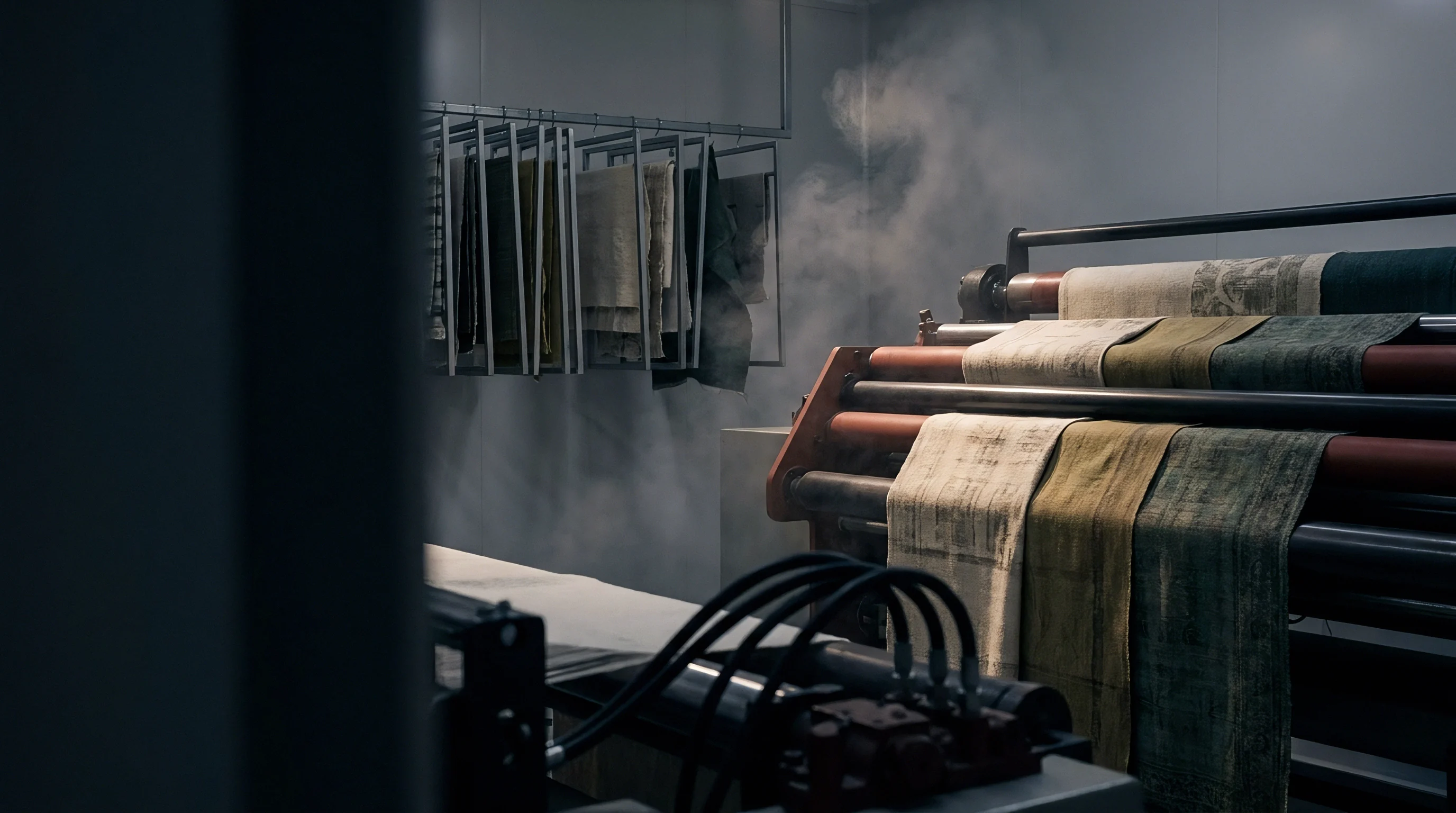
Surface evaporation during early drying triggers capillary flow from the wet fabric core toward heated outer faces. Unfixed dye particles suspended in the liquid move through these channels, gathering at the surface where vapor escapes. This movement ~ dye migration ~ alters surface colorant density, creating shade variation, surface frostiness, or face-to-back shade differences if drying is uneven across the web.
Why Do Wet Bulb Temperature Swings Drive Particulate Migration?
Wet-bulb temperature defines the thermal boundary of wet fabric during the constant-rate drying phase. As water evaporates, fabric temperature remains tied to the wet-bulb temperature inside the dryer, regardless of the dry-bulb setting. Humidity shifts alter this wet-bulb baseline, changing surface tension and liquid viscosity inside the web.
A higher wet-bulb temperature drops surface tension, accelerating capillary flow and speeding dye particle transport to the outer faces.
Infrared pre-dryers placed directly after the pad unit lock dye in place by rapidly lowering web moisture from eighty percent to forty percent without physical contact. Operating in the intermediate spectrum between two point five and three point five microns, non-contact infrared heats internal water directly. This uniform heating prevents sharp thermal gradients between core and surface, arresting capillary movement before the web reaches the hot-flue transport rolls.
Contract specifications for continuous polyester-cotton dyeing mandate intermediate non-contact infrared pre-drying down to thirty-five percent residual moisture before hot-flue entry to bound migration-induced shade variance below zero point five Delta E CMC.
Anti-migration agents added to the pad bath alter liquor rheology during early drying. Polyelectrolytes, sodium alginates, and cross-linked polyacrylates increase viscosity as water evaporates, turning the fluid into a gel at critical solids levels. This rapid gelation fixes suspended dye particles in the yarn matrix well before drying is complete.
Choosing an anti-migrant requires compatibility testing against the ionic charges of dyes, wetting agents, and bath auxiliaries to avoid premature coagulation.
- Face-to-back shade differential caused by asymmetric airflow velocities between upper and lower jet nozzles in the hot-flue drying chamber.
- Center-to-selvedge shade banding resulting from non-uniform infrared lamp intensity across the wide fabric web.
- Roller pickup contamination induced by fabric entering contact drying cylinders carrying excess residual surface moisture above forty-five percent.
- Particulate dye agglomeration driven by high thermal air velocities stripping water faster than the anti-migration gel network can form.
- Moisture bar shading stemming from localized exhaust duct blockages inside the intermediate dryer housing.
Hot-flue dryers require balanced air systems with frequency-inverter blowers to maintain equal static pressure above and below the web. Asymmetric airflow forces vapor out predominantly on one side, drawing unfixed dye toward that face and causing permanent face-to-back shade differences. Calibrating nozzle velocities with hot-wire anemometers keeps air pressure balanced within a two percent tolerance along the entire cabinet.
Drying capacity must adjust dynamically to changes in line speed and fabric weight. Running a light one-hundred-gram poplin right after a three-hundred-gram drill without rebalancing thermal zones subjects the lighter cloth to heat shock, causing rapid surface vaporization and severe dye migration.
A faulty exhaust damper in the pre-dryer can raise local wet-bulb temperatures enough to cause severe face-to-back color migration across batch rolls, as when an unmonitored damper shift on an orange workwear order triggered a twelve-thousand-dollar re-dyeing penalty across three rolls.
Vapor
Fixing reactive and vat dyes on cellulosic fibers inside continuous steamers requires saturated steam free of atmospheric air. Saturated steam supplies the heat needed to swell the cellulosic matrix and forms the condensate film that dissolves dye molecules for ionic reaction with hydroxyl groups. Ambient air drawn through entry slits drops the partial vapor pressure of water, driving dry-bulb temperatures above boiling and causing localized drying in the fixation zone.
Air entrainment in steamers poses a major thermodynamic barrier to uniform yield. Oxygen in entrained air oxidizes vat dyes back to their insoluble keto form prematurely, stopping fiber penetration and leaving pale, blotchy fabric. With reactive dyes, superheated steam caused by air ingress prevents proper condensation on the web, slowing reaction kinetics and cutting overall fixation yield by up to thirty percent.
Entry locks must use steam knives and positive internal pressure to purge boundary-layer air carried by the web.
| Steam Atmosphere Condition | Steamer Temp (°C) | Air Content (Vol %) | Fixation Yield (%) | Color Strength (K/S Value) | Fastness Rating (ISO 105-C06) |
|---|---|---|---|---|---|
| Saturated Saturated Steam | 100.5 | 0.0 | 88.5 | 18.2 | 4-5 |
| Saturated Steam (Minor Air Ingress) | 101.8 | 1.5 | 81.2 | 16.1 | 4 |
| Superheated Steam Condition | 105.0 | 4.2 | 69.4 | 13.8 | 3-4 |
| Deheated Low-Pressure Steam | 100.1 | 0.2 | 87.9 | 18.0 | 4-5 |
| Dry Steam / High Intake Draft | 108.5 | 8.0 | 54.1 | 10.2 | 3 |
Monitoring steam quality depends on continuous wet-bulb and dry-bulb readings inside the fixation chamber. In pure saturated steam at sea level pressure, dry-bulb and wet-bulb temperatures converge at exactly one hundred degrees Celsius. Any spread where dry-bulb exceeds wet-bulb indicates superheating or air ingress.
Modern pad-steam ranges use automatic desuperheaters that inject atomized condensate into incoming steam lines whenever temperature drifts more than zero point five degrees above saturation.
Fixation reaction kinetic rates for high-reactivity vinyl sulfone dyes drop by half for every two-degree rise in steamer dry-bulb temperature above saturated equilibrium conditions.
Eliminating urea from reactive dye pad formulations puts higher demands on steamer humidity control. Urea traditionally served as a humectant, melting in the steamer to create a liquid film that dissolved dye even under dry conditions. Strict nitrogen limits in wastewater have largely phased urea out.
Without it, fixation relies entirely on steam quality to deliver instant condensation, leaving no room for humidity swings in the steamer.
Roof heating elements in the steamer prevent condensate from dripping off upper panels onto the moving web. Dripping condensate washes out localized dye, leaving permanent light spots across finished rolls. Running roof coils twenty degrees above saturation stops overhead condensation without altering the steam profile around the lower transport loops.
How much atmospheric air ingress can web entry seals tolerate at line speeds over one hundred meters per minute before triggering measurable hydrolysis?
Metrology
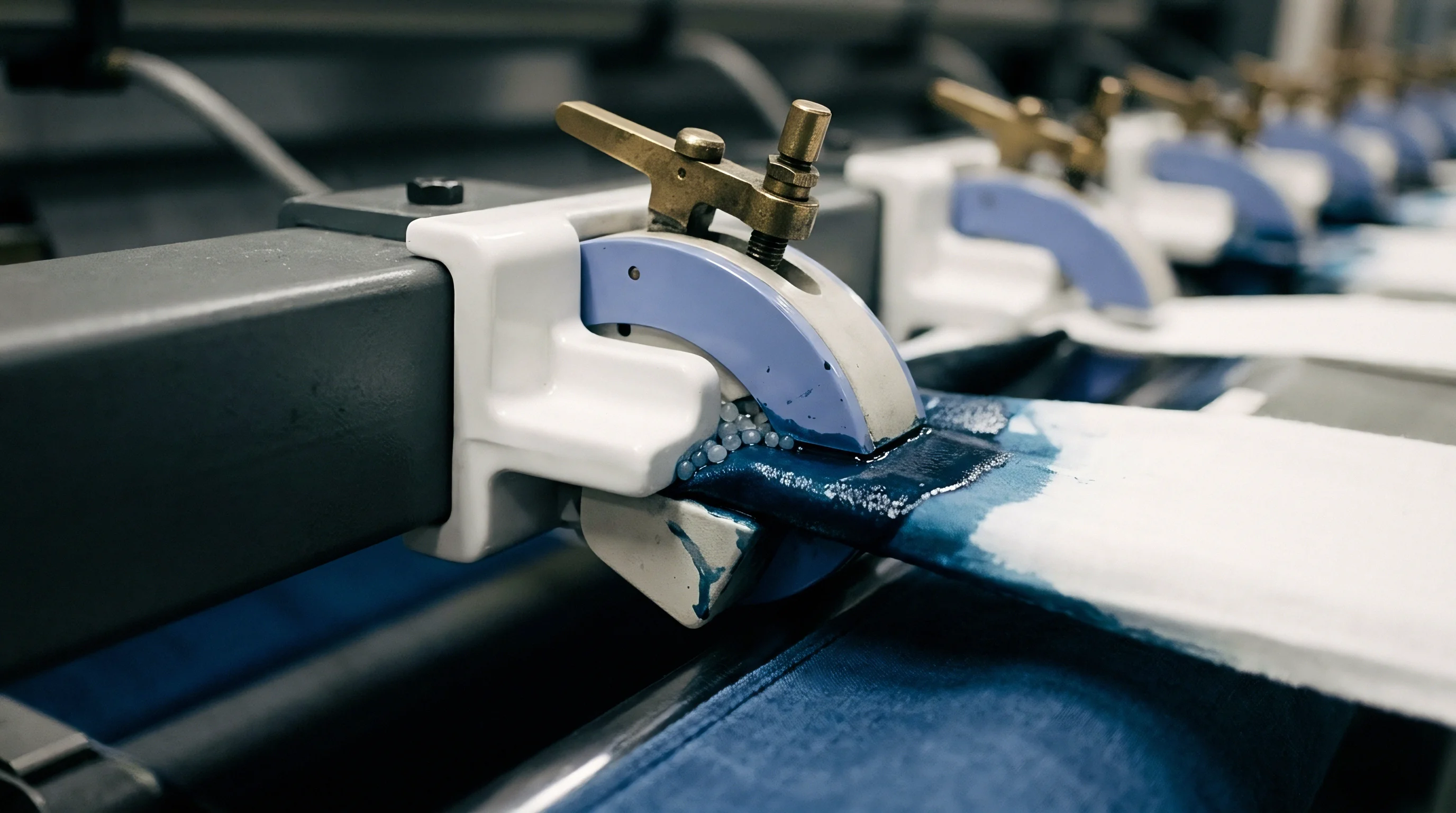
Closed-loop shade control depends on inline spectrophotometers mounted at the exit end of the range. Units built for wet processing use non-contact geometry, reading spectral reflectance across four hundred to seven hundred nanometers at full production speeds. Xenon flash pulses freeze web movement to gather data every few milliseconds, while optical height sensors adjust for web flutter and varying distances to the fabric surface.
Raw inline reflectance readings must be adjusted to predict final conditioned shade. Fabric exiting a stenter or thermosol unit is hot and bone dry ~ conditions that temporarily alter light absorption. Thermochromism causes many dye classes, especially direct and disperse dyes, to shift hue at high temperatures, while hygrochromism triggers further shifts as the fabric reabsorbs ambient moisture over the following hours.
Metrology systems run real-time algorithms that translate hot, dry spectral curves to standard conditioned baselines at twenty degrees Celsius and sixty-five percent relative humidity.
Moisture sensors mounted after the pad and dryer feed data directly into the range control loop. High-frequency microwave resonance sensors penetrate the entire web cross-section, measuring water mass per unit area regardless of fabric density or fiber composition. Positioning an array right after the squeeze rolls allows automated pneumatic pressure adjustments that correct edge-to-center pick-up imbalances before the web reaches the pre-dryer.
| Illuminant / Condition | Target Primary (D65) | Secondary (TL84) | Tertiary (A) | Metamerism Index (MI) | Action Threshold |
|---|---|---|---|---|---|
| Standard Commercial Garment | DEcmc ≤ 0.80 | DEcmc ≤ 1.00 | DEcmc ≤ 1.00 | MI < 0.50 | Accept / Pass |
| Strict Uniform / Tactical Spec | DEcmc ≤ 0.50 | DEcmc ≤ 0.60 | DEcmc ≤ 0.60 | MI < 0.30 | Accept / Pass |
| High-Risk Critical Matching | DEcmc ≤ 0.35 | DEcmc ≤ 0.45 | DEcmc ≤ 0.45 | MI < 0.20 | Accept / Pass |
| Out-of-Tolerance Drift | DEcmc > 0.81 | DEcmc > 1.05 | DEcmc > 1.10 | MI ≥ 0.51 | Flag / Hold Batch |
| Unrecoverable Metameric Failure | DEcmc ≤ 0.50 | DEcmc > 1.40 | DEcmc > 1.50 | MI ≥ 0.85 | Reject / Strip Bath |
Metamerism algorithms evaluate color matching across light sources to prevent batch failures under retail store lights. A recipe matched under Daylight 65 can flare noticeably under Store Fluorescent TL84 or Incandescent Tungsten A. Color management software calculates the index from spectral power distributions across all three illuminants, flagging formulations that exceed metameric limits before bulk bath preparation begins.
Online spectrophotometer integration operates under defined control parameters:
- Calibration protocol execution requires automated green-tile and black-trap optical baseline verification every four hours of continuous web operation.
- Averaging window selection must aggregate a minimum of fifty individual spectral flashes per linear meter of fabric to damp out structural weave surface reflections.
- Edge-center-edge sensor traversal speed must match line velocity to capture three-point transversal reflectance profiles every twenty linear meters.
- Temperature compensation mapping must apply real-time thermal coefficient corrections matching the specific dye class chemistry currently running on line.
- Automatic tolerance triggering must halt feed pumps and alert line engineers whenever trailing average shade drift exceeds zero point six Delta E CMC for more than fifteen consecutive meters.
Color difference calculations require CMC (2:1) or CIE2000 space rather than older linear CIELAB Delta E formulas. Linear CIELAB models treat color space as a uniform sphere, whereas human vision perceives color differences within irregular ellipsoids that vary across hues. Yellows and greens have tighter tolerance ellipses than deep navies or blacks.
Using DEcmc (2:1) establishes boundaries that mirror visual shade grading across the spectrum.
Commercial contracts typically specify that shade acceptance relies on ISO 105-J03 instrumental evaluation under D65 lighting at a ten-degree observer angle, replacing visual lightbox inspection as the legal baseline for compliance.

Allowance
Contracts for continuous processing should explicitly define liability for shade drift, yield loss, and re-dyeing allowances. When humidity swings push a line out of tolerance, deciding whether to strip and re-dye or sort and roll-select determines the margin on the order. Stripping reactive or disperse dyes degrades fiber tensile strength, consumes extra energy and water, and adds up to zero point forty-five Euros per meter in direct chemical reprocessing costs.
Shade sorting divides off-spec runs into usable groups to avoid total rejection. Color management software uses clustering algorithms to organize rolls into bands labeled Sub-Lots A, B, and C. Internal variance within each sub-lot stays tight ~ under zero point thirty-five Delta E CMC ~ so apparel plants cutting from a single sub-lot encounter no panel-to-panel shade variation. The buyer accepts the volume as long as the mill packs, labels, and ships each lot separately with clear cutting-room maps.
Technical dossiers submitted before bulk sign-off require specific processing documentation:
- Greige material certification documenting yarn blend ratio, fiber origin, loom state weight per square meter, and residual sizing chemical content.
- Ambient climate logs recording hourly relative humidity and dry-bulb ambient hall temperatures throughout the entire production run duration.
- Padding liquor records showing initial bath pH, bath density, wetting agent dosing concentrations, and total liquor turnover cycles.
- Spectrophotometric roll maps delivering complete edge-center-edge Delta E CMC data for every individual roll within the dye lot against the approved master lab dip.
- Fixation monitoring charts detailing steamer wet-bulb temperatures or thermosol chamber dwell times and zone temperature profiles.
Sourcing teams build seasonal shade allowances into purchase orders when placing production with unconditioned mills. Dyehouses in tropical areas without climate control see predictable yield losses during monsoon months. Factoring in a three percent yield buffer and adding seven calendar days to lead times during seasonal transitions protects cutting schedules from unexpected shade rejections.
Utility costs tied to steam and compressed air during dryer adjustments must be factored into the per-meter cost calculation. Running hot-flue exhausts at maximum capacity to offset high intake humidity increases gas consumption by up to eighteen percent per kilo of fabric. Tracking real-time energy use across processing lines allows cost targets to adjust dynamically, preventing margin erosion when weather forces mills to spend more thermal energy to hold shade.
Continuous line thermal energy consumption climbs by two hundred thirty kilojoules per kilogram of fabric for every ten percent increase in ambient air relative humidity inside the main dryer intake manifold.
Mills lacking psychrometric monitoring manage shade risk by requiring higher minimum dye quantities on custom colors. Larger runs give the line time to reach thermal and chemical equilibrium over the first thousand meters before production fabric is collected. When negotiating smaller minimums, buyers need to ensure the converter uses micro-troughs, automated inline spectro-controls, and climate-controlled greige bays to avoid heavy waste during range startup.
Process documentation recorded during bulk runs serves as the primary defense in quality disputes. If a buyer claims off-shade fabric on delivered rolls, comparing inline spectrophotometric maps against hall climate logs clarifies whether variances occurred in the mill or during handling at the garment plant. Solid operational data replaces subjective arguments, grounding commercial resolution in physical facts.