Wet Processing Relaxation Mechanisms and Laundering Stability Dispute Attribution
Laundering shrinkage disputes are resolved by measuring thread count shifts against fully relaxed state benchmarks to isolate mill draft from wash effects.
Rift
Laundering shrinkage claims originate at the cutting table when cut panels fail specification after garment wash, or at distribution centers when finished inventory alters size grades following initial domestic laundering. Greige dimensions deceive the cutter. The finished textile arrives meeting nominated weight per unit area and cuttable width, yet harbors latent mechanical strain induced by high-speed wet processing equipment.
When laundering introduces moisture, thermal energy, and mechanical agitation, internal stresses relax. The textile contracts toward its minimum energy configuration. Garment vendors routinely attribute this failure to aggressive retail laundering protocols or wet garment processing cycles.
Mills counter that laundry wash wheels exceeded permitted mechanical action or tumble dryer exhaust temperatures surpassed critical polymer glass transition points.
Attribution disputes turn on separating process-induced strain recovery from intrinsic fiber behavior. Relaxation shrinkage represents the spontaneous release of tensile elongations imposed during yarn formation, weaving or knitting, continuous scouring, dyeing, and stenter drying. Swelling shrinkage operates through transverse fiber diameter expansion, which forces yarn into steeper interlacing crimp paths even in strain-free structures.
In regenerated cellulose and cotton single jersey constructions, mills frequently mask severe yarn elongation by running stenters under high longitudinal tension to hit linear yield targets. This operational tactic maximizes billed yardage at the expense of structural stability.
Finished width and roll yield figures match purchase order sheets while concealing substantial latent longitudinal strain.
Determining liability requires establishing whether the delivered cloth retained excessive residual extension exceeding contractual tolerances under ISO 5077 and ISO 6330 standard procedures. A baseline tolerance of three percent length shrinkage in woven goods or five percent in circular knits represents an industry convention, but mills regularly deliver knits carrying twelve percent latent warp strain. When the cutting facility converts strained yardage into garments without prior relaxation conditioning, subsequent washing induces catastrophic dimensional collapse.
The resulting seam twisting, torque, and panel shortening expose the buyer to unsaleable inventory. Resolving the commercial fault requires tracing dimensional changes back to machine settings along the finishing line.
The dyehouse manager typically argues that all delivered rolls complied with agreed specifications when tested immediately off the inspection line, attributing subsequent garment shrinkage to excessive tumbling durations or improper water temperatures within the cut-and-sew laundering facility.
Nip
Mechanical tensions during continuous wet processing progressively stretch fabric along the machine direction. From the moment greige cloth enters continuous desizing, scouring saturators, and pad-steam dye ranges, driven guide rollers pull the wet assembly through fluid troughs. Stenter chains pull the filling.
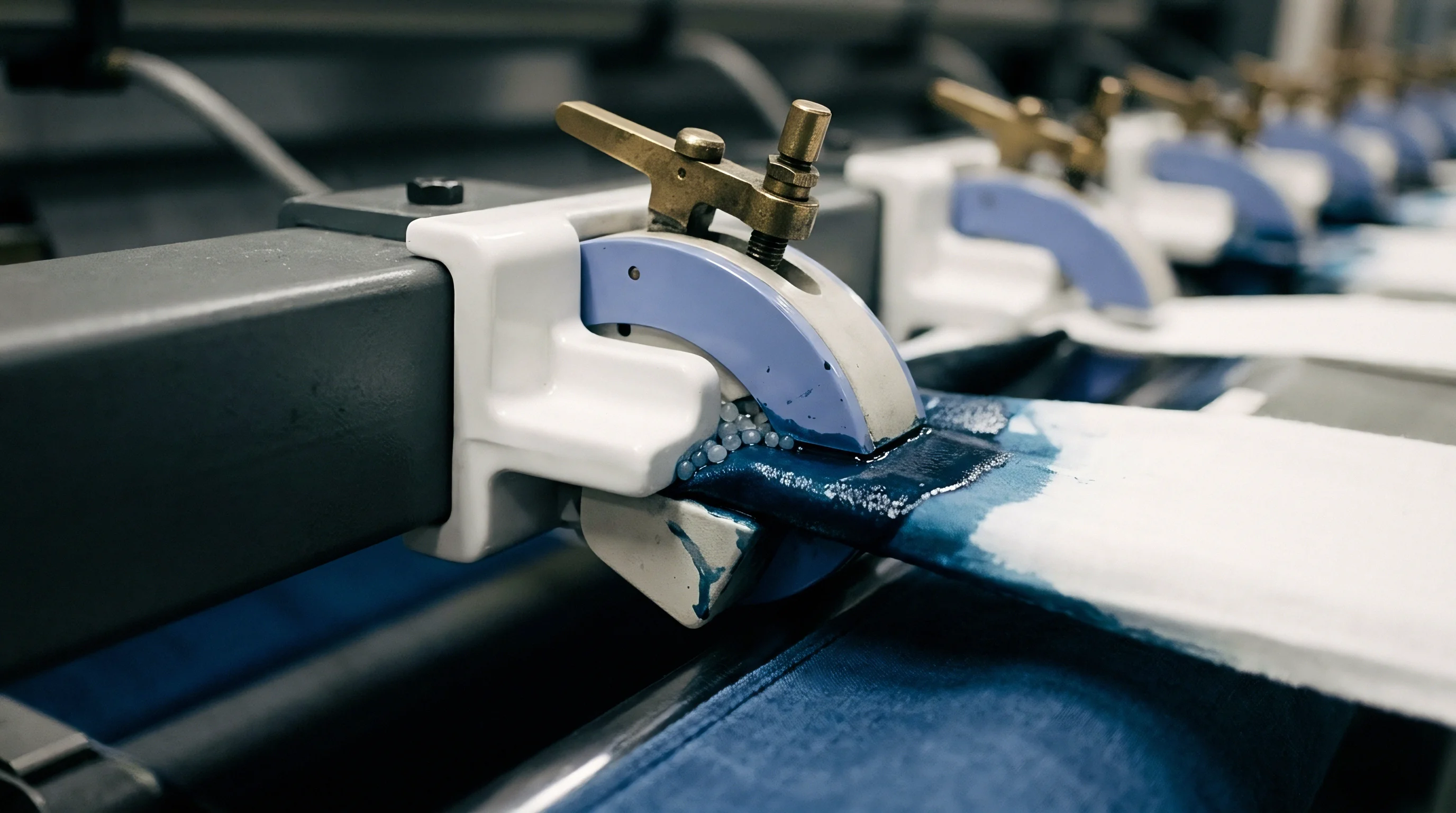
Squeeze roll pressures at padder nips generate longitudinal shear stresses. Saturated yarns exhibit lower inter-fiber friction, permitting yarn filaments to slip and elongate under line tensions that dry yarn resists without deformation. In single jersey and interlock knits, wet circular structures become ovalized under take-down reel pulls, establishing asymmetric internal strains before any chemical finish touches the fiber surface.
Jet dyeing vessels introduce alternating hydraulic impact and high-velocity transport nozzle draft. Fabric circulating through a jet venturi at four hundred metres per minute experiences cyclic longitudinal shocks every forty-five seconds. If the lifter reel surface speed decouples from cloth speed by more than three percent, friction drags the fabric rope, stretching wales and pulling loops into elongated, unstable configurations.
Subsequent wet processing units compound this distortion.
- Driven guide rollers introduce continuous longitudinal draw whenever motor synchronization drifts across successive wet treatment compartments.
- Squeeze padder nips exert high compressive forces that flatten yarn intersections while drawing the wet web forward under substantial linear tension.
- Lifter reel surfaces generate abrasive drag and warpwise elongation when peripheral rotational speeds exceed fabric rope transport velocities.
- Stenter entry rails grip fabric selvedges with pins or clips, applying acute cross-directional stretch that straightens filling yarns while drawing the machine direction taut.
Drying locks these unstable, elongated geometries into place. As moisture evaporates in drying ovens, temporary hydrogen bonds reform between adjacent cellulose polymer chains, or van der Waals bonds solidify between synthetic filaments. These crosslinks freeze the yarn in an extended physical state.
If the stenter operator runs insufficient longitudinal overfeed, the dried roll emerges with high frozen-in strain. Finishing tension creates latent instability. Water breaks temporary hydrogen bonds.
When the consumer submerges the fabric in water, hydration frees the trapped polymer chains, permitting elastic recovery of the original loop architecture.
A fabric dried under longitudinal tension retains that elongation as frozen strain until water breaks the temporary intermolecular bonds.
Compacting equipment counters this process strain by mechanically compressing yarn loops before winding. Rubber belt compactors for wovens and shoe or felt compactors for circular knits drive fabric against a retarding shoe or decelerating rubber surface, shortening warp spacing while increasing yarn crimp. Wet fibres swell radially.
Inadequate overfeed or worn rubber blankets negate this mechanical compaction. When a mill runs a compactor with excessive exit winder tension, the machine direction elongation re-enters the textile within two metres of the compaction zone.
| Processing Stage | Applied Tension Mechanism | Cumulative Warp Elongation Range | Subsequent Wash Relaxation Potential |
|---|---|---|---|
| Continuous Rope Scouring | Driven overhead reels and tight squeeze nips | 4.0% to 7.0% | 3.5% to 6.0% |
| Jet Dyeing And Uncurling | Nozzle pressure differential and lifter drag | 3.0% to 5.5% | 2.5% to 4.5% |
| Pad Mangle Softener Application | Differential roll speed and bath entry draw | 2.0% to 4.0% | 1.8% to 3.5% |
| Stenter Frame Without Overfeed | Pin rail transport under longitudinal draft | 5.0% to 9.0% | 4.5% to 8.0% |
| Stenter Frame With 25% Overfeed | Wave pinned overfeed into drying chambers | -12.0% to -18.0% | 1.0% to 2.5% |
| Rubber Belt Compactor | Compressive shrinkage zone retardation | -6.0% to -10.0% | 0.5% to 2.0% |
Compacting units operated with worn rubber belts produce inconsistent compaction along the length of an individual roll.

Cycle
Evaluating laundering stability requires separating initial relaxation from progressive structural shrinkage over consecutive wash cycles. Single-cycle wash tests conducted under ISO 6330 Method 4N at forty degrees Celsius with flat drying capture only a fraction of total residual strain. A single domestic wash cycle releases superficial surface tensions while leaving deeper yarn crimp adjustments incomplete.
Agitation accelerates internal energy release. Complete structural relaxation demands multiple consecutive washing and drying cycles to allow loop structures to reach energetic equilibrium.
Whose Baseline Sett Governs Relaxation Allowances?
Disputes frequently emerge over the baseline benchmark used to establish whether fabric meets dimensional criteria. Mills prefer calculating stability against greige dimensions, whereas garment brands evaluate performance against cuttable finished dimensions stated on purchase orders. Loop curvature seeks mechanical equilibrium.
Three cycles establish the plateau. In single jersey cotton knits, the Starfish model demonstrates that fully relaxed loop geometry conforms to fixed mathematical constants. The product of courses per centimetre and wales per centimetre divided by loop length squared approaches invariant values when internal strain fully dissipates.
If a delivered knit displays course counts twenty percent below its fully relaxed Starfish target, that deficit directly quantifies processing overstretch.
- Cut conditioned square fabric specimens measuring fifty centimetres by fifty centimetres along true yarn grainlines.
- Mark benchmark datum points exactly forty centimetres apart in machine and cross directions using indelible ink or sewn monofilament markers.
- Condition marked specimens in a standard atmosphere of twenty degrees Celsius and sixty-five percent relative humidity for four hours.
- Subject specimens to repeated wash cycles under ISO 6330 using horizontal drum front-loading machines with non-phosphate reference detergents.
- Tumble dry specimens according to ISO 6330 Procedure C at an exhaust temperature of sixty degrees Celsius until completely dry.
- Recondition specimens in standard atmosphere for twenty-four hours before remeasuring marked gauge lengths across three separate locations.
A multi-cycle test run under ISO 6330 Method 4N at forty degrees Celsius demonstrates that eighty percent of processing relaxation releases during the initial cycle while structural loop reassortment continues through cycle five.
Progressive shrinkage past the third wash cycle indicates structural instability or progressive yarn swelling rather than latent mill draft. Synthetic fibers such as polyester and polyamide exhibit negligible swelling shrinkage in warm water. Cotton, viscose, and lyocell absorb moisture heavily, causing fiber cross-sections to expand by twenty to thirty percent.
Dryers lock in temporary dimensions. This diametric expansion forces neighboring yarns to take a longer path around one another, producing macroscopic fabric contraction. Identifying whether shrinkage stabilizes by cycle three or escalates through cycle five distinguishes mill-induced draft from inherent fiber-yarn swelling mechanics.
Whether laboratory wash wheels replicate the variable mechanical tumble forces and line drying tensions found across commercial export markets remains an open technical challenge.

Gauge
Structural diagnostic analysis attributes shrinkage liability through quantitative thread geometry. When a finished fabric shrinks excessively in length while expanding in width during laundering, the defect stems directly from machine direction extension on the stenter frame. Stenter operators frequently pull length to meet weight specifications.
If a knitter produces single jersey twenty grams per square metre lighter than specified, the finishing dyehouse stretches the fabric in length and narrows the stenter width pins. This artificially lowers the weight per unit area to match the specification sheet while distorting loop aspect ratios.
Will Successive Launderings Isolate Mill Induced Strain?
Successive wash cycles confirm whether dimensional contraction represents reversible hygral adjustment or permanent mechanical relaxation. In woven cotton twills, warp yarn crimp measured via ASTM D3883 reveals finishing distortion. Cold water halts thermal relaxation.
Normal balanced three-by-one twill weaves exhibit warp crimp between eight and twelve percent alongside filling crimp between six and nine percent. When a mill runs a tenter range under excessive warp draft, warp crimp drops to four percent while filling crimp rises to fourteen percent. Subsequent laundering restores crimp balance, manifesting as eight percent warp shrinkage and four percent weft growth.
Offcut tests expose hidden draft. Course density drops during elongation.
A rigorous dispute attribution dossier integrates multiple fabric construction metrics taken before and after multi-cycle relaxation testing.
- Course and wale counts counted under optical magnifiers verify loop density shifts before and after relaxation washing.
- Warp and weft crimp percentages extracted from unravelled yarn sets indicate whether linear tension suppressed one yarn system during drying.
- Loop length measurements unknitted across fifty consecutive stitches verify whether knitters altered stitch cam depths during greige fabrication.
- Yarn twist spirality angles measured before and after water immersion separate torque distortion from plain linear shrinkage.
Comparing measured thread counts against reference targets permits precise mathematical allocation of fault. Consider a bulk lot of cotton poplin specified at forty ends per centimetre and thirty picks per centimetre with a finished weight of one hundred twenty grams per square metre. If incoming rolls measure thirty-eight picks per centimetre and forty-one ends per centimetre, the mill stretched the cloth longitudinally by five percent during continuous pad dyeing, dropping pick density.
Laundering will recover those missing two picks per centimetre, generating five percent relaxation shrinkage. The mill caused that failure directly through line speed control.
| Fabric Construction | Initial State | Cycle 1 Warp Shift | Cycle 3 Warp Shift | Cycle 5 Warp Shift | Weft Dimensional Shift |
|---|---|---|---|---|---|
| 100% Cotton Single Jersey 30s Ne (Standard Compacted) | 32 Wales / 44 Courses | -2.1% | -2.8% | -3.1% | +0.5% (Stable) |
| 100% Cotton Single Jersey 30s Ne (Stretched Stenter) | 36 Wales / 34 Courses | -8.6% | -11.2% | -11.8% | +4.2% (Growth) |
| Cotton/Spandex 95/5 Jersey 40s Ne (Heatset Stable) | 38 Wales / 52 Courses | -1.2% | -1.8% | -2.0% | -1.5% (Stable) |
| Cotton/Spandex 95/5 Jersey 40s Ne (Under-Heatset) | 42 Wales / 42 Courses | -6.4% | -8.9% | -9.5% | +3.8% (Growth) |
| 100% Cotton Twill 20×16 / 108×56 (Sanforized) | 108 Ends / 56 Picks | -1.1% | -1.6% | -1.8% | -0.8% (Stable) |
| 100% Cotton Twill 20×16 / 108×56 (Non-Sanforized) | 114 Ends / 51 Picks | -6.2% | -8.4% | -8.9% | +1.8% (Growth) |
Failing to verify structural thread counts off the finishing frame transfers financial liability for unsaleable, off-grain garments entirely onto the sourcing merchant.
Fault
Commercial allocation of dimensional shrinkage disputes requires uncoupling raw mill defects from cut-and-sew garment handling errors. Fabric contracts must incorporate precise definitions of relaxation testing standards, sampling frequency, and reference states. When garment manufacturers receive rolls, standard incoming inspection procedures demand cutting head-end blanket swatches for five-cycle wash verification before unrolling bulk goods across the spreading table.
If an apparel factory spreads fabric directly from shipping crates without providing a twenty-four-hour tension-free relaxation dwell, mechanical roll-winding tension compounds the mill process strain. The cutter amplifies the defect.
Arbitration protocols rely on benchmark testing performed on untouched fabric retained from master roll shipments. If retained swatches washed under neutral laboratory conditions fail dimensional parameters nominated in the technical data sheet, financial liability lands fully upon the fabric mill. The mill reimburses fabric yardage costs, freight expenses, and customs tariffs.
Conversely, if laboratory blanket samples pass testing within specified tolerances while cut garments exhibit severe shrinkage, investigation shifts toward garment processing facilities. Garment dye cycles, aggressive wet laundering, rotary pressing temperatures, or high-tension fusing presses introduce structural shrinkage that raw piece goods never contained.
A contractual clause binding acceptance to ISO 5077 after five full ISO 6330 laundering cycles eliminates preliminary single-wash acceptance loopholes.
Attribution disputes resolve cleanly when supply agreements establish clear structural thresholds rather than generic percentage shrinkage allowances. Overfeed settings govern warp stability. Compactors compress the loop legs.
Shrinkage disputes turn on measurement. Technical purchasing specifications must state finished course counts, finished pick densities, cuttable widths, and maximum allowable wash shrinkage across five consecutive cycles. If the specification defines both yarn sett and maximum shrinkage, the mill cannot stretch the fabric to gain length yardage without breaching the yarn count parameter.
Standard purchasing contracts incorporating a clause that mandates supplier acceptance of independent third-party test verification under ISO 6330 cycle 5 automatically assign full chargeback costs for recutting, sewing labor, and freight to the textile mill whenever delivered fabric displays latent mechanical strain exceeding nominated tolerances.