Calculating Loom State Thread Spacing and Finished Density Relationships
Finished fabric density derives directly from loom reed spacing and total length shrinkage across wet processing.

Contraction
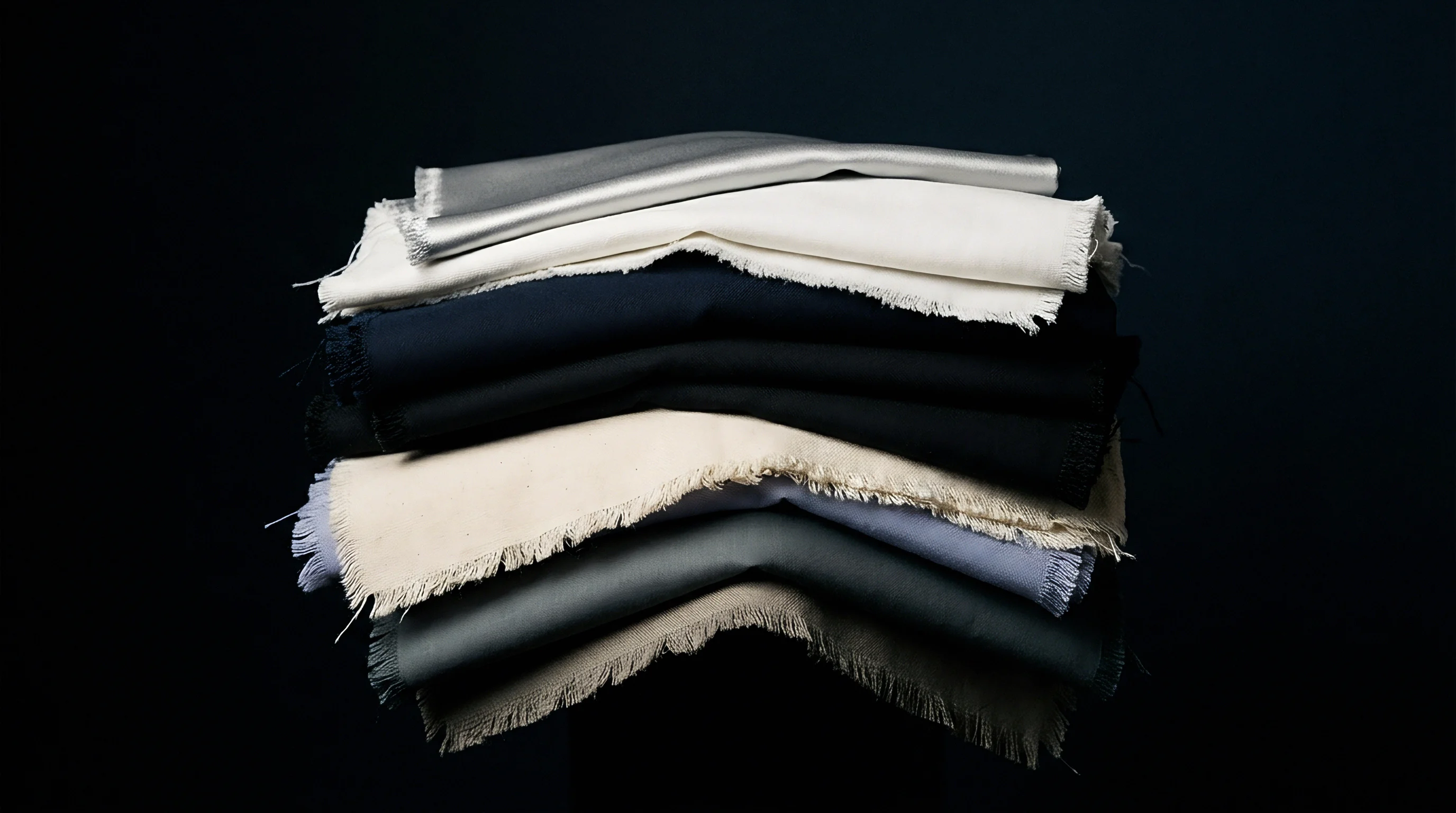
Loom settings dictate the immediate geometric layout of warp and weft yarns long before chemical wet processing modifies thread spacing. When yarn leaves the creel and passes through the drop wires, heald eyes, and reed, it experiences constant mechanical tension. The moment cloth is cut from the take-up roll, this mechanical tension releases, triggering an immediate physical relaxation known as off-loom relaxation.
This initial dimensional change occurs long before scouring, bleaching, or dyeing, yet yarn specifications frequently mistake off-loom counts for true greige values.
Tension skews thread alignment.
Warp crimp represents the excess length of warp yarn relative to the length of the woven fabric, expressed as a percentage. Weft crimp defines the corresponding percentage for pick yarns traversing the warp sheet. Air-jet looms increase warp tension.
When calculating loom state thread spacing, the weave planner accounts for both the reed width and the drawn-in width inside the reed dents. The reed number specifies the count of dents per unit length, typically expressed in dents per two inches or dents per centimeter. Thread spacing inside the reed does not equal the thread density on the loom roll.
Weave geometry dictates crimp distribution.
| Weave Architecture | Fibre Composition | Off-Loom Warp Crimp (%) | Off-Loom Weft Crimp (%) | Width Contraction (%) |
|---|---|---|---|---|
| 1/1 Plain Weave | 100% Ring Spun Cotton | 7.5 – 9.0 | 8.0 – 10.5 | 6.5 – 8.0 |
| 2/1 Weft Twill | 100% Combed Cotton | 5.5 – 7.0 | 6.5 – 8.0 | 5.0 – 6.2 |
| 2/2 Z-Twill | 65/35 Poly-Cotton | 4.8 – 6.0 | 5.2 – 6.8 | 4.2 – 5.5 |
| 5-End Satin | 100% Filament Polyester | 2.5 – 3.8 | 3.5 – 4.8 | 2.8 – 3.6 |
Off-loom relaxation occurs within hours.
The difference between the reed width and the grey fabric width stems directly from weft crimp and selvedge pull. As the loom insertion mechanism drives the weft yarn across the shed, the yarn remains straight under tension. When the reed beats up the pick against the fell of the cloth, the interlacing warp threads force the weft into a undulating path.
This structural bending draws the outer warp threads inward, reducing the width of the fabric relative to the physical spread of the reed wires. High-twist yarns amplify this effect because the internal torque encourages immediate Snarling and buckling once shed tension drops.
High-twist combed yarns yield half the wet finishing width shrinkage observed in low-twist carded equivalents.
Density shift impacts total yield.
Calculating the relationship between on-loom ends per centimeter and off-loom ends per centimeter demands a take-up factor. If a reed holds 24 ends per centimeter across two ends per dent, the on-loom warp density is 24 ends per centimeter. If the off-loom width contracts by seven percent upon removal from the loom frame, the off-loom warp density increases proportionately.
The mathematical relationship uses the contraction ratio, dividing the on-loom density by one minus the width contraction percentage. Miscalculating initial warp tension levels leads directly to unrecoverable selvedge bowing and permanent fabric off-grain distortion during downstream tentering.


Shrinkage
Wet processing floors alter fabric dimensions through aqueous yarn swelling, tension relaxation, and mechanical compaction inside the finishing range. When greige goods enter desizing and scouring baths, water breaks the hydrogen bonds inside natural cellulosic fibres, forcing individual filaments to expand radially. As yarn diameters swell, the inter-thread spaces shrink, forcing warp and weft paths to travel longer, more tortuous routes around each other.
This structural alteration pulls the entire fabric sheet inward across both axes simultaneously.
Moisture triggers rapid fibre swelling.
Continuous mercerization applies concentrated sodium hydroxide solutions to cotton fabrics under severe mechanical tension. Cold caustic treatment causes swelling of the cotton cellulose, changing the fibre cross-section from a flat ribbon to a round bean shape. If the mercerizer runs with insufficient chain width control, the fabric contracts violently in width, drastically increasing finished ends per centimeter while shortening total yardage.
Caustic mercerization improves dye affinity and tensile strength, but an unmonitored pin-chain width shift alters the final fabric weight per square meter beyond commercial allowances.

Which Finishing Sequence Minimizes Warp Contraction Variance?
Jet dyeing accelerates length compaction.
The selection of wet processing machinery dictates the balance between length and width compaction. Rope-form dyeing inside high-temperature jet dyeing machines allows the fabric to relax without longitudinal tension, causing significant length compaction. Conversely, continuous pad-batch processing holds the fabric under longitudinal tension, suppressing length compaction while promoting width contraction.
Finishing plants must adjust stenter overfeed parameters to balance these forces before heat setting or final curing.
- Inadequate Scouring Temperature leads to uneven wax removal, causing localized density pockets across the roll width.
- Excessive Stenter Overfeed forces pick compaction, resulting in longitudinal relaxation during subsequent garments laundering.
- Uncontrolled Mercerization Tension induces width contraction, exceeding calculated cutter margins.
- Inconsistent Heat Setting Rates cause thermal memory variations in synthetic blends, creating density gradients.
Yarn twist alters swell dynamics.
Synthetic fibres react primarily to heat rather than aqueous swelling. Polyester and polyamide yarns undergo thermal relaxation when exposed to temperatures above their glass transition point. During stenter heat setting at 180 to 200 degrees Celsius, oriented polymer chains relax, shrinking the yarn length unless held under rigid mechanical pin tension.
Heat setting locks the final thread spacing into place, making subsequent dimensional changes minimal during standard washing cycles.
An eight percent stenter overfeed restores length density without inducing residual bias at twenty meters per minute.
Finishing ranges use mechanical compaction units, such as rubber-belt sanforizers, to pre-shrink cotton fabrics. The sanforizing process dampens the cloth with steam and forces it against a compressed rubber belt. As the belt relaxes, it physically drives the weft yarns closer together, intentionally increasing the picks per centimeter to eliminate residual washing shrinkage.
Whether ultrasonic agitation during continuous desizing can stabilize yarn packing factors before tentering remains actively debated across technical processing plants.

Sizing
Slashing machinery applies protective film formers to warp sheets, altering raw yarn elasticity and introducing measurable longitudinal stretch prior to reed insertion. Size formulas containing poly-vinyl alcohol, modified starches, and acrylic binders coat the outer yarn surface, flattening protruding fibres and locking the core structure. Slashing stretch permanently elongates yarn.
This elongation reduces the residual elasticity of the warp end, directly altering how the yarn behaves under the high-frequency beating action of the loom reed.
PVA binders coat surface fibres.
Slashing stretch ranges from one percent to nearly three percent depending on squeeze roll pressure, creel brake tension, and drying cylinder speed sync. Yarn elongated by two percent during sizing enters the loom longer and thinner than its spun state. When wet processing desizes the fabric, the chemical binders dissolve, releasing the artificial elongation.
The yarn recoils to its natural length, generating an additional wave of longitudinal fabric contraction that increases finished picks per centimeter.
Starch removal reduces fabric mass.
| Parameter | Symbol | Greige State Value | Finished State Value | Calculation Basis |
|---|---|---|---|---|
| Warp Density | E | 28.0 ends/cm | 32.5 ends/cm | E_f = E_g / (1 – S_w) |
| Weft Density | P | 22.0 picks/cm | 25.2 picks/cm | P_f = P_g / (1 – S_l) |
| Yarn Count (Warp) | N_w | 30 Ne (19.7 tex) | 30 Ne (effective) | Excludes size mass loss |
| Fabric Mass | GSM | 125 g/m² | 142 g/m² | Conditioned mass adjustment |
| Total Width | W | 168 cm (reed) | 145 cm (cuttable) | S_w = 13.7% net contraction |
Reed width determines off-loom dimensions.
Desizing mass loss changes the mass per unit area equation. Standard warp sizing adds eight to fourteen percent dry chemical weight to cotton warp yarns. When wet finishing removes this temporary protective binder, fabric mass drops significantly.
However, because concurrent widthwise and length wise shrinkages compress the thread counts per unit area, the net finished fabric weight per square meter usually increases despite size removal. Weaving sheds regularly attribute unexpected pick density spikes to uncalibrated batching rollers rather than improper beam sizing tension.

Allowance
Converting a target finished density into precise loom setup parameters demands a clear mathematical backward chain from cuttable bolt width to reed denting schedules. Product developers start with the required finished construction: target cuttable width, target ends per centimeter, target picks per centimeter, and finished mass per unit area. Working backward requires applying historical processing factors derived from identical fibre blends and finishing equipment sequences.
Widthwise shrinkage compresses weft spacing.
Calculating total warp ends starts by establishing the cuttable finished width plus selvedge allowances. If a customer requires 150 centimeters of usable cuttable fabric at 30 ends per centimeter, the total functional warp sheet comprises 4500 ends. Adding selvedge reinforcement, such as 24 double ends per side, brings the total warp count to 4548 ends.
The weaving planner then estimates total widthwise contraction, combining loom off-loom width reduction and wet finishing shrinkage into a single composite percentage factor.
- Determine target finished ends per centimeter and finished cuttable width from customer specifications.
- Multiply finished ends per centimeter by finished width to calculate total warp ends required.
- Apply total widthwise shrinkage factor to derive minimum required loom reed width.
- Divide total warp ends by chosen reed width to identify target on-loom warp density.
- Select reed dent number and ends per dent combination matching on-loom warp density.
- Adjust grey pick insertion rate based on calculated longitudinal finishing compaction.
Selvedge trim removes structural distortion.
If the calculated total widthwise contraction is twelve percent, the required drawn-in reed width is calculated by dividing the target finished width by 0.88. A 150-centimeter finished width thus demands a minimum reed width of 170.4 centimeters. Dividing the 4548 total warp ends by 170.4 centimeters yields a required on-loom warp density of 26.69 ends per centimeter.
The planner selects a reed with a matching dent density, such as a 13.34 dent-per-centimeter reed with two ends per dent, or an 8.89 dent-per-centimeter reed threaded at three ends per dent.
EN ISO 1049 2 specifies thread density count determinations using traversing counting microscopes across a minimum specimen length of ten centimeters.
Calculating target pick density uses an identical longitudinal logic. If finished specifications mandate 24 picks per centimeter and historical processing exhibits an eight percent length contraction from loom fall to finished roll, the take-up motion on the loom must be set lower than the finished target. Dividing 24 picks per centimeter by one plus the longitudinal contraction ratio yields a required loom state density of approximately 22.2 picks per centimeter.
Wider reed margins always provide superior shade uniformity across high-speed continuous dye ranges.
Tolerance
Commercial fabric specifications establish legal boundaries between mill delivery variances and actionable buyer rejections on incoming roll stock. International standards grant manufacturing tolerances because textile materials exhibit inherent elasticity, moisture regain variance, and mechanical processing scatter. A fabric specified at 30 ends per centimeter and 25 picks per centimeter is rarely delivered at those exact mathematical figures across every roll in a ten-thousand-meter dye lot.
| Standard Designation | Tested Parameter | Allowed Commercial Variance | Actionable Rejection Boundary |
|---|---|---|---|
| EN 1049-2 (Method A) | Thread Density (Ends/Picks) | ± 2.5% of nominal spec | Exceeding ± 4.0% variance |
| ISO 3801 (Method 5) | Mass per Unit Area (GSM) | ± 3.0% of nominal weight | Exceeding ± 5.0% variance |
| ISO 22198 | Fabric Cuttable Width | -0 cm / +2.0 cm above spec | Any negative width deviation |
| ISO 6330 / ISO 5077 | Dimensional Stability | ± 3.0% after 5 wash cycles | Exceeding -5.0% contraction |
Thread counts vary across roll widths.
Standard testing procedures under EN 1049-2 demand counting threads across at least five distinct areas of a fabric roll, avoiding the initial two meters of the roll head and staying at least ten centimeters away from the selvedges. Density measurements taken near the selvedges yield artifically high warp counts due to local reed crowding and pin-tenter drag during drying. ISO 3801 governs mass determination, requiring test specimens to be conditioned at 20 degrees Celsius and 65 percent relative humidity for 24 hours prior to weighing on calibrated analytical balances.
- Yarn Count and Twist Multiplier define baseline physical diameter and potential crimp capacity under tension.
- Target Cuttable Width establishes the functional working boundary for pattern marker efficiency on cutting tables.
- Finished Mass Per Unit Area governs physical compliance with buyer weight specifications under controlled atmospheric conditioning.
- Maximum Dimensional Change sets acceptable shrinkage limits across standard laundering cycles.
Four point inspection protocols penalty points escalate when width drops below the purchase order minimum. If reed selection is too narrow, the dyehouse must over-stretch the fabric on the stenter frame to hit target cuttable width. Over-stretching reduces the finished picks per centimeter below specification, decreases the fabric mass per square meter, and instigates severe secondary shrinkage during subsequent apparel manufacturing processes.
Standard purchasing contracts incorporating ISO 3801 Method A permit a plus or minus three percent mass tolerance, directly shifting financial liability back to the weaving mill for underweight deliveries.