Greige Thread Density Influence on Wet Fabric Relaxation
Greige thread density limits wet fabric relaxation by establishing inter-yarn friction boundaries that block yarn swelling and crimp interchange during finishing.
Reed
Loom-state structural dimensions set the absolute physical limits for how much a fabric can relax during subsequent wet processing. Thread density in the greige state ~ warp ends per unit width and weft picks per unit length on the loom ~ determines the room individual yarns have to swell, flex, and re-orient in an aqueous bath. Shrinkage resistance builds primarily at the crossover points where warp and weft interlock.
When hydrophilic fibers like cotton, linen, or regenerated cellulose submerge in water, their cross-section expands laterally by 14 to 20 percent while axial length increases by less than 2 percent. This uneven volumetric expansion increases yarn diameter and forces intersecting yarn paths to lengthen their wave contours through crimp interchange. High greige thread densities restrict this geometric adjustment, because adjacent threads collide before strain releases completely.
Calculating maximum theoretical thread density before structural jamming relies on geometric models built from thread diameter and weave interlacings. In a plain weave, complete jamming occurs when the distance between adjacent yarn centers equals the sum of their swollen diameters. A greige specification approaching this geometric limit leaves almost no space for yarn movement.
As water immersion expands yarn diameter, warp threads arch more steeply over weft threads. When adjacent warp ends sit tightly packed in the reed, they block lateral movement and stop weft yarns from increasing their crimp. Tension stored during warping and weaving stays trapped inside the jammed matrix.
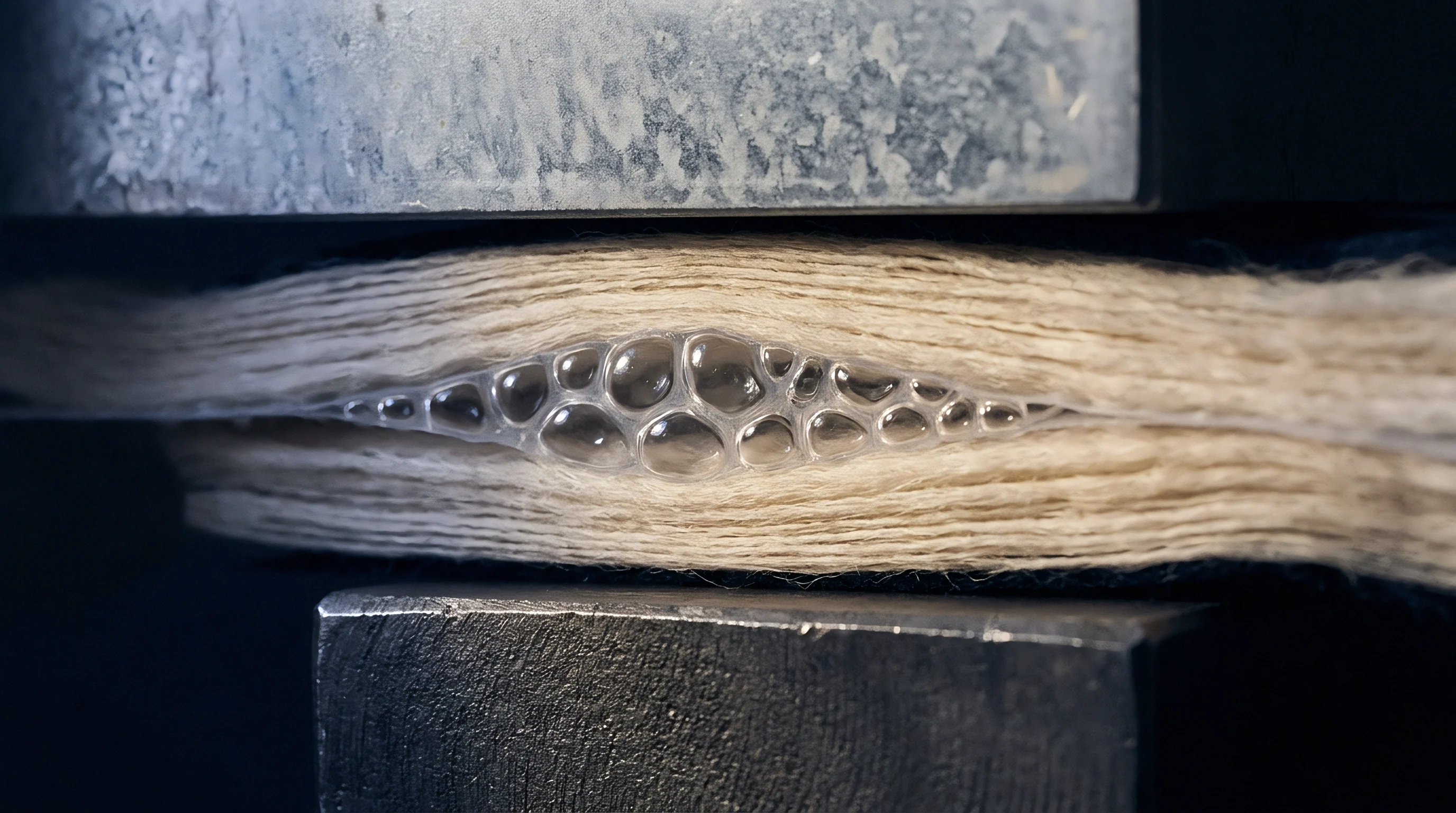
Fabric woven with excessive thread density remains locked in this high-energy state until heavy mechanical agitation breaks the inter-yarn friction ~ frequently causing surface distortion, planar creasing, or local density variations across the roll width.
Mechanics of Thread Spacing and Thread Interference
Physical interference between adjacent threads marks the boundary between stable fabric relaxation and structural distortion. In low-density greige constructions, wide spacing between yarns permits mobility during wet processing. Immersion releases the mechanical stretch imparted by loom let-off and take-up motions, allowing yarns to contract toward an un-tensioned equilibrium.
Warp crimp increases and fabric length drops quickly in continuous washers or dyeing vessels. High-density greige constructions feature tightly packed architectures where spacing between adjacent threads remains smaller than the swollen yarn diameter. Contact zones between crossing yarns generate high static friction that resists movement.
When hydrated, these yarns attempt to swell laterally, but neighboring threads obstruct expansion and build up high internal compression stresses within the plane of the cloth.
Warp contraction under free-swelling immersion across four distinct plain weave greige constructions illustrates these jammed-state boundaries. The observed dimensional changes confirm that thread density acts as a direct mechanical brake on aqueous relaxation. Fabrics woven at 85 percent of maximum theoretical cover factor undergo substantial dimensional shift upon first wetting, whereas fabrics woven at 96 percent cover factor experience suppressed structural contraction.
Warp crimp differential between loom state and relaxed state decreases systematically as greige thread density approaches theoretical geometric jamming limits.
Thread packing controls how crimp distributes between warp and weft systems. When warp density far exceeds weft density, closely spaced warp threads form continuous rigid walls along the length of the cloth. Weft yarns bend around these warp boundaries, absorbing almost all the crimp during weaving.
During aqueous finishing, hydrated weft yarns try to straighten out and push warp ends apart, but tight warp packing blocks this outward movement. Weft crimp stays locked in place, leaving the fabric vulnerable to severe widthwise shrinkage during garment washing if stenter frame drying overrides natural equilibrium. Achieving predictable finished dimensions requires balancing greige warp and weft thread counts so neither system drives the other into a jammed state during aqueous exposure.
Yarn Swelling Mechanics in Water Immersion
Hydrating natural staple yarns triggers immediate physical changes at the micro-structural level. Hydrogen bonds within non-crystalline cellulose regions dissolve, letting water molecules penetrate the amorphous matrix. Fiber walls expand outward, increasing yarn cross-sectional area and closing down inter-fiber void space within the bundle.
As yarn diameter expands, internal twist geometry steepens, shortening the overall linear length of the spun structure. In woven cloth, this longitudinal yarn contraction occurs alongside diameter expansion. High greige thread density magnifies these structural consequences: closely packed yarns press against neighbors as they expand, building inter-thread friction that resists planar movement.
The fabric stiffens noticeably when wet, resisting the gentle folding and flexing needed for uniform relaxation in tensionless processing machinery.
The rate and extent of yarn swelling depend on fiber blend, yarn construction, and twist multiplier. Ring-spun yarns undergo greater volumetric change than rotor-spun yarns because of their fiber distribution and core packing density. Higher twist multipliers increase initial thread rigidity, slowing water penetration while raising the mechanical force exerted during lateral expansion.
Synthetic filament yarns behave differently, showing minimal moisture swelling while undergoing thermal relaxation and structural shrinkage in hot baths. When synthetic warp yarns sit densely packed alongside hydrophilic staple weft yarns, differential swelling generates uneven tension across the fabric matrix. Managing these internal forces requires precise control over greige density ratios so yarn systems adjust without causing planar bowing, skewing, or localized density bands.
A rule of thumb dictates that open greige structures contract heavily in liquid baths, whereas dense greige structures resist shrinkage in the bath only to contract later under wet pressing.

Swelling
Running woven greige fabric through wet processing machinery subjects it to competing hydrodynamic, mechanical, and capillary forces. Operations like desizing, scouring, bleaching, and dyeing introduce liquid into the open pore network of the textile matrix. As liquid fills inter-yarn voids, capillary pressure pulls fibers together within individual yarn structures, while mechanical movement continuously bends and stretches the saturated sheet.
Greige thread density dictates how water moves through or around the fabric structure. Dense fabrics with restricted air permeability impede liquor flow through the sheet’s thickness, forcing processing baths around the fabric surfaces instead. This hydrodynamic resistance creates boundary layer friction, increasing mechanical drag through winches, rollers, and jet nozzles.
Processing tension in continuous finishing ranges directly opposes the natural relaxation triggered by yarn hydration. Machine drives pull the fabric web longitudinally through chemical padders, washing compartments, and steamers. This tension pulls warp yarns straight and flattens warp crimp.
High thread density amplifies warp tension sensitivity: in tightly packed warp architectures, machine-direction tension forces weft yarns to buckle laterally, narrowing fabric width long before the material reaches the drying stenter. Low-density fabrics deform easily under small mechanical loads, requiring continuous tension control to prevent permanent structural distortion. Balancing transport speed and wet web tension against greige construction density prevents premature structural locking in an unbalanced state.
Hydrodynamic Tension and Structural Crimp Interchange
Aquatic processing environments apply multidirectional mechanical loads that alter crimp equilibrium. When fabric enters a hot scouring or dyeing bath, warm liquor reduces fiber modulus, lowering the force needed to bend and reshape individual threads. Warp yarns under machine tension surrender their crimp to unconstrained weft yarns.
Weft yarns flex more deeply around the straight, tensioned warp threads, immediately narrowing the roll. High greige weft density resists this crimp transfer because closely spaced weft picks leave no room for deep warp indentation. In tightly woven goods, machine tension drives warp ends into heavy friction against weft picks, trapping strain in the structure.
Once warp tension releases at the delivery end of the washer, trapped elastic strain recovers instantly, causing unpredictable length shrinkage on the batching roll.
Open-width processing equipment handles dense greige constructions more reliably than rope-form dyeing machines. In rope dyeing, fabric collapses into a rope geometry, passing through jet tubes or winch reels thousands of times under warm, wet conditions. Tightly woven greige fabrics with high thread counts have high bending rigidity.
Forced into a narrow rope configuration, these dense structures form sharp longitudinal folds where local mechanical pressure concentrates. High thread density prevents internal yarns from sliding past one another to relieve localized strain, leaving permanent longitudinal marks ~ known as running creases or rope marks ~ along compressed folds. Low-density fabrics flex easily without creasing, but their high mobility increases the risk of edge curling, fabric distortion, and local surface abrasion under high liquor velocities.
Liquor Shearing in Open Width and Rope Operations
Liquor flow patterns in processing equipment interact directly with greige surface geometry. High-density greige fabrics present a smooth, continuous surface with small interstitial pores. When exposed to high-velocity liquor sprays or jet nozzles, water bounces off the dense yarn barrier, generating intense hydraulic shear.
This surface shearing mobilizes loose surface fibers, inducing fiber migration and pilling before chemical desizing or scouring is complete. Low-density greige constructions feature larger open pores that allow fluid to pass rapidly through the plane of the fabric. Fluid penetration facilitates fast chemical exchange and uniform temperature distribution through the yarn matrix, accelerating size removal and hydrophobic impurity extraction without requiring extreme mechanical agitation or high pump pressures.
The list below details specific operational failure modes triggered when greige thread density conflicts with wet processing machinery dynamics.
- Running Crease Instability creates permanent longitudinal pressure marks in dense greige fabrics processed in rope-form jet dyeing units due to elevated yarn-to-yarn static friction.
- Selvedge Curling Strain manifests in asymmetrical greige constructions when high warp density generates unbalanced lateral curling forces along unconstrained fabric borders during tensionless washing.
- Hydrodynamic Surface Pilling arises when high liquor jet velocities scrape against dense, rigid greige surfaces, abrading surface fibers rather than penetrating through yarn interstices.
- Moisture Gradient Skewing occurs in thick, high-density fabrics when rapid surface hydration swells outer fibers, creating a transient barrier that slows liquid ingress into core yarns.
- Differential Crimp Trapping locks high longitudinal warp strain into the matrix when continuous washer drive rollers drag high-density fabrics under excessive web tension.
Band-like width variations in finished goods after continuous open-width preparation stem from uneven thread packing or greige yarn lot variations.
Metrics
Correlating greige thread density with post-wet processing relaxation requires standardized test protocols and explicit geometric equations. Thread counts taken directly on the loom under tension do not reflect the relaxed state of greige cloth. Once cut from the loom, off-loom relaxation occurs immediately as elastic recovery pulls warp and weft back toward un-tensioned lengths.
Standard test methods, such as ISO 7211-2 or ASTM D3775, mandate measuring thread density after conditioning the sample in a standard atmosphere of 20 degrees Celsius and 65 percent relative humidity for at least 24 hours. Documenting the difference between loom-state and conditioned thread counts before aqueous testing isolates weaving strain recovery from moisture-induced structural relaxation.
Quantifying fabric relaxation requires standardized wet processing cycles followed by stress-free drying methods. ISO 5077 specifies procedures for determining dimensional changes after washing and drying, utilizing test conditions defined in ISO 6330. To measure maximum structural relaxation without mechanical restraint, laboratory procedures use total immersion in boiling water baths containing non-ionic wetting agents, followed by flat-bed ambient drying.
Comparing initial conditioned greige dimensions with post-relaxation dimensions yields percentage dimensional changes for both warp and weft directions. Linear thread density, areal mass (per ISO 3801), and yarn crimp percentage (per ISO 7211-3) are evaluated simultaneously to map structural adjustments inside the matrix.
Where Does Greige Sett Limit Moisture-Driven Contraction?
Greige thread density limits moisture-driven relaxation at the threshold where structural packing reaches maximum cover limits. Geometric cover factor equations quantify this state by expressing thread diameter relative to thread spacing. Peirce’s geometric model defines maximum theoretical cover factor in plain woven structures, where warp and weft cover factors sum to a limit beyond which yarns cannot swell without forcing adjacent threads out of plane.
When greige cover factor exceeds 88 percent of this theoretical maximum, moisture-driven contraction drops sharply. Inter-yarn space disappears as fibers swell, converting voids into solid friction zones. Moisture can no longer induce further crimp development: longitudinal contraction stops in the wash, transferring stress into structural deformation that manifests as planar buckling, surface distortion, or severe residual skewing after drying.
Below this critical cover threshold, dimensional contraction correlates linearly with greige thread spacing. In open constructions where cover factor sits between 65 and 80 percent, wide gaps accommodate fiber volume expansion easily. Yarns shift position freely under liquid agitation, allowing warp and weft crimp to reach natural thermodynamic equilibrium.
The fabric experiences significant length and width reduction during initial immersion, but achieves high dimensional stability in subsequent laundering cycles. Establishing the precise cover factor limit for a given fiber blend and yarn structure enables greige designers to dial in finished dimensions accurately, avoiding excessive shrinkage allowances or structural jamming during wet processing.
| Greige Sett (Ends x Picks / cm) | Greige Mass (g/m²) | Total Cover Factor (%) | Warp Relaxation (%) | Weft Relaxation (%) | Finished Mass (g/m²) |
|---|---|---|---|---|---|
| 24.0 x 20.0 | 112.5 | 68.4 | 8.20 | 6.40 | 131.2 |
| 28.0 x 22.0 | 127.8 | 77.6 | 6.50 | 4.80 | 143.8 |
| 32.0 x 24.0 | 143.1 | 86.8 | 4.10 | 2.90 | 154.1 |
| 36.0 x 26.0 | 158.4 | 96.0 | 1.80 | 1.10 | 163.2 |
| 40.0 x 28.0 | 173.7 | 105.2 | 0.60 | 0.30 | 175.3 |
Standardized Measurement of Dimensional Equilibrium
Determining true structural relaxation requires isolating chemical desizing effects from physical immersion alone. Sizing agents applied during slasher preparation ~ such as polyvinyl alcohol, starch derivatives, or polyacrylates ~ lock warp threads into an artificially elongated state. These polymers form rigid surface films that prevent yarn flexure and inter-yarn movement.
Dimensional measurements taken on greige fabric immersed in water without removing size yield inaccurate relaxation figures. Standard test protocols require thorough desizing pre-treatment using enzyme or hot alkali baths to dissolve size films completely before evaluating relaxation dynamics. Removing size restores native fiber friction coefficients, exposing true yarn mobility inside the woven matrix.
Measuring dimensional shifts across multiple test cycles verifies whether a single wet processing pass achieves absolute dimensional stability. Data collected across continuous washing sequences show that high-density fabrics require multiple aqueous cycles to release trapped weaving stress completely. Initial wet processing releases primary elastic strain, but inter-yarn friction traps residual stress inside tightly packed thread intersections.
Subsequent thermal and mechanical cycles gradually overcome this friction, causing incremental dimensional losses over repeated washings. Lower density fabrics reach geometric equilibrium in the first aqueous bath because open yarn spacing presents minimal frictional resistance to crimp movement.
Contractual delivery conditions specify that dimensional stability after commercial wet finishing must meet ISO 5077 standards, limiting residual washing shrinkage to less than 2.0 percent in both warp and weft directions.
Modeling
Operational tracking of structural parameters from loom state through wet processing to final finishing reveals exact physical transitions governed by initial greige density. To illustrate these dynamics, two contrasting 100 percent cotton woven constructions processed under identical continuous dyehouse conditions provide a baseline. Construction A represents a high-density, jammed plain weave poplin; Construction B represents a medium-density, open twill construction.
Both fabrics use identical yarn linear densities (30s Ne ring-spun warp and weft) to isolate thread spacing and weave structure as primary independent variables. Processing steps include continuous enzymatic desizing, open-width hot alkali scouring, jet dyeing, and stenter frame drying with overfeed control.
Initial off-loom greige dimensions establish distinct structural starting points. Construction A enters wet processing with a conditioned greige density of 42.0 ends per cm and 28.0 picks per cm, generating an initial greige areal weight of 178.5 grams per square meter. Construction B enters with 30.0 ends per cm and 22.0 picks per cm, yielding an initial greige areal weight of 133.0 grams per square meter.
As both fabrics enter the aqueous desizing range, yarn hydration initiates immediate swelling and crimp redistribution. However, structural packing limits force these two fabrics along dramatically different trajectories during continuous processing.
Comparative Analysis of High and Low Density Constructions
Construction A exhibits severe geometric confinement during initial aqueous contact. With a greige warp cover factor approaching theoretical limits, lateral expansion of warp yarns reduces inter-yarn clearance to zero. As water penetrates yarn cores, warp yarns attempt to expand laterally from an un-swollen diameter of 0.141 mm to a hydrated diameter of 0.165 mm.
Inter-yarn spacing between warp ends in Construction A is only 0.097 mm. Hydrodynamic swelling forces warp ends into tightly compressed contact zones, locking warp crimp at its initial weaving level of 7.2 percent. Weft yarns cannot draw warp ends closer together, preventing longitudinal contraction.
Warp length shrinkage during desizing and scouring remains restricted to 1.2 percent, leaving substantial internal stress locked within the yarn polymer structure.
Construction B demonstrates unconstrained geometric adjustment under identical processing conditions. Initial spacing between warp ends in Construction B is 0.192 mm, providing ample clearance for yarn diameter expansion. Upon hydration, warp crimp increases freely from an initial weaving level of 8.5 percent to 14.1 percent as weft yarns flex around expanding warp ends.
Longitudinal warp shrinkage proceeds rapidly, reaching 6.8 percent during desizing and scouring. Weft crimp increases simultaneously, driving fabric width down from 165 cm greige width to 151 cm wet open-width. The open structure of Construction B lets yarns adjust positions without encountering inter-yarn packing resistance, dissipating internal weaving strain completely within the aqueous bath.
Tightly packed greige constructions store mechanical weaving stress through aqueous processing, transferring dimensional instability into downstream garment laundering cycles.
Sequential tracking across subsequent dyeing and drying operations highlights the persistent influence of greige thread density on finishing machinery requirements. Construction A requires minimal stenter frame overfeed because minimal warp contraction occurred during wet baths. However, because internal stress remains unreleased, drying under tension risks setting the fabric in an unstable geometric state.
Construction B enters the stenter frame in a heavily contracted wet state, requiring 8.5 percent warp overfeed and high widthwise clip tension to pull the relaxed matrix to targeted finished specifications. Finished weight of Construction B increases by 21.8 percent over its greige state to 162.0 grams per square meter, whereas Construction A increases by only 7.5 percent to 191.8 grams per square meter.
| Processing Phase | Construction A: Warp Density (ends/cm) | Construction A: Weft Density (picks/cm) | Construction A: Weight (g/m²) | Construction B: Warp Density (ends/cm) | Construction B: Weft Density (picks/cm) | Construction B: Weight (g/m²) |
|---|---|---|---|---|---|---|
| Off-Loom Greige | 42.0 | 28.0 | 178.5 | 30.0 | 22.0 | 133.0 |
| Conditioned Greige | 42.8 | 28.2 | 181.2 | 30.8 | 22.3 | 136.1 |
| Post-Desize & Scour | 43.3 | 28.6 | 184.8 | 33.0 | 23.8 | 148.5 |
| Post-Jet Dyeing | 43.8 | 28.9 | 187.2 | 34.5 | 25.1 | 157.2 |
| Finished (Stentered) | 44.1 | 29.0 | 191.8 | 35.0 | 25.5 | 162.0 |

Empirical Tracking across Continuous Processing Steps
Data gathered during continuous processing trials illustrate how mechanical tension overrides natural wet relaxation in high-density goods. When Construction A moved through open-width continuous washing boxes, machine transport tension stretched warp yarns by 1.8 percent, completely reversing the small 1.2 percent warp relaxation achieved during initial desizing. High thread density prevented weft yarns from shifting position to lock in warp crimp.
The fabric exited the washing range longer than its conditioned greige length, carrying severe latent shrinkage. To correct this dimensional imbalance during final finishing, the stenter frame had to run at reduced speed with maximum steam injection, increasing energy consumption per linear meter by 24 percent.
A cost penalty of 14,200 USD occurred when a 50,000-meter bulk lot of high-density greige poplin suffered planar distortion and severe running creases during continuous rope bleaching, forcing the order onto slow open-width jig processing ranges.
Post-finishing physical performance confirms that structural relaxation directly impacts fabric strength parameters. Construction B achieved full crimp equilibrium, yielding a finished fabric with balanced tensile strength under ISO 13934-1 (480 N warp breaking force and 420 N weft breaking force). Construction A, constrained by jammed packing, retained unbalanced structural strain: tensile testing revealed 620 N warp breaking force but only 280 N in the weft direction, alongside a 35 percent reduction in ISO 13937-2 tear strength in the weft direction.
Tightly packed warp yarns prevented tear stress distribution across adjacent threads, concentrating tear loads onto individual isolated yarns.
The sequence below details the operational adjustments required when processing high-density versus low-density greige fabrics through wet finishing lines.
- Verify conditioned greige thread density against loom specification sheets using ISO 7211-2 counting methods before introducing fabric to chemical pads.
- Adjust continuous pad-wash range drive motor synchronization to maintain web tension below 150 N per meter of fabric width for high-density constructions.
- Set enzymatic desizing bath temperature to 75 degrees Celsius with a non-ionic surfactant concentration of 2.0 g/L to ensure complete size film solubilization.
- Configure jet dyeing machine nozzle pressure to 1.2 bar for low-density goods to avoid structural skewing, while increasing pressure to 2.2 bar for high-density goods to ensure liquor penetration.
- Calculate required stenter frame overfeed percentage based on observed wet bath contraction, applying up to 12 percent overfeed for open weaves and under 3 percent for jammed structures.
- Audit finished roll dimensions after a 24-hour conditioning period, confirming residual wash shrinkage remains below contract parameters.

Sourcing
Commercial procurement links greige construction design directly to landed cost per finished linear meter. Selecting greige thread density dictates raw material consumption, loom efficiency, wet processing route selection, and volumetric yield conversion. Weaving mills price fabric based on total picks inserted per inch, as weft insertion rates set loom capacity.
Increasing greige weft density to minimize post-wet shrinkage raises greige loom costs directly. Conversely, specifying a lower weft density to cut weaving charges increases fabric contraction during wet processing, reducing finished linear meter yield per roll. Technical buyers must balance greige thread density against finishing width yield to determine the true minimum cost path.
Volumetric yield loss from wet relaxation is a major financial variable in commercial textile converting. When open-weave greige cloth contracts by 8 percent in length and 10 percent in width during aqueous scouring and dyeing, a 10,000-meter greige order yields only 9,200 finished linear meters at target width. The buyer pays weaving, freight, and conversion charges on the full 10,000 meters, spreading total expenditures over fewer finished meters.
If greige thread density is specified higher to prevent contraction, weaving costs rise, but linear yield conversion improves toward 97 percent. Sourcing models must calculate this yield intersection accurately based on real mill capabilities.
Yield Arithmetic and Finished Width Reconciliation
Reconciling greige reed width and finished cuttable width requires precise accounting of thread density increases. To achieve a target finished width of 140 cm with a finished warp density of 36.0 ends per cm, a converter cannot simply purchase 140 cm wide greige cloth. If the greige construction undergoes a 7.5 percent lateral contraction during wet relaxation, greige reed width must be set to at least 152 cm.
Warp ends counted in the reed total 5,040 ends across the full width. During wet processing, these 5,040 ends draw closer together as weft crimp increases, compressing total width to 140 cm while pushing finished warp density up to the required 36.0 ends per cm. Specifying an incorrect greige reed width forces the dyehouse to overstretch the fabric on the stenter frame, introducing latent shrinkage that guarantees garment-level failure.
The financial impact of greige thread density extends into chemical and thermal utility consumption. Dense greige fabrics require higher surfactant concentrations, extended dwell times in desizing steamers, and increased stenter drying energy to achieve uniform chemical penetration and heat setting. Dyehouses frequently apply surcharge tariffs ranging from 0.12 to 0.28 USD per linear meter when handling dense, jammed greige constructions due to reduced running speeds and elevated rework rates.
Converter margins rely on identifying these operational cost drivers before issuing bulk greige purchase orders.
| Specification Parameter | Option 1: Low Greige Sett | Option 2: Medium Greige Sett | Option 3: High Greige Sett |
|---|---|---|---|
| Greige Sett (Ends x Picks / inch) | (cm) | 70 x 50 | (27.5 x 19.7) | 80 x 60 | (31.5 x 23.6) | 90 x 70 | (35.4 x 27.5) |
| Greige Reed Width (cm) | 160.0 | 155.0 | 148.0 |
| Greige Cost per Meter (USD) | 1.45 | 1.72 | 2.05 |
| Wet Processing Contraction (%) | 9.2 | 5.4 | 1.8 |
| Wet Processing Conversion Cost (USD/m) | 0.65 | 0.68 | 0.78 |
| Finished Linear Yield from 10,000m Greige | 9,080 m | 9,460 m | 9,820 m |
| Finished Cuttable Width (cm) | 140.0 | 140.0 | 140.0 |
| Landed Finished Cost per Meter (USD) | 2.31 | 2.53 | 2.88 |
Contractual Specifications for Greige Sett Tolerances
Legal procurement documents must define explicit physical tolerances for greige thread density, recognizing that looms experience minor mechanical variations across production runs. Standard commercial practice allows a tolerance of plus or minus 2.0 percent on warp end counts and plus or minus 3.0 percent on weft pick counts relative to the technical specification sheet. However, when buying greige cloth intended for tight-tolerance wet processing, standard commercial tolerances leave buyers exposed to quality defects.
A 3.0 percent drop in weft pick count reduces structural jamming resistance, allowing excessive fabric contraction during dyeing, whereas a 3.0 percent increase can push an already dense construction into a jammed state, causing running creases.
High-value commercial contracts enforce tightened greige density tolerances coupled with standardized wet relaxation testing before bulk roll dispatch. Contract clauses mandate that weaving mills perform ISO 7211-2 thread counts on off-loom conditioned samples taken from every production beam. If thread density falls outside agreed control bands, the buyer retains the contractual right to reject the lot or apply financial yield adjustment penalties before greige goods ship to the dyehouse.
Structuring purchase orders with these explicit boundaries eliminates disputes over whether shrinkage stems from dyehouse range tension errors or out-of-spec greige construction parameters.
How far can greige thread density tolerances be tightened on modern high-speed air-jet looms before weaving efficiency drops below economic viability for standard commercial apparel contracts?