Calculating Weft Crimp and Loom Reed Width for Cotton Twills
Calculate loom reed width by dividing target finished width by wet contraction loss, then multiplying by the weft crimp factor.
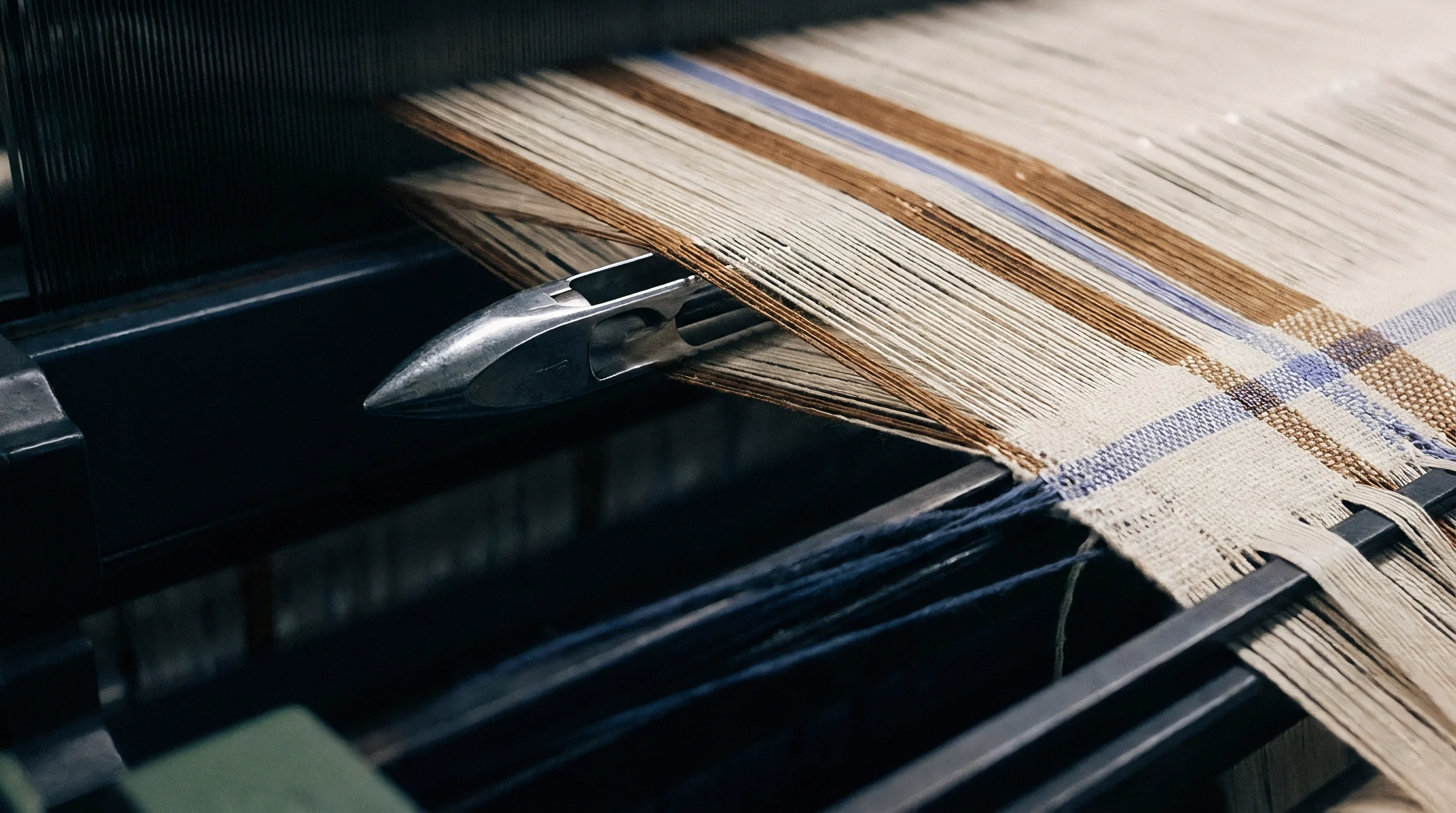

Geometry
Loom reed width fixes the physical boundary where greige dimensions, wet processing shrinkage, and finished roll width collide. In woven cotton twills, calculating the required reed spread demands isolating the exact path that filling yarns trace around warp ends. When the sley drives a pick home, the yarn does not rest in a straight horizontal line.
The alternating interlacing points force the pick into an undulation whose true yarn length substantially exceeds the cloth width measured off the pins. Greige width falls short of reed width by the exact degree of that yarn take-up, modified by temple hold-down efficiency at the fell. Mills that estimate this difference using flat approximations routinely under-specify reed widths, producing narrow cuttable widths that fail garment cutting plans.
The calculation sequence begins with the target finished width, reversing the physical contractions introduced along the manufacturing route. A 3/1 right-hand twill behaves differently than a 2/1 or 2/2 construction due to float length. Long yarn floats reduce the count of interlacing points per repeat, decreasing crimp percentage relative to plain weaves.
However, the asymmetric twill line induces structural torque and yarn packing behavior during aqueous desizing, scouring, and open-width dyeing. These wet finishing sequences release mechanical tensions imparted by the loom, inducing both fibre swelling and longitudinal yarn relaxation. The resulting finished width contraction represents an accumulation of on-loom crimp, off-loom elastic recovery, and wet-processing relaxation shrinkage.
Quantifying these shifts relies on standard test methods. Fabric technicians establish the finished and greige yarn crimp percentages using ISO 7211-3, which governs the removal and unbending of threads under tension. Mass per unit area is verified under ISO 3801, while dimensional change during laundering or processing conforms to ISO 5077 combined with ISO 6330 cycle profiles.
Weft crimp, denoted as Cw, measures the percentage increase of unstraightened pick length relative to the measured fabric width. The initial reed spread calculation follows a strict mechanical progression: the target finished fabric width is scaled up to account for wet processing width shrinkage, yielding the target off-loom greige width. The off-loom width is subsequently corrected for on-loom fabric take-up and contraction between the reed dents to arrive at the precise reed space required on the loom.
A 3/1 cotton twill woven at 148 centimetres reed width contracts to 140 centimetres greige width off the loom under an eight percent weft crimp factor.
Cotton yarns exhibit specific diameter expansions when wetted. Single ring-spun cotton yarns follow the Peirce geometric model, where the nominal yarn diameter in inches equals 1 divided by twenty-eight times the square root of the English cotton count. For metric calculations, the diameter in millimetres converts directly through linear density.
When warp ends pack tightly in heavy twill constructions, such as bottom-weight workwear fabrics, the pick experiences greater amplitude in its cross-sectional deflection. This deflection increases the weft crimp factor. A mill running an unadjusted 20/1 Ne cotton warp at 42 ends per centimetre forces the filling into steep angles of inflection, widening the disparity between reed space and greige dimensions.
The choice of twill float pattern establishes the geometric baseline. Table 1 outlines the operational crimp baselines for primary cotton twill builds across balanced and unbalanced weaves under standard mill tension conditions.
| Weave Structure | Yarn Count (Warp × Weft) | Finished Sett (Ends × Picks / cm) | Weft Crimp Range (%) | Total Width Contraction (%) |
|---|---|---|---|---|
| 2/1 Twill (Chino) | 30/1 × 30/1 Ne | 42 × 24 | 7.2 to 8.8 | 11.5 to 13.0 |
| 2/2 Twill (Uniform) | 20/2 × 20/2 Ne | 32 × 28 | 6.5 to 7.8 | 10.0 to 11.8 |
| 3/1 Twill (Drill) | 16/1 × 12/1 Ne | 38 × 21 | 8.0 to 10.2 | 12.5 to 14.5 |
| 3/1 Heavy Twill (Denim) | 7/1 × 6/1 Ne | 26 × 17 | 9.5 to 12.0 | 14.0 to 17.5 |
Fabric structures with asymmetric floats pull yarns across multiple axes simultaneously. The warp threads dominate the fabric surface in a 3/1 construction, compressing the filling yarn at the isolated interlacing point. This localized pinch alters the circular cross-section into an ellipse, flattening the thread along the plane of the cloth.
This cross-sectional flattening decreases the effective crimp height while increasing the yarn width, introducing a non-linear variable into theoretical calculations. Estimating reed spread based on pure circular yarn geometry yields an overbuilt loom width, which subsequently drives up raw yarn consumption per linear metre produced. Calculating weft crimp and reed width therefore bridges pure elastomechanical modeling and empirical finishing line performance.
Failure to align reed spread with wet processing shrinkage yields finished goods that cannot meet pattern requirements without aggressive mechanical stretching on the stenter frame. Mechanical stenter compensation creates permanent latent tension, driving wash shrinkage values beyond acceptable retail limits.
Calculation
Deriving the exact reed width requires a rigorous algebraic reversal starting from the required cuttable finished width. The target parameter is Reed Width (RW). The calculation must incorporate three primary variables: Target Finished Width (FW), Total Wet Processing Width Contraction (Wc), and On-Loom Weft Crimp (Cw).
Each factor functions as a fractional multiplier derived from conditioned laboratory measurements rather than theoretical assumptions. The interaction of these variables accounts for the longitudinal recovery of the filling yarn and the cross-directional pull exerted by the warp system under shed tension.
Processing shrinkage and structural crimp operate sequentially. When grey cloth drops from the loom take-up roll, it undergoes an immediate relaxation shrinkage, termed off-loom contraction, driven by the release of shedding tension. Subsequent wet processing, comprising desizing, scouring, bleaching or dyeing, and drying, alters this dimension further.
Total width contraction, Wc, reflects the percentage change from grey width off the loom (GW) to finished fabric width (FW). The mathematical definition presents as:
Wc = (GW – FW) / GW
Rearranging this relationship defines the necessary off-loom greige width needed to deliver the finished target:
GW = FW / (1 – Wc)
The calculation now addresses the mechanical transformation occurring between the reed dents and the fabric fell. Weft crimp, Cw, defines the excess length of weft yarn inserted across the fabric width relative to the width of the cloth at the fell. The yarn fed from the accumulator traverses the shed along the reed line, but as the warp threads cross during beat-up, the weft bends.
The actual length of the pick corresponds approximately to the width of the warp in the reed. Weft crimp percentage is expressed formally through ISO 7211-3 as:
Cw = (Lw – GW) / GW
Where Lw is the straightened length of the filling thread removed from the greige cloth. Because the straightened thread length corresponds directly to the width of the yarn array inside the reed dents, Lw serves as the operational equivalent of the Reed Width. Substituting RW for Lw establishes the direct calculation:
Cw = (RW – GW) / GW
Solving directly for Reed Width produces the fundamental greige equation:
RW = GW × (1 + Cw)
Integrating the wet processing contraction relationship into this equation consolidates the entire production route into a single operative formula:
RW = × (1 + Cw)
To ground this mechanics, take a 3/1 right-hand cotton drill specified for a workwear bulk order. The purchase order stipulates a finished cuttable width (FW) of 150 centimetres. Analysis of the mill wet-finishing route, consisting of continuous pad-steam dyeing and sanforizing, yields an empirical total width contraction (Wc) of 7.5 percent (expressed as 0.075).
Physical unbending trials on comparable greige constructions establish a weft crimp factor (Cw) of 8.5 percent (0.085). The greige width off the loom must measure:
GW = 150 / (1 – 0.075) = 150 / 0.925 = 162.16 centimetres
Applying the weft crimp correction factor produces the definitive reed space requirement:
RW = 162.16 × (1 + 0.085) = 175.94 centimetres
The weaver rounds this calculation up to 176 centimetres to establish the total working reed width. Specifying this value wrong cascades through the reed selection process. A reed built to 170 centimetres produces a greige cloth measuring only 156.6 centimetres off the loom.
When that narrow fabric encounters the 7.5 percent wet processing pull, the finished width drops to 144.8 centimetres, falling over five centimetres short of the 150-centimetre contract specification. Converting these dimensions into loom denting requires calculating the total number of warp ends divided by the usable reed width, which determines the reed count, typically defined in the metric system as the number of dents per 10 centimetres.
Contract defaults on width yield immediate roll rejections under ASTM D3774 when goods arrive even one centimetre narrower than the specified cuttable limit.
The arithmetic shifts substantially when open-end yarns replace ring-spun cotton in the weft. Open-end cotton yarns possess lower packing density and higher structural bulk due to the presence of wrapper fibres along their outer sheath. When bent through the warp shed, an open-end weft resists compression more aggressively than a combed ring yarn.
The effective crimp amplitude rises, demanding an upward adjustment of the weft crimp factor by 0.8 to 1.5 percentage points. Conversely, mercerization in the wet processing line introduces caustic swelling, which contracts the weft system by an additional 2 to 3 percent unless locked under heavy clip tenter cross-tensions.
The calculated reed width remains valid only when warp and weft tensions remain uniform across the operating shift. Air-jet weaving machines running at 800 picks per minute impart different kinetic insertion profiles than rapier systems running at 550 picks per minute. The air nozzle profile stretches the pick dynamically upon entry, leaving localized residual stress that recovers unevenly once cut from the selvedge.
The calculation must reflect the operational state of the actual loom type assigned to the manufacturing run.
The supplier routinely claims that an off-width lot resulted from unpredicted variation in raw cotton fibre micronaire that shifted yarn bulk during wet finishing.


Dynamics
Loom mechanics actively alter the geometric variables calculated on paper. While mathematical formulas assume uniform tension distribution across the fabric plane, the physical loom operating floor introduces continuous mechanical forces that shift crimp values in real time. The shedding mechanism, whether driven by negative cam motions or electronic dobbies, subjects the warp sheet to cyclical tensile loading.
In cotton twills, the asymmetry of the lift plan creates uneven shed geometry. In a 3/1 twill, three warp ends lift while one remains down for each pick inserted. This imbalance produces disparate tension profiles between the high-lift ends and the resting ends, tilting the yarn balance toward the warp and forcing the filling yarn to absorb higher crimp.

Do Machine Settings Alter Weft Crimp?
Beat-up dynamics exert immediate force upon the pick at the fabric fell. The reed advances to push the freshly inserted filling thread into the cloth body against the frictional resistance of the existing warp ends. As the sley passes through front dead centre, the kinetic energy transferred to the pick forces it to crimp around the warp.
If the loom technician sets shed closure early, the warp threads cross before the reed completes its forward stroke. This early crossing locks the pick into a tight geometric bind, elevating weft crimp and driving down off-loom greige width. Conversely, late shed timing permits the pick to slip backward slightly as the sley retreats, lowering weft crimp and widening the greige cloth at the cost of structural stability.
The mechanical temples mounted on either side of the fabric fell hold the woven cloth to a width matching the reed space as closely as possible. Because the woven fabric naturally contracts toward the centre under tension, the selvedge edges experience severe lateral pull. Ring temples utilize spiked brass rings positioned at calculated angles to grip the cloth edges, preventing premature contraction before the fabric advances to the take-up motion.
The choice of temple rings directly influences the crimp gradient across the fabric roll:
- Temple ring count must provide sufficient grip area across dense twill selvedges to prevent internal pin-pull tears during the beat-up cycle.
- Pin angle orientation controls the lateral holding force, counteracting the high contraction tendencies of heavy weft counts.
- Nip clearance calibration prevents surface abrasion and broken filaments on the outer twill face while the fabric advances through the head.
- Cylinder length selection distributes holding force inward, eliminating the sharp drop in weft crimp commonly found ten centimetres from the edge.
The physical tension maintained across the filling yarn during insertion forms a primary mechanical variable. On rapier looms, the give-up and take-over positions between the carrying and receiving heads apply a distinct tension spike at the fabric centre. On air-jet looms, main nozzle acceleration pressure and relay nozzle timing combine to control the pick trajectory.
If the braking force applied by the weft tensioner before the pick reaches the profile reed dent is insufficient, the filling yarn recoils upon cut-off. This recoil introduces slack, producing irregular weft crimp that manifests as downstream width variation along the roll length.
A variation of two millibars in air-jet main nozzle pressure shifts weft crimp by half a percent, altering greige width across a bulk lot.
Warp let-off and cloth take-up motions must operate in exact kinetic synchronization. Electronic let-off motions monitor warp beam back-rest deflection through load cells, adjusting the drive motor to maintain constant warp sheet tension from full beam to empty core. As the warp beam empties, beam diameter decreases, demanding continuous rotational acceleration.
If the back-rest dampening system fails to absorb the shedding oscillation, warp tension spikes violently. High warp tension flattens the warp threads, forcing the weft yarn to perform all the bending. Under these running conditions, weft crimp surges above calculated projections, causing sudden drops in greige width off the loom.
The technical staff on the loom floor constantly navigate the trade-off between pick density and operating efficiency. Running cotton twills at elevated warp tensions suppresses end breakage rates and maintains a clean shed clear of lint fuzz balls. However, this practice shifts the structural crimp balance heavily into the filling system.
The fabric exits the front of the loom narrower than planned, shifting the burden of width correction entirely to the wet processing plant.
Every mechanical adjustment on the weaving machine translates into a corresponding dimensional shift on the finished roll. The greige mill cannot alter shed timing or let-off tension without simultaneously resetting the calculated reed width baseline.

Finishing
Wet processing floors permanently reshape the mechanical dimensions established in the weave shed. Greige cotton twills arrive at wet finishing carrying spinning oils, sizing agents like polyvinyl alcohol or modified starches, and natural non-cellulosic impurities. The presence of sizing stiffens the warp system, artificially locking the greige yarn crimp into place.
As soon as the fabric plunges into the desize bath, enzymatic degradation breaks down these sizing polymers. The loss of sizing removes the rigid external matrix, freeing the cotton fibres to hydrate, swell, and release the kinetic strains induced by high-speed weaving.
Cellulose swelling during aqueous processing alters yarn diameter and generates longitudinal fiber contraction. When a cotton yarn swells in water, its cross-sectional area expands by approximately twenty to thirty percent, while its axial length shrinks. In a tightly woven 3/1 drill or denim twill, this volumetric expansion leaves insufficient void space within the fabric geometry.
As the warp ends swell, they exert enormous compressive force on the picks interwoven between them. The filling yarn must travel an even longer, more tortuous path around these enlarged warp threads, dramatically increasing the weft crimp in the wet state.
Continuous open-width processing paths present distinct tension profiles compared to discontinuous batch equipment. In continuous bleaching and pad-steam dyeing ranges, drive rollers pull the wet fabric longitudinally under tensions reaching 1500 to 2500 Newtons across the web. This continuous axial warp tension stretches the fabric lengthwise, pulling the warp crimp flat.
The Poisson effect takes hold: as warp crimp decreases under tension, filling crimp is mechanically forced to spike, pulling the fabric inward and triggering substantial width shrinkage. Table 2 details the width shrinkage performance and weft crimp evolution across common industrial wet processing routes for cotton twills.
| Processing Sequence | Typical Equipment | Warp Tension Profile | Weft Crimp Change (%) | Net Width Loss (%) |
|---|---|---|---|---|
| Continuous Bleach + Pad-Dry-Pad-Steam Dye | Open-width roller ranges | High continuous (1800 N) | +2.5 to +4.0 | 10.0 to 13.5 |
| Atmospheric Overflow Jet Dyeing | Jet / Overflow vessels | Low cyclic intermittent | +0.5 to +1.5 | 6.0 to 8.5 |
| Cold Pad-Batch Dyeing | Perforated beam wash-off | Moderate controlled | +1.2 to +2.2 | 7.5 to 9.5 |
| Mercerizing + Continuous Dye + Sanforize | Chain mercerizer + Rubber belt | Extremely high variable | -1.5 to +1.0 | 4.0 to 6.5 |
Controlling this contraction occurs principally on the pin stenter frame. The stenter carries the damp fabric through heated drying chambers via parallel chains fitted with needle plates that grip the selvedges. By independently setting the overfeed percentage and the cross-rail rail width, the finishing engineer can force the fabric to dry at a designated width.
However, mechanical over-widening on the stenter merely masks structural shrinkage. If a twill with an intrinsic greige capacity of 145 centimetres is pulled out to 152 centimetres across the stenter pins to hit a PO requirement, the filling yarns are placed under severe elastic extension. The subsequent wash test conducted under ISO 5077 will immediately expose this practice, revealing excessive weft dimensional change upon laundering.
The compressive shrinkage unit, commonly termed the Sanforizer, serves as the final mechanical intervention for woven cotton twills. The sanforizing process forces the fabric between a heated chrome cylinder and a thick, compressed rubber belt. As the belt recoils from its curved deformation, it grips the fabric surface and compresses the warp threads longitudinally.
This mechanical action forces the warp crimp back into the structure, locking the finished residual shrinkage below three percent. However, this dramatic compression of the warp pushes the warp ends closer together, compressing the filling yarn horizontally and causing a secondary width loss that must be compensated for during the preceding stenter pass.
Wet processing technicians frequently encounter disputes when a batch fails width specifications following shade matching. If an initial pad-steam run comes up off-shade, running the fabric through an additional chemical stripping and re-dyeing pass exposes the cellulose to a second wet relaxation cycle. The cumulative tension pulls the fabric narrower with each pass through the squeeze nips.
Unless the loom reed width was engineered with a safety tolerance for potential reprocessing, the re-dyed lot finishes below cuttable width limits, destroying the commercial value of the bulk goods.
Processing a cotton twill through a secondary wash-off cycle increases width contraction by an average of 1.8 percent beyond initial specification targets.
The interaction between twill skewing and width must also be managed during finishing. Asymmetric twill weaves naturally skew toward the direction of the twill line due to structural torque. To eliminate skew in finished garments, finishing plants run the fabric through a differential roller weft straightener, forcibly angling the picks before entering the drying cans.
Skew correction shifts the rectangular yarn lattice into a parallelogram, reducing the effective horizontal width between selvedges. Reed width formulas that omit this geometric skew allowance fail to provide the cuttable width promised on the technical specification.
A standard quality assurance clause in apparel sourcing contracts dictates that delivered cuttable width must exclude pin holes and damaged selvedge margins. When the engineering team miscalculates finishing shrinkage, the temptation to trim selvedges closer to the edge invites seam failures during high-speed garment assembly.

Route
Transforming a fabric specification into bulk physical yardage binds an apparel brand to an interconnected chain of independent production facilities. Every manufacturing choice, from spinning methodology to reed engineering and wet processing chemistry, dictates the operational profile, the lead-time horizon, and the financial liability of the purchase order. Fabric route engineering evaluates how structural parameters govern this downstream supply chain, ensuring that the theoretical arithmetic of weft crimp functions seamlessly within commercial reality.
Selecting a production route requires weighing vertical integration against commission converting networks. When sourcing a heavyweight cotton twill, a buyer faces distinct operating models that directly influence how reed width adjustments and shrinkage tolerances are managed across companies:
- Vertical composite mills manage spinning, weaving, wet processing, and sanforizing under single management, standardizing internal reed inventories and controlling dimensional tolerances directly.
- Commission weaving networks purchase commercial yarn and weave greige cloth across decentralized loom sheds, increasing the variance of loom tension and producing fluctuating weft crimp across delivered rolls.
- Independent converter chains buy spot greige market fabric and route it to independent commission dyehouses, transferring the commercial risk of finished width failures entirely to the brand technical specification.
The choice between ring-spun and open-end cotton filling yarns introduces immediate cost-per-metre trade-offs. Ring-spun yarns cost substantially more per kilogram due to slower production rates and the necessity of roving preparation. However, ring-spun yarns permit a lower weft crimp profile, allowing the weaver to utilize a narrower reed width to achieve the same cuttable finished target.
By utilizing a narrower reed spread, the mill reduces filling yarn consumption per running metre of cloth. An open-end yarn, while cheaper per kilogram at the spinning gate, requires a wider reed space to offset its elevated crimp and wet contraction tendencies, consuming more total yarn weight per linear metre and eroding the initial spinning savings.
Minimum Order Quantities (MOQs) and Minimum Colour Quantities (MCQs) are inextricably tied to the machinery dimensions established during reed calculations. Sizing and warping machines require minimum yarn lengths to justify beam preparation; setting up a warp beam for a 176-centimetre reed setup typically requires at least 3,000 metres of warp yarn to amortize the setup costs. If a buyer requires multiple small dye lots, running those lots through a continuous pad-steam range designed for 5,000-metre minimums forces the converter into overflow jet dyeing.
As established, jet dyeing exhibits an entirely different contraction profile than continuous ranges, meaning the single greige reed construction chosen for the bulk program will yield inconsistent finished widths across different colorways.
Lead-time accumulation across the cotton twill production route follows strict mechanical gating. Ring spinning requires ten to fourteen days. Warping, sizing, drawing-in, and weaving 20,000 metres on high-speed air-jet machines consumes twelve to sixteen days.
Wet preparation, continuous dyeing, and sanforizing add an additional ten days, while physical testing, shade sorting under multi-illuminant light booths, and roll grading consume five days. The total route calendar spans thirty-seven to forty-five days under stable conditions. When a reed width calculation error occurs, it is rarely discovered until the fabric emerges from the final sanforizer line at day thirty-eight.
At that stage, remaking the greige base requires restarting the entire sequence, blowing garment factory cut dates and triggering air-freight penalties.
The financial impact of reed width errors is magnified when buying fabric across cross-border trading corridors. When customs authorities assess duties on imported woven cotton fabrics, classifications fall under HS Chapter 52, where tariff lines routinely differentiate between fabrics based on mass per unit area and width. If a mill narrows the reed width to save filling yarn, the finished fabric ends up narrower.
Because the same number of warp threads are now compressed into a tighter physical width, the finished ends per centimetre increase. This shifts the finished weight upward, potentially bumping the fabric into a higher import tariff category or violating garment yield templates negotiated with cut-and-sew factories.
The standard commercial purchase order specifies width tolerances strictly under a zero-minus, plus-two percent framework. Fabric delivered narrower than the purchase order requirement is legally non-conforming, leaving the converter holding unsellable custom-dyed inventory. The mill floor never absorbs this risk passively; it will aggressively attempt to pull the goods out on the stenter frame to meet the invoice width, silently passing latent shrinkage failure down the line to the consumer garment wash cycle.

Verification
Defending a bulk fabric order against width and shrinkage disputes requires an unyielding verification framework executed before, during, and after manufacturing. A fabric specification sheet that merely states target dimensions without explicit test methods and tolerance thresholds is an unenforceable commercial document. Technical buyers must establish unambiguous testing protocols that tie physical laboratory measurements directly to the invoice settlement conditions.

Which Parameters Belong in the Technical Specification?
The fabric specification must define the exact physical state of the cloth for every stated metric. Sett, mass, width, and crimp evolve across the manufacturing timeline, making it imperative to state whether figures apply to greige goods at the loom fell, relaxed greige at packing, or conditioned finished goods. The document must explicitly lock in the following parameters:
- Usable cuttable width measured inside the outer needle pinholes under ISO 22198, excluding damaged or loose selvedge zones completely.
- Conditioned weft crimp limits determined under ISO 7211-3 with an agreed measurement tolerance of plus or minus 0.6 percentage points across bulk lots.
- Dimensional stability thresholds verified through three consecutive washing cycles per ISO 5077 and ISO 6330 Method 4N at 40 degrees Celsius, capped at three percent maximum shrinkage.
- Mass per unit area stated in grams per square metre under ISO 3801 with an acceptable variance band strictly limited to plus or minus three percent.
Physical sampling protocols must prevent suppliers from cherry-picking compliant rolls. Incoming lot verification requires acceptance sampling governed by ISO 2859-1 under normal single-sampling inspection plans. Fabric rolls undergo structural audits on illuminated inspection frames operating at controlled tension, recording defects under the standard ASTM D5430 4-Point System.
During this inspection, width measurements must be verified every one hundred linear metres across the roll. If width readings fluctuate by more than 1.5 centimetres between the head, middle, and tail of an individual roll, the roll fails inspection due to irregular tentering tension.
In-mill technical audits bridge the gap between paperwork specifications and mechanical execution. When auditing a weaving mill contracted for twill production, the auditor inspects the loom sley directly, verifying that the actual wire denting matches the calculated reed plan. A calibrated measuring tape placed across the warp sheet in the reed establishes the operating reed space.
If the mill is observed running a 170-centimetre reed setup for a construction that requires 176 centimetres to safely meet the finished target, the auditor halts production before thousands of metres of narrow greige are wound onto loom take-up beams.
Shade evaluation under multi-illuminant conditions functions as a concurrent control on width stability. During continuous dyeing, colour yield is sensitive to the pick density per centimetre. If the loom reed width was engineered too narrow, the resulting increase in filling crimp pushes warp ends closer together, creating a tighter structural face that reflects light differently.
When evaluated in a calibrated light box under D65 daylight, Point of Sale incandescent, and TL84 store lighting, goods with fluctuating weft crimp display pronounced batch-to-batch metamerism and shade drift that cannot be resolved through formulation tweaks.
Disputes over delivered width routinely trace back to differing laboratory conditioning protocols. Cotton is a hygroscopic natural cellulose fibre; its physical dimensions change depending on ambient relative humidity. Measuring cuttable width in a non-conditioned warehouse at twenty percent relative humidity produces a significantly narrower reading than a test conducted inside an accredited laboratory maintained at twenty degrees Celsius and sixty-five percent relative humidity under ISO 139.
Commercial contracts must explicitly state that all verification measurements are legally binding only when executed following a minimum of twenty-four hours of conditioning under standard ISO 139 atmosphere.
A mill caught delivering narrow goods typically argues that the fabric will relax to full cuttable width during garment steaming and panel preparation. Accepting this explanation without laboratory substantiation guarantees that the garment factory will experience cutting marker misalignments, pattern grading distortion, and elevated scrap rates on the production floor.