Wet Processing Contraction Dynamics across Fine Gauge Knitted Fabric Formats
Fine gauge knit contraction relies on balancing hydrodynamic wet relaxation with stenter overfeed to lock loop geometry before garment cutting.
Pitch

Yarn Loop Geometry and Structural Energy Storage
Fine gauge circular knitting introduces substantial physical torque into spun or filament yarns. High needle counts, operating between E28 and E44 gauges, bend yarn into tightly curved loop heads and sinker loops. Mechanical friction inside the knitting zone locks these loops into non-equilibrium geometric configurations during stitch formation.
The yarn retains internal torsional energy and longitudinal tensile strain from yarn feeding carriers. Unprocessed greige fabric holds this elastic strain under dry frictional contact between adjacent loop legs. Loop length governs total shrinkage.
Fine yarns deform rapidly. Higher courses reduce length loss.
When the dry fabric encounters an aqueous liquor bath during wet processing, water molecules disrupt hydrogen bonding within cellulosic fibers or plasticize synthetic polymer chains. This lubricates yarn contact points within the stitch structure. Inter-yarn friction drops instantly, permitting stored mechanical strain to release.
The yarn attempts to return to its lowest energy physical state, forcing three-dimensional movement of every loop head. Fine gauge structures exhibit high stitch densities, often exceeding 1,200 loops per square centimeter in E36 single jersey knits. This high density amplifies micro-level loop movement into severe macro-level dimensional contraction along both warp and weft axes.
Conditioned single jersey E36 cotton knit exhibits 14.2 percent length contraction when relaxed at 80 degrees Celsius in zero-tension liquor according to ISO 5077 testing.
Relaxational versus Hygral Shrinkage Vectors
Dimensional contraction during wet operations splits into two primary mechanisms: relaxational contraction and hygral movement. Relaxational contraction is an irreversible structural adjustment. It occurs as knitting tensions dissipate and loop shapes transition from elongated ellipses toward rounder, energy-stable configurations.
Water swells hydrophilic fibers. Diameter expansion increases yarn cross-sections, forcing loop head curvature to widen. This physical thickening shortens the linear path of yarn through each course, pulling adjacent wale lines closer together and driving high longitudinal contraction.
Hygral expansion and contraction cycles operate reversibly in response to moisture absorption and drying phases. Swelling increases yarn diameter while shortening yarn length along the helical axis of spin. In fine gauge fabrics made from continuous filament synthetic yarns, thermal plasticization during jet dyeing triggers secondary contraction.
Polyester and nylon yarns contract thermally as internal crystalline regions reorient above their glass transition temperatures. Managing these combined vectors demands separating reversible fiber swell from permanent mechanical loop relaxation throughout scouring, bleaching, and dyeing operations.
Commission dyers frequently attribute initial batch length losses to uncalibrated yarn delivery tension on the knitting machine rather than wet bath relaxation dynamics.
Formats

Single Jersey Instability and Spirality Coupling
Structural geometry determines how an aqueous bath releases stored mechanical energy. Single jersey fabric represents an asymmetrical construction where all loop heads pull toward the technical face, while sinker loops extend toward the back. Unbalanced torsional forces cause single-ply spun yarns to untwist within the open loop geometry.
Single jersey torque creates spirality. This unbalanced moment causes wale lines to shift away from vertical 90-degree alignments, generating spirality angles exceeding 8 degrees in untreated wet-processed rolls.
Widthwise contraction in single jersey knits drives high edge curl along cut fabric margins. Raw edges roll toward the technical face along courses and toward the technical back along wales. During tensionless scouring, single jersey formats experience unchecked longitudinal shrinkage because loop legs slip across sinker loops without mechanical restraint.
This structural imbalance makes single jersey the most volatile fine gauge format during batch jet dyeing.
Double Knit and Warp Knit Resistance Thresholds
Interlock and rib structures balance yarn torque through back-to-back loop positioning. In 1×1 rib structures, alternating face and back wales cancel out torsional moments, preventing fabric spirality entirely. Rib structures balance internal torque.
Widthwise elasticity in fine gauge rib formats remains high, generating width contraction exceeding 25 percent when submerged without transverse pinning tension. Interlock fabrics interlock two 1×1 rib structures, creating smooth technical surfaces on both sides while restricting lateral contraction through yarn crossing points.
Warp knits, including tricot and raschel constructions, exhibit exceptional dimensional resistance during wet processing. Tricot knits hold directional stability. The continuous zigzag movement of warp guide bars creates diagonal underlaps that physically brace adjacent wales against collapse.
Warp knit length contraction rarely exceeds 4 percent under standard jet scouring, making warp formats substantially more stable than circular knit formats under continuous wet tension.
| Format | Machine Gauge (E) | Stitch Density (loops/cm²) | Length Contraction Range (%) | Width Contraction Range (%) |
|---|---|---|---|---|
| Single Jersey | E28 – E40 | 600 – 1,400 | 12.0 – 18.0 | 6.0 – 12.0 |
| Interlock | E28 – E36 | 700 – 1,200 | 8.0 – 13.0 | |
| 1×1 Rib | E28 – E32 | 500 – 900 | 5.0 – 9.0 | 22.0 – 30.0 |
| Tricot (Warp) | E28 – E44 | 800 – 1,800 | 2.0 – 4.5 | 3.0 – 6.0 |
| Values measured following tensionless liquor immersion at 60 degrees Celsius per ISO 5077 specifications. | ||||
- Loop skewing and course distortion occurs when unbalanced single-ply yarn torque forces wale lines off perpendicular alignment during wet relaxation.
- Differential shrinkage in plated elastomeric knits arises because elastomeric core yarn retracts at a higher rate than the outer cellulosic cover during heating.
- Edge curling along cut margins develops in single jersey formats as three-dimensional stress gradients force raw edges to roll toward the face.
- Wale line compaction jamming happens in fine interlock structures when adjacent loops crowd together until geometric interference prevents further width contraction.
Higher stitch densities in fine gauge knits reduce overall wet relaxation velocity by creating geometric packing limits between adjacent yarn surfaces.
Jet
Hydrodynamic Hydro-Compression in Jet Chambers
Aqueous processing in overflow liquor transport vessels subjects fine knit loops to intense physical turbulence. High velocity jet nozzles propel fabric ropes through transport tubes, generating internal hydraulic pressure that forces fluid through the porous loop matrix. Hydrodynamic forces compress the fabric rope radially while longitudinal liquid drag pulls the rope forward.
Tension ruins loop relaxation. In high-speed jet machines operating above 350 meters per minute, mechanical drag stretch neutralizes natural longitudinal relaxation, driving unwanted elongation along the course axis.
Adjusting liquor ratio and venturi nozzle size controls hydraulic impact. Soft-flow nozzles operating at lower pump pressures between 0.8 and 1.2 bar reduce mechanical pull on fine gauge single jersey. When jet nozzle diameters run too small for the rope density, localized mechanical abrasion creates surface pilling and distorted wale lines.
Hydraulic agitation must provide sufficient mechanical impact to collapse temporary yarn crimp without exceeding the yield point of fine count elastomeric core yarns.
- Load greige fabric into jet vessel while maintaining bath temperatures below 35 degrees Celsius to prevent thermal shock setting of stress states.
- Add non-ionic wetting agents and liquor lubricants while raising the temperature at 1.5 degrees Celsius per minute to 95 degrees Celsius.
- Maintain low nozzle pressure between 1.2 and 1.5 bar with reel speeds synchronized to fabric lineal speed to eliminate rope drafting.
- Cool the bath at 1.0 degree Celsius per minute down to 60 degrees Celsius before draining to preserve loop relaxation geometry.
- Plait fabric directly into perforated stainless steel bins without vertical draft pulling to prevent re-stretching relaxed loop length.
Lower liquor ratios in jet dyeing increase mechanical impact on fabric ropes, forcing rapid loop shape equilibrium before chemical setting occurs.
Continuous Aqueous Relaxation Sequence
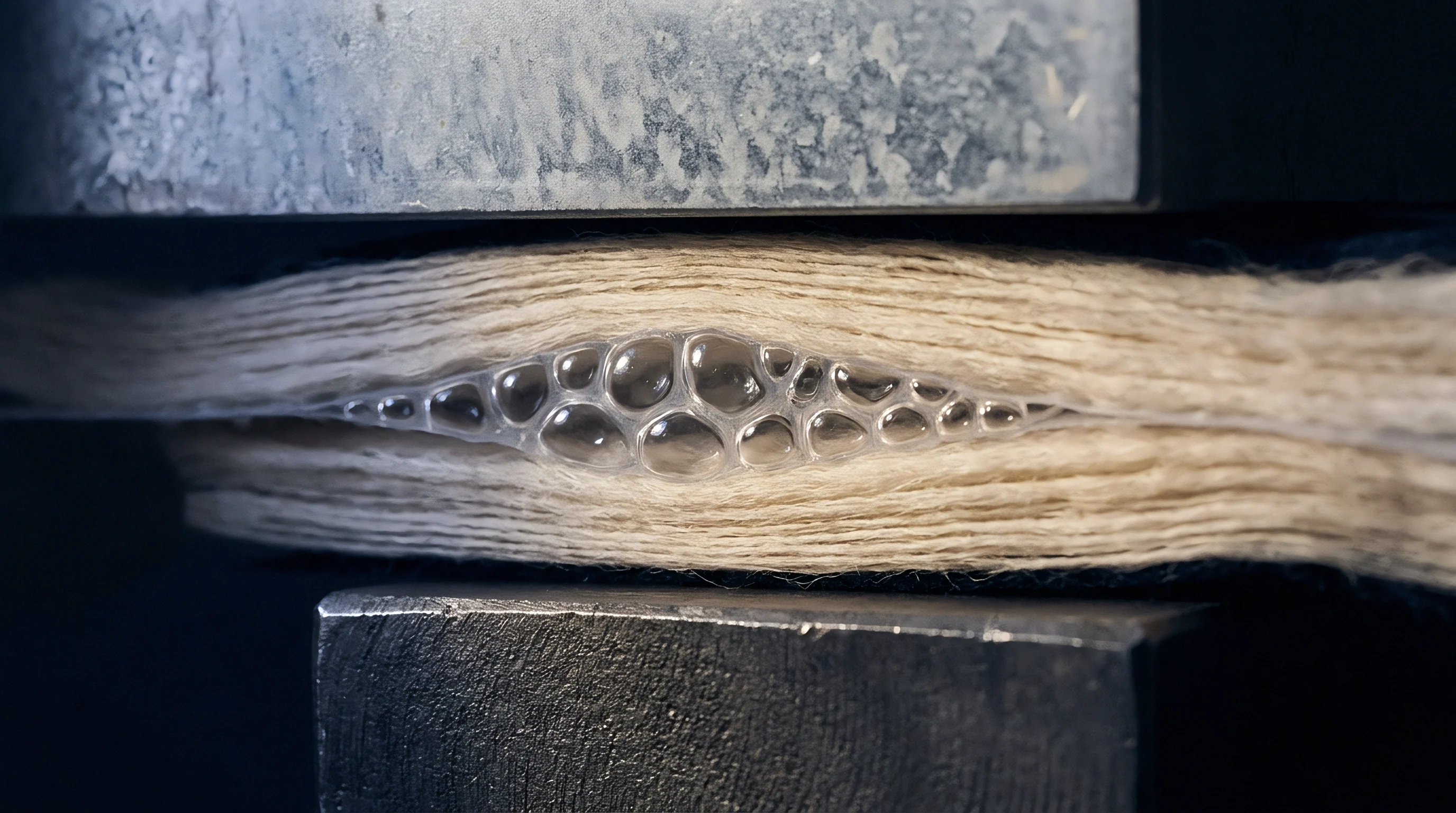
Continuous open-width scouring lines offer an alternative wet path that eliminates rope mark creasing in fine gauge elastomeric blends. Fabric travels over driven immersion rollers into aqueous baths equipped with submerged ultrasonic transducer banks or high-impact water jet manifolds. Cavitation bubbles generated by ultrasonic transducers collapse on yarn surfaces, accelerating chemical penetration and lubricated loop relaxation without applying longitudinal tension.
Continuous relaxation ranges utilize controlled drive zones with frequency-inverter motors. Driven conveyor belts support the submerged fabric weight, maintaining continuous overfeed rates between 10 and 20 percent into the wet bath. This zero-tension aqueous exposure allows fine gauge elastomeric knits to contract naturally before entering thermal drying units, securing low residual shrinkage values without destroying fabric surface aesthetics.
Running high-elastomeric fine knits through jet dyeing vessels with uncalibrated reel speeds causes permanent longitudinal stretching, yielding finished garments that shrink over 15 percent upon home laundering.
Calculus
How Does Tightness Factor Alter Wet Processing Shrinkage?
Predictive dimensional modeling relies on quantifying loop shape factor transformations during wet treatments. The metric tightness factor defines the area covered by yarn relative to the area of the loop. Tightness factor is calculated as the square root of yarn tex divided by loop length in millimeters.
Tight knits resist loop compression. Fine gauge knits operating at high tightness factors between 1.45 and 1.60 contain tight geometric packing, restricting loop head movement during wet swelling operations.
The empirical Starfish model defines fabric dimensional equilibrium using structural constants that connect stitch density and loop shape factors to final fully relaxed dimensions. The model uses course constant Kc, wale constant Kw, stitch density constant Ks, and loop shape factor K. The relationship between courses per centimeter and loop length follows the inverse proportion equation:
Courses per centimeter = Kc / Loop Length (mm)
Wales per centimeter = Kw / Loop Length (mm)
Stitch Density (loops/cm²) = Ks / (Loop Length (mm))²
| Process State | Tightness Factor (K) | Course Constant (Kc) | Wale Constant (Kw) | Area Constant (Ks) |
|---|---|---|---|---|
| Dry Relaxed (Off Knitting Machine) | 1.25 | 5.0 | 3.8 | 19.0 |
| Wet Relaxed (Jet Scoured) | 1.40 | 5.8 | 4.2 | 24.36 |
| Fully Laundering Relaxed (Reference) | 1.55 | 6.2 | 4.4 | 27.28 |
Worked Structural Contraction Calculation
Assume an E32 single jersey cotton fabric knitted at a target loop length of 2.60 millimeters. Off the knitting machine, dry relaxed course density measures 19.23 courses per centimeter based on a Kc of 5.0. Upon entering an aqueous jet dyeing process, the fabric transitions to a wet relaxed state where the course constant Kc shifts from 5.0 to 5.8 due to loop shape restructuring.
Calculating the new wet relaxed course density yields:
Wet Relaxed Courses = 5.8 / 2.60 mm = 22.30 courses per centimeter
To determine total longitudinal contraction percentage resulting from wet processing relaxation:
Contraction (%) = ((22.30 – 19.23) / 22.30) 100 = 13.76 percent
If the finishing line draws machine draft that pulls course density back down to 20.0 courses per centimeter at the stenter exit, the residual potential laundering shrinkage S is calculated against fully relaxed state (Kc = 6.2):
Fully Relaxed Courses = 6.2 / 2.60 mm = 23.85 courses per centimeter
Residual Laundering Shrinkage (%) = ((23.85 – 20.0) / 23.85) 100 = 16.14 percent
This mathematical proof demonstrates that failing to allow complete loop head contraction during wet finishing leaves high residual shrinkage potential locked into the fabric structure.
Whether non-linear friction variations in sub-15 denier elastomeric core yarns corrupt standard Starfish area constant prediction equations across high-speed jet cycles remains an open question on the dyehouse floor.
Overfeed
Stenter Pinning Dynamics and Cross-Directional Tension
Dimensional recovery on the stenter frame depends on mechanical over-feeder differentials. Overfeed systems deliver fabric onto stenter pins at a higher lineal velocity than the stenter transport chain speed. This positive speed differential compresses fabric courses together, feeding excess longitudinal slack directly into the drying chambers.
Overfeed compensates for longitudinal draft. Fine gauge knits require overfeed settings ranging from 15 to 25 percent to compensate for machine strain applied during preceding jet dyeing and extraction steps.
Matching overfeed percentage to the wet contraction potential determined in lab trials is mandatory. If overfeed is set too low, drying under longitudinal tension sets stretched loop shapes permanently into synthetic fibers or temporarily into hydrogen-bonded cellulosic matrix structures. Pinning units must grip fine gauge selvedges cleanly without tearing fine loop walls.
Cross-directional chain width adjustment applies lateral tension, pulling wales out to targeted width while allowing course density to increase naturally.
- Longitudinal overfeed adjustment compensates for machine draft by delivering fabric to stenter pins at 15 to 25 percent above chain speed.
- Cross-directional pin width setting sets the wet fabric width 3 to 5 percent wider than target finished specifications to allow for cooling contraction.
- Thermal chamber dwell time optimization keeps temperatures at 180 degrees Celsius for 30 seconds to lock synthetic filament thermal memory without scorching.
- Mechanical felt belt compacting compression drives rubber blanket compression to force loop heads closer, eliminating residual laundering shrinkage.
Delivering fabric above the specified five percent dimensional stability threshold triggers automatic lot rejection under standard commercial supply agreements.

Chemical Crosslinking and Mechanical Compacting Mechanics
Resin application alters cellulosics by creating covalent bonds. DMDHEU (dimethyloldihydroxyethyleneurea) resins crosslink hydroxyl groups within amorphous cellulose regions, restricting fiber swelling upon subsequent aqueous immersion. Resins lock cellulosic polymer chains.
Applying 30 to 45 grams per liter of ultra-low formaldehyde crosslinking resin reduces cellulosic fine knit wet contraction from 14 percent down to under 3 percent. Crosslinking reduces fiber moisture regain and lowers fabric tensile strength by 15 to 20 percent.
Mechanical compacting machines utilize steam-heated cylinders paired with thick rubber blankets or felt belts to deliver non-chemical dimensional stabilization. Fabric enters the compacting zone pinched between a rubber blanket and a heated chrome cylinder. As the compressed rubber blanket relaxes and contracts linearly, it forces fabric loop heads closer together, increasing course density mechanically.
Compacting sets final fabric density. For fine gauge circular knits, compacting units achieve up to 12 percent length compression, locking finished dimensional stability below 4 percent residual shrinkage across repeated laundering cycles.
Standard purchasing contracts stipulate that finished goods displaying over 5.0 percent dimensional change under ISO 6330 laundering test protocols entitle the buyer to full credit memo issuing or bulk lot return at supplier expense.
Dossier
Dimensional Testing under ISO Standards
Standardized dimensional testing quantifies structural movement across multiple laundering cycles. Testing protocol ISO 5077 paired with ISO 6330 washing procedures provides the universal commercial baseline for evaluating fine gauge knit shrinkage. Square test specimens measuring 50 centimeters by 50 centimeters receive conditioned conditioning at 20 degrees Celsius and 65 percent relative humidity for 24 hours prior to marking bench lines.
Digital camera measurement systems track distance changes between benchmark dots after specified washing and drying cycles.
Testing must account for drying methods. Tumble drying accelerates loop shape relaxation through continuous mechanical agitation, surfacing maximum shrinkage potential. Flat drying or line drying leaves partial mechanical tension in the loops, under-reporting true end-user laundering contraction.
Unrelaxed knits fail garment testing. For fine gauge synthetic elastomeric blends, evaluation mandates testing dimensional change after thermal dry-cleaning or steam pressing to verify high-temperature stability prior to cutting room spreading operations.
| Test Standard | Parameter Evaluated | Test Condition | Standard Target Limit | Rejection Threshold |
|---|---|---|---|---|
| ISO 5077 / ISO 6330 | Length Dimensional Change | 40°C Normal Wash, Tumble Dry | ± 4.0 % | > − 6.0 % |
| ISO 5077 / ISO 6330 | Width Dimensional Change | 40°C Normal Wash, Tumble Dry | ± 4.0 % | > − 6.0 % |
| ISO 16322 | Fabric Spirality / Skew | Post 3 Laundering Cycles | < 3.0 % | > 5.0 % |
| AATCC 135 | Dimensional Stability | 105°F Machine Wash, Tumble Dry | ± 3.5 % | > − 5.0 % |

Specification Tolerances for Commercial Sourcing
Commercial purchasing agreements specify acceptable dimensional variance across fine gauge bulk knits. Technical specification sheets set explicit limits on mass per unit area, course density, wale density, spirality, and residual shrinkage. Tolerances protect cutting room layouts.
Garment cutting markers demand stable roll-to-roll widths; width variation exceeding 1.5 centimeters off specified cuttable width disrupts automated knife paths, causing panel mismatch during garment assembly.
Dyehouses must control finishing overfeed to ensure bulk rolls meet exact square-meter weight targets without compromising dimensional stability. Pushing stenter overfeed excessively high increases mass per unit area artificially while leaving fabric susceptible to width expansion during steam pressing. Balancing physical stitch density, loop length parameters, chemical crosslinking levels, and mechanical compacting yields fine gauge knitted goods that maintain tight geometric stability throughout wet processing, garment manufacturing, and consumer laundering care cycles.