Modeling Non Linear Viscoelastic Yield Limits in High Density Cotton Twill Wet Processing
Exceeding wet viscoelastic yield limits in dense cotton twill causes permanent width loss and latent warp shrinkage that destroys commercial garment marker yields.
Rheology
Cellulosic fibers in high-density 3/1 warp-faced woven structures exhibit complex strain behavior when exposed to aqueous chemical baths. Dense woven builds, characterized by high thread counts such as 42 ends per centimeter and 24 picks per centimeter using 30 tex combed cotton yarns, create significant mechanical restraint within the fabric matrix. When immersed in aqueous baths during desizing, scouring, or dyeing, water molecules rapidly break hydrogen bonds within the amorphous regions of the native cellulose microfibrils.
This molecular cleavage reduces the elastic modulus of the fiber while increasing its susceptibility to time-dependent plastic deformation under applied line tension.
Cotton fibers absorb aqueous chemistry rapidly.
The structural response of dense twill under wet tension is non-linear and strain-rate dependent. At low tensile loads, hydrated amorphous cellulose displays linear viscoelastic recovery, returning to its equilibrium orientation once tension releases. When process tension crosses the viscoelastic yield threshold, polymer chains slip permanently along microfibrillar boundaries.
In high-density twills, this yield point drops substantially as bath temperature rises from 20°C to 95°C, further decreasing when swelling agents such as sodium hydroxide enter the liquor.

Amorphous Cellulose Swelling under Hydrothermal Stress
Water molecules enter the inter-crystalline regions of natural cotton upon immersion, breaking secondary crosslinks between adjacent polymer chains. Hydrothermal processing weakens the intra-molecular hydrogen bonding framework that maintains native cellulosic rigidity. As thermal energy increases, kinetic vibration expands the free volume between cellulose chains.
This physical expansion lowers the activation energy required for molecular slip under external tensile forces.
The reduction of amorphous hydrogen bond density during hot aqueous processing lowers the mechanical yield limit of cotton twill yarns by over forty percent compared to dry conditioning.
The combination of thermal energy and aqueous saturation converts rigid crystalline-bounded networks into flexible polymer systems. Cotton yarns in dense twill weaves experience crimp redistribution as warp yarns align under tension while fill yarns bend further around the straightened warp. The high packing density of 3/1 twill intensifies lateral compression between adjacent yarns during warp extension.
This structural constraint forces wet yarn cross-sections to flatten, locking in permanent cross-web contraction if processing tension exceeds the yield boundary.
Constitutive Stress Strain Behavior in Saturated Yarns
When mechanical forces act upon hydrated cotton threads during continuous web movement, force deformation profiles deviate significantly from Hookean linear elasticity. Initial loading exhibits elastic deformation governed by crystalline microfibril stiffness. As axial tension surpasses the yield strain limit, the response shifts to non-linear viscoelastic creep, characterized by a rapid drop in tangential modulus.
The rate of deformation accelerates non-linearly with increases in line tension and bath temperature.
Hydrogen bonds dissociate under heat.
Modeling this wet deformation requires constitutive equations incorporating stress-dependent viscosity and non-linear strain hardening. The Eyring thermal activation model effectively describes the molecular slip of cellulose chains across potential energy barriers under wet mechanical loading. Beyond the yield strain threshold, plastic flow dominates, generating permanent structural changes that persist through subsequent drying steps.
A practical engineering guideline dictates that processing tension on wet high-density twill must never exceed the lower limit of the strain rate transition zone identified on the force-elongation curve.
Pad
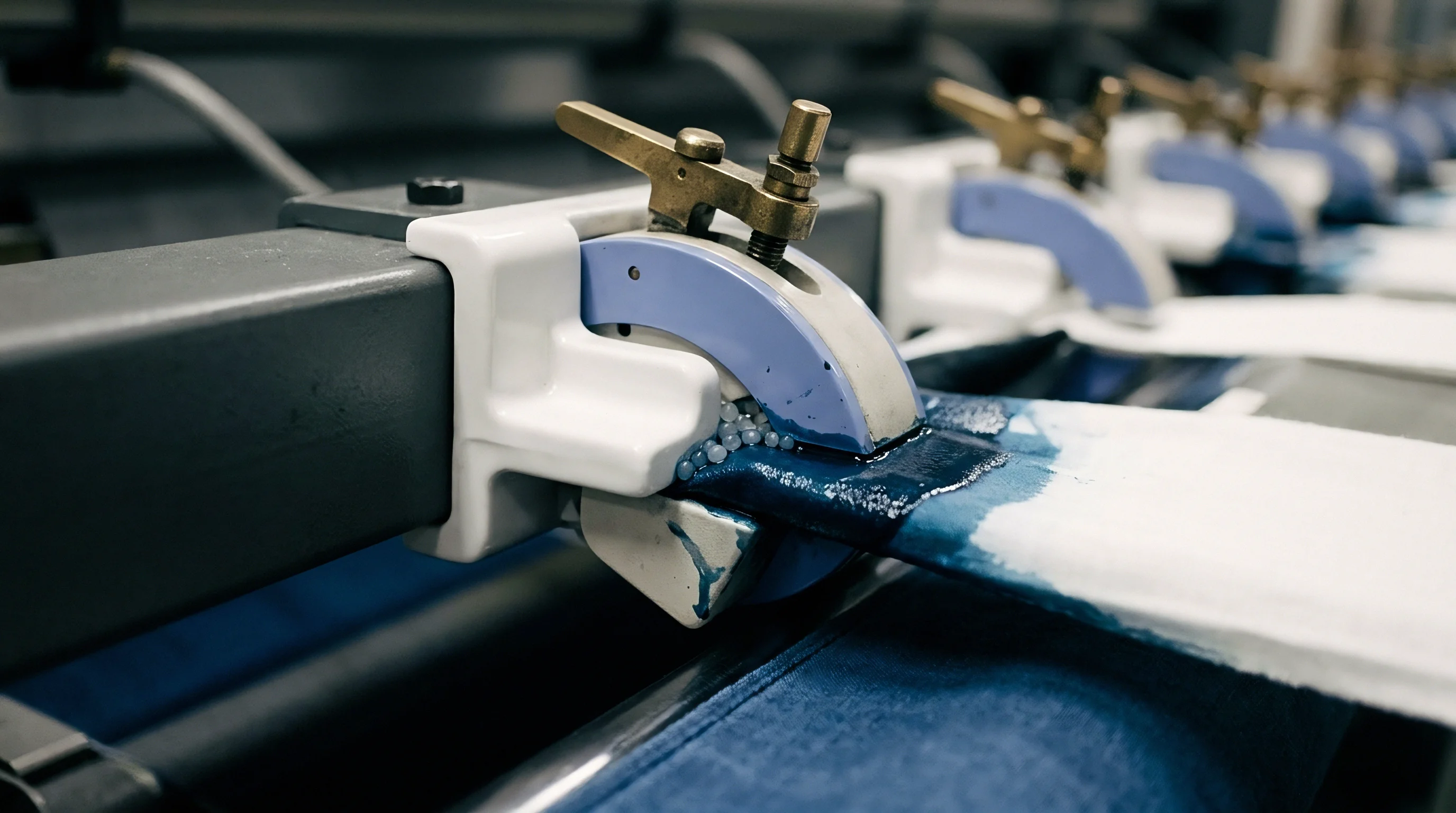
Liquid impregnation ranges exert significant compressive and tensile forces on wet woven structures. Continuous pad-dry-cure systems, pad-batch dyeing setups, and continuous scouring lines pass wet fabric through high-pressure roller nips to enforce liquor penetration. In high-density cotton twill, the combination of hydraulic pressure in the nip squeeze and longitudinal transport tension induces combined axial and transverse stress states.
These combined stresses frequently trigger localized viscoelastic yielding in saturated yarns.
Roller Nip Strain and Wet Cross Sectional Distortion
Squeegee pressure drives fluid into the inner void spaces of dense weave interlacings while simultaneously forcing individual threads into flattened cross-sectional profiles. Nip squeeze pressures ranging from 20 to 50 kilonewtons per meter compress the wet, swollen yarns beyond their transverse elastic limit. This mechanical squeezing forces water through the microscopic pores of the weave, inducing localized hydraulic shear stresses along the yarn boundaries.
Squeegee force determines bath pickup.
When high nip pressure coincides with excessive web transport tension, warp yarns undergo irreversible axial extension while fill yarns lock into extreme crimp profiles. This structural distortion alters the balance between warp and fill cover factors. The resulting asymmetry manifests as permanent fabric narrowness, severe face-to-back shade variations, and pronounced skewing of the 3/1 twill line across the usable width.
Continuous Scouring and Mercerization Tension Limits
Caustic liquor treatment at elevated concentrations swells natural cotton fibers, converting native Cellulose I crystal lattices into dense Cellulose II forms. Mercerization baths containing 22 to 28 percent sodium hydroxide solution induce extreme intra-crystalline swelling, causing cotton fibers to untwist and assume round cross-sections. In this highly swollen condition, the yield strength of the cellulose substrate reaches its absolute minimum during the entire wet finishing sequence.
| Processing Stage | Chemical Condition | Operating Temperature | Critical Tension Boundary | Primary Yield Failure Mode |
|---|---|---|---|---|
| Continuous Desizing | Enzymatic aqueous liquor | 60°C to 70°C | 180 N/m web tension | Warp elongation and crimp loss |
| Caustic Scouring | 40 g/L NaOH pad solution | 95°C to 100°C | 140 N/m web tension | Viscoelastic yield and center bow |
| Mercerization | 250 g/L NaOH swelling bath | 15°C to 25°C | 220 N/m web tension | Irreversible width contraction |
| Pad-Steam Dyeing | Reactive dye and alkali bath | 102°C saturated steam | 110 N/m web tension | Face-to-back shade differential |
| Stenter Drying | Aqueous finish application | 150°C to 180°C | 250 N/m web tension | Thermal fixation of permanent set |
Exceeding mechanical tension boundaries during continuous wet processing triggers specific, reproducible defects in heavy twill constructions:
- Warp Crimp Elimination occurs when axial line tension flattens warp yarn interlacing contours, transferring total weave crimp into the fill yarns and reducing overall length recoil.
- Center-to-Selvedge Density Gradient develops as lateral contraction forces edge threads into dense alignments while the fabric center stretches thin under longitudinal draw.
- Twill Line Skewing manifests when asymmetrical drive torque across conveyor rollers rotates the diagonal twill angle away from its perpendicular axis.
- Hydrophilic Set Loss emerges when permanent structural distortion locks cellulose polymer chains into strained orientations, impairing subsequent moisture absorption during dyeing.
Tension transforms yarn geometry permanently.
Finishing mills frequently claim that post-dyeing stenter framing fully restores nominal fabric dimensions and eliminates structural distortion created during continuous pad processing.

Stress
Tensile loads applied to wet cotton twill during continuous jet dyeing or jigger transport force polymer chains to slip past one another. Modeling this non-linear viscoelastic yield requires quantitative expressions that account for stress level, temperature, and moisture content. The total strain response combines instantaneous elastic deformation, time-dependent viscoelastic creep, and permanent plastic set.
When processing stress exceeds the material’s yield point, plastic strain dominates the fabric response.
Mercerization amplifies lateral chain mobility.
Which Constitutive Models Predict Permanent Set under Dye Jigger Tension?
Classical linear viscoelastic representations fail when axial force levels cross the physical yield threshold of hydrated cellulosic assemblies. The Bingham plastic model introduces a discrete yield limit but neglects time-dependent post-yield creep relaxation. A modified Eyring constitutive model incorporates an activation volume parameter, accurately mapping how tensile force lowers the energy barrier for molecular chain slippage in wet fibers.
The Eyring activation model predicts non-linear viscoelastic yield in 320 gsm cotton twill with an absolute error under four percent when bath temperature exceeds eighty degrees.
In high-density 3/1 twill weaves, yarn-to-yarn friction adds a macro-structural yield component to the intrinsic polymer yield point. Internal pressure between densely packed warp and fill threads resists initial deformation until external line tension overcomes inter-yarn contact forces. Beyond this macro-yield limit, yarn sliding accelerates rapidly, creating permanent structural changes that standard linear models cannot predict.
Mathematical Formulation of Eyring Rate Parameters in Wet Twill
Thermally activated polymer slip governed by potential energy barrier theory provides an accurate mathematical representation for non-linear deformation rates. The plastic shear strain rate is expressed as an exponential function of applied stress, activation energy, and temperature. Incorporating a hydration scaling factor accounts for the plasticizing effect of water molecules on the cellulosic amorphous matrix.
Consider a worked engineering calculation for a 340 grams per square meter combed cotton 3/1 twill running through a continuous dyeing range at 85°C. Assume a web tension of 160 N/m, a yarn hydration level of 85% water pickup, an activation volume of 1.8 cubic nanometers, and an un-strained activation energy of 115 kilojoules per mole. Under these specified conditions, the Eyring model yields the calculated strain parameters outlined below.
| Model Variable | Physical Description | Calculated Value | Engineering Unit |
|---|---|---|---|
| Yield Stress Threshold | Critical stress for plastic slip onset | 2.45 | Megapascals |
| Apparent Viscosity | Wet non-linear fluid flow resistance | 1.28 x 10^5 | Pascal-seconds |
| Viscoelastic Relaxation Time | Time constant for stress decay | 14.2 | Seconds |
| Instantaneous Elastic Modulus | Initial elastic stiffness in hot bath | 38.5 | Megapascals |
| Permanent Set Strain Rate | Rate of irreversible elongation | 3.12 x 10^-4 | Per second |
Continuous web processing equipment must maintain operating tension below the calculated yield stress threshold to prevent unrecoverable fabric deformation.
- Monitor Web Tension Continuously using load cells installed on every roller transport drive across the wet processing range.
- Scale Tension to Temperature Profiles by reducing applied line force as bath temperatures pass sixty degrees Celsius.
- Adjust Speed Differentials between adjacent driven rolls to compensate for wet length changes without inducing tensile creep.
- Maintain Squeegee Uniformity to prevent localized variations in moisture pickup that alter the yield limit across the fabric width.
Linear models fail in production.
Running wet heavy cotton twill above its critical viscoelastic stress limit permanently alters warp density, causing catastrophic width reduction that destroys commercial garment cutting layouts.
Recovery
Thermal drying inside stenter frames establishes the final dimensional equilibrium of finished woven fabrics. When wet fabric enters the stenter drying chamber, hot air currents evaporate moisture, causing cellulose microfibrils to reform hydrogen bonds in their current spatial orientation. If the fabric enters the dryer in a highly strained state, this thermal setting process locks in permanent plastic deformation, suppressing elastic recoil and preventing dimensional recovery.
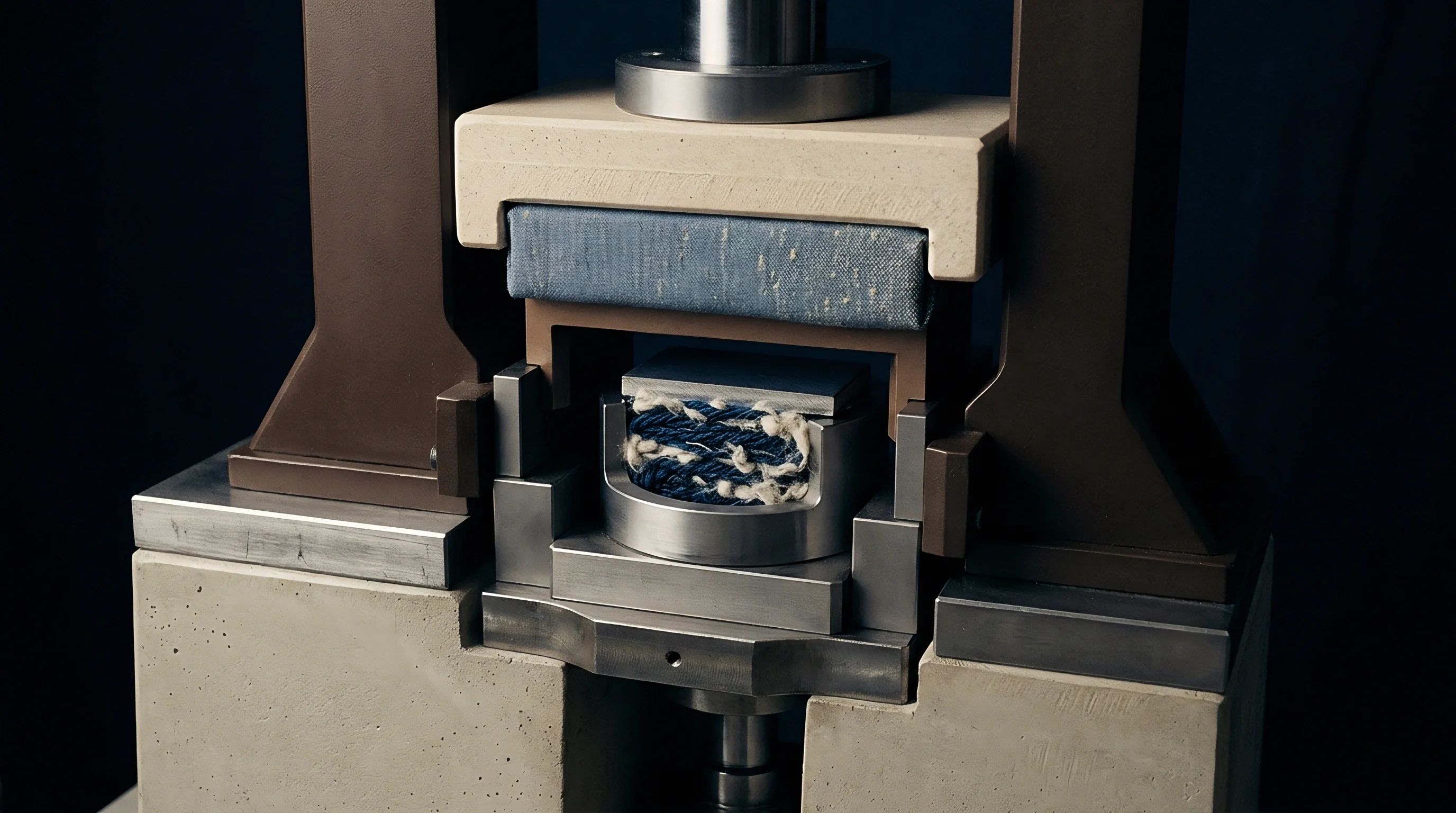
Stenter Overfeed Optimization to Eliminate Residual Warp Set
Controlled longitudinal feeding of wet web into pin chains allows distorted yarn crimp to recoil before heat sets the material. Applying an overfeed rate between plus three percent and plus eight percent compensates for warp elongation accumulated during earlier washing, scouring, and dyeing operations. Overfeeding feeds fabric onto the stenter pins faster than the chain transport speed, creating mechanical slack that allows warp yarns to retake their natural woven wave contour.
Standard EN ISO 5077 requires dimensional stability testing after three complete washing cycles, exposing un-recovered viscoelastic creep as severe washing shrinkage.
Overfeeding neutralizes longitudinal strain accumulation.
As water evaporates inside the stenter housing, hydrogen bonds reform between cellulose chains, stabilizing the re-established crimp balance. Regulating heat setting temperatures between 150°C and 170°C ensures thorough drying without causing thermal degradation of natural cellulosic fibers. Precise control of overfeed percentages matches web speed to fabric relaxation rates, eliminating latent strain before dry crosslinking fixes yarn locations.
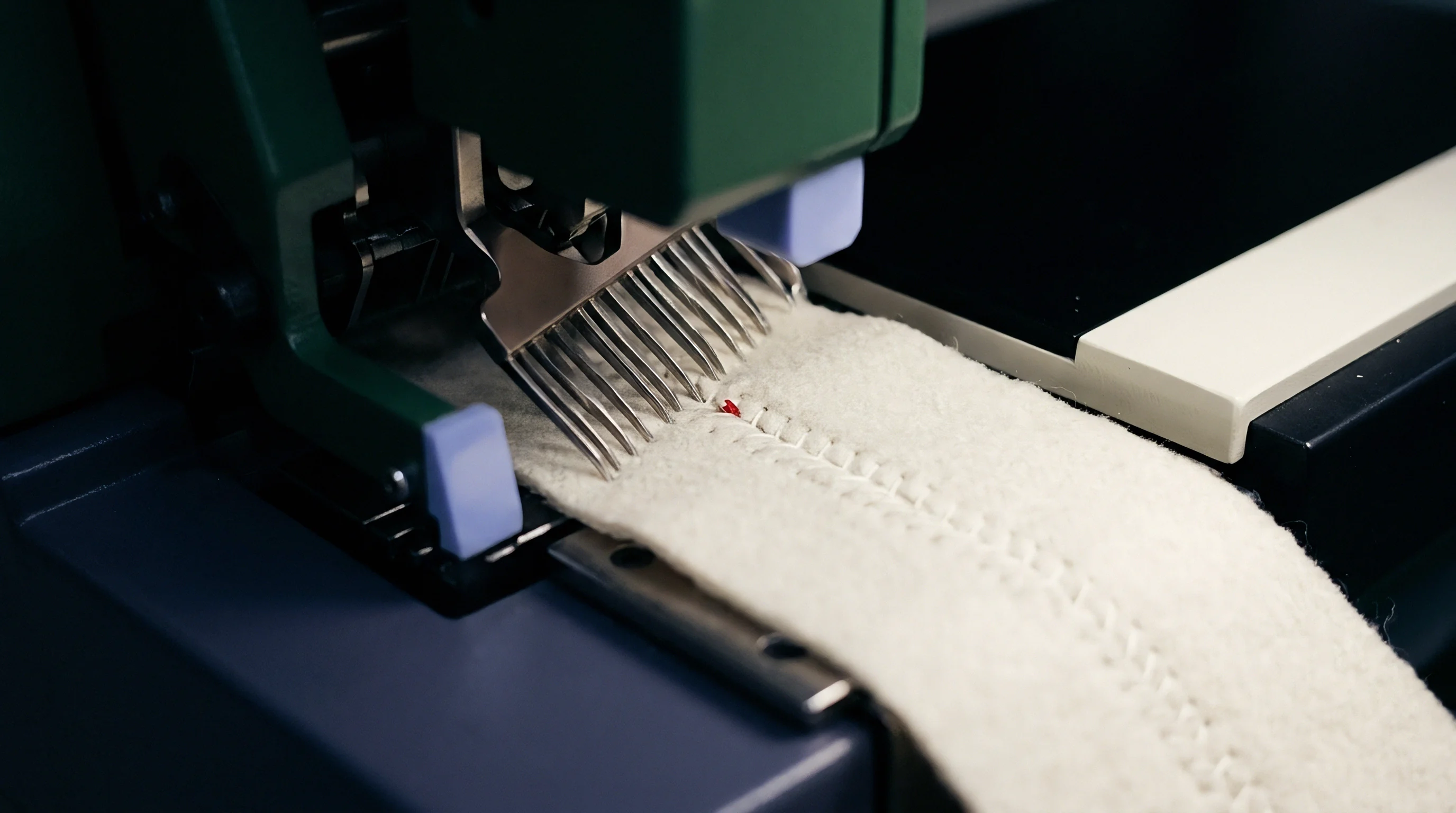
Laboratory Qualification Methods for Moisture Induced Creep
Standardized testing procedures evaluate delayed deformation in conditioned specimens subjected to dead-weight loading under controlled relative humidity. Evaluating non-linear viscoelastic recovery requires measuring both immediate elastic rebound and time-dependent creep recovery after stress removal. ISO 13934 tensile testing methods, modified with sustained dwell times at sub-yield force levels, isolate plastic set from recoverable viscoelastic strain.
Saturated yarns yield under tension.
- Cut five warp and five fill specimens measuring fifty millimeters by two hundred and fifty millimeters from conditioned bulk fabric rolls.
- Mount each specimen in a tensile tester operating under standard ambient conditions of twenty degrees Celsius and sixty-five percent relative humidity.
- Apply a pre-tension load of two Newtons to straighten initial specimen slack without inducing plastic strain.
- Immerse the mounted specimen in a temp-controlled distilled water bath at eighty degrees Celsius for ten minutes to achieve full hydration.
- Ramp tensile load to thirty percent of maximum breaking force at a rate of fifty millimeters per minute.
- Hold maximum test load for a dwell duration of six hundred seconds while recording total specimen elongation.
- Unload the specimen rapidly to zero force and measure immediate elastic recovery.
- Maintain the un-loaded specimen in the wet state for eighteen hundred seconds to record time-dependent viscoelastic creep recovery.
- Dry the specimen flat without tension at one hundred and five degrees Celsius to fix the final unrecoverable plastic set.
- Calculate permanent strain percentage by dividing residual specimen elongation by the original benchmark gage length.
Drying fixes structural yarn displacement.
Which specific combination of overfeed percentage, dwell time, and moisture removal rate achieves zero residual warp creep in heavy twills without triggering selvedge pucker?
Ledger
Uncontrolled fabric elongation across continuous wet processing ranges directly degrades garment yield and manufacturing profitability. When wet yield limits are exceeded, high-density cotton twill permanently gains length while losing width. A mill shipping fabric that stretched two percent in length and lost three centimeters of usable width forces garment cutters to re-engineer marker layouts, increasing textile waste and driving up garment unit costs.

Width Allowance Specifications and Commercial Tolerances
Purchase contracts specify usable cuttable fabric margins alongside nominal weight per square meter target values. When non-linear viscoelastic creep narrows fabric width below agreed purchase tolerances, garment factories cannot lay out pattern pieces efficiently. Fabric weight per square meter also drops proportionally as longitudinal stretching thins out the fill pick count per centimeter.
Wet yield alters finished GSM.
Excessive draft reduces cutting width.
| Production Variable | Baseline Target | Exceeded Yield Limit State | Commercial Consequence | Financial Cost Impact |
|---|---|---|---|---|
| Usable Cuttable Width | 148 centimeters | 141 centimeters | Marker layout pattern loss | 4.7 percent fabric scrap increase |
| Finished Mass (GSM) | 320 g/m² nominal | 302 g/m² actual | Sub-weight spec rejection | 100 percent lot re-processing claim |
| Warp Washing Shrinkage | Less than 2.0 percent | 5.8 percent actual | Garment sizing distortion | Bulk garment customer chargeback |
| Twill Line Skewing | Less than 1.5 degrees | 3.8 degrees actual | Leg twist in finished pants | Garment factory reject rate surge |
| Refining Yield Loss | 1.0 percent target | 3.5 percent actual | Unrecoverable length trim | Direct loss of billable meters |
Financial recovery mechanisms for processing defects rely on rigorous incoming fabric verification against master technical specifications.

Contractual Risk Allocation for Wet Processing Yield Failures
Converter agreements must establish clear mechanical strain thresholds before greige fabric enters continuous finishing ranges. Standard commercial purchase contracts incorporate tolerances defined under ASTM D3774 for fabric width and ISO 5077 for dimensional change. When laboratory testing proves that bulk fabric batch failures stem from excessive processing tension rather than greige weaving defects, financial liability transfers directly to the wet processing mill.
A standard quality addendum specifies that fabric exhibits less than two percent dimensional change after three domestic washes, penalizing wet processing mills for tension-induced permanent set.
Residual strain drives garment distortion.
Standard sales agreements state that buyer acceptance of fabric rolls delivered to the cutting room waives all subsequent claims regarding width loss or latent dimensional instability resulting from wet processing tension.