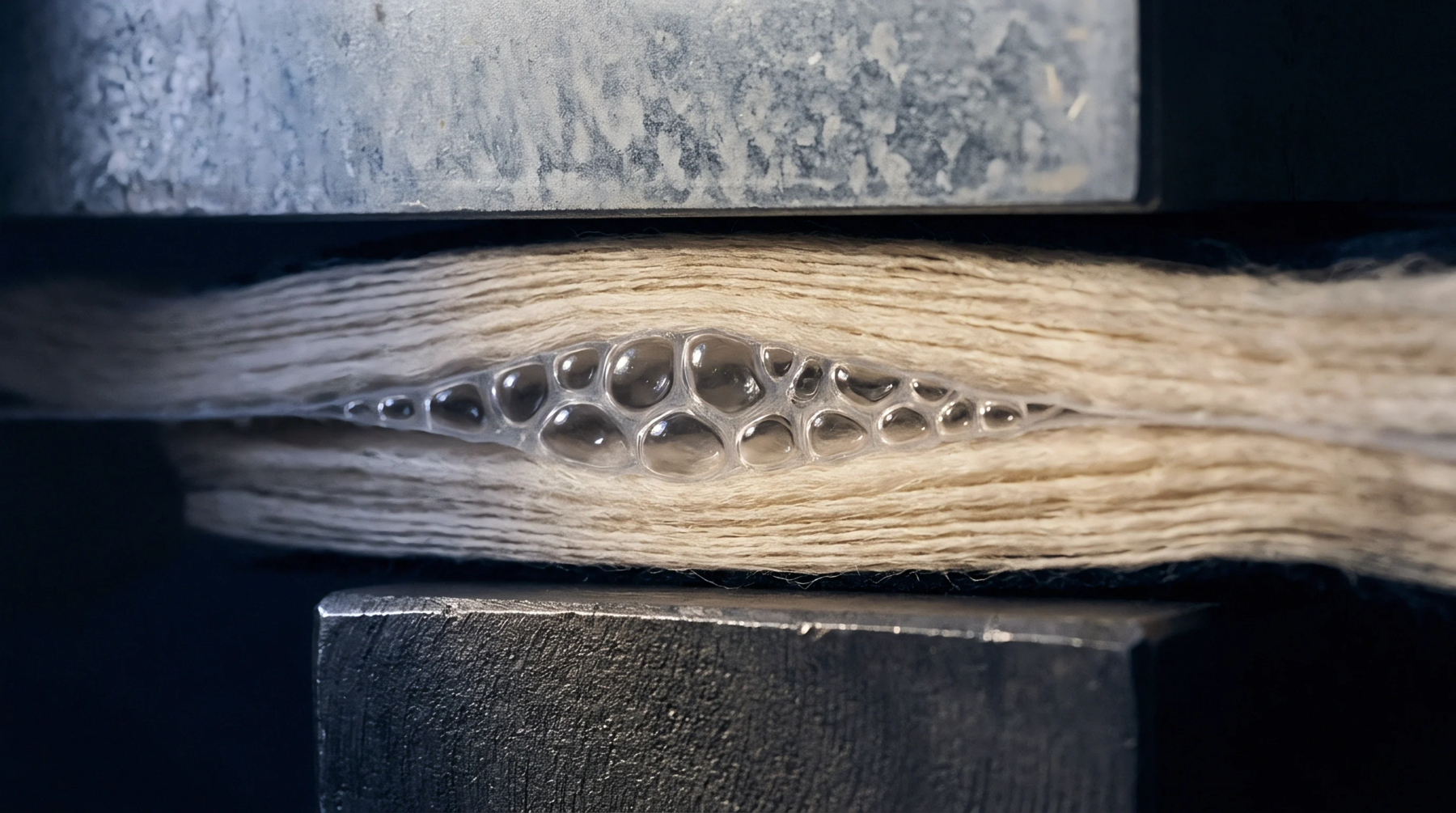
Structural Void
Open spaces bounded by the intersections of warp and weft yarns, or adjacent loop courses in knits, form macroscopic conduits for bulk fluid and gas transport across a fabric structure. Fabric porosity analysis classifies inter-yarn macropores as the voids larger than individual yarn cross-sections, ranging typically from ten to several hundred micrometres in equivalent diameter. These spaces govern air permeability, convective liquid transfer and particulate filtration efficiency in woven, braided and knitted architectures.
The classification excludes microscopic voids occurring between individual filaments inside a single yarn bundle, as well as sub-micron polymer voids.
Hydrodynamic Function
Fluid moving through a porous fabric under pressure follows the path of least resistance across these macroscopic pathways. Convective flow dominates within the inter-yarn voids, while capillary diffusion slowly draws liquid into the denser adjacent yarn bodies. When these pores are excessively large, water-repellent finishes fail because hydrostatic head pressure easily forces liquid droplets through the fabric grid.
Tightening warp and weft densities squeezes these pores closed, shifting permeability toward intra-yarn flow mechanisms. High macropore volume enhances thermal convection and garment breathability in activewear garments.
Inspection Methods
Optical microscopy, air permeability testing to ISO 9237 and liquid extrusion porometry quantify the size distribution of these macroscopic apertures. In filtration media, bubble point testing identifies the largest macropore present, which dictates the absolute particle retention rating of the fabric. Mills verify yarn density during greige inspection to ensure that macropore dimensions remain within commercial tolerance limits.
Variations in weaving tension cause pore distortions that appear as streaky air permeability across the fabric roll width.
Finishing Alteration
Mechanical compaction processes like calendering and sanforizing deform adjacent yarns, flattening macropores to restrict air passage and increase water resistance. In downstream wet processing, macropore collapse during aggressive chemical scouring causes unexpected shrinkage and altered fluid uptake rates. Conversely, caustic soda mercerization swells cotton fibres, narrowing the open macropore channels while enhancing overall fabric lustrousness.
The dimensional stability of these pores determines whether a technical fabric maintains target acoustic dampening or particulate capture values during laundering.