Woven Fabric Crimp Measurement and Yarn Take up Analysis
Woven fabric crimp measurement converts raw fabric dimensions into actual yarn consumption and linear density corrections required for precise material costing.


Tension
Laboratory evaluation of structural yarn bending relies on precise mechanical pulling to eliminate undulations without inducing filament elongation. When yarn is woven into cloth, beat-up forces and intersection geometry force individual threads into serpentine wave paths. Removing a thread from woven fabric and measuring its straightened length reveals the difference between fabric dimensions and actual yarn length.
Applied load during this measurement determines whether the analyst measures pure geometric waviness or unwanted fiber deformation.
ISO 7211-3 and ASTM D3883 establish standard procedures for determining yarn crimp and yarn take-up in woven textiles. The distinction alters buying models. Both standards mandate that extracted yarns undergo straightening under a specified pretension force based on yarn linear density.
Standard pretensioning levels set the load at 0.5 cN per tex for spun yarns and continuous filaments. For delicate, highly extensible, or textured yarns, standard provisions reduce this force to 0.25 cN per tex or 0.2 cN per tex. Insufficient load fails to remove full wave amplitude, yielding artificially low crimp figures.
Excessive load stretches the yarn past its uncramped length, artificially inflating both crimp and take-up metrics.

Standardized Straightening Forces
Standard ISO 7211-3 specifications specify a pretension load calculated directly from the nominal linear density of the thread. Technicians adjust weight loads on manual crimp testers or digital load cells to match batch yarn counts before specimen isolation. Cotton system yarns ranging from 10 tex to 100 tex receive proportional loading scales to maintain uniform stress during manual uncrimping.
Continuous filament polyester and polyamide yarns require exact load calibration because low yield points allow irreversible drawing during hand extraction.
| Yarn Type and Composition | Nominal Linear Density (tex) | ISO 7211-3 Target Load (cN/tex) | Applied Tension Force (cN) | Measured Warp Crimp (%) | Measured Weft Crimp (%) |
|---|---|---|---|---|---|
| Ring Spun Combed Cotton | 20 tex (30s Ne) | 0.50 | 10.0 | 9.2 | 6.4 |
| Open-End Rotor Cotton | 30 tex (20s Ne) | 0.50 | 15.0 | 8.1 | 5.8 |
| Air-Jet Viscose Staple | 15 tex (40s Ne) | 0.50 | 7.5 | 11.4 | 7.2 |
| Textured Polyester Filament | 16.7 tex (150d) | 0.25 | 4.2 | 14.8 | 9.1 |
| Flat Nylon Continuous Filament | 7.8 tex (70d) | 0.20 | 1.6 | 7.6 | 12.3 |
| Worsted Wool Ring Spun | 25 tex (40s Nm) | 0.50 | 12.5 | 12.2 | 8.5 |
| Data gathered under standard conditioning conditions of 20 degrees Celsius and 65 percent relative humidity. Target loads apply to extracted single threads prior to linear mass calculations. | |||||

Mathematical Relationship between Metrics
Calculated values for thread shortening and structural extension describe identical physical geometry through distinct reference bases. Crimp percentage expresses yarn waviness as an increase relative to the woven fabric length. Take-up percentage, also referred to as yarn retraction or contraction, expresses thread shortening as a fraction of the fully straightened yarn length.
Representing fabric length as L sub f and straightened yarn length as L sub y establishes the exact mathematical identities.
Crimp percentage equals one hundred times the quantity of straightened length minus fabric length, divided by fabric length. Take-up percentage equals one hundred times the quantity of straightened length minus fabric length, divided by straightened length. Conversion between the two metrics follows direct arithmetic formulas.
Crimp percentage divided by the sum of one plus crimp percentage decimal value equals take-up percentage. Take-up percentage divided by the quantity of one minus take-up percentage decimal value equals crimp percentage.
Applying a 0.5 cN/tex pretension load on continuous filament polyester removes interlace waviness while keeping permanent filament elongation under 0.05 percent.
Execution of laboratory yarn straightening follows a strict sequence to ensure data integrity across multiple fabric samples.
- Condition fabric swatches for twenty-four hours in an atmosphere maintained at twenty degrees Celsius and sixty-five percent relative humidity.
- Cut rectangular test strips measuring fifty centimeters along the warp axis and ten centimeters along the weft axis, taking care to avoid selvage boundaries.
- Ravel parallel threads from the long edges until exactly ten testing yarns remain isolated in the central strip width.
- Mark two reference benchmarks spaced precisely two hundred millimeters apart across the central span of the woven specimen using a fine-line indelible marker.
- Clamp one end of an isolated yarn into the fixed grip of the crimp testing apparatus without applying initial axial twist.
- Thread the opposite yarn end through the movable clamp, attaching the appropriate pre-calculated tension weight to the load arm.
- Release the movable clamp mechanism smoothly to allow the pre-calculated load to straighten the thread wave across the measuring scale.
- Record the distance between the two marked benchmarks on the extended thread scale to the nearest half-millimeter.
- Repeat the extraction and measurement process across ten warp threads and ten weft threads selected from non-overlapping weave zones.
Applying excessive load during crimp testing elongates individual filaments, artificially inflating the recorded yarn length and causing significant yarn volume shortfalls when purchasing raw material for large weaving orders.

Geometry
The physical spatial path taken by warp and weft threads governs how much yarn resides within a given square meter of woven cloth. Thread diameter, thread density, and interlacing frequency combine to define fabric thickness and yarn consumption. Loom tension settings drive this behavior during weaving.
High warp tension holds warp ends taut, forcing weft picks to do the majority of bending around the straight warp lines. Low warp tension permits warp yarns to bend heavily, shifting crimp distribution toward the longitudinal axis.
Balanced fabric geometry occurs when warp crimp percentage equals weft crimp percentage, creating isotropic tensile performance across orthogonal axes. Commercial weaving practice rarely yields balanced crimp. Plain weaves present maximum thread bending due to one-over-one interlacing at every thread intersection.
Plain weave generates maximum wave. Twill and satin weaves extend float lengths across multiple threads, reducing intersection frequency and lowering structural crimp values.
Interlacing Density across Weave Structures
Warp yarn passing over and under sequential weft threads creates wave peaks that store excess yarn length inside the fabric plane. In a standard plain weave, every yarn intersection introduces a bending pivot point. Float length dictates axis slope.
Float length increases in twill or satin constructions allow threads to pass straight over adjacent yarns, reducing total undulation per unit length. Twill weaves reduce crimp value.
Thread packing limits also influence vertical crimp height. High pick counts in dense poplins prevent weft threads from remaining flat, forcing weft picks into high-amplitude crimp waves while warp ends remain nearly straight. Conversely, heavy filling yarns in rib fabrics bend warp threads around wide diameters, increasing warp crimp to levels exceeding fifteen percent.

Yarn Flattening and Reed Space Contraction
Cross-sectional deformation under loom beat-up alters the distance between adjacent yarn axes. Flexible spun yarns flatten from circular cross-sections into elliptical profiles under beat-up pressure at the felt line. Flattening reduces effective wave amplitude, decreasing crimp percentage compared to rigid, non-deformable monofilaments.
Weave geometry controls yarn intake.
Off-loom relaxation triggers immediate fabric contraction along both axes once warp sheet tension releases at the take-up roller. Grey fabric width measured in the reed space of the loom shrinks to a narrower off-loom grey width. Wet finishing, scouring, and heat setting induce further dimensional consolidation.
Wet processing relaxes residual yarn strains, locking high crimp levels into finished apparel fabrics.
- Interlacing Frequency Deficit reduces warp yarn consumption per meter in satin weaves compared to plain weaves constructed from identical yarn counts.
- Asymmetric Warp Tension Peak shifts thread bending entirely into the weft system, causing severe widthwise fabric shrinkage during off-loom relaxation.
- Yarn Compression Resistance prevents coarse open-end rotor yarns from flattening at interlace points, forcing higher fabric thickness profile elevations.
- Finishing Thermal Contraction shrinks synthetic filament yarns during stenter drying, multiplying geometric crimp values beyond weaving room calculations.
Higher interlacing frequency shifts a greater proportion of total yarn length into vertical wave amplitude rather than horizontal fabric extension.
Unbalanced yarn tension across the loom shed forces the weaker thread system to absorb the higher percentage of crimp amplitude during beat-up.

Calculus
Determining actual material requirements relies on precise conversions between fabric dimensions and extracted thread lengths. Raw yarn purchasing based solely on square fabric weight and nominal thread counts produces substantial inventory deficits. Converting target fabric yardage into accurate yarn mass demands accounting for crimp factor multipliers across both thread systems.
Crimp increases the linear mass per unit length of thread as packed inside the woven structure.
A yarn possessing a nominal linear density of twenty tex prior to weaving occupies greater linear mass per meter within finished cloth. This shift alters grey fabric mass. If warp crimp equals ten percent, one meter of fabric contains one point one meters of warp yarn.
The effective linear density of that warp yarn inside the woven fabric becomes twenty-two tex. Calculating total yarn mass without adjusting for crimp factor creates an immediate ten percent raw material deficit on the spinning and weaving balance sheet.
How Does Yarn Crimp Distort Declared Count?
Thread linear density measured from spun packages changes once woven into structural waves. Spun yarns purchased on cones under standard indirect counts, such as English Cotton Count or Metric Count, yield denser effective weights inside cloth. Direct tex measures increase proportionally with crimp percentage.
Indirect counts decrease inversely with crimp percentage. Yarn count shifts inside fabric.
Consider a 100 percent cotton fabric woven from a warp yarn with a nominal spun count of 30s Ne (19.68 tex) and a weft yarn with a nominal count of 20s Ne (29.53 tex). Laboratory analysis per ISO 7211-3 determines warp crimp at 9.5 percent and weft crimp at 6.0 percent. The effective warp linear density inside the fabric increases to 21.55 tex, corresponding to an effective yarn count of 27.4s Ne. The effective weft linear density increases to 31.30 tex, corresponding to an effective count of 18.9s Ne. Customs declarations citing yarn counts extracted directly from fabric samples without converting for measured crimp risk misclassification penalties under Harmonized System tariff audits.

Linear Consumption and Mass Yield Formulations
Translating target fabric weight into raw material purchasing units relies on accounting for both warp and weft retraction coefficients. Calculating total warp mass requires reed width, total ends, weave length, and warp crimp. Calculating weft mass requires finished width, picks per cm, fabric length, and weft crimp.
| Weave Pattern Construction | Spun Warp Tex | Spun Weft Tex | Warp Crimp C_w (%) | Weft Crimp C_f (%) | Warp Take-Up T_w (%) | Effective Warp Tex | Warp Mass per Metre (g/m) |
|---|---|---|---|---|---|---|---|
| Plain 1/1 Poplin | 20.0 | 20.0 | 10.5 | 5.2 | 9.50 | 22.10 | 79.56 |
| Twill 2/2 Chino | 30.0 | 30.0 | 7.8 | 4.1 | 7.24 | 32.34 | 97.02 |
| Satin 5/1 Heavy Canvas | 40.0 | 60.0 | 5.2 | 8.5 | 4.94 | 42.08 | 151.49 |
| Matt Weave 2/2 Basket | 25.0 | 25.0 | 8.6 | 6.0 | 7.92 | 27.15 | 81.45 |
A full worked example illustrates the financial risk of ignoring crimp in bulk production planning. Assume an order specifies 50,000 meters of plain weave cotton fabric with a finished width of 150 cm, containing 36 ends per cm and 24 picks per cm. Nominal spun warp count is 20 tex and nominal spun weft count is 25 tex.
Laboratory testing establishes warp crimp at 10.0 percent and weft crimp at 7.0 percent. Reed space width on the loom is 165 cm to yield the 150 cm finished width.
Total warp ends equal 150 cm times 36 ends per cm, giving 5,400 ends across the warp sheet. Total warp yarn length without crimp equals 5,400 ends multiplied by 50,000 meters, totaling 270,000,000 meters of yarn. Accounting for 10.0 percent warp crimp multiplies this required length by 1.10, yielding 297,000,000 meters.
At 20 tex (20 grams per 1,000 meters), required warp mass equals 5,940 kilograms. Omitting warp crimp from the purchasing model results in ordering only 5,400 kilograms of warp yarn, leaving the mill 540 kilograms short of raw material before weaving begins.
Weft consumption calculation requires reed space width rather than finished fabric width because filling yarn inserts across the full reed span. Insertion length per pick equals 1.65 meters. Total picks per meter equal 2,400.
Total picks for 50,000 meters equal 120,000,000 picks. Total weft yarn length inserted on the loom equals 120,000,000 picks multiplied by 1.65 meters, giving 198,000,000 meters of weft yarn. Accounting for 7.0 percent weft crimp reflects post-loom width contraction and thread relaxation.
At 25 tex (25 grams per 1,000 meters), required weft yarn mass equals 4,950 kilograms. Combined total raw yarn mass required for the production run equals 10,890 kilograms.
A contract clause stipulating yarn delivery against grey fabric length without crimp factor adjustments results in an unrecoverable six percent material shortage at the loom.
Standard procurement contracts adhering to ISO 7211-3 annex specifications adjust total invoiced yarn mass by adding the measured crimp percentage directly to the finished fabric linear requirements.

Apparatus
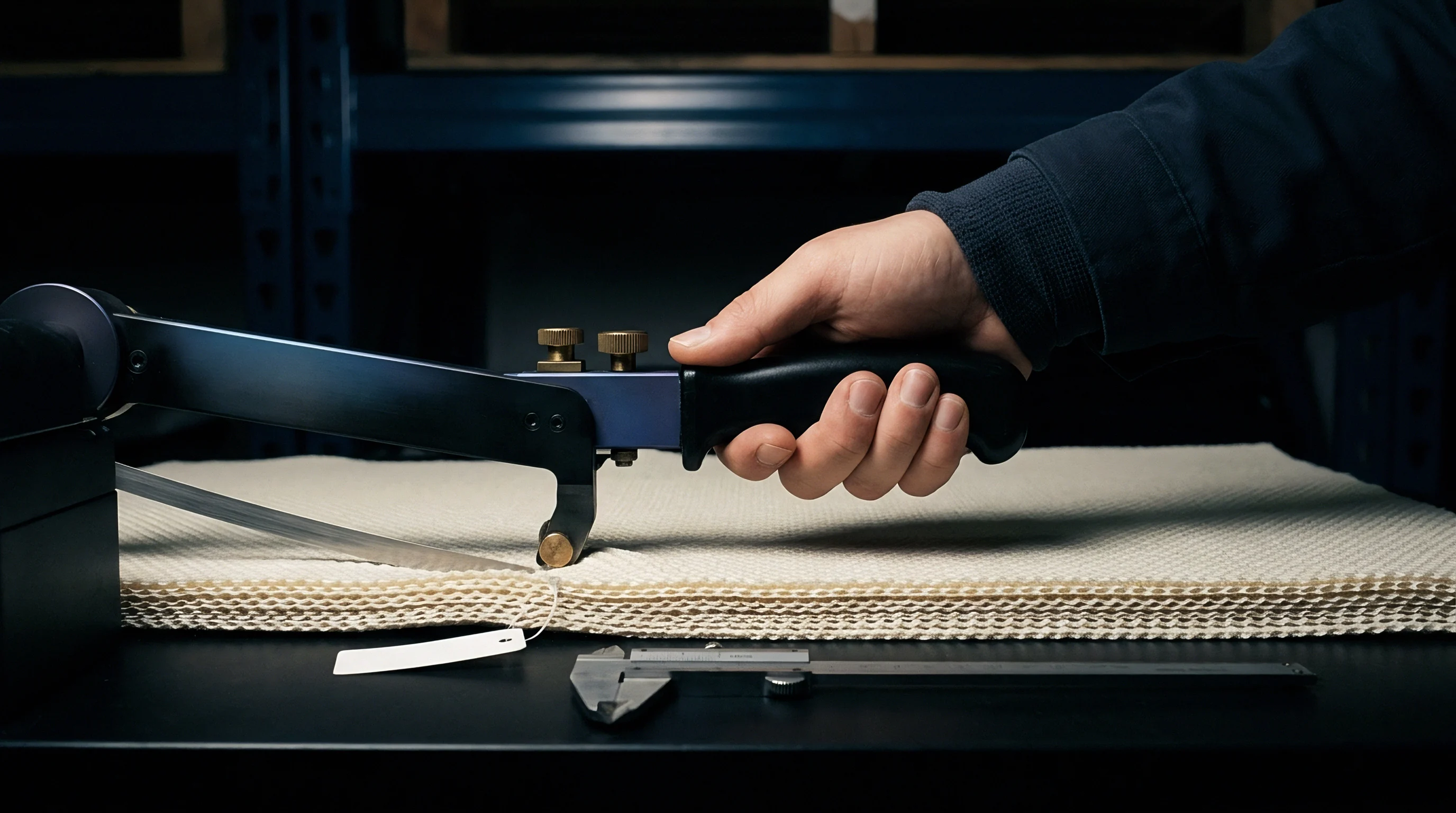
Laboratory instruments for analyzing structural thread contraction range from traditional manual distance gauges to motorized pulling rigs. Manual devices like the Shirley crimp tester rely on mechanical deadweight levers and dial indicators. The operator unweaves individual threads, secures them in spring jaws, and manually moves a sliding scale until balance indicators align.
Human operator variability in jaw positioning and manual load release introduces up to two percent measurement variance across identical fabric swatches.
Automated crimp testers integrate digital load cells and optical distance sensors to standardize extraction protocols. Digital devices pull the isolated thread at a controlled crosshead velocity, continuously recording force against elongation. Automated load cells identify the exact inflection point where structural wave straightening transitions into elastic fiber stretching.
Lab reports hide local variation.

Mechanical Testers and Digital Load Cells
Manual distance meters employ spring-loaded clamps that apply static weights based on target yarn tex. Mechanical dial gauges display straightened thread lengths directly in millimeters or percentage values against fixed bench scales. Operator technique influences manual readings heavily.
Rapid lever release snaps tension onto the thread, causing artificial over-stretching before visual readings stabilize.
Digital load cell instruments eliminate manual clamping errors by using pneumatic action grips with controlled clamping pressure. Stepper motors extend the movable grip at constant speeds between 50 and 100 millimeters per minute. Software algorithms detect the exact tension threshold corresponding to ISO 7211-3 force criteria, freezing the length measurement precisely at the standard pretension level.
Static charge disrupts thread alignment.

Specimen Preparation and Edge Fraying Controls
Extracting undamaged yarns requires removing selvage edges and isolating parallel thread groups across standard rectangular strip dimensions. Cutting specimens with sharp rotary shears prevents mechanical thread fraying and fiber distortion along cut boundaries. Technicians handle extracted threads using fine tweezers, taking care not to insert or remove yarn twist during transfer to the instrument jaws.
High-twist yarns, such as crepe or worsted voiles, present extreme helical curling upon extraction from fabric matrixes. The unweaving process demands care. Unstiffened crepe threads snarl rapidly, losing orientation before tension loads can be applied.
Technicians apply light temporary weights to both ends during thread removal to prevent helical snarls from creating measurement errors.
- Load Cell Calibration Audit verifies tension transducer accuracy to within plus or minus 0.01 cN across low force testing scales.
- Pneumatic Grip Pressure Tuning prevents jaw pinching that crushes soft spun yarns while eliminating slippage on smooth filament synthetic threads.
- Environmental Equilibrium Lock maintains laboratory humidity controls to prevent cellulosic yarn swelling from altering measured thread retraction factors.
- Optical Marker Alignment Check uses high-resolution digital cameras to verify initial benchmark distances prior to mechanical thread extraction.
Manual extraction of high-twist worsted yarns introduces rotational unraveling that reduces measured straightened length prior to load application.
Mills frequently claim that discrepancies between warp yarn consumption and fabric yardage stem entirely from standard loom waste rather than unrecorded crimp variation across beam tension zones.


Margin
Financial exposure on bulk fabric orders develops when linear yarn purchases do not match physical fabric production volumes. Mill purchasing managers who calculate raw material budgets using fabric weight without crimp integration face systematic yarn deficits. Costing per finished meter must account for every millimeter of yarn drawn into warp and weft wave structures.
Overlooking crimp factors squeezes gross margins on high-volume apparel contracts.
Cross-border sourcing agreements specify strict landed cost schedules based on delivered fabric weight and square meter yield. Crimp variations between trial swatches and bulk production shipments cause shifts in final weight per square meter. Excess crimp increases weight per square meter, consuming extra yarn and elevating freight costs per yard.
Fibre type dictates recovery rate. Deficient crimp creates thin, loose fabric structures that fail buyer physical performance specifications, triggering batch rejections.

Reconciling Loom Planning with Delivery Invoices
Commercial fabric costing models integrate structural contraction differentials to protect profit boundaries across long weaving runs. Yield reconciliation audits compare original yarn purchasing invoices against final delivered fabric roll weights. Discrepancies between theoretical yarn consumption and actual yarn mass consumed indicate unrecorded shifts in warp tension, loom beat-up force, or finishing relaxation.
When weaving dense cotton twills, a two percent increase in warp crimp across a 100,000-meter order consumes thousands of additional kilograms of ring-spun yarn. Sourcing contracts that lack explicit crimp tolerance clauses leave the fabric buyer vulnerable to price renegotiations or delivery delays when mills run out of warp beam inventory prior to order completion.

Customs Classification and Weight Tolerances
Tariff declarations relying on yarn linear density account for crimp induced mass variations to satisfy border inspection audits. Customs authorities verify declared fabric compositions by extracting yarns and determining linear density under standard test methods. Failing to adjust extracted yarn mass for measured crimp yields inaccurate tex calculations, shifting the declared yarn count past tariff heading boundaries.
Misdeclaring yarn counts on customs documentation risks severe commercial penalties, duty recalculations, and shipment impoundment at port entry terminals. Border agencies inspect high-value synthetic and worsted shipments to verify that declared chief-weight components align with laboratory test reports. Accurate crimp and take-up testing provides the legal audit trail needed to defend tariff declarations and secure landed margin targets.
Whether automated optical scanning can replace manual yarn extraction while maintaining ISO compliance across textured synthetic blends remains an active question among mill technical directors.