Standardizing Solvent Reflux Kinetics and Regain Adjustments in Cellulosic Analysis
Accurate cellulosic blend analysis requires pairing strict solvent reflux kinetics and d-factor scission corrections with standard commercial regain adjustments.


Flask
Quantitative separation of cellulosic blends begins at the boiling boundary. When analyzing mixtures of cotton, modal, lyocell, and regenerated viscose, analytical laboratories rely on selective chemical dissolution under precise thermal controls. The standard solvent systems, specified in ISO 1833-6 and ISO 1833-22, deploy mixtures such as zinc chloride with formic acid, or sodium zincate solutions, to dissolve the regenerated component while leaving the native cotton cellulose intact.
In complete dissolution of the target phase, the mass transfer depends on convective flow around the fiber bundles inside the boiling flask. Compact yarns and high-twist roving retard solvent ingress, shielding internal fibrils from instantaneous wetting.
A round-bottom flask fitted with a water-cooled Liebig or Graham condenser provides the controlled reflux environment. The solvent charge requires rapid thermal equilibrium to maintain uniform solvency power without thermally degrading the residual cellulose fraction. Viscose dissolves within twenty minutes at 40 degrees Celsius in sodium zincate, whereas formic acid and zinc chloride systems run at 70 degrees Celsius with strict kinetic windows.
Exceeding the reaction time induces hydrolytic scission in native cotton chains, falsely shifting measured mass toward the dissolved phase.
A boiling charge left twenty seconds past the kinetic threshold strips measurable weight from native cellulosic residue.
Solvent purity governs the dissolution threshold. Industrial formic acid reagents often contain varying fractions of water that alter dielectric properties and dissolution kinetics. An elevated moisture level in the chemical charge slows down the cleavage of hydrogen bonds in regenerated fibers, leaving un-dissolved viscose residues on the filter crucible.
Laboratory technicians compensate by drying the analytical samples to an oven-dry state at 105 degrees Celsius prior to weighing, ensuring that water held within the amorphous regions of the fiber does not dilute the reagent.
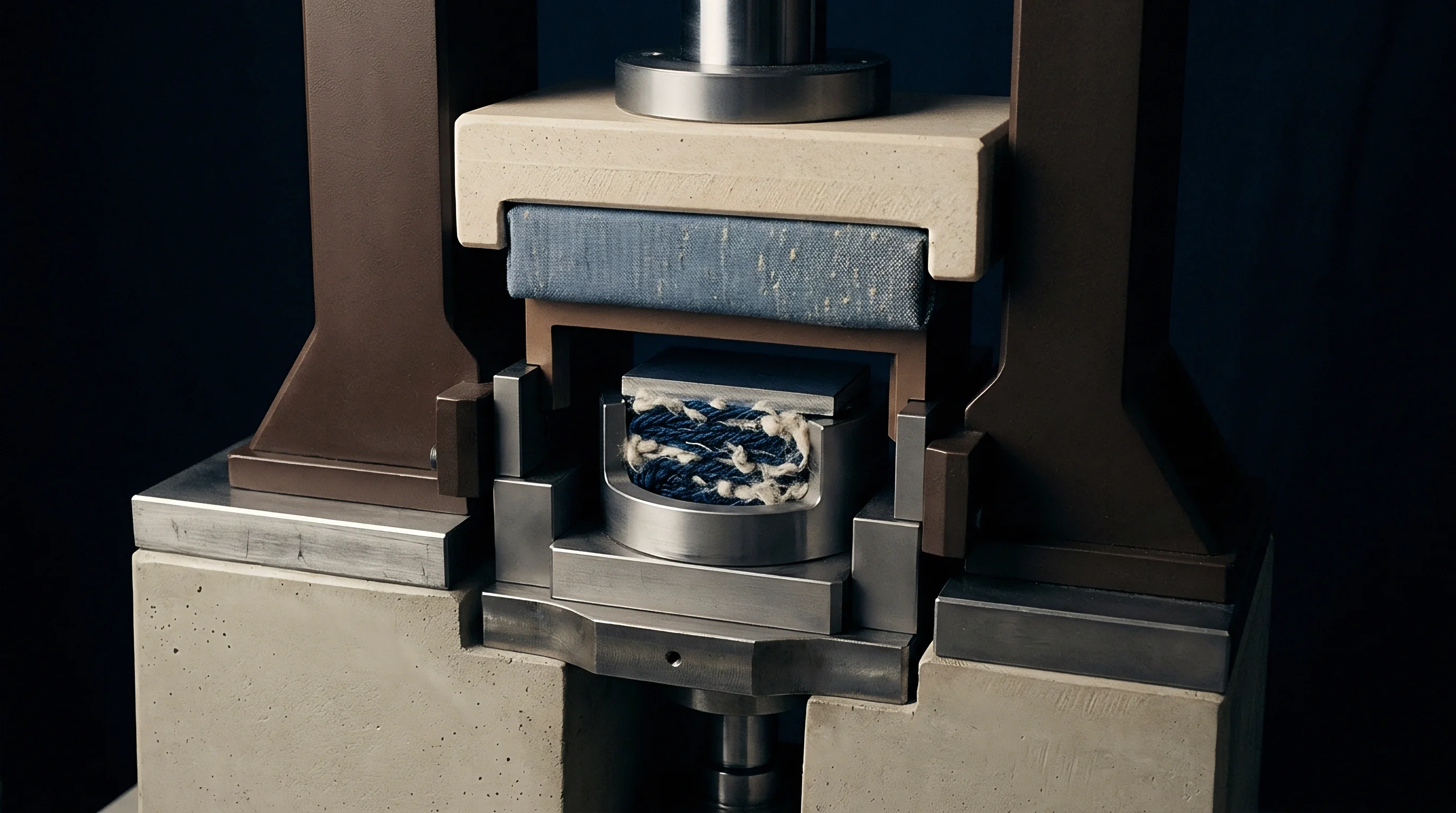
Can Solvent Purity Drift Invalidate Quantitative Dissolution?
Reagent grade specifications define strict thresholds for trace contaminants and volatile impurities. Standard testing procedures mandate a formic acid concentration between 85.0 and 86.5 percent by mass, paired with anhydrous zinc chloride containing less than 1.5 percent oxychloride impurities. Even minor deviations shift dissolution equilibrium, leaving partially dissolved lyocell microfibrils caught in the sintered glass filter disc.
Sintered crucibles of porosity grade 2 or 3 retain particles between 40 and 100 micrometers, capturing all undissolved cellulosic structures. High back-pressure during aspiration signals gelatinous surface film formation, indicating incomplete solvent clearing.
The operational consequence lands on the invoice: an under-dissolved viscose fraction distorts the calculated blend percentage by two to four percentage points, sufficient to misclassify a blend under customs tariff thresholds.

Kinetics
Solvent extraction kinetics follow a two-stage mechanism. Initial dissolution of the accessible amorphous regions proceeds rapidly within the first five minutes of steady reflux. The second phase involves slower transport through crystalline regions, where intermolecular hydrogen bonds restrict solvent diffusion.
During this phase, mechanical agitation maintains an even boundary layer around every staple fiber.
Chemical separation methods account for the slight solubility of the non-dissolving component through an empirical correction factor, known in test standards as the d-factor. For native raw cotton subjected to zinc chloride and formic acid extraction, the standard d-factor sits at 1.02, indicating a two percent mass loss during standard exposure. Mercerized cotton, possessing higher amorphous fractions, yields a d-factor between 1.03 and 1.045.
Applying an uncalibrated d-factor to pre-treated or bleached cotton distorts the final mass computation, creating artificial variance between testing facilities.
| Fiber Component Blend | Reagent Chemistry | Operating Temperature (°C) | Contact Duration (min) | Published d-Factor Correction |
|---|---|---|---|---|
| Viscose / Native Cotton | Formic Acid / Zinc Chloride | 70 ± 2 | 20 | 1.020 |
| Cupro / Native Cotton | Aqueous Sodium Zincate | 20 ± 1 | 15 | 1.015 |
| Lyocell / Raw Cotton | N-Methylmorpholine N-Oxide | 90 ± 3 | 30 | 1.030 |
| Modal / Combed Cotton | Zinc Chloride / Formic Acid | 70 ± 2 | 25 | 1.025 |
Temperature control inside the reflux vessel governs the reaction selectivity. Automated heating mantles with integrated magnetic stirrers maintain homogeneous heat transfer, eliminating localized hotspots at the flask base. Hotspots accelerate localized chain degradation, breaking native cellulose down into soluble cellodextrins that pass directly through the filter porosity.
Cold zones produce incomplete extraction. Analytical precision demands an agitation rate between 180 and 220 revolutions per minute during the entire reflux cycle.
Laboratories handling high volumes of apparel fabrics frequently process batches under accelerated extraction routines. Shortening contact time by elevating temperature alters the mass transfer rate non-linearly. The relationship between temperature and reaction rate constant follows Arrhenius kinetics, where minor thermal spikes disproportionately accelerate the secondary degradation of cotton.
Uncalibrated hotplates cause mass loss excursions that no standard empirical factor can rectify.
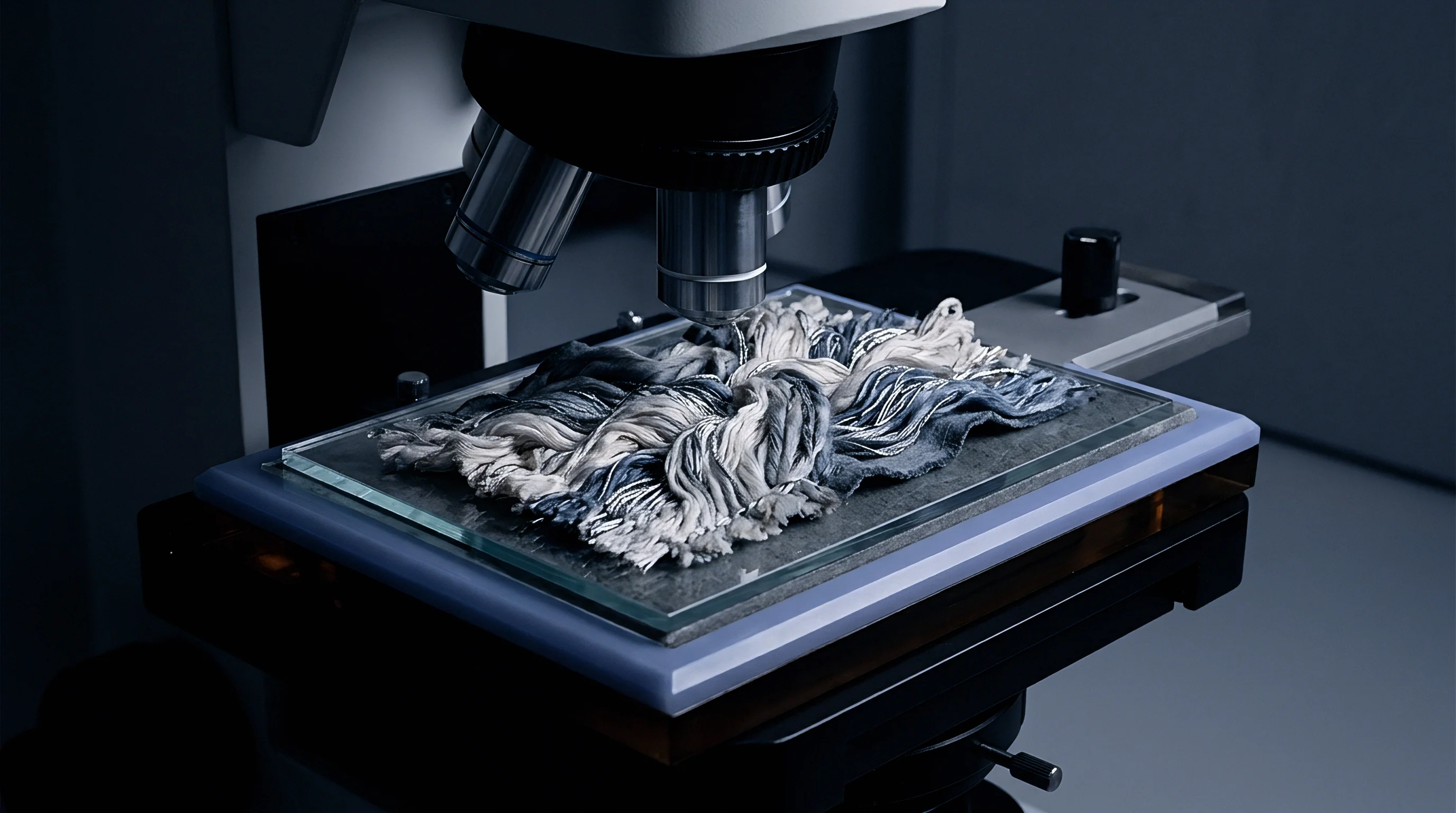

Moisture
Cellulosic fibers absorb substantial atmospheric moisture, varying with ambient relative humidity and temperature. Cotton exhibits an official moisture regain allowance of 8.50 percent under commercial conventions, while viscose carries an official allowance of 11.00 percent, modal carries 11.00 percent, and lyocell is standardized at 11.50 percent according to ISO 6741 and ASTM D1909 schedules. Raw analytical yields derived from solvent extraction reflect oven-dry masses.
Conversion from clean dry mass to commercial declared composition requires mathematically rigorous regain adjustments.
Failing to apply commercial moisture regain adjustments shifts blend ratios in favor of the lower-regain fiber. In a declared 60/40 cotton and viscose intimate blend, clean oven-dry measurements report lower relative viscose content due to the differential water absorption capacities of the two materials. The mathematical transformation adjusts the dry weight of each component by multiplying it by its respective moisture regain factor.
When evaluating compliance against contractual terms, analytical houses calculate the adjusted mass percentage per the standard formulas:
Commercial declared percentages rely on these standardized adjustments:
- Oven dry mass calculation establishes the absolute anhydrous weight of the insoluble residue after drying in a ventilated oven at 105 degrees Celsius until mass constancy within 0.05 percent over fifteen minutes.
- Chemical mass loss correction applies the empirical d-factor to restore the original dry mass of the insoluble component prior to extraction.
- Commercial moisture addition applies the statutory regain percentage to each isolated fraction to reproduce standardized commercial yarn mass.
- Final proportion reconciliation normalizes the individual adjusted masses against the total conditioned package mass to establish legal trade composition.
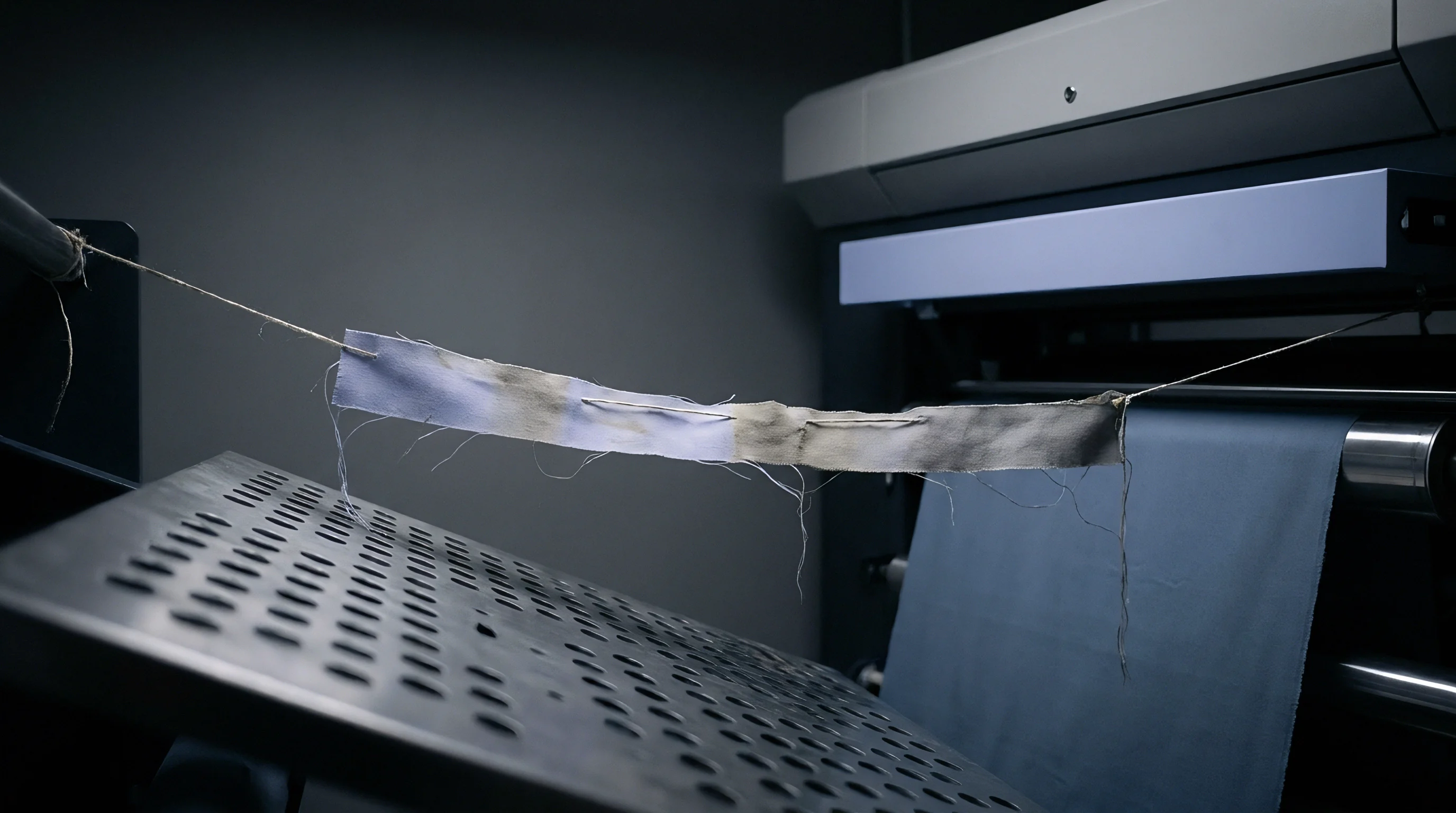
Should Commercial Allowance Precede or Follow Mass Loss Factoring?
The sequence of arithmetic operations changes the reported commercial blend fraction. Factoring the chemical dissolution loss d-factor must occur directly upon the dry residue mass before any moisture allowance multipliers are introduced. Applying moisture regain percentages directly to uncorrected dry residues compounds the procedural error, disproportionately inflating the inferred weight of the undissolved phase.
Precision calculations isolate the dry component, factor residue scission, scale via commercial moisture regain, and then compute the final component percentage.
ISO 6741 mandates moisture regain adjustment exclusively after gravimetric d-factor scission compensation.
Variations in finishing chemistry introduce non-cellulosic mass that corrupts gravimetric accuracy. Sizing agents, cross-linking resins, and silicone softeners add two to six percent of clean dry fabric weight. Standard quantitative protocols mandate Soxhlet pre-extraction with petroleum ether and enzymatic desizing before initiating solvent reflux kinetics.
Omitting solvent pre-scouring traps resin residues on the cotton fibrils, creating an artificially elevated dry cotton weight.
The finished goods supplier typically claims that spinning oil residues account for minor composition drift during laboratory audits.

Variance
Inter-laboratory discrepancy in cellulosic blend determination arises from three distinct operational variables. Reagent concentration stability during reflux, washing thoroughness of the residue cake, and humidity control within the balance room each introduce measurable deviations. A comparative assessment across multiple accredited testing laboratories testing an identical 50/50 combed cotton and lyocell ring-spun yarn demonstrates systemic drift across testing protocols.
| Standard Protocol | Solvent Matrix | Reported Cotton Dry % | Calculated Commercial Cotton % | Method Stated Tolerance |
|---|---|---|---|---|
| ISO 1833-6 | Formic Acid / Zinc Chloride | 49.12 ± 0.35 | 48.45 ± 0.40 | ± 1.0 % |
| AATCC 20A Method 6 | Sodium Zincate Aqueous | 50.40 ± 0.42 | 49.73 ± 0.45 | ± 1.5 % |
| ASTM D629 | Sulfuric Acid 70% w/w | 48.20 ± 0.60 | 47.52 ± 0.65 | ± 2.0 % |
| ISO 1833-22 | Dimethylacetamide / LiCl | 49.85 ± 0.28 | 49.18 ± 0.30 | ± 0.8 % |
The data demonstrates that solvent selection directly affects the unadjusted dry weight fraction. Sulfuric acid dissolution routes, while rapid, hydrolyze native cotton fibrils more aggressively than zincate systems, pulling calculated cotton percentages downward. When blend boundaries hover near the 85 percent threshold, standard analytical tolerances decide whether a consignment qualifies as a single-fiber dominant tariff classification or an intimate blend line.
Weighing errors compound during the transfer of hot crucibles from drying ovens to desiccators. Sintered glass crucibles absorb ambient moisture rapidly upon exposure to room air. An unsealed desiccator containing depleted silica gel adds eight to twelve milligrams of moisture to the crucible mass within three minutes of bench handling.
In a two-gram analytical specimen, ten milligrams of unrecorded moisture equates to a 0.5 percent error in final composition assignment.
Analytical desiccators lose active moisture absorption capacity after forty cycles of ambient atmospheric exposure.
Systemic deviations appear when evaluating fine yarn counts. Ring-spun yarns at Ne 60/1 contain fewer individual fibers in the cross-section, causing chemical penetration to occur faster than in coarse Ne 16/1 open-end yarns. Laboratories running fixed-time digestion protocols without adjusting for yarn linear density over-extract fine counts and under-extract coarse bundles.
Whether modern automated kinetic reflux stations eliminate the need for manual specimen agitation remains an open technical dispute among testing houses.

Customs
Tariff classification under the international Harmonized Tariff Schedule turns entirely on composition by chief weight. Under Chapter 52, cotton fabrics containing 85 percent or more cotton by weight attract distinctly lower duty rates in major consuming markets than cotton-blend fabrics grouped under Chapter 55. A laboratory finding that returns 84.4 percent cotton on a declared 85/15 cotton-modal fabric triggers immediate reclassification, tariff penalties, and potential border holds.
Consider a 30,000-kilogram consignment of circular knit jersey declared as 85 percent combed cotton and 15 percent regenerated viscose, invoiced at 7.20 dollars per kilogram landed. At 85 percent cotton, the consignment enters under HS heading 5208.32 with a standard duty rate of 4.5 percent. If quantitative dissolution testing reports an unadjusted oven-dry cotton yield of 83.2 percent, and the laboratory fails to apply the 8.5 percent cotton and 11.0 percent viscose moisture regain adjustment, the shipment faces immediate reassignment to HS heading 5516.42, where the duty rate steps up to 12.0 percent.
The arithmetic illustrates the financial exposure across commercial shipments:
- Raw dry analysis reports 83.20 percent cotton and 16.80 percent viscose on an oven-dry mass basis.
- Regain adjustment application recalculates the commercial mass to 83.58 percent cotton and 16.42 percent viscose.
- D-factor correction integration restores the dissolved cotton fraction, bringing the true legal cotton proportion to 85.12 percent.
- Customs classification defense presents the fully adjusted test report, retaining the preferential 4.5 percent duty schedule.
Commercial contracts protect the buyer through explicit technical specification clauses. Precision sourcing mandates specifying the precise analytical standard, required extraction chemistry, mandatory pre-treatment wash cycles, and statutory moisture regain tables in the purchase order. Commercial mass reconciliations depend entirely on whether the invoice billing specifies conditioned weight per ISO 6741 or net delivered scale weight.
Standard contract clause 14.2 of the International Textile Sourcing Agreement confirms that testing tolerances govern customs disputes only when pre-shipment testing follows identical chemical digestion methods.