Capillary Pathway
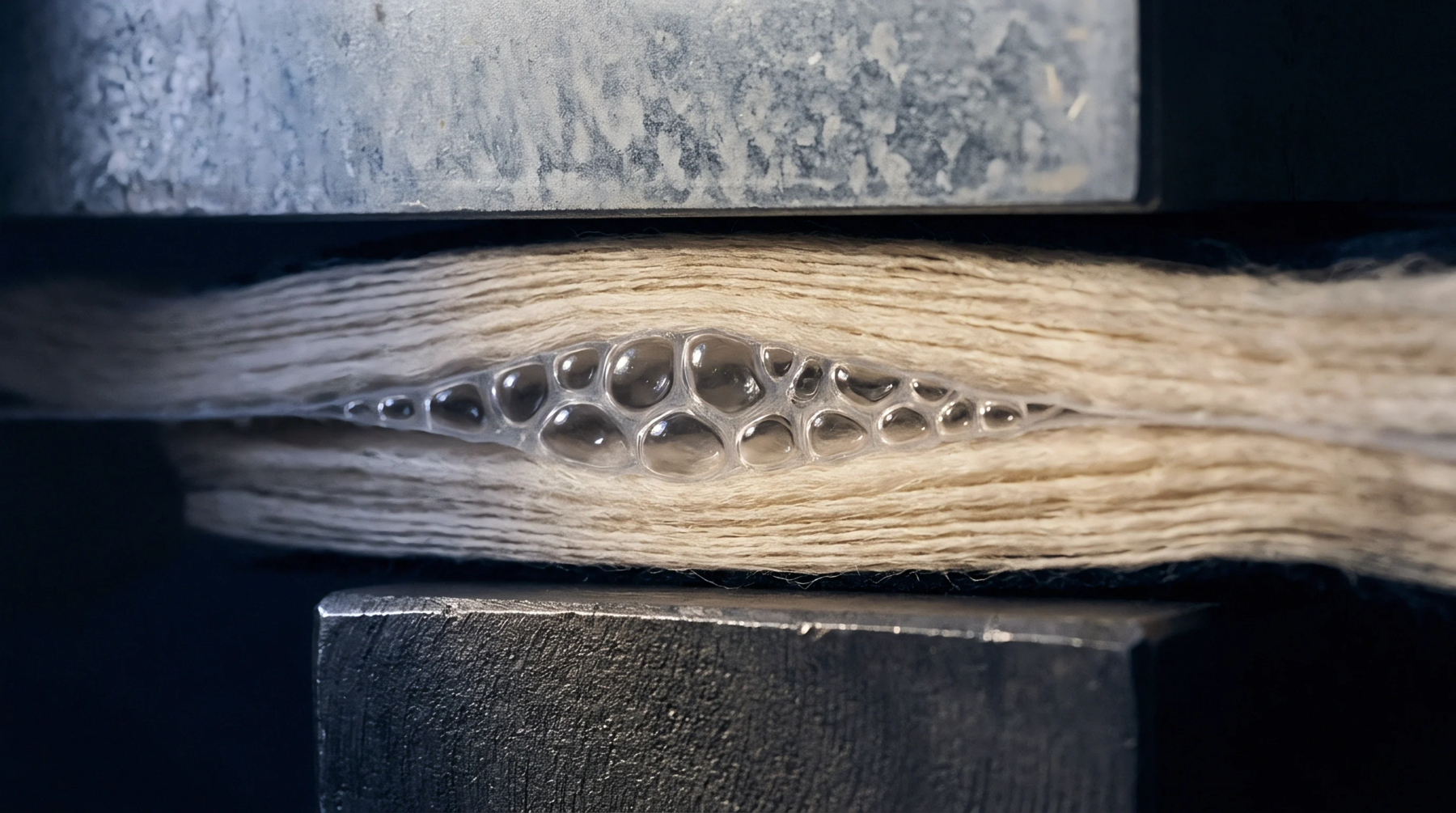
Interstitial capillary spaces formed between individual filaments or staple fibres packed inside a single yarn strand govern microscopic fluid transport and dye liquid retention. These intra-yarn micropores feature equivalent diameters ranging from sub-micron dimensions up to approximately ten micrometres, bounded entirely by fibre perimeters. Their spatial configuration controls spontaneous wicking, chemical diffusion and drying rates in textiles through strong capillary suction forces.
This internal porosity stops at the outer perimeter of the yarn bundle and does not include the macroscopic apertures that separate neighbouring yarns.
Capillary Transport
High Laplace pressure generated inside these narrow channels pulls moisture along the yarn axis without requiring external pressure gradients. Wicking speed correlates inversely with pore radius, making tight intra-yarn spaces highly effective at spreading sweat or processing liquors through capillary action. However, excessively dense packing impedes bulk fluid penetration, slowing chemical saturation during rapid immersion treatments.
As moisture fills these micropores, fibre surfaces absorb water molecules, occasionally causing fibre swelling that alters internal channel geometry. The physical balance between fibre cross-sectional shape and filament packing density dictates the overall volume fraction of these spaces.
Laboratory Evaluation
Capillary rise testing according to DIN 53924 and mercury intrusion porosimetry measure the effective radius and total pore volume inside yarn assemblies. In synthetic moisture-wicking textiles, yarn spinners engineer non-round fibre cross-sections, such as trilobal or scalloped profiles, to amplify micropore volume. Greige yarn quality checks assess twist levels, as higher twists compress intra-yarn cavities and reduce internal liquid holding capacity.
Liquid retention determinations in wet processing confirm whether yarns have absorbed sufficient finishing agents deep into their bundle interiors.
Industrial Processing
Scouring agents must penetrate these dense microscopic networks to remove natural waxes and processing spin finishes before dyeing begins. Incomplete liquor evacuation from intra-yarn voids during washing cycles leads to residual salt accumulation and poor colourfastness ratings. During sizing operations, high-viscosity starches are excluded from entering these tight channels, intentionally coating only the yarn perimeter.
Fabric performance changes permanently if heat-setting operations soften thermoplastic filaments, causing adjacent fibres to fuse and extinguish the capillary network.