Fluid Maintenance Purge Loss Allocation in Single Pass Industrial Sourcing Contracts
Single pass contracts separate printhead maintenance purge chemistry from base yardage rates through real time flow telemetry and agreed spit latency baselines.

Nozzle
Industrial single-pass digital printing presses deposit millions of picoliter-scale fluid droplets per second onto rapidly moving textile webs running at line speeds between 40 and 80 meters per minute. The print carriage remains stationary across the full width of the material, spanning up to 3.4 meters with dozens of tightly aligned piezoelectric printheads arranged in fixed color bars. Fluid droplets emerge through microscopic orifices ranging from 18 to 30 microns in diameter, where surface tension and negative hydrostatic pressure sustain a precise fluid meniscus.
Slight variations in ambient shed humidity, localized thermal drafts off intermediate dryers, or airborne lint generated by dry yarn movement induce instantaneous drying at the plate interface. Ink dries in open orifices. When water or co-solvents volatilize at the fluid-air boundary, dissolved colorants and polymeric binders form dried skins that deflect ejection trajectories or choke droplet expulsion entirely.
Continuous readiness across thousands of active firing chambers requires active hydrodynamic fluid management. Piezoelectric printhead arrays cannot sit idle while a textile lot indexes forward or while operators align a new supply roll on the uncoiler. The machine computer commands automated spitting sequences, periodic vacuum suction wipes, and pressurized fluid flushes directly into collection gutters positioned beneath the carriage.
These purge sequences discard active printing ink alongside specialized conditioning surfactants, humectant washes, and flush solutions. In continuous high-speed finishing operations, fluid consumed solely to prevent orifice starvation accounts for 8 to 22 percent of total chemical throughput. Sourcing agreements that treat ink strictly as an applied solid on yarn face substantial unallocated expenditure.
Mechanical Open Time and Fluid Meniscus Stability
Piezoelectric printheads sustain operating stability by maintaining a sub-atmospheric chamber balance between negative 1.5 and negative 4.5 millibar. This slight vacuum prevents fluid weeping through the orifice plate under static head pressure from elevated day tanks while simultaneously preventing air ingestion during high-frequency pressure pulses. Shear-thinning fluid formulations drop from a resting viscosity of 8 to 12 centipoise down to 3 to 5 centipoise inside the microscopic pumping chamber during actuation.
As the actuator pulses at frequencies exceeding 30 kilohertz, mechanical heat builds within the silicon micro-electro-mechanical channels. When line interruptions halt drop generation, convective air currents along the moving web strip solvent molecules from exposed orifices within 3 to 8 seconds. Meniscus failure causes drop deflection.
Printhead recovery cycles consume active colorant volumes that scale with idle duration rather than finished linear production.
The resulting crust alters the acoustic impedance of the firing chamber, causing subsequent droplet ejections to deviate from their calibrated straight-line trajectory. Single-pass architectures possess zero mechanical redundancy: a single blocked or misdirected orifice produces a continuous white or off-shade longitudinal streak extending across thousands of running meters of finished sheeting. Printhead wiper assemblies sweep across the silicon orifice face using elastomer blades, drawing out fresh fluid to redissolve semi-solid polymer crusts before resuming production.
Operators cannot bypass these cycles without sacrificing lot yield.
- Substrate Lint Ingestion occurs when dry cotton dust enters the vacuum boundary layer above the moving web, attaching directly to wet orifice openings and causing severe ink redirection across multiple adjacent channels.
- Meniscus Vacuum Collapse follows sudden air line fluctuations within the secondary header tanks, dropping line vacuum and causing whole print modules to weep raw ink across the moving textile face.
- Viscosity Creep develops during prolonged standby periods as internal printhead channel heaters accelerate solvent evaporation through open orifices, shifting internal fluid resistance outside the piezoelectric pulse profile.
- Capillary Starvation strikes high-density printing blocks when local fluid replenishment rates fail to match continuous high-frequency firing cycles, pulling ambient air inward through the fluid plate.
Print Bar Architecture across Continuous Ranges
Modern single-pass textile installations mount multiple printhead modules on rigid bridge beams spanning the web transport blanket. A machine running an eight-color process with 1200 dots per inch native resolution deploys upwards of 64 discrete print modules across its chassis. Each individual module houses thousands of active fluid channels linked to internal fluid recirculation circuits.
Recirculating printheads mitigate face plate drying by circulating tempered fluid continuously across the rear of the orifice plate at flow rates between 50 and 200 milliliters per minute per module. Purge cycles run automatically.
Recirculation reduces spit frequency during brief pauses, yet line clearing cycles remain unavoidable during substrate lot transitions or shift handovers. Whenever the press operator re-threads the entry feeder with a fresh lot of greige goods, the print array moves into a dedicated service docking station. Automated pneumatic valves open, driving positive pressure flushes at 150 to 300 millibar through the entire fluid network.
The resulting chemical discharge expels trapped micro-bubbles, dissolved air pockets, and particulate debris into an isolated waste collection manifold. This purge loss occurs entirely independent of printed pattern coverage. The converter routinely justifies these chemical charges as unavoidable operating overhead dictated by machine mechanics.
Latency
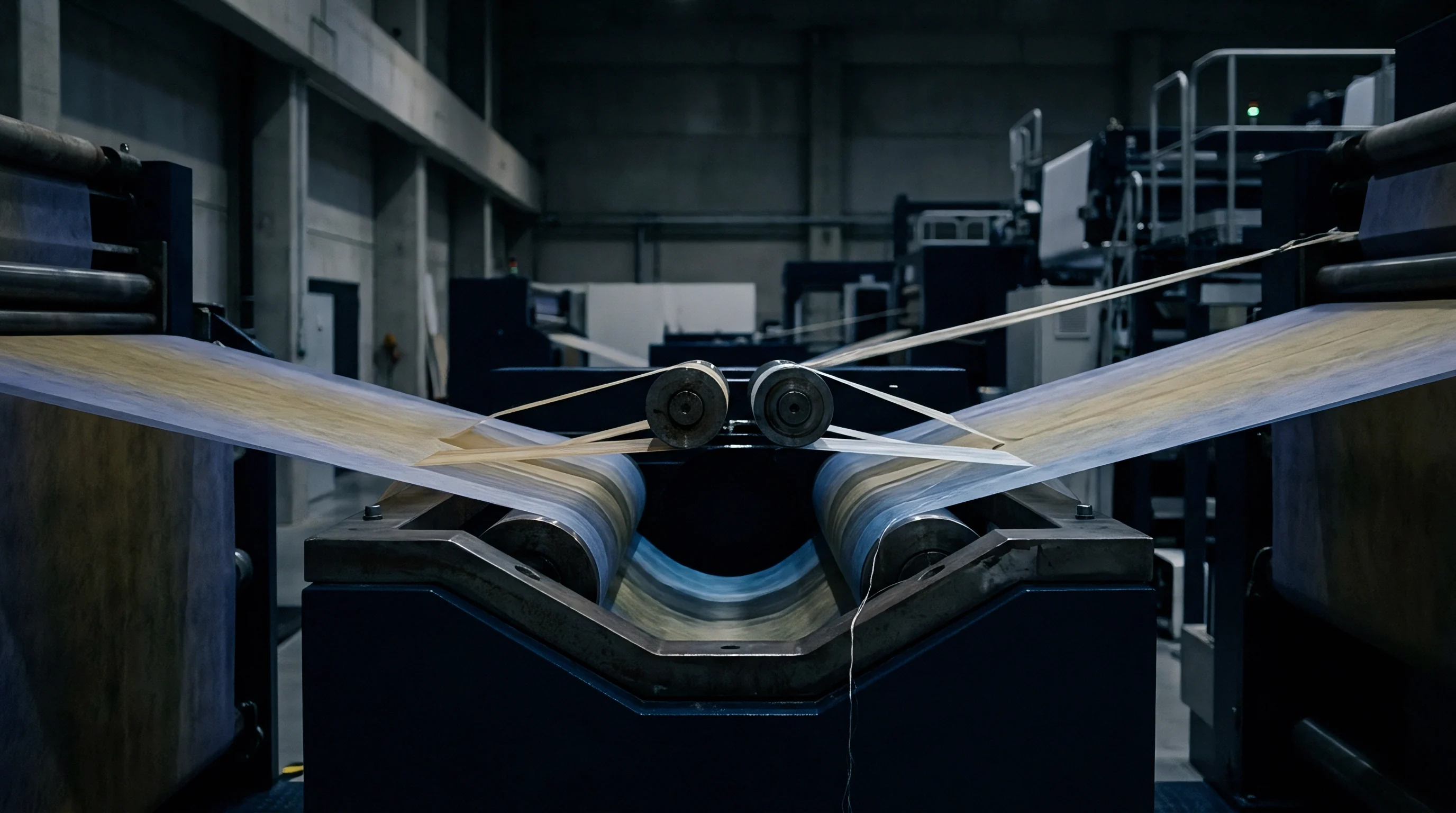
Production pauses represent the most destructive operational variable in industrial single-pass inkjet converting. When line operators halt the conveyor blanket to splice rolls, clear seams, or untangle misfed selvages on the entry uncurlers, the print carriage enters an escalating latency protocol. Single-pass ink formulations contain carefully calibrated balances of deionized water, co-solvents like glycerol and diethylene glycol, biocides, and surfactants designed to achieve rapid wet-out on treated natural or synthetic fibres.
The volatile fraction begins evaporating from the microscopic fluid meniscus immediately upon mechanical cessation. Latency curves dictate how long an orifice can pause before requiring an active expulsion pulse to restore clean drop formation.
Decap time describes this window of functional latency. For high-velocity reactive dye inks operating at elevated printhead temperatures around 32 degrees Celsius, decap latency rarely exceeds 4 seconds under typical finishing plant conditions of 45 percent relative humidity. Once the decap boundary lapses, the press software triggers cross-firing spitting routines, firing hundreds of drops per orifice into internal catch gutters every few seconds.
Solvent costs compound over time. As line stoppages extend beyond 60 seconds, simple spitting becomes inadequate to restore meniscus compliance, necessitating complete positive pressure hydraulic cycles that discharge liters of chemical into the wastewater drain.

Fluid Evaporation and Decap Dynamics
Evaporative loss rates at the orifice plate follow the vapor pressure profiles of the specific carrier chemistry. Reactive and acid dye inks depend primarily on aqueous vehicle formulations, resulting in rapid moisture depletion under the airflow generated by adjacent stenter frames or infrared pre-dryers. Pigment inks compound this vulnerability by incorporating dispersed binder emulsions consisting of acrylic or polyurethane polymer chains.
When local water concentration drops below a critical threshold at the orifice boundary, polymer particles coagulate irreversibly. Capping stations collect spit volume.
Printhead manufacturers combat coagulation by programming tiered maintenance cycles that scale fluid expulsion exponentially with elapsed downtime. A 10-second stoppage triggers a micro-spit burst consuming roughly 0.05 milliliters per print module. A five-minute delay triggers an aggressive automated maintenance routine consisting of a forward positive pressure purge, vacuum suction blade wipe, and high-frequency clearing spit.
This intermediate intervention draws between 15 and 40 milliliters of ink and wash chemistry per module directly from the delivery headers. Tension variations induce head strikes. When a finishing line experiences intermittent tension disruptions or seam detector trips, maintenance fluid consumption outpaces the active colorant deposited onto the commercial goods.
| Printhead Architecture | Fluid Chemistry | Decap Latency Limit | Spit Fluid Loss Rate | Pressure Purge Consumption |
|---|---|---|---|---|
| Recirculating Piezo Silicon MEMS | Aqueous Reactive Dye | 12 seconds | 0.85 ml/min/bar | 22 ml/cycle/bar |
| Recirculating Piezo Silicon MEMS | Dispersed Pigment Emulsion | 4 seconds | 2.40 ml/min/bar | 48 ml/cycle/bar |
| End-Shooter Bulk Piezo | Aqueous Reactive Dye | 3 seconds | 3.10 ml/min/bar | 65 ml/cycle/bar |
| End-Shooter Bulk Piezo | Aqueous Acid Dye | 5 seconds | 2.25 ml/min/bar | 52 ml/cycle/bar |
| Recirculating Thin Film Piezo | Disperse Sublimation Dye | 8 seconds | 1.15 ml/min/bar | 31 ml/cycle/bar |

Chemical Stress during Line Stoppages
Extended stoppages force the deployment of dedicated flush solutions containing aggressive pyrrolidone solvents or glycol ether mixtures to purge the main manifold. This solvent flush preserves the piezoelectric components during overnight shutdowns or prolonged mechanical maintenance, but it requires thorough displacement before production can restart. Re-priming an industrial print bridge with active ink displaces the entire internal fluid volume of the secondary tanks, degasser units, and delivery sub-manifolds.
Substrate lint chokes nozzle plates.
The displaced volume represents pure chemical loss that cannot be recycled into the main reservoir due to dilution by residual rinse agents. Pigment stability deteriorates rapidly if flush solvents enter the bulk storage drums, destabilizing steric dispersion barriers and generating microscopic flocculation. Viscosity dictates replenishment speed.
Sourcing contracts that fail to define responsibility for unscheduled downtime allow converters to bill this wasted fluid directly to current yardage accounts, inflating landed printing expenses by double-digit margins.

Volume
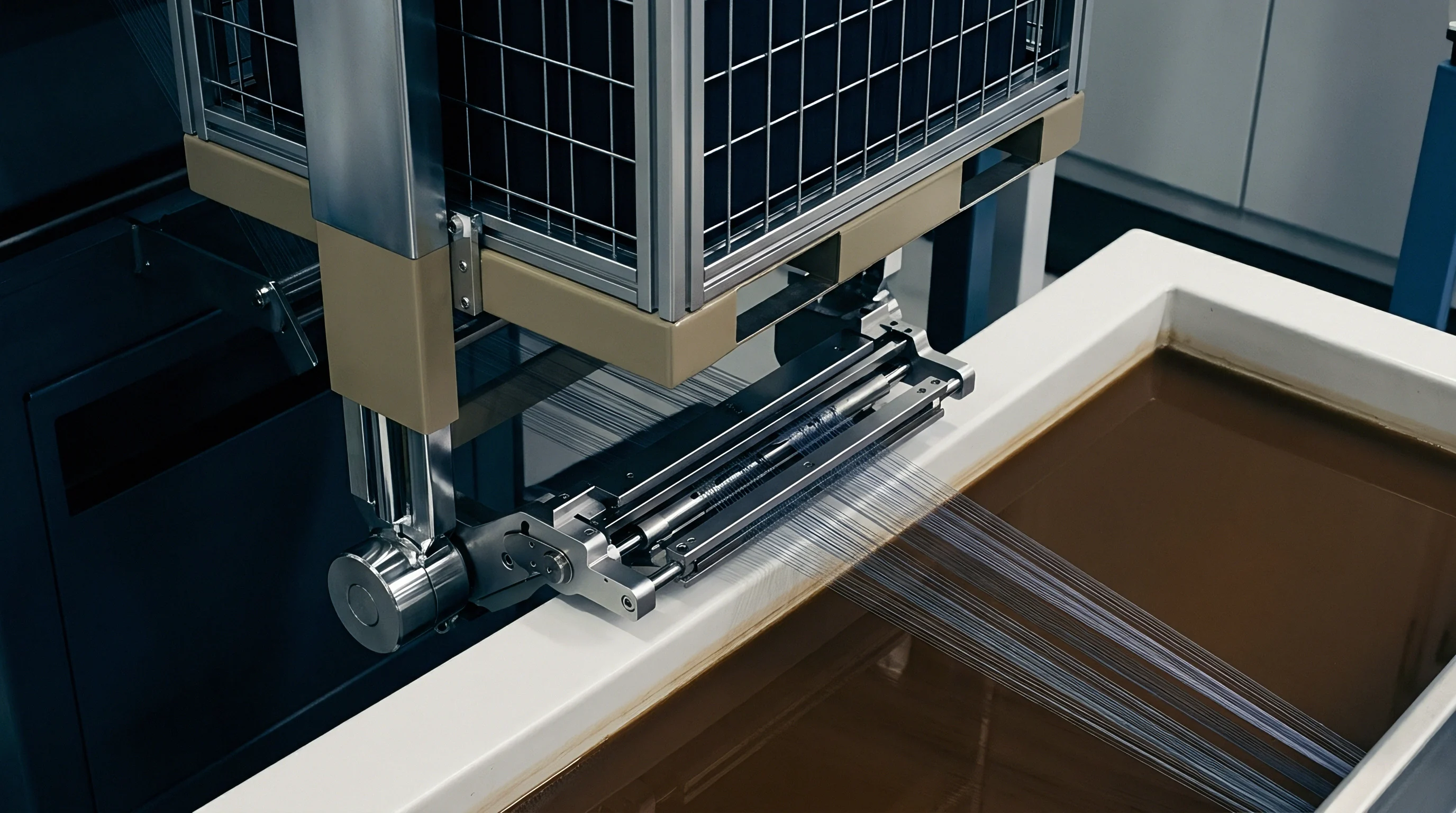
Quantifying maintenance fluid volume demands a rigorous gravimetric mass balance across the entire printing run. Metering input drums before and after lot execution does not reveal the true deposition volume on the finished textile. Single-pass operations generate three distinct fluid discharge paths: theoretical pattern consumption on yarn, automated maintenance waste directed to internal collection gutters, and manual chemical flushes during color changeovers.
Theoretical consumption derives from digital raster image processing software, calculating ink mass based on drop count tables calibrated in picoliters per droplet. Real production invariably displays an unexplained discrepancy between software RIP projections and physical drum depletion.
A typical four-color process running reactive ink at a nominal coverage of 8 grams per square meter across a 10,000-meter lot of 120-gram cotton lawn requires approximately 96 kilograms of deposited colorant. If the conversion line experiences four roll changes, two seam-detection retractions, and one scheduled shift clean, secondary maintenance gutters accumulate between 12 and 24 kilograms of additional fluid. The physical volume lost to purging scales with run continuity rather than fabric surface area or order size.
Pumps deliver steady head pressure.

Mass Balance Calculations across Continuous Runs
Establishing true fluid utilization requires isolating pattern coverage from mechanical line upkeep. Conversion facilities operating without secondary sump scales cannot distinguish between ink delivered to the cloth and ink routed to the waste barrel. When a supplier bills a flat kilogram consumption rate derived solely from gross tank depletion, the buyer absorbs the cost of poor plant housekeeping, frequent roll splices, and erratic line management.
Purge fluid mass must be monitored directly at the waste outlet pipe through dedicated metering systems or calibrated load cells positioned beneath collection sumps.
Baseline contract agreements require physical sump mass logs to reconcile digital RIP consumption against net barrel draw.
The arithmetic governing a standard continuous commission finishing run highlights the commercial exposure embedded in ambiguous sourcing terms. Take a production run of 20,000 meters of 140-gram woven poplin printed at 1.8 meters finished width, utilizing an aqueous reactive dye system priced at 28 dollars per kilogram across eight color channels. Pattern coverage averages 10.5 grams per square meter, generating a net pattern requirement of 396.9 kilograms of fluid.
During a continuous 10-hour run, the machine software executes regular spitting routines consuming 0.45 kilograms per color bar per hour, totaling 36.0 kilograms. Three unplanned line stoppages triggered by defective sewing seams require three intermediate high-pressure purge cycles, expelling 4.8 kilograms per event across the array, adding 14.4 kilograms. Color changeover and end-of-run manifold flushing draw an additional 18.0 kilograms of pure ink before the introduction of wash chemistry.
- Gross Fluid Depletion reaches 465.3 kilograms against the theoretical deposition requirement of 396.9 kilograms, establishing a total fluid variance of 68.4 kilograms.
- Net Maintenance Ratio calculates to 14.7 percent above net printed consumption, shifting the actual ink cost per finished linear meter from 0.555 dollars to 0.651 dollars.
- Unallocated Expense Allocation adds 1,915 dollars of chemical cost to a single 20,000-meter production invoice, demonstrating how fluid mechanics override initial quoting models.
Where Does Maintenance Fluid Loss Enter Tolling Invoices?
Converters bury maintenance fluid expenditure within one of two commercial accounting structures: elevated base tolling tariffs or variable line-item chemical waste surcharges. Under an elevated tolling tariff, the finishing mill quotes a fixed price per linear or square meter that bundles greige handling, stenter framing, digital printing, steaming, washing, and final inspection into a consolidated unit cost. To insulate their operating margin against erratic printhead maintenance losses, the converter incorporates an assumed purge overhead of 15 to 25 percent directly into the base conversion rate.
If the production run proceeds with zero downtime and minimal purging, the mill captures this unspent chemical margin as internal profit. When mechanical stoppages multiply, the mill absorbs the loss until run performance triggers secondary surcharge clauses.
Open-book chemical accounting separates machine conversion tariffs from fluid replenishment. The buyer purchases active ink sets and maintenance flush chemistry directly from the approved chemical vendor, consigning drums to the toll printer’s warehouse. The converter tracks inventory depletion on a per-batch basis, billing the client for exact drum consumption alongside a baseline machine operating fee per hour or meter.
This open-book route exposes the buyer to catastrophic price inflation if the mill operates poorly maintained machinery, employs undertrained operators who trigger frequent seam stops, or allows printheads to dry out through improper capping. Without explicit contract boundaries limiting accountable purge mass, the buyer subsidizes the mechanical inefficiency of the converter’s equipment. Standard sourcing specifications establish an absolute purge allowance ceiling of 8 percent on continuous runs exceeding 10,000 meters, transferring any chemical cost exceeding that threshold directly back to the toll converter’s ledger.
Tariff
Constructing an enforceable industrial sourcing agreement for single-pass textile production requires an unambiguous structural boundary between operational maintenance losses and billable conversion yield. Printhead purge cycles cannot be treated as general process waste comparable to selvage trimmings or stenter pin marks. In conventional wet processing, bath exhaustion ratios and pad trough hold-up volumes follow predictable thermodynamic and mechanical limits determined by textile weight and liquor ratios.
Digital single-pass printing decouples chemical usage from textile mass entirely. A converter running identical yardage of identical substrate can consume drastically differing fluid volumes based entirely on production scheduling, job sequence, and machine maintenance frequency.
Tariff models must tie purge absorption to specific root causes across the plant floor. Sourcing contracts define three discrete operational states: steady-state continuous printing, scheduled maintenance and changeovers, and unscheduled line downtime. A fair commercial division assigns steady-state spitting and meniscus preservation to the buyer as a legitimate manufacturing requirement, provided the line operates within agreed speed and continuity parameters.
Scheduled changeovers represent a split liability negotiated based on order volume and minimum run lengths. Unscheduled downtime caused by seam failures, feeder jams, or printhead mechanical crashes remains the absolute liability of the mill.

Surcharge Allocation in Tolling Agreements
Industrial contracts achieve clarity by dividing chemical invoices into three distinct structural billing mechanisms. Each mechanism addresses a different component of the fluid delivery cycle, establishing clear boundaries between predictable process chemistry and avoidable plant losses.
Contracts assigning unmetered purge overhead to standard yardage rates penalize continuous volume buyers while subsidizing short-run job changes.
The structure of these tariff models dictates which party bears financial exposure during catastrophic line failures or routine shift turnovers. Toll converters generally prefer blanket volume markups that eliminate detailed fluid accounting.
- Fixed Allowance Tariffs incorporate a capped purge loss percentage between 6 and 10 percent into the standard linear printing rate, holding the mill liable for any chemical consumption above that benchmark.
- Two-Tier Unit Billing separates active pattern ink deposition billed via digital RIP droplet counts from auxiliary maintenance flushes billed as discrete hourly machine servicing units.
- Consignment True-Up Audits permit the converter to draw fluid from customer-owned tank stock while requiring quarterly physical reconciliation against verified linear output and calibrated waste gutter logs.
| Allocation Mechanism | Printhead Purge Accountability | Buyer Margin Risk | Converter Operating Risk | Verification Requirement |
|---|---|---|---|---|
| Bundled Yardage Rate | Converter absorbs internal losses | Low: pricing remains fixed per meter | High: downtime erodes conversion margin | Visual quality audit and streak inspection |
| Open-Book Reconciled Consignment | Split based on calibrated gutter baselines | Medium: exposed to machine downtime rates | Medium: requires rigorous fluid bookkeeping | Inline flow meters and load cell records |
| Capped Maintenance Surcharge | Buyer pays up to contract threshold | Controlled: capped at agreed limit | Moderate: unrecovered purges exceed cap | Drum weight logs and RIP telemetry files |
| Direct Fluid Passthrough | Buyer absorbs all gross drum depletion | Severe: fully liable for plant inefficiency | Zero: all waste billed directly to buyer | Requires continuous on-site plant auditing |
Reconciling Waste Fluid Spoilage Allowances
Negotiating waste allowances requires auditing the converter’s equipment vintage and maintenance routines. Older single-pass print engines lacking automated meniscus recirculation systems require triple the spit volume of modern internal-flow architectures to maintain nozzle health. When contracting with toll processors operating first-generation single-pass hardware, sourcing managers must demand lower base conversion rates to offset the guaranteed 18 to 25 percent fluid purge tax.
Failure to evaluate printhead architecture during the technical audit leads to irreconcilable billing disputes once bulk production invoices arrive.
Dispute resolution clauses in international sourcing agreements establish clear evidential standards for contested chemical consumption. If drum depletion exceeds contract tolerances by more than 3 percent, the converter must produce electronic machine run logs detailing the exact timestamp and duration of every automated purge cycle, line stop, and carriage docking event. Run logs that reveal excessive head strikes, frequent blanket jam stops, or prolonged carriage capping indicate poor plant operation rather than chemical incompatibility.
How should buyers allocate purge chemistry during widespread printhead failure when mechanical jet recovery flushes fail to clear blocked silicon channels?

Telemetry
Modern industrial single-pass presses capture extensive sensor data that completely eliminates reliance on manual fluid logs or converter estimates. Every printhead module communicates with the central machine controller through high-speed internal buses, logging real-time operational status, internal channel temperatures, piezoelectric driving voltages, and firing droplet tallies. Dedicated programmable logic controllers monitor positive and negative pressure manifolds, logging vacuum fluctuations to the fraction of a millibar.
Toll tariffs rarely separate purges. When disputes arise over excess chemical consumption, electronic machine logs provide incontrovertible evidence of true line performance.
Gravimetric sump monitoring forms the secondary pillar of physical process verification. Automated service stations on modern single-pass equipment route purge discharge away from the main machine frame through segregated stainless steel drain lines. Purge fluid, wiper blade run-off, and capping drainage empty into dedicated intermediate waste tanks mounted on precision industrial load cells.
Telemetry closes the evidential gap. These load cells record fluid accumulation continuously, linking weight increases directly to specific machine states such as active printing, standby spitting, or high-pressure flushing. Sourcing auditors verify material balances by comparing waste load cell increases against the mass depletion of external day tanks.

Inline Mass Flow Instrumentation
High-reliability toll finishing operations install Coriolis mass flow meters directly on the bulk ink delivery lines feeding the secondary carriage tanks. Coriolis instruments measure fluid mass flow directly, operating completely independent of variations in fluid temperature, density, or dynamic viscosity. As ink moves through the vibrating measurement tubes, Coriolis forces induce a measurable phase shift proportional to true mass flow.
The instrument logs mass delivery with an accuracy tolerance within 0.1 percent, providing an unalterable record of total chemical delivered to the print bridge.
By synchronizing Coriolis mass flow telemetry with digital raster image processor droplet counts, the printer’s software platform calculates the exact split between deposited fluid and discarded purge mass in real time. If the Coriolis meter registers 150 kilograms of fluid delivered to the print carriage during a lot where digital image droplet calculations predict exactly 132 kilograms of textile deposition, the telemetry system flags an auxiliary loss of 18 kilograms. The press records whether that 18 kilograms exited through the continuous spitting gutters or through emergency manual pressure flushes initiated by press operators.
Sourcing contracts that mandate daily data exports from these instruments eliminate subjective disputes over waste allocation.
Coriolis mass flow data linked to printhead firing telemetry establishes an unalterable audit trail separating pattern deposition from maintenance purges.
Gravimetric Sump Auditing and Run Verification
Third-party testing protocols provide independent verification when telemetry data shows systemic deviations between physical barrel draw and finished textile weight. A classic laboratory technique uses gravimetric extraction testing according to ISO 105-C06 wash procedures combined with atomic absorption spectrometry to measure exact trace element concentrations on the finished cloth. Many industrial textile inks incorporate stable metal-complex dyes or trace tracer elements such as cobalt, copper, or specific inorganic markers added at fixed ratios of 50 to 500 parts per million.
By analyzing dried textile swatches cut from the beginning, middle, and end of a bulk production roll, a technical auditor calculates the exact mass of dry solids deposited per square meter.
Multiplying this measured chemical mass by the known non-volatile solids ratio of the liquid ink yields the true volume of ink applied directly to the textile web. Subtracting this verified application mass from the gross drum depletion recorded at the converter’s intake dock determines total process waste down to the single kilogram. When an audit reveals that 28 percent of consigned ink disappeared into maintenance sumps while the converter billed under an 8 percent allowance ceiling, the commercial ledger automatically debits the difference against the converter’s outstanding finishing invoices.
Precision telemetry and gravimetric auditing transform fluid purge allocation from an arbitrary mill surcharge into an exact, verifiable physical balance. Unmetered fluid maintenance lines invariably drain contract margin before a single roll reaches the shipping container.